Nav Wireless Technologies Pvt Ltd (NavTech) has signed an agreement with the Indian Institute of Technology-Delhi For Further Development of LiFi Technology

Table of Contents

    Nav Wireless Technologies Pvt Ltd (NavTech) has signed an agreement with the Indian Institute of Technology-Delhi For Further Development of LiFi Technology

    Photo credit to Nav Wireless technologies

    Nav Wireless Technologies Pvt Ltd (NavTech) signed an agreement with the Indian Institute of Technology-Delhi. This announcement was released through an article from the Indiaeducationdiary website.

    The agreement was signed by Mr. Hardik Soni, Co-Founder and CTO, Nav Wireless Technologies Pvt Ltd and Dr. Anil Wali, Managing Director, Foundation for Innovation and Technology Transfer-, IIT-Delhi at New Delhi in the presence of Prof. Abhishek Dixit (Principal Investigator) who has expertise in the area of optical wireless communication.

    Mr. Hardik Soni from NavTech stated: “NavTech is the pioneer and leading technology company in India working on Optical Wireless Communications – LiFi | FSO technologies and developed products. We are glad to join hands with one of India’s premier technology institutions for further development of LiFi technology.” 

    IIT-D with support of NavTech will design an indigenous LiFi network based on visible lights. This solution will be energy efficient as the same transceivers will be used both for illumination and communication. The development of LiFi networks on visible light is rare. The developed solution will aim to deliver high bit rates to mobile users – a challenging task due to the highly directional light beams.

    Prof. Abhishek Dixit, Department of Electrical Engineering, IIT-Delhi said: “We are glad to partner with NavTech for the development of indigenous LiFi network, targeting the demands of future 6G technology. We envision a health-safe indoor system with high throughput, low latency, and high security. As 6G research has picked up globally, our LiFi network can build upon our country’s ecosystem with its inherent energy efficiency and can satisfy some of its use cases. Our system will address three goals: Scalable, intelligent, and affordable.”

    Article source: https://indiaeducationdiary.in/ahmedabad-based-navtech-signed-an-agreement-with-iit-delhi-for-co-research-on-the-development-of-futuristic-lifi-technology/

    Nav Wireless Technologies Pvt Ltd

    According to its website, Nav Wireless Technologies Pvt Ltd is a leading global solutions and services provider of wireless and information communications systems with its own R&D facilities, manufacturing base, and sales and service teams. The company offers a comprehensive suite of products and services including Optical Wireless Communication Systems, Wireless Electricity Transmission systems, Electronic Tattoo for Healthcare Monitoring systems, Wireless enhancement products, and subsystems and wireless transmission systems to its global customers.

    NavTech is a technology company focused on Research, Design and Development in Optical Wireless Communications, Electronic Materials, and Renewable Energy – Nanoscale to develop high-efficiency photovoltaic devices. NavTech's R&D initiative brings advanced wireless technologies to improve lives with projects that strengthen economic and social development.

    NavTech product portfolio includes Optical Wireless Communication, Smart LED Lights, Advanced Wireless Transmission Systems, Wireless Broadband and Wireless Access Equipment. NavTech's services range includes consultation, product & network design, optimisation and commissioning.

    Li-Fi Conference 2022

    The Li-Fi Conference 2022 Edition was a great success. Li Fi Tech News will very soon write articles on the topics treated at the Conference.

    What is LiFi?

    LiFi, also known as "Light Fidelity" is a wireless optical networking technology, which uses light-emitting diodes (LEDs) to transmit data. In 2011, professor Harald Haas made a LiFi demonstration at the TED (Technology, Entertainment, Design) Global Talk on Visible Light Communication (VLC).

    VLC uses light as a medium to deliver high-speed communication like Wi-Fi and complies with the IEEE standard IEEE 802.15.7. The IEEE 802.15.7 is a high-speed, bidirectional, and fully networked wireless communication technology-based standard similar to Wi-Fi's IEEE 802.11.

    How does LiFi work?

    LiFi is a high speed, bidirectional, and fully networked wireless communication of data using light. LiFi constitutes of several light bulbs that form a wireless network.

    When an electrical current goes through to a LED light bulb, a stream of light (photons) emits from the lamp. LED bulbs are semiconductor devices, which means that the brightness of the light flowing through them can change at extremely high speeds. The signal is sent by modulating the light at different rates. The signal can then be received by a detector that interprets the changes in light intensity (the signal) as data. Also when the LED is ON, you transmit a digital 1, and when it is OFF, you transmit a 0.

    LiFi Benefits

    The primary benefits of LiFi are as follows:

    Security: Provides entirely secure access. Where there is no light there is no data.

    Safety: Does not produce electromagnetic radiation and does not interfere with existing electronic systems.

    Localisation: Allows localisation due to the small coverage area of LiFi access point - localisation can be used for very precise asset tracking.

    Data density: Provides ubiquitous high-speed wireless access that offers substantially greater data density (data rate per unit area) than RF through high bandwidth reuse.

    Credit to Oledcomm

    LiFi Applications

    LiFi can be used for so many applications and the list is increasing every year. You can read our updated list of Li-Fi applications at the following link:

    https://www.lifitn.com/blog/2021/2/13/top-30-li-fi-applications-updated-list-including-potential-applications

    Credit to pureLiFi


    LiFi Systems Reviews by LiFi Tech News


    OLEDCOMM LIFIMAX KIT REVIEW - ONE YEAR IN

    We reviewed the LiFiMax kit produced by the leading French LiFi company Oledcomm. We bought this LiFi kit system at the end of 2020. After over a year of use, we decided to write a review of this LiFi system. We looked briefly at the profile of Oledcomm, a brief history of the LiFiMax system, the Kit box contents, some testing and performance results of this LiFi system, the customer experience and our own verdict (the good and the bad points) of the LiFiMax kit.

    You can read the review on this link:

    https://www.lifitn.com/blog/lifimaxreview


    SIGNIFY TRULIFI 6002.1 STARTER KIT SYSTEM REVIEW


    We also reviewed the Trulifi 6002.1 starter kit produced by Signify, the world leader in lighting for professionals, consumers and lighting for the Internet of Things. We got this LiFi kit system with the help of PCDSI and Signify around August 2021. In a similar fashion done with our previous review of the LiFiMax kit a few months ago, we will look briefly at the profile of Signify, a brief history of the Trulifi 6002.1 kit, the Kit box contents, some testing and performance results of this LiFi system, the customer experience and our own verdict (the good points and the bad points) of the Trulifi 6002.1 kit.

    You can read the review on this link:

    https://www.lifitn.com/blog/trulifi6002review


    In conclusion, if you are also interested to hear more information about the OWNII Coin or enquire about LiFi devices such as the LiFiMax and Trulifi, you can contact us through our chatbot or by sending an email through our contact us form. If you enjoyed this post and would like to hear more updates about LiFi technology, subscribe to our newsletter. Don’t forget to subscribe to our social media accounts. You can also join our Telegram group about LiFi technology on this link:

    https://t.me/joinchat/FMzOmsEKyJFrU6Af


    Oledcomm LiFiMAX2G, The Latest Addition To The LiFiMAX Family, at CES 2023

    Table of Contents

      Oledcomm LiFiMAX2G, The Latest Addition To The LiFiMAX Family, at CES 2023

      LIFIMAX2G®


      In one of our previous articles, we stated that Oledcomm will unveil its latest LiFi system, LIFIMAX2G®, at CES 2023.

      According to Oledcomm, the LiFIMAX2G® is best suited for subways, trains and any vehicle applications that need to download huge amounts of data in terabytes (images and videos) in less than 20 seconds as well as for industrial Industry 4.0 applications in augmented reality, IoT or M2M. As fast as Gigabit Ethernet, more secure than WiFi, and as small as a smoke detector, LiFiMAX2G® takes Vehicle-to-Infrastructure communications and connectivity for Industry 4.0 to a new level.

      This new generation of LiFi transceivers doubles the speed achieved by the previous generation, now reaching nearly 2 Gigabits per second upstream and 2 Gigabits per second downstream at a distance of 1-5m.

      The infrared VCSEL laser diodes in the system come from ams Osram. The LiFiMAX2G uses two VCSELs per transceiver, which is how Oledcomm doubled the speed compared to the single VCSEL of the current generation, called the LiFiMAX1G. VCSEL stands for Vertical Cavity Surface Emitting Laser. VCSEL is a semiconductor whose laser is emitted perpendicular to the top surface. It differs from an edge-fired laser, which emits the laser from the edge.

      VCSEL is a breakthrough light-emitting device in optical communications, as well as a new form of optoelectronic technology with enormous development prospects.

      According to an article from LEDs Magazine, Oledcomm has priced the new LiFiMAX2G at €6000 per link, the company told LEDs Magazine (the LiFiMAX1G is priced at €3000). A link consists of two laser-based transceivers — one at either end of the transmission at up to 5m apart.

      A spokesperson told LEDs that a railway company is trialling the LiFiMAX2G in Europe. The same customer has been using the 1-Gbps LiFiMAX1G, as has a Formula 3 race car team, she said.

      “The dizzying growth in the amount of data collected in mobility situations and the increase in multimedia flows require a reliable and uninterrupted communication standard for all, especially in transport and factory 4.0,” Oledcomm co-CEO Benjamin Azoulay noted during last week’s product introduction.


      Demo at CES 2023


      The LiFIMAX2G® prototype demonstration was mainly a point-to-point demonstration. Oledcomm stated that they are now focusing mainly on defence and security and some industrial and transportation with this application.

      During the demo, Naomi Azoulay said: “So, our photonic antenna, the beam is more around 70 to 80 degrees. And for the point-to-point, this one is 50 to 60 degrees, if you want to keep the speed and the distance, it can go up to five metres. But the farther you go, the less speed you get, obviously.”

      “So, for the moment, this prototype is only doing a demonstration that the speed can be up to two gigabits. And the idea, with the main project we recently signed, is for a train to be equipped with one of those, and the station to be equipped with another one to exchange data instead of cable. So, basically, it's replacing cable at high speed. So, it's very interesting in an environment where radio frequencies are not either allowed or desired. And there is no cable, so it's really easier to set up.”


      It was stated that the LiFiMAX2G product will be available for sale around September 2023.

      LiFiMAX2G Prototype

      LiFiMAX2G Prototype

      During CES 2023, TOM.travel interviewed Benjamin Azoulay, President and CEO of Oledcomm, to find out what Li-Fi is, a wireless communication technology that works by light, to know its evolutions and to find out more about its upcoming installation in the Paris metro. The video is in French but we translated some of the conversations in English.


      Benjamin Azoulay: “It's a bit like fibre optics in free space. So, we use LEDs, we make them flash at a very high speed 30 million times per second, 30 MHz. We manage to communicate and connect to the internet. The big advantage is first and foremost cybersecurity. The light not being attackable, not being outside the room, not being visible outside the room, is it not blurred? There are a lot of defence applications in environments where radio frequencies are prohibited, but there are also other applications such as in schools. You know that in France, Belgian law prohibits the exposure of radio frequency waves to the waves. So, I have children under three and that's why we also have apps for schools. So, that's a big defence for space, industry, but also schools and we're keen on it in tourism, it was geolocation applications, that is to say, that the light that is above a painting, for example, can be used to trigger content on your smartphone or tablet that will allow the museum to send geo-contextualized information. It is a technology that we called at the time the GeoLIFI, which worked very well, which had applications in museums but also in supermarkets and which continues to progress.”


      “We have partners working on the subject. The technology has nevertheless evolved towards bi-directional at a very high speed. Today, we have reached two gigabits per second. We are going to equip a Greater Paris metro line. Soon, we will make announcements in the coming months. It is a technique. That's the natural evolution of technology and its use cases. So, in a metro, it will be rather the downloading of data from the metro to the infrastructure. That is to say that the metro will stop or take in 20 seconds on hacked and it is necessary to download all the information that the metro will store. For example, the videos that will have been filmed inside. You know that for legal reasons, you have to keep it for at least seven days and that's it. The technology allows this to be downloaded at a very high speed and that is what is going to be used more than a lot of people. Imagine consumer applications. We are more today on the very B2B application but which will gradually evolve towards the general public when smartphones will start to be equipped. There, the technology will reach the general public, but it will not be for two or three years. Four years.”


      CES 2023

      As stated on their website, CES is the most influential tech event in the world and the proving ground for breakthrough technologies and global innovators. This is where the world's biggest brands do business and meet new partners, and the sharpest innovators hit the stage. Owned and produced by the Consumer Technology Association (CTA)®, CES features every aspect of the tech sector.

      CES showcases companies including manufacturers, developers and suppliers of consumer technology hardware, content, technology delivery systems and more. It also includes a conference program where the world's business leaders and pioneering thinkers address the industry's most relevant issues.

      CES® 2023 will be held in Las Vegas from the 5th to the 08th of January 2023 providing global audience access to major brands and startups, as well as the world’s most influential leaders. Over 1900 companies have committed to exhibiting in Las Vegas and many more are being added each week.


      Oledcomm

      Oledcomm designs and develops LiFi network interface devices that enable high-speed wireless data communication. It also serves LiFi equipment in the telecom, datacom, personal electronics, and industrial markets. The company’s product portfolio includes hubs, routers, switches, adapters, drivers, power supplies, and more.

      Oledcomm was founded in 2012 and is based in Paris, France. Oledcomm's adventure began in 2005 in the research laboratories of the University of Versailles-Saint-Quentin with the first work on communication by visible light.

      Following years of research & development and a passion for innovation, Oledcomm became the pioneer of LiFi (Light Fidelity) solutions and innovation on a global scale.

      Based in the Paris region, Oledcomm employs around 20 people and designs complete solutions for LiFi operation, including microcontrollers, LiFi photoreceivers and software platforms.

      Today, after more than 33 patents, 15 years of R&D, over 500 trusted clients and several awards, Oledcomm is pursuing a strong mission: to transform the 14 billion points of light in the world into a powerful communication network.

      The company is ISO 9001:2015 and ISO 14001:2015 certified. Oledcomm's LiFi offering solves connectivity problems by replacing cables in environments where radio waves are undesirable. Targeted sectors include space, defence, industrial and education. Since 2020, LiFiMAX® has been installed and tested in more than 800 projects worldwide and has been validated by ORANGE for Cybersecurity.

      At the Mobile World Congress in Barcelona in 2021, Oledcomm announced an integrated circuit (ASIC) that enables native LiFi integration in tablets, PCs or smartphones. Oledcomm is a laureate of the European Deeptech EIC Accelerator program, which provides for the European Commission to invest in Oledcomm through the EIC Fund.


      Article source: Oledcomm


      Li-Fi Conference 2022


      The Li-Fi Conference 2022 Edition was a great success. Li Fi Tech News will very soon write articles on the topics treated at the Conference.

      What is LiFi?

      LiFi, also known as "Light Fidelity" is a wireless optical networking technology, which uses light-emitting diodes (LEDs) to transmit data. In 2011, professor Harald Haas made a LiFi demonstration at the TED (Technology, Entertainment, Design) Global Talk on Visible Light Communication (VLC).

      VLC uses light as a medium to deliver high-speed communication like Wi-Fi and complies with the IEEE standard IEEE 802.15.7. The IEEE 802.15.7 is a high-speed, bidirectional, and fully networked wireless communication technology-based standard similar to Wi-Fi's IEEE 802.11.

      How does LiFi work?

      LiFi is a high speed, bidirectional, and fully networked wireless communication of data using light. LiFi constitutes of several light bulbs that form a wireless network.

      When an electrical current goes through to a LED light bulb, a stream of light (photons) emits from the lamp. LED bulbs are semiconductor devices, which means that the brightness of the light flowing through them can change at extremely high speeds. The signal is sent by modulating the light at different rates. The signal can then be received by a detector that interprets the changes in light intensity (the signal) as data. Also when the LED is ON, you transmit a digital 1, and when it is OFF, you transmit a 0.

      LiFi Benefits

      The primary benefits of LiFi are as follows:

      Security: Provides entirely secure access. Where there is no light there is no data.

      Safety: Does not produce electromagnetic radiation and does not interfere with existing electronic systems.

      Localisation: Allows localisation due to the small coverage area of LiFi access point - localisation can be used for very precise asset tracking.

      Data density: Provides ubiquitous high-speed wireless access that offers substantially greater data density (data rate per unit area) than RF through high bandwidth reuse.

      Credit to Oledcomm

      LiFi Applications

      LiFi can be used for so many applications and the list is increasing every year. You can read our updated list of Li-Fi applications at the following link:

      https://www.lifitn.com/blog/2021/2/13/top-30-li-fi-applications-updated-list-including-potential-applications

      Credit to pureLiFi


      LiFi Systems Reviews by LiFi Tech News


      OLEDCOMM LIFIMAX KIT REVIEW - ONE YEAR IN

      We reviewed the LiFiMax kit produced by the leading French LiFi company Oledcomm. We bought this LiFi kit system at the end of 2020. After over a year of use, we decided to write a review of this LiFi system. We looked briefly at the profile of Oledcomm, a brief history of the LiFiMax system, the Kit box contents, some testing and performance results of this LiFi system, the customer experience and our own verdict (the good and the bad points) of the LiFiMax kit.

      You can read the review on this link:

      https://www.lifitn.com/blog/lifimaxreview


      SIGNIFY TRULIFI 6002.1 STARTER KIT SYSTEM REVIEW


      We also reviewed the Trulifi 6002.1 starter kit produced by Signify, the world leader in lighting for professionals, consumers and lighting for the Internet of Things. We got this LiFi kit system with the help of PCDSI and Signify around August 2021. In a similar fashion done with our previous review of the LiFiMax kit a few months ago, we will look briefly at the profile of Signify, a brief history of the Trulifi 6002.1 kit, the Kit box contents, some testing and performance results of this LiFi system, the customer experience and our own verdict (the good points and the bad points) of the Trulifi 6002.1 kit.

      You can read the review on this link:

      https://www.lifitn.com/blog/trulifi6002review


      In conclusion, if you are also interested to hear more information about the OWNII Coin or enquire about LiFi devices such as the LiFiMax and Trulifi, you can contact us through our chatbot or by sending an email through our contact us form. If you enjoyed this post and would like to hear more updates about LiFi technology, subscribe to our newsletter. Don’t forget to subscribe to our social media accounts. You can also join our Telegram group about LiFi technology on this link:

      https://t.me/joinchat/FMzOmsEKyJFrU6Af


      Interesting Highlights From KVKurious Podcast Episode 4 - Harald Haas: LiFi, IoT, Commercializing and Scaling Tech Innovation

      Table of Contents

        Interesting Highlights From KVKurious Podcast Episode 4 - Harald Haas: LiFi, IoT, Commercializing and Scaling Tech Innovation

        Today, we will discuss a recent KVKurious Podcast podcast. Professor Harald Haas was invited as a guest. Prof. Harald Haas FRSE is the pioneer of LiFi. He is one of the co-founders of PureLiFi. He also holds the Chair of Mobile Communications and is the director of the LiFi Research and Development Center at the University of Edinburgh.

        They also discuss the following topics:

        • LiFi technology

        • Internet of Things (IoT)

        • Commercialisation and Scaling tech innovation

        Below are some of the podcast’s conversations. Some of these conversations have been edited by Chuks from LiFi Tech News:

        Krishna K V: “So, you were mentioning how that needs to be more aware and perhaps more of an incentive or reason for, you know, different stakeholders in the system to really jump onto this waggon. What do you think are some pressing reasons for you know, on existing internet service providers or governments or other communication device manufacturers, what's a good reason for them to jump onto this waggon? What do you think they're missing today that LiFi promises?”

        Prof.Harald Haas: “That's a very good, good question. And I think, for us, there's still a big job to do in order to educate people and stakeholders, because we have to understand that we are introducing a completely new technology in the sense of sort of wireless connectivity, where, first of all, there's been a lot of investment that went into radio-based wireless communications. And there's a lot of drive in order to get better, better LiFi, to get better cellular, 5g and so on. There are priorities that the industry has in order to be able to monetise its investment. And therefore there is naturally probably not that much of a sort of natural interest to scan and see what else is there that may be in the medium to short term, can really unlock completely new applications and completely new possibilities around as I said earlier, AR, VR digital twins, even sort of connectivity and so on. And it's really the opportunity to showcase to people the benefits that technology can bring because of the fact that there is so much spectrum that can be utilised. And the fact that they are, so they are existing devices. out there.”


        Prof.Harald Haas: “I think that's a very good question. And as I said earlier, we have that technology already deployed in niche verticals. For a mass market, I think a very important step is the integration into smartphones or into mobile devices. And that could be either via a sleeve that is LiFi-enabled or by a dongle or via an integrated module. And, and there's a lot of development in that area. And so, once we see that integrated, I mean, that will unlock those new applications I've spoken about. So, I mean, it's imminent. And I would say I think certainly I mean, within the next couple of years, we will see a major change in sort of consumer uptake of that technology.”

        Krishna K V: “Very interesting. I'd maybe take a step outside of this and, you know, ask you a much broader question around. What do you think is just the future of communication? And not just connectivity? Maybe in 2030 or in 2050? How do you see the world communicating?”

        Prof.Harald Haas: “I think yours is a very, very difficult but very exciting question. And really, it may be if we look back 20 years from now, where were we 20 years ago, I say around 2000. So, this was the time when we move from, from circuit switch to communication, through voice communication, to more mobile internet, we didn't have a smartphone, that time you didn't have smart devices was primarily voice calls that were taken by a phone. And now see where we are basically packet data, we have, we have data rates up to one gigabit per second at that time, we had data rates of no 50 kilobits per second and more. So, we have increased the data rate. And we've substantially improved the performance. Now 20 years from now, we'll see this trend moving further. But in my view, what will be a massive change is the connectivity between machines. So far, it's all human-centric. It's all social media is all people using the internet for YouTube and all the video sharing. And that consumes a lot of data. But we'll see in the future machines that do exactly their social media as well, but at data rates even higher because they need much more information, think about an auto autonomous car, it needs gigabytes of data, upload and download per day, an aircraft to giga, gigabytes, terabytes of data. I mean, all these autonomous systems require a lot of data. So, we will see basically an explosion of autonomous systems that require connectivity that makes our home, our world do to get smarter with the robots that assist us. And we've seen just recently a robot being encased in Silicon Valley, a humanoid robot. And that's the way to go. We need robotics. But in order to have all this working, we need connectivity. We need a nervous system, not only inside a robot but between robots and between robots and the environment. And therefore connectivity is a critical part of the infrastructure that has to be developed. And if you don't do that, we can't really move on. overt in our digital societies in a way that the potential is there.”


        Krishna K V: “So, would you like to elaborate a little bit more on what you think are key limitations of both the academia and industry study?”

        Prof.Harald Haas: “I mean, might give you my Frank view here. So, the industry has to be very product-oriented, very revenue-oriented, it has to be very strategic, in a sense, what industry can do in the industry has to play understand really, where they play in the market and gear everything towards one narrative in terms of making the product the industry is selling a success. That's very narrative, and therefore, many things in terms of out-of-the-box thinking often are excluded, because they don't feed into that, that that narrative, meaning, as an example with other companies that give employees more freedom, but that's only possible if you have a huge company that has the resources to allow that freedom, but if you talk about a smaller company has to be focused around a product that limits naturally a few things that can be done. On the other hand, academia allows exactly that, out of the box, the blue sky thinking, coming up with radically new ideas, and academia comes up with ideas. But, Academia is measured by the number of new ideas that are produced. And therefore, you see that cycle of having a new idea, testing it, finding the end and the analysis around it, publishing the paper and then publishing that high-impact journal paper. And once that is published, go back to the next idea and test it and do another paper. But really, it stays within this sort of incentive cycle of academia. But I've been trying to do is basically take the freedom of academia, right to research papers and to have high impact research papers, but then take also the next steps in, in stepping up that technology readiness level to prototypes and, and then even find founding a company and trying to get it into the market.”

        Prof.Harald Haas: “I think the way to do it really speaks to people to come out and explain what the benefits are and what that new innovation could achieve. And showing that the innovation works, first of all, but really going out and using social media using platforms to spread the idea and galvanise people in a minute. It's a hard thing to do, but it is very rewarding. And because it's hard, that's why I said it's important if one believes in it, not to give up because there is always going to be a backslash.”


        Podcast Recording


        You can also listen to the podcast in full at the following link:

        LiFi Tech News’ Take on the podcast episode

        In our own opinion, the podcast was very insightful on the current challenges of convincing the benefits of LiFi to relevant stakeholders and the masses.

        Some key notes taken from the podcast:

        -More needs to be done to increase the awareness of LiFi and this needs commitment and diligence.
        -Some misconceptions about the technology are still around and this needs to be rectified with more education and demonstration of LiFi technology.
        -It takes time to bring new technology to the masses. So, patience is needed.
        -It is hard to convince VC to invest in Large scale LiFi projects.
        -Within the next few years, we will start seeing an increase in consumer uptake of LiFi technology.

        I highly recommend you all to follow his social media channels:

        Li-Fi Conference 2022

        The Li-Fi Conference 2022 Edition was a great success. Li Fi Tech News will very soon write articles on the topics treated at the Conference.

        What is LiFi?

        LiFi, also known as "Light Fidelity" is a wireless optical networking technology, which uses light-emitting diodes (LEDs) to transmit data. In 2011, professor Harald Haas made a LiFi demonstration at the TED (Technology, Entertainment, Design) Global Talk on Visible Light Communication (VLC).

        VLC uses light as a medium to deliver high-speed communication like Wi-Fi and complies with the IEEE standard IEEE 802.15.7. The IEEE 802.15.7 is a high-speed, bidirectional, and fully networked wireless communication technology-based standard similar to Wi-Fi's IEEE 802.11.

        How does LiFi work?

        LiFi is a high speed, bidirectional, and fully networked wireless communication of data using light. LiFi constitutes of several light bulbs that form a wireless network.

        When an electrical current goes through to a LED light bulb, a stream of light (photons) emits from the lamp. LED bulbs are semiconductor devices, which means that the brightness of the light flowing through them can change at extremely high speeds. The signal is sent by modulating the light at different rates. The signal can then be received by a detector that interprets the changes in light intensity (the signal) as data. Also when the LED is ON, you transmit a digital 1, and when it is OFF, you transmit a 0.

        LiFi Benefits

        The primary benefits of LiFi are as follows:

        Security: Provides entirely secure access. Where there is no light there is no data.

        Safety: Does not produce electromagnetic radiation and does not interfere with existing electronic systems.

        Localisation: Allows localisation due to the small coverage area of LiFi access point - localisation can be used for very precise asset tracking.

        Data density: Provides ubiquitous high-speed wireless access that offers substantially greater data density (data rate per unit area) than RF through high bandwidth reuse.

        Credit to Oledcomm

        LiFi Applications

        LiFi can be used for so many applications and the list is increasing every year. You can read our updated list of Li-Fi applications at the following link:

        https://www.lifitn.com/blog/2021/2/13/top-30-li-fi-applications-updated-list-including-potential-applications

        Credit to pureLiFi


        LiFi Systems Reviews by LiFi Tech News


        OLEDCOMM LIFIMAX KIT REVIEW - ONE YEAR IN

        We reviewed the LiFiMax kit produced by the leading French LiFi company Oledcomm. We bought this LiFi kit system at the end of 2020. After over a year of use, we decided to write a review of this LiFi system. We looked briefly at the profile of Oledcomm, a brief history of the LiFiMax system, the Kit box contents, some testing and performance results of this LiFi system, the customer experience and our own verdict (the good and the bad points) of the LiFiMax kit.

        You can read the review on this link:

        https://www.lifitn.com/blog/lifimaxreview


        SIGNIFY TRULIFI 6002.1 STARTER KIT SYSTEM REVIEW


        We also reviewed the Trulifi 6002.1 starter kit produced by Signify, the world leader in lighting for professionals, consumers and lighting for the Internet of Things. We got this LiFi kit system with the help of PCDSI and Signify around August 2021. In a similar fashion done with our previous review of the LiFiMax kit a few months ago, we will look briefly at the profile of Signify, a brief history of the Trulifi 6002.1 kit, the Kit box contents, some testing and performance results of this LiFi system, the customer experience and our own verdict (the good points and the bad points) of the Trulifi 6002.1 kit.

        You can read the review on this link:

        https://www.lifitn.com/blog/trulifi6002review


        In conclusion, if you are also interested to hear more information about the OWNII Coin, you can contact the OWNii Support team at info@ownii.net or use the contact form on the new OWNii website, ownii.net. If you are enquiring about LiFi devices such as the LiFiMax kits and the Trulifi kits, you can contact us through our chatbot or by sending an email through our contact us form. If you enjoyed this post and would like to hear more updates about LiFi technology, subscribe to our newsletter. Don’t forget to subscribe to our social media accounts. You can also join our Telegram group about LiFi technology on this link:

        https://t.me/joinchat/FMzOmsEKyJFrU6Af

        KYOCERA SLD Laser Demonstrates World’s First Laser-based Automotive Headlight Modules with White and Infrared Dual Illumination for Increased Safety and Visibility at CES 2023

        Table of Contents

          KYOCERA SLD Laser Demonstrates World’s First Laser-based Automotive Headlight Modules with White and Infrared Dual Illumination for Increased Safety and Visibility at CES 2023

          KYOCERA SLD AT CES 2023


          KYOCERA SLD Laser, Inc. (KSLD), a world leader in the commercialization of laser light sources, is introducing its new high-power 5-watt blue laser diode products for industrial, biomedical, defence and display applications at the SPIE Photonics West Exhibition, January 31 – February 2, 2023, in San Francisco, CA. The company will showcase this new product line along with its new high brightness White/IR LaserLightTM SMD products, winner of the 2021 Prism Award. Additionally, KSLD will demonstrate its DataLightTM high-speed LiFi communication system, a 2023 Prism Award finalist, as well as its new innovations in high-efficiency laser diodes for AR/VR applications and efficient optical power transfer technology.

          KSLD’s new high-power blue laser diode products deliver 5 watts of optical power at 445 nm and are based on KSLD’s proprietary high-gain semipolar GaN architecture. The product is available in a TO-can package or chip-on-submount, as well as a fibre-delivered configuration. The devices are ideally suited for integration into customer end systems in industrial marking, engraving for non-metals and organics such as resins, plastics, and printed circuit boards as well as in 3D printing and welding of metals such as copper for EV battery production where absorption is more than 10 times higher than for infrared lasers. High-power blue lasers also have a broad range of use in biomedical applications including dental, surgical, and dermatology where absorptions in haemoglobin and melanin are more than 5 times that of infrared lasers, as well as defence applications including avionics LiDARs and undersea communications. Additionally, high-power blue laser diodes are used in projection displays to excite RGB phosphors to replace lamps in portable projectors, home theatre, boardroom and education projectors, as well as large venues and cinemas. KSLD is also applying its high-gain Semipolar GaN innovation to develop high efficient low power red, green, and blue laser diodes to miniaturize, brighten, and reduce the power consumption of RGB laser beam scanning modules in for the emerging AR/VR market.

          KSLD will also showcase its LaserLightTM SMD devices that deliver high-brightness white and infrared (IR) dual illumination for medical, machine vision, inspection, safety lighting, bioinstrumentation and other applications that require high-intensity spots or high-efficiency fiberoptic delivery of white light. The company will feature expanded IR wavelengths from 850 nm to 1000 nm and increased white light up to 1000 lumens to deliver high brightness, high visibility, and eye-safe illumination. Mobility applications include automotive, avionics, drones, railway, marine white light and IR night vision, range finding and flash LiDAR. Specialty lighting applications include portable flashlights and light bars, high-lumen spotlights for avionics, helicopter search & rescue and security applications, as well as entertainment and outdoor lighting. Until now, dual-emission white/IR sources have not been possible because LEDs and legacy lamp-based light sources are unable to deliver high-brightness white and IR emission from the same point source, and they are incapable of being modulated at the high speeds required for accurate sensing and fast data rates.

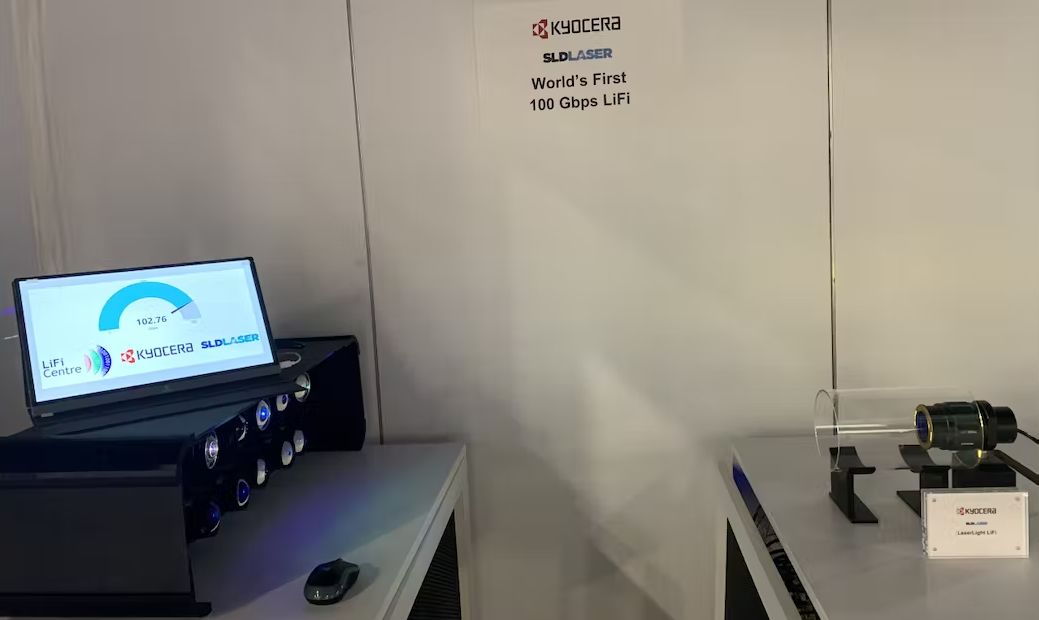
          To support the future of wireless connectivity, KSLD will display DataLightTM, the world’s first laser LiFi commercial development kit featuring a high-speed 1 Gbps, secure, RF-free, eye-safe bidirectional link. Laser LiFi is being adopted in mobility applications including car-to-x exterior, vehicle interiors, airplane cabins, undersea and space, defence and security, as well as future smart cities, healthcare, and smart factories. KSLD is pioneering LiFi innovations for future products as well and recently demonstrated a world-record performance of 100 Gbps. This product is a finalist for the 2023 Prism awards in the Laser category.

          Beyond lighting, sensing, and communication, KSLD will demonstrate its innovative optical power transmission over fibre using its high-efficiency GaN laser diode and photodiode semiconductor chip technology. This significant advancement in the field of power transfer has the potential to replace heavy and sensitive metal wire harnesses in mobility and harsh-environment applications with a lightweight, noise-free optical solution, increasing the efficiency and extending the range of electric vehicles, airplanes, or satellites, while making them more secure and safe. This power-over-light solution can be configured to include optical data communications to deliver data and power to sensors in a distributed system in a vehicle or even in space, where radiation-hardened GaN-based semiconductors are ideally suited.

          KYOCERA SLD Laser will host meetings in person at Photonics West 2023 in South Exhibition Hall Booth 1762 and virtually by appointment. To schedule an appointment, please contact Kristen Hanna at KHanna@KYOCERA-SLDLaser.com.


          KYOCERA SLD

          KYOCERA SLD Laser is pioneering the future of light. As stated on their website, new ideas are being harnessed to realise tomorrow’s product innovations.

          The next generation in lighting has arrived, shining brighter and farther than ever before. In the last decade, LED enabled a new generation of lighting that changed everything. Now, LaserLight outshines the limits of LED to deliver safe, high luminance white light from an incredibly small point source. LaserLight doesn’t just offer superior technology, it’s enabling entirely new opportunities.

          KYOCERA SLD are commercialising revolutionary semi-polar GaN LaserLight for the next generation of display, automotive, and specialty applications. LaserLight sources are used directly in single color and R-G-B applications, or integrated into laser pumped phosphor architectures.

          As an independent spin-off from Soraa Inc, SLD Laser was founded in 2013 by several leading global pioneers in solid state lighting, including Dr. Shuji Nakamura, a 2014 Nobel Laureate in Physics for his groundbreaking work with LEDs, Dr. Steve Denbaars, Dr. James Raring, and Dr. Paul Rudy. Our laser technology incorporates a robust intellectual property portfolio of over 500 patents. SLD Laser was acquired by KYOCERA Corporation and has commenced operations as a Kyocera group company under the name KYOCERA SLD Laser, Inc.

          Article source: https://www.businesswire.com/news/home/20230105005306/en/KYOCERA-SLD-Laser-Introduces-World%E2%80%99s-First-Laser-based-Automotive-Headlight-Modules-with-White-and-Infrared-Dual-Illumination-for-Increased-Safety-and-Visibility#:~:text=KYOCERA%20SLD%20Laser%20Introduces%20World%E2%80%99s%20First%20Laser%2Dbased%20Automotive%20Headlight%20Modules%20with%20White%20and%20Infrared%20Dual%20Illumination%20for%20Increased%20Safety%20and%20Visibility


          Li-Fi Conference 2022


          The Li-Fi Conference 2022 Edition was a great success. Li Fi Tech News will very soon write articles on the topics treated at the Conference.

          What is LiFi?

          LiFi, also known as "Light Fidelity" is a wireless optical networking technology, which uses light-emitting diodes (LEDs) to transmit data. In 2011, professor Harald Haas made a LiFi demonstration at the TED (Technology, Entertainment, Design) Global Talk on Visible Light Communication (VLC).

          VLC uses light as a medium to deliver high-speed communication like Wi-Fi and complies with the IEEE standard IEEE 802.15.7. The IEEE 802.15.7 is a high-speed, bidirectional, and fully networked wireless communication technology-based standard similar to Wi-Fi's IEEE 802.11.

          How does LiFi work?

          LiFi is a high speed, bidirectional, and fully networked wireless communication of data using light. LiFi constitutes of several light bulbs that form a wireless network.

          When an electrical current goes through to a LED light bulb, a stream of light (photons) emits from the lamp. LED bulbs are semiconductor devices, which means that the brightness of the light flowing through them can change at extremely high speeds. The signal is sent by modulating the light at different rates. The signal can then be received by a detector that interprets the changes in light intensity (the signal) as data. Also when the LED is ON, you transmit a digital 1, and when it is OFF, you transmit a 0.

          LiFi Benefits

          The primary benefits of LiFi are as follows:

          Security: Provides entirely secure access. Where there is no light there is no data.

          Safety: Does not produce electromagnetic radiation and does not interfere with existing electronic systems.

          Localisation: Allows localisation due to the small coverage area of LiFi access point - localisation can be used for very precise asset tracking.

          Data density: Provides ubiquitous high-speed wireless access that offers substantially greater data density (data rate per unit area) than RF through high bandwidth reuse.

          Credit to Oledcomm

          LiFi Applications

          LiFi can be used for so many applications and the list is increasing every year. You can read our updated list of Li-Fi applications at the following link:

          https://www.lifitn.com/blog/2021/2/13/top-30-li-fi-applications-updated-list-including-potential-applications

          Credit to pureLiFi


          LiFi Systems Reviews by LiFi Tech News


          OLEDCOMM LIFIMAX KIT REVIEW - ONE YEAR IN

          We reviewed the LiFiMax kit produced by the leading French LiFi company Oledcomm. We bought this LiFi kit system at the end of 2020. After over a year of use, we decided to write a review of this LiFi system. We looked briefly at the profile of Oledcomm, a brief history of the LiFiMax system, the Kit box contents, some testing and performance results of this LiFi system, the customer experience and our own verdict (the good and the bad points) of the LiFiMax kit.

          You can read the review on this link:

          https://www.lifitn.com/blog/lifimaxreview


          SIGNIFY TRULIFI 6002.1 STARTER KIT SYSTEM REVIEW


          We also reviewed the Trulifi 6002.1 starter kit produced by Signify, the world leader in lighting for professionals, consumers and lighting for the Internet of Things. We got this LiFi kit system with the help of PCDSI and Signify around August 2021. In a similar fashion done with our previous review of the LiFiMax kit a few months ago, we will look briefly at the profile of Signify, a brief history of the Trulifi 6002.1 kit, the Kit box contents, some testing and performance results of this LiFi system, the customer experience and our own verdict (the good points and the bad points) of the Trulifi 6002.1 kit.

          You can read the review on this link:

          https://www.lifitn.com/blog/trulifi6002review


          In conclusion, if you are also interested to hear more information about the OWNII Coin or enquire about LiFi devices such as the LiFiMax and Trulifi, you can contact us through our chatbot or by sending an email through our contact us form. If you enjoyed this post and would like to hear more updates about LiFi technology, subscribe to our newsletter. Don’t forget to subscribe to our social media accounts. You can also join our Telegram group about LiFi technology on this link:

          https://t.me/joinchat/FMzOmsEKyJFrU6Af


          Oledcomm Announces The Unveiling of Their Latest System, LiFiMAX2G, at The Upcoming CES 2023

          Table of Contents

            Oledcomm Announces The Unveiling of Their Latest System, LiFiMAX2G, at The Upcoming CES 2023

            Photo credit to Oledcomm

            LIFIMAX2G® at The Upcoming CES 2023


            Oledcomm released a press statement today stating that they will unveil their latest LiFi system at CES 2023.

            Oledcomm, the global leader in LiFi technology, is furthering its leadership at CES 2023. Oledcomm unveils LIFIMAX2G®, enabling the factory and transportation of the future to connect through invisible light. Oledcomm announces a doubling of the speed of its LiFiMAX range with a 2Gbps connection. Now even faster, more reliable and secure, LiFi is a high-performance, greener alternative to radio waves and cables, with low energy consumption.

            Following the worldwide success of LiFiMAX Cybersecurity Solutions® launched at CES 2020, Oledcomm unveils its latest breakthrough in wireless optical communication. Oledcomm's LiFiMAX2G® enables industrial and rail and other mobility infrastructures to access high-speed transmissions securely, without interference and tamper-resistant.

            LiFIMAX2G® is particularly suited for subways, trains and any vehicle that needs to download huge amounts of data in terabytes (images and videos) in less than 20 seconds as well as for industrial Industry 4.0 applications in augmented reality, IoT or M2M. As fast as Gigabit Ethernet, more secure than WiFi, and as small as a smoke detector, LiFiMAX2G® takes Vehicle-to-Infrastructure communications and connectivity for Industry 4.0 to a new level.

            This new generation of LiFi transceivers doubles the speed achieved by the previous generation, now reaching nearly 2 Gigabits per second upstream and 2 Gigabits per second downstream at a distance of 1-5m. Also addressing the growing capabilities of IoT in rail or industrial 4.0 infrastructures, the use of invisible light avoids interference compared to other radio wave-based communication modes, allowing devices to exchange data safely at any time.

            Benjamin Azoulay, President of Oledcomm, said: "The dizzying growth in the amount of data collected in mobility situations and the increase in multimedia flows require a reliable and uninterrupted communication standard for all, especially in transport and factory 4.0. We are proud to contribute to the development of these new standards."

            Oledcomm will be exhibiting at CES from January 5-8 in booth 59206. Industrial LiFi-connected augmented reality (AR) application demos as well as V2I (Vehicle to Infrastructure) connection demos will be performed upon request.


            CES 2023

            As stated on their website, CES is the most influential tech event in the world and the proving ground for breakthrough technologies and global innovators. This is where the world's biggest brands do business and meet new partners, and the sharpest innovators hit the stage. Owned and produced by the Consumer Technology Association (CTA)®, CES features every aspect of the tech sector.

            CES showcases companies including manufacturers, developers and suppliers of consumer technology hardware, content, technology delivery systems and more. It also includes a conference program where the world's business leaders and pioneering thinkers address the industry's most relevant issues.

            CES® 2023 will be held in Las Vegas from the 5th to the 08th of January 2023 providing global audience access to major brands and startups, as well as the world’s most influential leaders. Over 1900 companies have committed to exhibiting in Las Vegas and many more are being added each week.


            Oledcomm

            Oledcomm designs and develops LiFi network interface devices that enable high-speed wireless data communication. It also serves LiFi equipment in the telecom, datacom, personal electronics, and industrial markets. The company’s product portfolio includes hubs, routers, switches, adapters, drivers, power supplies, and more.

            Oledcomm was founded in 2012 and is based in Paris, France. Oledcomm's adventure began in 2005 in the research laboratories of the University of Versailles-Saint-Quentin with the first work on communication by visible light.

            Following years of research & development and a passion for innovation, Oledcomm became the pioneer of LiFi (Light Fidelity) solutions and innovation on a global scale.

            Based in the Paris region, Oledcomm employs around 20 people and designs complete solutions for LiFi operation, including microcontrollers, LiFi photoreceivers and software platforms.

            Today, after more than 33 patents, 15 years of R&D, over 500 trusted clients and several awards, Oledcomm is pursuing a strong mission: to transform the 14 billion points of light in the world into a powerful communication network.

            The company is ISO 9001:2015 and ISO 14001:2015 certified. Oledcomm's LiFi offering solves connectivity problems by replacing cables in environments where radio waves are undesirable. Targeted sectors include space, defence, industrial and education. Since 2020, LiFiMAX® has been installed and tested in more than 800 projects worldwide and has been validated by ORANGE for Cybersecurity.

            At the Mobile World Congress in Barcelona in 2021, Oledcomm announced an integrated circuit (ASIC) that enables native LiFi integration in tablets, PCs or smartphones. Oledcomm is a laureate of the European Deeptech EIC Accelerator program, which provides for the European Commission to invest in Oledcomm through the EIC Fund.


            Article source: Oledcomm


            Li-Fi Conference 2022


            The Li-Fi Conference 2022 Edition was a great success. Li Fi Tech News will very soon write articles on the topics treated at the Conference.

            What is LiFi?

            LiFi, also known as "Light Fidelity" is a wireless optical networking technology, which uses light-emitting diodes (LEDs) to transmit data. In 2011, professor Harald Haas made a LiFi demonstration at the TED (Technology, Entertainment, Design) Global Talk on Visible Light Communication (VLC).

            VLC uses light as a medium to deliver high-speed communication like Wi-Fi and complies with the IEEE standard IEEE 802.15.7. The IEEE 802.15.7 is a high-speed, bidirectional, and fully networked wireless communication technology-based standard similar to Wi-Fi's IEEE 802.11.

            How does LiFi work?

            LiFi is a high speed, bidirectional, and fully networked wireless communication of data using light. LiFi constitutes of several light bulbs that form a wireless network.

            When an electrical current goes through to a LED light bulb, a stream of light (photons) emits from the lamp. LED bulbs are semiconductor devices, which means that the brightness of the light flowing through them can change at extremely high speeds. The signal is sent by modulating the light at different rates. The signal can then be received by a detector that interprets the changes in light intensity (the signal) as data. Also when the LED is ON, you transmit a digital 1, and when it is OFF, you transmit a 0.

            LiFi Benefits

            The primary benefits of LiFi are as follows:

            Security: Provides entirely secure access. Where there is no light there is no data.

            Safety: Does not produce electromagnetic radiation and does not interfere with existing electronic systems.

            Localisation: Allows localisation due to the small coverage area of LiFi access point - localisation can be used for very precise asset tracking.

            Data density: Provides ubiquitous high-speed wireless access that offers substantially greater data density (data rate per unit area) than RF through high bandwidth reuse.

            Credit to Oledcomm

            LiFi Applications

            LiFi can be used for so many applications and the list is increasing every year. You can read our updated list of Li-Fi applications at the following link:

            https://www.lifitn.com/blog/2021/2/13/top-30-li-fi-applications-updated-list-including-potential-applications

            Credit to pureLiFi


            LiFi Systems Reviews by LiFi Tech News


            OLEDCOMM LIFIMAX KIT REVIEW - ONE YEAR IN

            We reviewed the LiFiMax kit produced by the leading French LiFi company Oledcomm. We bought this LiFi kit system at the end of 2020. After over a year of use, we decided to write a review of this LiFi system. We looked briefly at the profile of Oledcomm, a brief history of the LiFiMax system, the Kit box contents, some testing and performance results of this LiFi system, the customer experience and our own verdict (the good and the bad points) of the LiFiMax kit.

            You can read the review on this link:

            https://www.lifitn.com/blog/lifimaxreview


            SIGNIFY TRULIFI 6002.1 STARTER KIT SYSTEM REVIEW


            We also reviewed the Trulifi 6002.1 starter kit produced by Signify, the world leader in lighting for professionals, consumers and lighting for the Internet of Things. We got this LiFi kit system with the help of PCDSI and Signify around August 2021. In a similar fashion done with our previous review of the LiFiMax kit a few months ago, we will look briefly at the profile of Signify, a brief history of the Trulifi 6002.1 kit, the Kit box contents, some testing and performance results of this LiFi system, the customer experience and our own verdict (the good points and the bad points) of the Trulifi 6002.1 kit.

            You can read the review on this link:

            https://www.lifitn.com/blog/trulifi6002review


            In conclusion, if you are also interested to hear more information about the OWNII Coin or enquire about LiFi devices such as the LiFiMax and Trulifi, you can contact us through our chatbot or by sending an email through our contact us form. If you enjoyed this post and would like to hear more updates about LiFi technology, subscribe to our newsletter. Don’t forget to subscribe to our social media accounts. You can also join our Telegram group about LiFi technology on this link:

            https://t.me/joinchat/FMzOmsEKyJFrU6Af


            Highlights From Get A Grip On Lighting Podcast EP 293 - Tony Lawrence, CEO of LightRider Inc Gives Updates on His Quantum LiFi Now called Quantum Light

            Table of Contents

              Highlights From Get A Grip On Lighting Podcast EP 293 - Tony Lawrence, CEO of LightRider Inc Gives Updates on His Quantum LiFi Now called Quantum Light

              Happy new year and happy new month from the LiFi Tech News Team.

              Today, we are writing an article on a recent Get a Grip On Lighting podcast episode 293. Michael Colligan and Greg Ehrich invited Tony Lawrence on the podcast. He is an entrepreneur and technologist and a prophet of quantum possibilities through his current role as CEO of LIGHTRIDER. Tony is a service disabled veteran of the US Army who began his career being recruited into the intelligence field by the National Security Agency. Serving in multiple high profile roles, Tony gained invaluable experience in counterterrorism and threat analysis as well as tracking high value targets and tactical intelligence collection.

              They discussed on the LIGHTRIDER quantum light (previously known as quantum LiFi), quantum computers, some current cybersecurity developments and the future of quantum light products in the US within the next 2 years.

              Get A Grip On Lighting Podcasts are hosted by Michael Colligan and Greg Ehrich, who have over 30 years of combined experience in the lighting industry. Michael Colligan is an entrepreneur and inventor. He’s a subject matter expert in commercial and industrial lighting supply, lighting retrofits, and finding recycling streams for hard-to-recycle waste. Greg Ehrich, LC is the former President of the National Association of Innovative Lighting Distributors (NAILD) and owner of a progressive lighting distributorship. The podcast is sponsored by Keystone.

              Below are some of the Podcast conversations. Some of the conversations have been edited by Chuks from LiFi Tech News:

              Michael Colligan: “And, you know, Tony Lawrence, been on the show before he's an entrepreneur and technologist and a prophet of quantum possibilities through his current role as CEO of LIGHTRIDER. Tony is a service disabled veteran of the US Army who began his career being recruited into the intelligence field by the National Security Agency. Serving in multiple high profile roles, Tony gained invaluable experience in counterterrorism and threat analysis as well as tracking high value targets and tactical intelligence collection. This is a long one, you know, I want to try to sum it up a little bit here. He started in the military. And then he was part of the team that invented LiFi or built LiFi. He's gonna tell us a little bit more about it. But with LIGHTRIDER with years of R&D and investment in quantum technologies and applications Tony created LIGHTRIDER, a quantum communications company focused on the nexus of quantum based encryption and communications and light fidelity, LiFi technology. Using LiFi and quantum encryption, LIGHTRIDER mission is to provide unhackable communications to the planet at a price they can afford. With product lines covering encrypted storage, secure communications, networking and infrastructure. LIGHTRIDER has always captured the attention of emerging security and communications outlets across healthcare, military education, government, contracting and verticals.”

              Tony Lawrence: “All right. Hey, it is a pleasure to be back with you gentlemen, really enjoy the last conversation we had. I've been hearing nothing about but great things across the lighting community. So, yeah, here at LIGHTRIDER, we've done a lot of R&D and things have changed. We're not offering quantum LiFi anymore. We're now calling our solution quantum light. All right, soon as that light bulb comes on, boom, you got quantum information flow into your device, your tablet, your phone, your computer, any sort of IoT device, we're streaming quantum keys and quantum entropy to your device while providing you internet service.

              Now, right behind me, we have one of our demonstration units, or one of our quantum light lamps. And these lamps stream quantum keys. And you might be wondering, what are quantum keys? So, recently, President Biden has issued an executive order for quantum computing, right? They call it the post quantum cryptography executive order. And what's happening here is the president and the National Security Council are preparing the entire nation for the potential attack or potential exploitation from a quantum computer.  Whether that quantum computer comes from Russia, or China, one day, our adversaries are going to have a working quantum computer. And with that computer, they can hack any system we have here currently in the United States.

              So, what the president's doing is, he's using quantum keys and quantum cryptography to protect our websites, our critical infrastructure, and he's stood up a new organisation called the CISA, the cybersecurity infrastructure security agency. So, CISA is responsible for pushing quantum encryption across the government. Now, here in the United States, we're really good at software, right? We're not so good at making cell phones. We're now so good at making computers. And we're common good at making vehicles right. But software is our way of stopping these quantum computers here at LIGHTRIDER. We've just just through analysis, we realise that hey, here in America, we're amazing at making light bulbs. You guys know this. That's something that we do the best here in the United States. So, what we've done is we've integrated quantum computing quantum technologies and light bulbs, and we're able to mass produce these quantum light bulbs and distribute them across the United States to protect Americans against quantum computers.”


              Tony Lawrence: “But we just talked about the software that the White House is pushing out, the PQC software, everybody has software, you know, the advanced cybersecurity companies, the folks that really know what they're doing, they're already creating PQC software, they're submitting it to the government to do a lot of good things so they can meet the President's objectives. Here at LIGHTRIDER, what we're doing is we're using that same software that same exact software, but guess what, but pushing it through light bulbs, right, but pushing it through light bulbs.”

              So, you get the software from the light bulb, it goes to your computer, it goes to your tablet, it goes to your your phone. And in order to use your computer, tablet or phone, guess what you got to be underneath a specific light bulb, you got to be underneath this light bulb. If you're not underneath that light bulb, then your devices won't work. So, what we've done is we've taken something that's digital, something that's in cyberspace, and we've combined it with something that we use everywhere in our homes or offices, and we tethered the two together.”

              “So, you can't have you know, your OP, you can't have your computer without being underneath of a specific light bulb. And the same thing applies to software, right we have programmes that are linked to the light bulbs. So, if you're not underneath this specific light bulb, you won't be able to open up your Facebook, you won't be able to open up your Instagram, things like that. And that's what we're doing to protect our users data. By the year 2024, Probably June 2024, you'll be seeing our technology in BestBuy and Home Depot, we're already working with major Realtors major construction companies right now. And they're looking at buying a large amount of our lightbulbs and putting them into new construction. So, soon you're going to see a wireless fidelity or WiFi which is very unsecure, you're gonna see that transition now. And you're gonna see quantum light transition.”


              Michael Colligan: “What if you turn the light bulb off?”

              Tony Lawrence: “So, we have an infrared backup channel, right? So, we broadcast an infrared into technology that we're using is very similar to the technology used for a TV remote, very, very similar. I mean, it's more advanced, but in theory is very similar. So yeah, it works without visible light. Visible light is great because you can see your data, right and with our lives if the lights start to flicker, things like that, you know, hey, something's wrong with my access point.”


              Tony Lawrence: “So, my technology is a wireless version of fibre optics. So, as fibre optics becomes more prevalent, you have hollow core fibre, hollow core fibre can move information at the same rate as free space, free space communications are, you know, so hollow core fibre is the future and it’s very advanced, but as fibres laid throughout the country, you won't need data storage would change, right information doesn't have to rest information can keep moving, it can keep moving through the light, it can keep moving through fibre optics. And if it keeps moving, it's going to be very difficult for our adversaries to gain access to it, it'd be impossible for them again, they have to hunt it down, you know, like a dog or hunting rabbit, or chicken. So, you know, as the new technological infrastructure becomes more robust, more prevalent, then we have different means of storing and sending information, it doesn't have to be just the cloud.”

              Tony Lawrence: “So, we have connected lights.  Connected lights are a huge feature that I offer my customers, you will be able to turn the lights on and off through your computer, you'll also be able to store up to a terabyte worth of data inside your life. And if you have other lights connected to that network, guess what those lights all share the data, right? So instead of having a cloud system that's far away, or in Virginia, at a data centre or something somewhere, you will have a cloud lighting system inside of your home, everything stays inside your home, and never needs to leave.”


              Greg Ehrich: “Just being curious. Why did you guys drop the name LiFi? You know, at the beginning, you mentioned that you get rid of that term. Now that you are quantum light.”


              Tony Lawrence: “Yeah, quantum light, our technology is completely different than LiFi. It is nothing like LiFi. Originally, we use the term LiFi, because it was closely related to what we were doing. But I didn't start with lightbulbs. I started with two lasers, a whole room full of equipment spectrum analyzers. Guidance point, just huge amounts of equipment, just like your traditional quantum computing laboratories a day, right. But I was doing this stuff back in 2014, working at the National Security Agency working at NSA. So, we had amazing equipment. And one day I went into the laboratory. And I just started looking at things, I'm just like, This is too much, this is too much. And I just start throwing, I'll just start throwing things away, right throwing things away to some of this equipment was $10,000. Some of it was $100,000. I didn't care, I was just like this is not realistic. And at the end, I was left with one laser. And I was left with one box. And I looked at that laser. And I said, I turned it upside right. And I was like this is a light, this could be a light. And then that's where I created quantum light technology. It wasn't that I didn't get through this through lighting. I got through this through Quantum research, quantum analysis and quantum information science.”


              Michael Colligan: “So I'm sitting in this room, these lights are hooked up to quantum light. That means anywhere that light is shining is a high speed, an incredibly high speed internet connection that's only going to get faster and faster and faster as it learns.”

              Tony Lawrence: “Exactly, correct.


              Michael Colligan: “From the lighting distributor perspective, Tony, who do you think is the first initial adopter of this technology that's gonna run with it as a possible customer for lighting distributors?”

              Tony Lawrence: “So, I believe Orion lighting is the furthest. We've been working with them for quite some time and after Orion, Philips Signify Trulifi. So, Philips has amazing LiFi technology. Trulifi is their company that oversees LiFi R&D, we're working with them as well. Trulifi internet speeds are fast; they work as they use infrared lighting to do so. Great technology. And this that's where that's working right now. Their technology works today.”


              Michael Colligan: “If you could give us the who the early adopters would be customer wise, not just manufacturer wise, but who do you think is going to be the first type of people that will want to purchase their technology for their business? This technology?”

              Tony Lawrence: “Great question. So, the United States government, foreign governments, and governments will be the first early adopters after them. I see it being colleges University of cities, and after education is going to be hospitals. I believe hospitals and emergency health organisations should be one of the first to use it because it's more secure.”


              Michael Colligan: “Tony, any final thoughts for the Get a grip on lightning listeners to close it out?”

              Tony Lawrence: “Hey, so my final thoughts are, this is a great time for the lightning community. What we're seeing here is the integration of, you know, in advance technology with your everyday life or so for innovators out there, inventors, inventors out there, this is your time to shine, please take opportunities that are presented by quantum technologies and Quantum Information Science and apply it anywhere you can. Right so I wish everyone luck and thank you guys again for having me.”


              Podcast Recording


              You can also listen to the podcast in full at the following link:

              LiFi Tech News’ Take on the podcast episode

              As always, this was an enlightening and mind boggling podcast from the Get a grip on Lighting team. Mr Tony Lawrence did not disappoint in shaking tables with quantum technology. We find it interesting that LightRider Inc now terms their quantum LiFi technology to quantum light. It was good to hear some of their recent developments and what to expect in the next few years. To us, this confirms that we are going to see more LiFi deployments and more quantum light products being introduced to the market within the next 2 years. The future is indeed very bright in the LiFi and Lighting industry.

              Li-Fi Conference 2022

              The Li-Fi Conference 2022 Edition was a great success. Li Fi Tech News will very soon write articles on the topics treated at the Conference.

              What is LiFi?

              LiFi, also known as "Light Fidelity" is a wireless optical networking technology, which uses light-emitting diodes (LEDs) to transmit data. In 2011, professor Harald Haas made a LiFi demonstration at the TED (Technology, Entertainment, Design) Global Talk on Visible Light Communication (VLC).

              VLC uses light as a medium to deliver high-speed communication like Wi-Fi and complies with the IEEE standard IEEE 802.15.7. The IEEE 802.15.7 is a high-speed, bidirectional, and fully networked wireless communication technology-based standard similar to Wi-Fi's IEEE 802.11.

              How does LiFi work?

              LiFi is a high speed, bidirectional, and fully networked wireless communication of data using light. LiFi constitutes of several light bulbs that form a wireless network.

              When an electrical current goes through to a LED light bulb, a stream of light (photons) emits from the lamp. LED bulbs are semiconductor devices, which means that the brightness of the light flowing through them can change at extremely high speeds. The signal is sent by modulating the light at different rates. The signal can then be received by a detector that interprets the changes in light intensity (the signal) as data. Also when the LED is ON, you transmit a digital 1, and when it is OFF, you transmit a 0.

              LiFi Benefits

              The primary benefits of LiFi are as follows:

              Security: Provides entirely secure access. Where there is no light there is no data.

              Safety: Does not produce electromagnetic radiation and does not interfere with existing electronic systems.

              Localisation: Allows localisation due to the small coverage area of LiFi access point - localisation can be used for very precise asset tracking.

              Data density: Provides ubiquitous high-speed wireless access that offers substantially greater data density (data rate per unit area) than RF through high bandwidth reuse.

              Credit to Oledcomm

              LiFi Applications

              LiFi can be used for so many applications and the list is increasing every year. You can read our updated list of Li-Fi applications at the following link:

              https://www.lifitn.com/blog/2021/2/13/top-30-li-fi-applications-updated-list-including-potential-applications

              Credit to pureLiFi


              LiFi Systems Reviews by LiFi Tech News


              OLEDCOMM LIFIMAX KIT REVIEW - ONE YEAR IN

              We reviewed the LiFiMax kit produced by the leading French LiFi company Oledcomm. We bought this LiFi kit system at the end of 2020. After over a year of use, we decided to write a review of this LiFi system. We looked briefly at the profile of Oledcomm, a brief history of the LiFiMax system, the Kit box contents, some testing and performance results of this LiFi system, the customer experience and our own verdict (the good and the bad points) of the LiFiMax kit.

              You can read the review on this link:

              https://www.lifitn.com/blog/lifimaxreview


              SIGNIFY TRULIFI 6002.1 STARTER KIT SYSTEM REVIEW


              We also reviewed the Trulifi 6002.1 starter kit produced by Signify, the world leader in lighting for professionals, consumers and lighting for the Internet of Things. We got this LiFi kit system with the help of PCDSI and Signify around August 2021. In a similar fashion done with our previous review of the LiFiMax kit a few months ago, we will look briefly at the profile of Signify, a brief history of the Trulifi 6002.1 kit, the Kit box contents, some testing and performance results of this LiFi system, the customer experience and our own verdict (the good points and the bad points) of the Trulifi 6002.1 kit.

              You can read the review on this link:

              https://www.lifitn.com/blog/trulifi6002review


              In conclusion, if you are also interested to hear more information about the OWNII Coin, you can contact the OWNii Support team at info@ownii.net or use the contact form on the new OWNii website, ownii.net. If you are enquiring about LiFi devices such as the LiFiMax kits and the Trulifi kits, you can contact us through our chatbot or by sending an email through our contact us form. If you enjoyed this post and would like to hear more updates about LiFi technology, subscribe to our newsletter. Don’t forget to subscribe to our social media accounts. You can also join our Telegram group about LiFi technology on this link:

              https://t.me/joinchat/FMzOmsEKyJFrU6Af

              LiFi Trends and Predictions For 2023 and Beyond Everyone Should Pay Attention

              Table of Contents

                LiFi Trends and Predictions For 2023 and Beyond Everyone Should Pay Attention

                In this article, we will look at some of the trends that are emerging in the LiFi industry. Industry trends can be defined as patterns or trends that occur within a specific industry. These trends may relate to pricing, cost, consumer purchasing, marketing, manufacturing, sales methodology and any other relevant areas.

                The LiFi market is highly competitive and consists of several major players. In terms of market share, few of the major players currently dominate the market. These major players with prominent shares in the market are focusing on expanding their customer base across foreign countries.

                There's a lot of future potential here with LiFi as there's a strong body of research and academia, who have been pushing the envelope and growing the capability of the technology over a long period of time, and continue to do so.

                Here are the trends we believe will have the greatest day-to-day impact on the way we work and do business in 2023.

                LiFi Trends and Predictions


                1) LiFi is here to stay

                The need for faster and better connectivity by consumers and businesses is growing every year. Cellular connectivity and WiFi connectivity are nearly reaching their limits to this ever-growing demand. Since the viral TEDTalk presentation of LiFi by Professor Harald Haas over 11 years ago, LiFi has yet to reach the mass market. However, a lot of extensive research and applications of LiFi have been done in different environments on a global scale for the past decade. This will not stop anytime soon. Since its presentation to the global audience by the Father of LiFi, a few companies and organisations specialising in LiFi in one way or the other have arisen such as pureLiFi, Oledcomm, Signify, LightRiderInc, LiFi Infinity, LiFiLED, LightBee, Lina, Global Greenology, Zero1, Fraunhofer HHI and many more. We have also seen the rise of different LiFi systems used mainly for research, industrial and home beta testing purposes. In short, LiFi is inevitable and it is only a matter of time before it becomes available to the mainstream. LiFi is not going anywhere.

                2) LiFi will still not replace WiFi

                According to a 2022 report from DataReportal, there are over 4.95 billion active internet users. It is also estimated that there Are More Than 9 Billion WiFi Devices In The World. 82% of people check their phones while shopping in-store, and most of the time, it’s to check reviews of products before they purchase them. 96% of people prefer to shop at a business that offers free WiFi over a business that doesn’t. 47% use public Wi-Fi to cut down on cellular data usage while they’re away from home. WiFi is essential to our daily lives, especially with our mobile devices since 71% of all mobile device communications are done over WiFi.

                For the 4 to 6 years, we are seeing more LiFi WiFi hybrid systems being experimented in research projects. An internet infrastructure that greatly supports WiFi connectivity and WiFi devices makes a huge difference. With these statistics and as there is no LiFi Internet infrastructure just yet, LiFi will not replace WiFi completely anytime soon but will definitively complement WiFi in so many areas where WiFi is prohibited or has limitations. However, a LiFi internet Infrastructure that can offer universal connectivity and compatibility of any LiFi devices will likely change the mentioned statistics in the years to come. This is left to be seen.


                3) LiFi Miniaturisation will continue to expand for IoT devices

                Miniaturisation can be defined as the process of making something very small using modern technology. The miniaturisation of electronic components has made it possible to build small portable and handheld computing devices that can be carried almost anywhere and at any time. As a result, smaller and lighter devices having high processing capacity are available on the market. Over the past decade, we have seen how LiFi systems have become smaller and smaller.

                Nowadays, we have LiFi chips that enable devices to transmit Data with Light. Oledcomm Gigabit Optical Front End (OFE) LiFi micro-chip and pureLiFi Gigabit Light Antenna™ are both examples of LiFi micro-chips. We now see some tablets with some LiFi receivers in them such as the LiFiMAXTab.

                We predict in the next 2 to 5 years that more devices will have LiFi components integrated into them. This means that it is only a matter of time before we see nearly all smartphones, IoT devices, computers and tablets with LiFi universal compatibility in them just like we have WiFi-enabled devices in our homes and work offices.


                4) More LiFi SYSTEMS CUSTOMISATION will BE DEPLOYED

                Product customisation generally means that a customer can select specific features, functionalities, add-on components or other options to make a more unique item rather than a mass-produced one. Most LiFi companies such as pureLiFi, Oledcomm and Signify offer LiFi system customisation to the specific requirements of their clients. We are seeing this in the Defence Industry as well.

                A good example of this is the Consolite Military and Navy LiFi systems for Defence requirements. Consolite is a leading producer of advanced warship lighting systems, which include LED internal lighting, LED external lighting and LED navigation lighting. Their latest development is the design and manufacture of military LiFi communication systems.

                Consolite’s partnership with the Signify Team has brought the combination of Signify’s huge industrial investment with Consolite specialist military focus. As a team and partners, they are providing connectivity to Naval ship operations which are revolutionising data use at sea.

                Another example is the Mobile Internet Extranet LiFi Access (MIELA) System By PoE-Tic or as we like to call it at LiFi Tech News, the portable LiFi system.

                PoE-Tic develops and integrates alternative wireless network infrastructures that limit cabling work and guarantee sobriety or even total suppression of radio waves.

                World leader in lighting, Signify has designed the Trulifi offer which allows transmitting high-speed data LiFi, with a bandwidth of around 150 Mbps.

                PoE-Tic and Signify have combined their know-how to meet connectivity and mobility needs in environments that must be free of radio frequencies. This is how the MIELA was born; innovative LiFi equipment that combines Mobility, Sobriety and Scalability.

                From 2023, we believe that we are going to see more specialists, consultants and professionals of different industries designing and deploying specific customisations of LiFi systems to their organisation and industry needs.


                5) LiFi Internet Infrastructure will arise from 2023 onwards

                Internet infrastructure can be defined as the physical hardware, transmission media, and software used to interconnect computers and users on the Internet. Internet infrastructure is responsible for hosting, storing, processing, and serving the information that makes up websites, applications, content, broadband and many more.

                Any form of wireless communication and wireless communication devices need a robust infrastructure to function properly and serve their intended purposes. LiFi technology and LiFi systems are no different to that. There is a need for a new or should we say additional internet infrastructure that could be tailored to LiFi devices and LiFi connectivity. A lot of LiFi installations and research projects in different environments are confirming this need. Broadband penetration will continue to increase globally every year as consumers seek faster and more reliable internet..

                From 2023 and beyond, we will see the rise and deployment of a new LiFi Internet Infrastructure that will be tailored to LiFi systems functionalities and eventually LiFi universal compatibility. We predict that this new upcoming LiFi Internet Infrastructure will be one of the ways to start deploying LiFi on a mass market level.


                6) LiFi Cities

                From 2023, there will be an increased number of large-scale LiFi projects. In some areas of the World, some communities, and cities would have deployed massive LiFi deployments. These cities will be termed as LiFi cities.

                We define LiFi cities as an urban area where LiFi Internet and device connectivity are predominantly used by residents and businesses. This means LiFi connectivity in a range of environments such as residential homes, offices, casinos, libraries, transport systems, shopping malls, places of entertainment, hotels, rural areas and many more.

                A smart city can be defined as an urban area where traditional networks and services are made more efficient with the use of digital solutions for the benefit of its inhabitants and business.

                A smart city goes beyond the use of digital technologies for better resource use and less emissions. It means smarter urban transport networks, upgraded water supply and waste disposal facilities and more efficient ways to light and heat buildings. It also means a more interactive and responsive city administration, safer public spaces and meeting the needs of an ageing population.


                7) LiFi Standardisation

                The race to accelerate LiFi integration to the mass market will continue in the year 2023. Efforts to develop international standards for light communications in wireless and wired local area networking have been going on for the last few years.

                ITU-T G.9991 standard is the 1st LiFi standard specifying the system architecture, physical (PHY) layer and data link layer (DLL) for high-speed indoor LiFi transceivers, the LiFi access points within LED and infrared lamps.

                There are also at least 3 IEEE standards that are being developed to bring LiFi to the mass market. These are the IEEE 802.11bb, IEEE 802.15.7 and IEEE 802.15.13.

                IEEE 802.11bb defines one medium access control (MAC) and several physical layer (PHY) specifications for wireless connectivity for fixed, portable, and moving stations (STAs) within a local area. In the near future, it could allow converting any existing WiFi chip solution into a Light Communication solution by adding cheap external circuitry.

                IEEE 802.15.7 supports high-data-rate visible light communication up to 96 Mb/s by fast modulation of optical light sources which may be dimmed during their operation. IEEE 802.15.7 provides dimming adaptable mechanisms for flicker-free high-data-rate visible light communication.

                IEEE 802.15.13 defines the protocol and compatible network equipment for optical wireless communications and its operation as an optical wireless personal area network (OWPAN) supporting data rates of multiple Gbit/s for wireless speciality applications. The standard defines a medium access control (MAC) layer operating in beacon-enabled or non-beacon-enabled mode and three physical layers (PHYs) enabling low complexity, low power, and high throughput. It uses light wavelengths from 10,000nm to 190 nm in optically transparent media for optical wireless communications. The standard is capable of delivering data rates up to 2.192 Gb/s at distances in the range of 200 m unrestricted line-of-sight. It is also designed for point-to-point and point-to-multipoint communications and adaptation to varying channel conditions. This standard provides the following new technologies outlined below, which are not included in 802.15.7:

                • Mobility support between LiFi cells and between LiFi and RF

                • Higher data rates through better technologies

                • Up to 10 Gb/s short-range using RGBY LEDs

                • Several 100 Mb/s single-colour in wide beams (a few meters)

                • Discrete multi-tone (DMT, also denoted as DC-OFDM)

                • Closed-loop rate adaptation

                • Multiple-input multiple-output (MIMO) and distributed multi-user MIMO

                A few years ago, Mr Marcos Martinez from MaxLinear, said: “Standards are really the only way for these different worlds to speak to one another and collaborate successfully in stimulating the growth of the LiFi market.”

                We predict that other new standards will be developed within the next 2 to 5 years.


                8) LiFi Deployment in Defence Industry is growing

                Over the last 2 or 5 years, there has been a growing demand for LiFi for many military applications. The first Large scale deployment of LiFi was with the US ARMY in the spring of 2021.

                The Defence sector, particularly in the US, Europe and UK, has explored the use of LiFi and has found this technology to be reliable for the most critical communications. LiFi not only enhances the US Army’s wireless connectivity toolset but has demonstrated in action, that LiFi solves real problems faced by the defence and national security.

                One of the main challenges of using radio frequencies (RF) in secure settings is that they can be detected and targeted. Kitefin is said to eliminate this risk because it can’t be detected outside its defined cone of coverage.

                Andrew Foreman, chief technology officer at USAREUR-AF, once said the detection of RF systems puts soldiers and systems in “dire straits”.

                “Including optical wireless in the commander’s toolbox is imperative to the survival of communications, command and control systems and, more importantly, soldiers,” he said. “Leadership within the Department of Defense are at a major transitional crossroads for communications and mission command systems and must make a critical decision.”

                CW5 Andrew Foreman, USAREUR-AF Chief Technology Officer commented

                “LiFi technologies answer all three of the serious issues associated with the RF portion of the spectrum. First, due to the low probability of detection, jamming, and intrusion, FSO and LiFi offer an extremely survivable form of communications when in direct conflict with a near-peer adversary.”

                The recent and continued war on Ukraine has also caused a high interest and demand for LiFi for military missions. We've seen more announcements of LiFi deployment in operational and tactical environments and deployments in the Military.

                From 2023, we predict that more armies based in Africa, Asia, North America, South America and Australia will explore and deploy LiFi in their tactical environments.


                9) LiFi Demand

                The demand for LiFi technology in various industries is increasing. Industrial businesses are looking to LiFi for the connection stability and low latency required by connected machinery and collaborative robotics.

                The increase in the demand for high-data transmission rates among businesses is one of the key driving factors for the market. The rising movement towards the deployment of LiFi technologies in applications such as healthcare and security offer a favourable industry outlook. Government authorities are urged to invest in R&D programs to promote business development. Due to government policies in the ICT market, such as the introduction of smart city developments, companies are required to spend and develop in LiFi. Additionally, the growing demand for networking is expected to create ample opportunities for key players in the LiFi market. However, lack of awareness about the technology is expected to hinder the market growth.

                From 2023 onwards, we predict that more organisations, individuals and professionals will trial LiFi systems in different environments on a global scale.


                10) Educating the Masses on LiFi will start to intensify

                We are seeing this trend increasing throughout 2022 than in previous years. This was mainly done through articles, research publications, video demonstrations and podcasts. This trend will continue to rise in 2023. We will see more audio and video podcasts discussing LiFi technology on the most popular podcast platforms such as Apple iTunes, Amazon, Spotify, Podbean and many more.

                Starting in 2023, we predict more companies from different industry sectors, lighting consultants, engineers, researchers, students (undergraduates, postgraduates, PhD) LiFi experts, and LiFi enthusiasts will demonstrate, showcase LiFi systems and discuss relevant topics on LiFi technology in various audio and media formats.

                We also believe as well that more educational videos on LiFi technology will be released on social media platforms such as YouTube, Instagram, Facebook, Twitter and TikTok.

                However, from a LiFi Tech News perspective, there is still a very long way to go to increase the awareness of LiFi to the masses. Everybody in this emerging industry has a role in this.


                11) LiFi and Laser

                For the last 5 years, the interest in using laser light for faster data transmission than LED light has been growing.

                Laser LiFi is a variant of LiFi technology that uses lasers instead of visible light to transmit data. Like traditional LiFi, laser LiFi works by modulating the intensity of light waves to transmit data at high speeds.

                One of the main advantages of laser LiFi is that it can achieve higher data transfer speeds than traditional LiFi. Laser LiFi systems can potentially reach speeds of up to 1 terabit per second, which is much faster than traditional LiFi systems, which can reach speeds of up to 224 gigabits per second in labs.

                Another advantage of laser LiFi is that it can transmit data over longer distances than traditional LiFi, which is limited by the range of visible light. Laser LiFi can potentially transmit data over distances of up to several kilometres.

                James Raring, CEO of Kyocera SLD Laser, stated at CES 2022: “We are thrilled to announce KSLD's achievement of world record LiFi data rate of 90 Gbps and our demonstration of this DataLight innovation at CES 2022 in our exhibition booth. To pioneer the future of lighting and wireless connectivity, our ultra-high speed LiFi technology is eye-safe, impervious to ambient lighting, secure, efficient, and RF-free. KSLD is commercialising LiFi solutions for customers in mobility applications, automotive, and undersea, as well as RF-sensitive environments such as airplane cabins, smart factories, healthcare, secure government facilities, and smart cities.”

                Li-Fi Conference 2022

                The Li-Fi Conference 2022 Edition was a great success. Li Fi Tech News will very soon write articles on the topics treated at the Conference.

                What is LiFi?

                LiFi, also known as "Light Fidelity" is a wireless optical networking technology, which uses light-emitting diodes (LEDs) to transmit data. In 2011, professor Harald Haas made a LiFi demonstration at the TED (Technology, Entertainment, Design) Global Talk on Visible Light Communication (VLC).

                VLC uses light as a medium to deliver high-speed communication like Wi-Fi and complies with the IEEE standard IEEE 802.15.7. The IEEE 802.15.7 is a high-speed, bidirectional, and fully networked wireless communication technology-based standard similar to Wi-Fi's IEEE 802.11.

                How does LiFi work?

                LiFi is a high speed, bidirectional, and fully networked wireless communication of data using light. LiFi constitutes of several light bulbs that form a wireless network.

                When an electrical current goes through to a LED light bulb, a stream of light (photons) emits from the lamp. LED bulbs are semiconductor devices, which means that the brightness of the light flowing through them can change at extremely high speeds. The signal is sent by modulating the light at different rates. The signal can then be received by a detector that interprets the changes in light intensity (the signal) as data. Also when the LED is ON, you transmit a digital 1, and when it is OFF, you transmit a 0.

                LiFi Benefits

                The primary benefits of LiFi are as follows:

                Security: Provides entirely secure access. Where there is no light there is no data.

                Safety: Does not produce electromagnetic radiation and does not interfere with existing electronic systems.

                Localisation: Allows localisation due to the small coverage area of LiFi access point - localisation can be used for very precise asset tracking.

                Data density: Provides ubiquitous high-speed wireless access that offers substantially greater data density (data rate per unit area) than RF through high bandwidth reuse.

                Credit to Oledcomm

                LiFi Applications

                LiFi can be used for so many applications and the list is increasing every year. You can read our updated list of Li-Fi applications at the following link:

                https://www.lifitn.com/blog/2021/2/13/top-30-li-fi-applications-updated-list-including-potential-applications

                Credit to pureLiFi


                LiFi Systems Reviews by LiFi Tech News


                OLEDCOMM LIFIMAX KIT REVIEW - ONE YEAR IN

                We reviewed the LiFiMax kit produced by the leading French LiFi company Oledcomm. We bought this LiFi kit system at the end of 2020. After over a year of use, we decided to write a review of this LiFi system. We looked briefly at the profile of Oledcomm, a brief history of the LiFiMax system, the Kit box contents, some testing and performance results of this LiFi system, the customer experience and our own verdict (the good and the bad points) of the LiFiMax kit.

                You can read the review on this link:

                https://www.lifitn.com/blog/lifimaxreview


                SIGNIFY TRULIFI 6002.1 STARTER KIT SYSTEM REVIEW


                We also reviewed the Trulifi 6002.1 starter kit produced by Signify, the world leader in lighting for professionals, consumers and lighting for the Internet of Things. We got this LiFi kit system with the help of PCDSI and Signify around August 2021. In a similar fashion done with our previous review of the LiFiMax kit a few months ago, we will look briefly at the profile of Signify, a brief history of the Trulifi 6002.1 kit, the Kit box contents, some testing and performance results of this LiFi system, the customer experience and our own verdict (the good points and the bad points) of the Trulifi 6002.1 kit.

                You can read the review on this link:

                https://www.lifitn.com/blog/trulifi6002review


                In conclusion, if you are also interested to hear more information about the OWNII Coin, you can contact the OWNii Support team at info@ownii.net or use the contact form on the new OWNii website, ownii.net. If you are enquiring about LiFi devices such as the LiFiMax kits and the Trulifi kits, you can contact us through our chatbot or by sending an email through our contact us form. If you enjoyed this post and would like to hear more updates about LiFi technology, subscribe to our newsletter. Don’t forget to subscribe to our social media accounts. You can also join our Telegram group about LiFi technology at this link:

                https://t.me/joinchat/FMzOmsEKyJFrU6Af


                Revisiting a Get A Grip On Lighting Podcast: The Potential of LiFi

                Table of Contents

                  Revisiting a Get A Grip On Lighting Podcast: The Potential of LiFi

                  In this article, we looked back at a Get a Grip Lighting podcast episode on LiFi. Michael Colligan and Greg Ehrich discussed their experience on doing a Livestream via LiFi at the Global LiFi Congress 2019. They also discussed the potential of LiFi, the future of lighting, and how it can be sold.

                  Get A Grip On Lighting Podcasts are hosted by Michael Colligan and Greg Ehrich, who have over 30 years of combined experience in the lighting industry. Michael Colligan is an entrepreneur and inventor. He’s a subject matter expert in commercial and industrial lighting supply, lighting retrofits, and finding recycling streams for hard-to-recycle waste. Greg Ehrich, LC is the former President of the National Association of Innovative Lighting Distributors (NAILD) and owner of a progressive lighting distributorship.

                  Below are some of the Podcast conversations. Some of the conversations have been edited by Chuks from LiFi Tech News:

                  Michael Colligan: “You know, I think it's interesting, this is what I've been telling people, this is a good way to think about, I just turned my cell phone off, there is a good way to think about LiFi. WiFi is like hearing. LiFi is like seeing. So, these are your LiFi receptors. These are your WiFi receptors. So, for example, if you're in your backyard, and you scream loud enough, someone in the front of your house can hear you. But it's kind of weird. And the more the louder you get, the stronger that signal has to be, the less secure it is the further it goes. So, WiFi is like hearing. LiFi is like seeing if you're in your backyard and you're sitting there you can't see somebody at the front of your house. Right. And so, LiFi is innately more secure than WiFi. It's innately faster. And I think eventually it's going to be able to set internet speed records that are going to go beyond the pale of internet like the idea of upload and download and ping speeds, these things are going to be ideas of the past as LiFi emerges, and becomes more and more and more pervasive.”

                  Greg Ehrich: “Sure, yeah. And we actually recorded one, a LiFi, or a podcast Livestream through LiFi. And I’m not sure we could have done it without standard WiFi.”

                  Michael Colligan: “So, if you think of WiFi, like hearing and you think of LiFi, like seeing it's not doesn't work that way, but that's a good way of thinking about it. So, the LiFi signal was boom, right there. And the receptor, the receptor was right there below the LiFi thing. And up, it went to the main router and oh, that went to the world. So, you know, it's, it's inherently faster by nature. And I think it's just a matter of time. So you know, you often hear like people say, Oh, humans are slow to adapt to change. And if everybody just changed, everything will be so much better. I think that humans are very sensitive to changing for the better. And I had a conversation with somebody recently about this, and it was on this topic. And he's like, well give me an example of the kind of change you're talking about. And I said, Well, when's the last time you saw a suitcase without wheels on it? Right, so, when I was a kid, all the suitcases in our house had didn't have wheels, and we would go to the airport, we'd be lugging all these suitcases now. Find a suitcase with wheels on it for me, impossible. Can't find one, you go to every airport in the world and 99% of the suitcases have wheels on them. Because when humans see something that's so obviously better.  So, obviously better the way to go than this other thing, they will switch and they will switch very quickly. And the other thing will become very minimal, doesn't mean it will disappear completely. But it'll become minimal. I think LiFi is going to eat a lot of WiFi applications now just because it makes so much sense.”

                  Michael Colligan: “Speed. So, they want it to be the speed in the world of virtual reality, artificial intelligence, and, you know, social networking videos and streaming and all this kind of stuff. It just seems to me that WiFi, the shelf date of WiFi is coming up real soon. And it's going to be replaced by LiFi.”

                  Greg Ehrich: “Yeah, and to break down a little bit about how it works and you know, with our podcasts that were recorded.  So, you have to have an internet connection to the light. Number one, the light fixture itself has to have an Ethernet cord going up to it. And correct me if I'm wrong, but that's what I saw. And that's what they told us and then you need a dongle that's basically like a USB stick that has a round receptor, or whatever it may be. It could be square, I guess, but a receptor that the light hits and then that's where the internet comes in through.”


                  Greg Ehrich: “Definitely. So, they were unveiling that and I think of right around that time of that conference, so I think their plans are starting to do that. And then it's going to eventually get rolled out, we had a number of talks with people on-site there. And really, there's not a lot of action in the US yet on it for whatever reason, but Europe is really getting active in it. And like you said, I think it's just a matter of time, some of the costs are still a little high.”

                  Michael Colligan: “I think the dongle was like 200 bucks.”

                  Greg Ehrich: “Well, the dongle but the light fixture, I think it was a light fixture and the dongle together was over 1000 bucks. And you know, that's a little much to have. But if you don't move, and you have one spot and you want high internet speed, maybe it's worth 1000 bucks to put over your head.”

                  Greg Ehrich: “I think the fact that you always need to be seen by the light is the downfall to it. But you know, if you're talking in an office environment, or commercial business, you always are going to have a light above you. Or you should always have a light above you.”

                  Michael Colligan: “Yeah, but they have ultraviolet ones too, right? They have ultraviolet LiFi, right? So it doesn't need to always need visible light.”

                  Michael Colligan: “But I think actually, that we're only touching, we're just beginning to understand how light waves of light can be used as a communication tool. Right now just beginning to understand that it may be WiFi and light and all this sort of stuff is really just a basic energy source that we can tap into at some point and manipulate and use and this is how we're going to travel across the universe.


                  Podcast Recording


                  You can also listen to the podcast in full at the following link:


                  Li-Fi Conference 2022


                  The Li-Fi Conference 2022 Edition was a great success. Li Fi Tech News will very soon write articles on the topics treated at the Conference.

                  What is LiFi?

                  LiFi, also known as "Light Fidelity" is a wireless optical networking technology, which uses light-emitting diodes (LEDs) to transmit data. In 2011, professor Harald Haas made a LiFi demonstration at the TED (Technology, Entertainment, Design) Global Talk on Visible Light Communication (VLC).

                  VLC uses light as a medium to deliver high-speed communication like Wi-Fi and complies with the IEEE standard IEEE 802.15.7. The IEEE 802.15.7 is a high-speed, bidirectional, and fully networked wireless communication technology-based standard similar to Wi-Fi's IEEE 802.11.

                  How does LiFi work?

                  LiFi is a high speed, bidirectional, and fully networked wireless communication of data using light. LiFi constitutes of several light bulbs that form a wireless network.

                  When an electrical current goes through to a LED light bulb, a stream of light (photons) emits from the lamp. LED bulbs are semiconductor devices, which means that the brightness of the light flowing through them can change at extremely high speeds. The signal is sent by modulating the light at different rates. The signal can then be received by a detector that interprets the changes in light intensity (the signal) as data. Also when the LED is ON, you transmit a digital 1, and when it is OFF, you transmit a 0.

                  LiFi Benefits

                  The primary benefits of LiFi are as follows:

                  Security: Provides entirely secure access. Where there is no light there is no data.

                  Safety: Does not produce electromagnetic radiation and does not interfere with existing electronic systems.

                  Localisation: Allows localisation due to the small coverage area of LiFi access point - localisation can be used for very precise asset tracking.

                  Data density: Provides ubiquitous high-speed wireless access that offers substantially greater data density (data rate per unit area) than RF through high bandwidth reuse.

                  Credit to Oledcomm

                  LiFi Applications

                  LiFi can be used for so many applications and the list is increasing every year. You can read our updated list of Li-Fi applications at the following link:

                  https://www.lifitn.com/blog/2021/2/13/top-30-li-fi-applications-updated-list-including-potential-applications

                  Credit to pureLiFi


                  LiFi Systems Reviews by LiFi Tech News


                  OLEDCOMM LIFIMAX KIT REVIEW - ONE YEAR IN

                  We reviewed the LiFiMax kit produced by the leading French LiFi company Oledcomm. We bought this LiFi kit system at the end of 2020. After over a year of use, we decided to write a review of this LiFi system. We looked briefly at the profile of Oledcomm, a brief history of the LiFiMax system, the Kit box contents, some testing and performance results of this LiFi system, the customer experience and our own verdict (the good and the bad points) of the LiFiMax kit.

                  You can read the review on this link:

                  https://www.lifitn.com/blog/lifimaxreview


                  SIGNIFY TRULIFI 6002.1 STARTER KIT SYSTEM REVIEW


                  We also reviewed the Trulifi 6002.1 starter kit produced by Signify, the world leader in lighting for professionals, consumers and lighting for the Internet of Things. We got this LiFi kit system with the help of PCDSI and Signify around August 2021. In a similar fashion done with our previous review of the LiFiMax kit a few months ago, we will look briefly at the profile of Signify, a brief history of the Trulifi 6002.1 kit, the Kit box contents, some testing and performance results of this LiFi system, the customer experience and our own verdict (the good points and the bad points) of the Trulifi 6002.1 kit.

                  You can read the review on this link:

                  https://www.lifitn.com/blog/trulifi6002review


                  In conclusion, if you are also interested to hear more information about the OWNII Coin, you can contact the OWNii Support team at info@ownii.net or use the contact form on the new OWNii website, ownii.net. If you are enquiring about LiFi devices such as the LiFiMax kits and the Trulifi kits, you can contact us through our chatbot or by sending an email through our contact us form. If you enjoyed this post and would like to hear more updates about LiFi technology, subscribe to our newsletter. Don’t forget to subscribe to our social media accounts. You can also join our Telegram group about LiFi technology on this link:

                  https://t.me/joinchat/FMzOmsEKyJFrU6Af