Looking Back at Get A Grip Podcast EP 084 - Dr Harald Hass - The Father of LiFi at the Global LiFi Congress

Table of Contents

    Looking Back at Get A Grip Podcast EP 084 - Dr Harald Hass - The Father of LiFi at the Global LiFi Congress

    In today’s article, we revisited a Get a Grip Lighting podcast episode 084 held around June 2019 at the Global LiFi Congress. Michael Colligan and Greg Ehrich interviewed Professor Harald Haas on the podcast. They discussed on the history and development of light-based data transmission, and its current applications in the fields of autonomous automobiles, privacy and security, as well as defence.

    Get A Grip On Lighting Podcasts are hosted by Michael Colligan and Greg Ehrich, who have over 30 years of combined experience in the lighting industry. Michael Colligan is an entrepreneur and inventor. He’s a subject matter expert in commercial and industrial lighting supply, lighting retrofits, and finding recycling streams for hard-to-recycle waste. Greg Ehrich, LC is the former President of the National Association of Innovative Lighting Distributors (NAILD) and owner of a progressive lighting distributorship.

    Below are some of the Podcast conversations. Some of the conversations have been edited by Chuks from LiFi Tech News:

    Prof.Harald Haas: “The focus is about the division of LiFi. So, as you know, we've coined out in a TED Global talk in 2011. And I would call it sort of LiFi 2.0, which we are entering now. So, LiFi has headed now into the markets. We have seen it. It's in many pilots. And that is only the start, right of that revolution. And we will see LiFi 2.0 Coming soon. And we are preparing that next transition at the moment in our research labs.

    Michael Colligan: “Which applications right now bring earning revenue, like, where's LiFi being sold to people right now?”

    Prof.Harald Haas: “I mean, the automotive industry, the automation industry, in Industry 4.0, where it's all about resilience to electromagnetic interference. It's about security. It's about privacy. And also defence. Defence is a very, very interesting market, as it's providing a very unique solution in that space.”

    Greg Ehrich: “Did you coin the term? Or did you actually invent LiFi?”

    Prof.Harald Haas: “So, basically, it was known as visible light communication using LEDs for point-to-point communication, but at very low rates. So, what we added is and say, Okay, we have a communication link. But we make it a networked communication system, a cellular communication system, with bi-directional communication, but also unlocking the full potential in terms of data rate. So, going sort of beyond the megabits into the gigabit region, and we've developed technologies that will allow us to move from a megabit per second to hundreds of gigabit per second. And that element of enabling high-speed communication, we called LiFi. That's what we contributed. So, light communication has been around for many, many years. And what people don't know is Alexander Graham Bell, the inventor, the father of the telephone, invented the photophone in 1883 i think, invented the photo phone before the telephone, even wanted to call a call is second daughter photophone. Sunlight, sunlight to communicate voice over 200 metre. So, using LEDs for data communication is old. It's very old. It is used in TV remote controls, it home uses infrared light, but the data rates are very low. And therefore it really couldn't take off only when you enable it to really compete, not to compete, but provide a similar data rate if used to with radio communications, then you can talk about LiFi.”

    Prof.Harald Haas: “Yeah, I mean, it's is centred here. And I mean, we've been working here. I personally have been involved in LiFi for the last 16 years. So I'm a radio communications engineer also, I've worked with Siemens in the past, but I saw around 2003 that we are running out of steam in terms of radio spectrum. We don't have enough spectrum and then I went into lighting.”

    Prof.Harald Haas: “I think the only way you can convey information with light is changing the intensity. But it's not only on off, right? It’s changing the intensity in a very subtle way. And that is the way to communicate and attack. The reason why we have these very high data rates is that we don't use the on-off key, but have a more advanced sophisticated modulation technique that we brought to the table which we spaced on what it's called OFDM, orthogonal frequency division multiplexing that we basically modified to make LiFi that high speed, and you're talking about gigabit and I started a research project in the UK, you're looking at with a terabit wireless communications using light.”

    Michael Colligan: “So, let me just unpack this.  I'm gonna light bulb salesman, I sell light bulbs every day. Well, I'm wondering when I'm going to be sitting down with a client saying, hey, why don't you change your network from WiFi to LiFi?”

    Prof.Harald Haas: “I mean, this is a wonderful example. Because that industry isn't in the same state as the photography industry. You know, the old analogue photography, you had the film room? Sure. And for companies like Kodak sure if you went off because the business model changed. And we see a similar change. Now in the lighting industry, the lighting industry, the moment sales light bulbs, is lighting devices, right? Yes, sir. But with a lifetime of 20 years or more that business model changes. So, the only way to change your business model is to diversify to different services. So, LiFi is a platform that would allow diversification, because if you have LiFi in a light bulb, then you would have a computer inside, yes, you have memory inside, you have a processor inside and think about the iPhone and the smartphone. It is a platform that allows communication processing, computing, and memory. And the same components are now in the light bulb. Now, you can programme the light bulb.

    Michael Colligan: "The only innovation I can think of Dr Haas is scary. The only thing whenever I think of what can be done with LiFi is all around spying on people. It surrounds gathering information that you know, from people, and I don't see any major innovation. Like I sell lighting systems every day to people. And I can't think of a really strong argument as a sales rep for LiFi other than the security ones. Yes, I get that. But in terms of like where’s the innovation, I just think of spying and getting more information for people than they don't want to necessarily give up and we're already giving up too much information in some ways.”


    Prof.Harald Haas: “I think the point that I want to make here is yeah, you enable new applications, right? You enable 8k TV, we enable 16k. TV, we enable 3d VR and AR. The reason why these glasses are so chunky is because of the rendering or the signal processing that happens in front of your eyes. Yes, you're not getting seasick, you need very low-latency links. Now imagine this light, basically, three metres above me is providing a gigabit data rate and I can have a thin client display in front of my eyes. And that thing there does all the processing and provides a gigabit multiple gigabit link that enables VR, AR and if you have VR, AR, you enable new ways of interacting with the environment, new ways of creating businesses. It is an enabler for new applications. You enable your fridges to communicate, you enable your washing machines, you enable your kettles, and you enable your devices to be connected to the Internet.”

    Prof.Harald Haas: “It is. And this is part of my talk as well, as everybody talks about machine learning in AI, everything gets intelligent. Basically, the research is about replicating the brain. Yes. Now, what is the brain here at that location? If you take a brain and put it on a table? What does it do for you? Nothing. If you don't build a nervous system around the brain? Sure, it's meaningless. Yes. And then the biggest problem that we see that problem happening isn't data centres. At the moment, data centres can't be scaled, because of the amount of cables, the amount of connectivity limit sort of the scalability of the cable and all that stuff. So, that's a problem. But you see that already that you need to think about the nervous system if you want to really go into the fourth industrial revolution if you really want a society that is driving innovation, rather than piggybacking on other regions that have basically been able to scale up quicker, that you need to take this opportunity and move forward.”

    Greg Ehrich: “So, you talked about some general industries that it would be successful. And is there one specific application or project you can point to where you guys have done it, and it's had great success, and it's still operating today?”

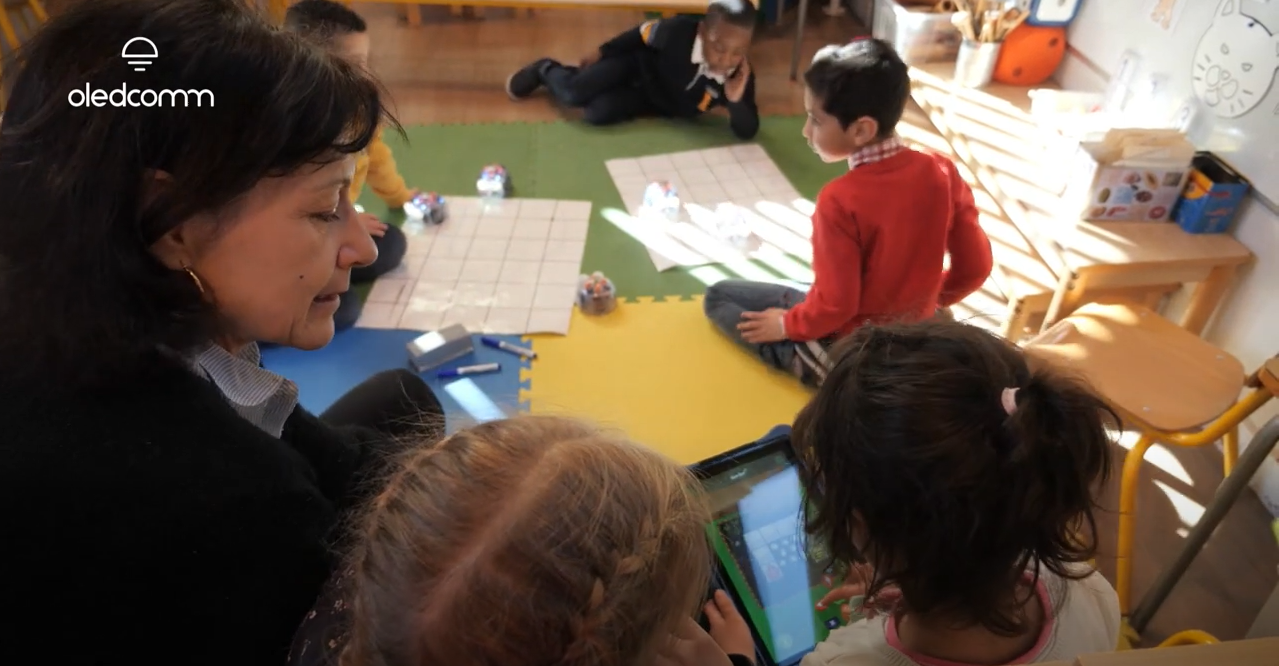
    Prof.Harald Haas: “I mean, it's many, many pilots, around 130 pilots. In the classroom, for example, enabled teaching, where it’s secure, it is sort of high data rate, it is very reliable, that providing very, very sort of robust, reliable communication, if you talk about WiFi at the moment, it's there, but it's very immediate service, the quality of service is not guaranteed, it's very sort of depends where you are if you're behind a wall or not. But with the LiFi, you can guarantee a very sort of steady and robust delivery of the service and guarantee a gigabit or 10 gigabit and not hope that maybe you know, 10% of the time you get your gigabits, it's really delivering that sort of robustness of quality of service, as well as providing the higher data rates.”


    Greg Ehrich: “Is it a classroom where all the students maybe have iPads or something?”

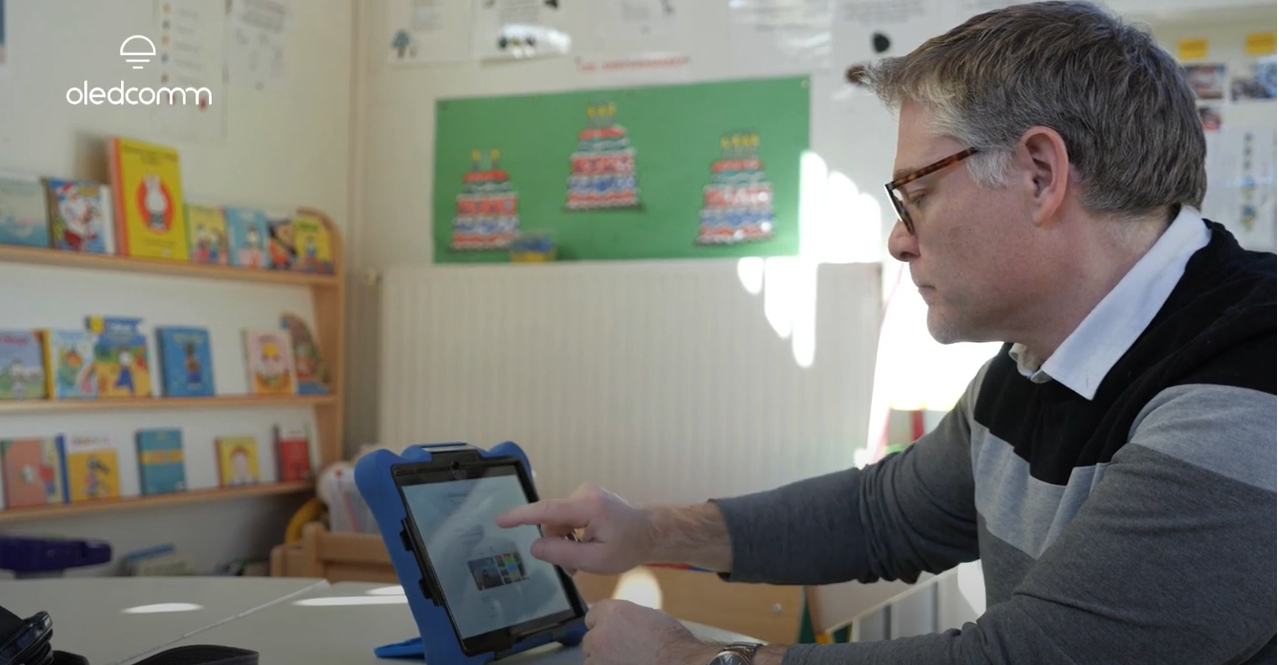
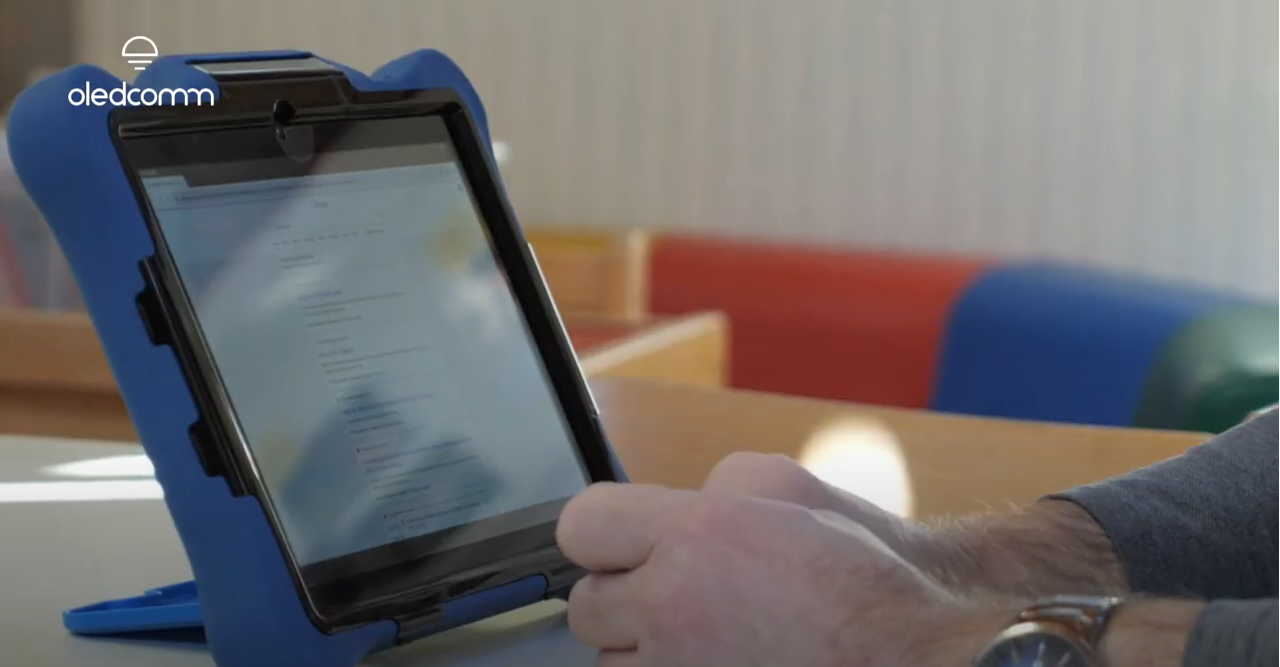
    Prof.Harald Haas: “It's a classroom with eight lights with LiFi access points. These laptops have a dongle, and they have a robust link, and they can move and they can turn around. And it's handover. And it's providing very, very high-speed communication in that classroom. And what we also have seen is that because that classroom and the pupils there won't occupy WiFi, the neighbouring classrooms saw a surge in the data rates that use WiFi still, because of the offloads of traffic from WiFi to LiFi. And that's an effect you always see people say, are you competing with WiFi? No, we don't. LiFi play helps provide better WiFi because of less contention.”


    Prof.Harald Haas: “You need to decode the ones and zeros. You need to have a detector.  Your eye takes a signal. But then you need to decode the fluctuations and decoded them as data.”

    Michael Colligan: “Any final predictions of the future make it crazy.”

    Prof.Harald Haas: “I think we will have LiFi in everything around us, at every table, in every chair, in every mall, in every mirror in every shoe and in every piece of cloth within the next 10 years.”


    Podcast Recording


    You can also listen to the podcast in full at the following link:


    Li-Fi Conference 2022


    The Li-Fi Conference 2022 Edition was a great success. Li Fi Tech News will very soon write articles on the topics treated at the Conference.

    What is LiFi?

    LiFi, also known as "Light Fidelity" is a wireless optical networking technology, which uses light-emitting diodes (LEDs) to transmit data. In 2011, professor Harald Haas made a LiFi demonstration at the TED (Technology, Entertainment, Design) Global Talk on Visible Light Communication (VLC).

    VLC uses light as a medium to deliver high-speed communication like Wi-Fi and complies with the IEEE standard IEEE 802.15.7. The IEEE 802.15.7 is a high-speed, bidirectional, and fully networked wireless communication technology-based standard similar to Wi-Fi's IEEE 802.11.

    How does LiFi work?

    LiFi is a high speed, bidirectional, and fully networked wireless communication of data using light. LiFi constitutes of several light bulbs that form a wireless network.

    When an electrical current goes through to a LED light bulb, a stream of light (photons) emits from the lamp. LED bulbs are semiconductor devices, which means that the brightness of the light flowing through them can change at extremely high speeds. The signal is sent by modulating the light at different rates. The signal can then be received by a detector that interprets the changes in light intensity (the signal) as data. Also when the LED is ON, you transmit a digital 1, and when it is OFF, you transmit a 0.

    LiFi Benefits

    The primary benefits of LiFi are as follows:

    Security: Provides entirely secure access. Where there is no light there is no data.

    Safety: Does not produce electromagnetic radiation and does not interfere with existing electronic systems.

    Localisation: Allows localisation due to the small coverage area of LiFi access point - localisation can be used for very precise asset tracking.

    Data density: Provides ubiquitous high-speed wireless access that offers substantially greater data density (data rate per unit area) than RF through high bandwidth reuse.

    Credit to Oledcomm

    LiFi Applications

    LiFi can be used for so many applications and the list is increasing every year. You can read our updated list of Li-Fi applications at the following link:

    https://www.lifitn.com/blog/2021/2/13/top-30-li-fi-applications-updated-list-including-potential-applications

    Credit to pureLiFi


    LiFi Systems Reviews by LiFi Tech News


    OLEDCOMM LIFIMAX KIT REVIEW - ONE YEAR IN

    We reviewed the LiFiMax kit produced by the leading French LiFi company Oledcomm. We bought this LiFi kit system at the end of 2020. After over a year of use, we decided to write a review of this LiFi system. We looked briefly at the profile of Oledcomm, a brief history of the LiFiMax system, the Kit box contents, some testing and performance results of this LiFi system, the customer experience and our own verdict (the good and the bad points) of the LiFiMax kit.

    You can read the review on this link:

    https://www.lifitn.com/blog/lifimaxreview


    SIGNIFY TRULIFI 6002.1 STARTER KIT SYSTEM REVIEW


    We also reviewed the Trulifi 6002.1 starter kit produced by Signify, the world leader in lighting for professionals, consumers and lighting for the Internet of Things. We got this LiFi kit system with the help of PCDSI and Signify around August 2021. In a similar fashion done with our previous review of the LiFiMax kit a few months ago, we will look briefly at the profile of Signify, a brief history of the Trulifi 6002.1 kit, the Kit box contents, some testing and performance results of this LiFi system, the customer experience and our own verdict (the good points and the bad points) of the Trulifi 6002.1 kit.

    You can read the review on this link:

    https://www.lifitn.com/blog/trulifi6002review


    In conclusion, if you are also interested to hear more information about the OWNII Coin, you can contact the OWNii Support team at info@ownii.net or use the contact form on the new OWNii website, ownii.net. If you are enquiring about LiFi devices such as the LiFiMax kits and the Trulifi kits, you can contact us through our chatbot or by sending an email through our contact us form. If you enjoyed this post and would like to hear more updates about LiFi technology, subscribe to our newsletter. Don’t forget to subscribe to our social media accounts. You can also join our Telegram group about LiFi technology on this link:

    https://t.me/joinchat/FMzOmsEKyJFrU6Af

    LiFi Rewind 2022 - A Look Back At The LiFi Technology News And Events That Occurred In 2022

    Table of Contents

      LiFi Rewind 2022 - A Look Back At The LiFi Technology News And Events That Occurred In 2022

      LiFi Rewind 2022

      As a yearly tradition at LiFi Tech News, we looked back at news and events in relation to LiFi technology that occurred throughout this year. 2022 was once again a year of great developments, achievements and advancements in LiFi technology. The following timeline displays the main events that took place in regard to LiFi.

      Kyocera SLD Laser, a developer of laser light sources, recently announced the development of the world’s fastest LiFi system, which delivers greater than 90 gigabits per second (Gbps)
      — January 2022
      Oledcomm Unveils The LIFIMAXTab, The World First LIFi Android Tablet
      — January 2022
      The Santa Maria delle Grazie hospital tested and install LiFi technology
      — January 2022
      Trialling Of LiFi Technology At The Museo Barracco De Escultura Antigua (Barracco Museum) In Rome
      — January 2022
      Lawrence Woodmere Academy Installs Signify Trulifi 6002 LED Infrared (IR) Transceivers
      — January 2022
      Net & You And The Conseil Départemental De l’Allier Demonstrated LiFi Technology At The Maison De Bellevue
      — February 2022
      pureLiFi Unveiled Their Next LiFi System For The Home At Mobile World Congress (MWC) in Barcelona
      — February 2022
      Oledcomm LIFIMax Kit Review by LiFi Tech News
      — February 2022
      Fraunhofer HHI Presented Their All Optical Fibre LiFi System At The Optical Networking and Communication Conference (OFC) 2022
      — March 2022
      Certification of The First G.hn Embedded Module for Industrial IoT By HomeGrid Forum With Teleconnect
      — March 2022
      L’école Communale D’Aubange Trialled LiFi Technology In Their Classrooms
      — April 2022
      Li-Fi Conference 2021 - Recap Series by LiFi Tech News
      — April 2022
      LiKEY LiFi System By LiNA
      — May 2022
      Signify Announced A Strategic Technology Partnership With Intelligent Waves, Award-Winning, Cyber-Defense Solution, GRAYPATH
      — May 2022
      The Mobile Internet Extranet LiFi Access (MIELA) System By PoE-Tic
      — May 2022
      Nadabet Gets Internet Powered By LiFi Technology From Ahmedabad-Based NAV Wireless Technologies Pvt Ltd
      — May 2022
      Li-Fi Conference 2022 Edition
      — June 2022
      Signify Trulifi 6002.1 Starter Kit System Review By LiFi Tech News
      — June 2022
      FlightPath3D and Latécoère Announced A Partnership To Supply 4K Plug and Play 3D Flight Map on Smart LiFi Monitor
      — June 2022
      Consolite Technology Introduces Military LiFi systems For Naval and Ground Forces Purposes
      — July 2022
      Signify Talked About The Use of LiFi To Deliver Wireless Data for XR at The AWE USA 2022
      — July 2022
      Twitter Space Podcast on LiFi Technology and Blockchain Technology
      — July 2022
      pureLiFi Secures £10 Million From The Scottish National Investment Bank
      — July 2022
      France Relance Aims To Put LiFi and Other Technologies and Services Based on Nanosatellites Into Orbit
      — August 2022
      Latest Linux Kernel Upgrade Release 5.19 Includes pureLiFi’s LiFi Drivers
      — August 2022
      LiFi MIMO Demonstration by ELIoT
      — September 2022
      Data Transmission via LiFi Between Two Computers at The École Polytechnique, D’Abomey-Calavi (EPAC) in Benin, Africa
      — September 2022
      ICLFT 2022: 16. International Conference on Li-Fi Technology
      — September 2022
      Presentation of a LiFi Project at the Olimpia Primary School in Montefano, Italy
      — September 2022
      Musa Unmehopa, Chair of the HomeGrid Forum LiFi Task Force, Shares His Highlights of The Li-Fi Conference 2022
      — September 2022
      Experimentation of a LiFi Prototype System For Data Transmission in Museums in Benin, West Africa
      — September 2022
      Oledcomm Made The Announcement of Appointing a Co-CEO, Pierre-Jean Beylier
      — September 2022
      Demonstration of LightBee’s LiFi Door Lock System With An Integrated LiFi transceiver by ELIoT H2020 Project
      — September 2022
      HomeGrid Forum Welcomes Oledcomm to Accelerate LiFi Interoperability With The Use of G.hn Backbone
      — October 2022
      pureLiFi is Picked as One of The UK’s Most Innovative and Pioneering Business by The WIRED Trailblazers in Partnership with HSBC UK
      — October 2022
      Nav Wireless Technologies LiFi Technology at The India Mobile Congress 2022
      — October 2022
      LEDs Magazine Interviews Oledcomm Co-CEOs On Their Shift to Sell LiFi Into The Defense, Aerospace And Airline Industries
      — October 2022
      5 sur 7 Matins Tv Programme Discusses LiFi Technology with Dr Fréjus Sanya and Anaïs Nassara in Benin, West Africa
      — October 2022
      Oledcomm Installs Their LiFi Systems in The First Nursery School, Chantefleur, in L’Isle-Adam, Paris
      — October 2022
      PoE-Tic and LiFi Solutions Presented The MIELA System at The EDUC Expo in Belgium
      — October 2022
      Nav Wireless Technologies Presented The LiFi Based Vehicle 2 Vehicle (V2C) Solution at The DEFEXPO 22, Gandhinagar
      — October 2022
      OLEDCOMM Awarded “Scaling Up” Prize at The EURONAVAL Exhibition 2022 Edition
      — October 2022
      Revisiting a Get A Grip Lighting Podcast on Quantum LiFi Technology With Special Guest Anthony Lawrence, CEO of Light Rider Inc
      — October 2022
      The Freie Waldorfschule am Prenzlauer Berg In Collaboration With Signify Installed Trulifi 6002 Systems In Classrooms
      — October 2022
      OPTICAL WIRELESS COMMUNICATION CONFERENCE 3rd Edition
      — November 2022
      OWNii Coin (LiFi Cryptocurrency) Updates And Highlights From A Recent OWNii Twitter Space Podcast
      — November 2022
      Installation of Li-Fi GigaDock® of Fraunhofer Institute for Photonic Microsystems IPMS On The ISS Space Station
      — November 2022
      Photonic Networks Experts Prof. Volker Jungnickel & Dr. Christoph Kottke Interviewed by InnoVisions on LiFi Technology
      — November 2022
      Radio 4 Brainport Podcast - Prof Jean-Paul Linnartz Interviewed Prof Harald Haas on Where Do We Stand in 2022 on LiFi and Optical Wireless Communications
      — November 2022
      Chantefleur, The First Nursery School in Paris Equipped with LiFi, Feedbacks Their Experience with Oledcomm LiFi system
      — November 2022
      OLEDCOMM Awarded The Silver Medal of The Grand Price of Innovation at The CYBERNIGHT Event in Paris
      — November 2022
      A paper based on the research, produced by Strathclyde’s Institute of Photonics and LiFi R&D Centre, has received the 2022 Best Paper Award from IEEE Photonics Technology Letters.
      — December 2022
      ELIoT (Enhance Lighting for the Internet of Things) H2020 Presents LiFi Solutions For The Mass Market
      — December 2022
      PoE-Tic Displayed and Demonstrated Their MIELA System at The Educ@tech Expo 2022 Edition in Paris, France
      — December 2022


      What is LiFi?


      LiFi, also known as "Light Fidelity" is a wireless optical networking technology, which uses light-emitting diodes (LEDs) to transmit data. In 2011, professor Harald Haas made a LiFi demonstration at the TED (Technology, Entertainment, Design) Global Talk on Visible Light Communication (VLC).

      VLC uses light as a medium to deliver high-speed communication like Wi-Fi and complies with the IEEE standard IEEE 802.15.7. The IEEE 802.15.7 is a high-speed, bidirectional, and fully networked wireless communication technology-based standard similar to Wi-Fi's IEEE 802.11.

      How does LiFi work?

      LiFi is a high speed, bidirectional, and fully networked wireless communication of data using light. LiFi constitutes of several light bulbs that form a wireless network.

      When an electrical current goes through to a LED light bulb, a stream of light (photons) emits from the lamp. LED bulbs are semiconductor devices, which means that the brightness of the light flowing through them can change at extremely high speeds. The signal is sent by modulating the light at different rates. The signal can then be received by a detector that interprets the changes in light intensity (the signal) as data. Also when the LED is ON, you transmit a digital 1, and when it is OFF, you transmit a 0.

      LiFi Benefits

      The primary benefits of LiFi are as follows:

      Security: Provides entirely secure access. Where there is no light there is no data.

      Safety: Does not produce electromagnetic radiation and does not interfere with existing electronic systems.

      Localisation: Allows localisation due to the small coverage area of LiFi access point - localisation can be used for very precise asset tracking.

      Data density: Provides ubiquitous high-speed wireless access that offers substantially greater data density (data rate per unit area) than RF through high bandwidth reuse.

      Credit to Oledcomm

      LiFi Applications

      LiFi can be used for so many applications and the list is increasing every year. You can read our updated list of Li-Fi applications at the following link:

      https://www.lifitn.com/blog/2021/2/13/top-30-li-fi-applications-updated-list-including-potential-applications

      Credit to pureLiFi

      In conclusion, if you are also interested to enquire about LiFi devices such as the LiFiMax and Trulifi, you can contact us through our chatbot or by sending an email through our contact us form. If you enjoyed this post and would like to hear more updates about LiFi technology, subscribe to our newsletter. Don’t forget to subscribe to our social media accounts. You can also join our Telegram group about LiFi technology at this link:

      https://t.me/joinchat/FMzOmsEKyJFrU6Af


      Comverde, The First Company in Peru To Offer Wireless Communication Services Through LiFi Technology

      Table of Contents

        Comverde, The First Company in Peru To Offer Wireless Communication Services Through LiFi Technology

        Comverde SAC


        About COMVERDE

        Comverde is a Peruvian service company that provides solutions to Smart Buildings. They have functional offices equipped with tools adapted to their activity. The company was founded in 2018.

        They have a flexible organisation oriented to the client needs and to the Smart Building sector. They have a quality commercial team to coordinate and develop consulting, engineering and service provider projects.

        Comverde is oriented toward the evolution of wireless technologies. We are currently focusing our activities on new opportunities, especially in the field of connected mobility (Smart Building, Smart Home, Smart Security, Smart Working, and Smart Retail, among others).

        They are the first company in Peru to offer wireless communication services through LiFi technology.

        Photo credit to Comverde

        Peru is a country in South America that's home to a section of the Amazon rainforest and Machu Picchu, an ancient Incan city high in the Andes mountains. The region around Machu Picchu, including the Sacred Valley, Inca Trail and the colonial city of Cusco, is rich in archaeological sites.

        MISSION STATEMENT AND VISION OF COMVERDE

        According to their website, the Mission of Comverde is to provide connectivity solutions in the different vertical sectors that guarantee lighting efficiency, comfort, and environmental support, contributing to the reduction of CO2 and generating great energy savings.

        Their Vision is to be one of the main and quality players in the communications sector, offering our clients the most complete range of intelligent solutions to meet their needs.

        Comverde provides wireless communication solutions using LiFi technology. This helps in boosting a network by improving upload and download speeds, stability, and security and creating radio waves-free environments.

        They also carry out comprehensive LED lighting and office automation projects, generating energy savings and gaining control of all the devices that are in your office from a single platform. They can also monitor, control and generate consumption reports. They create events for the autonomous operation of all your devices.

        Photo credit to Comverde


        COMVERDES SERVICES

        LIFI SERVICES

        LED technology is changing the way we light our spaces. The advantages that it brought with it, such as energy savings and the extension of the useful life of the luminaires, have been a great step in relation to previous lighting systems.


        LED lighting

        LED technology is changing the way we light our spaces. The advantages that it brought with it, such as energy savings and the extension of the useful life of the luminaires, have been a great step in relation to previous lighting systems.


        Automation

        Comverde designs projects to have control of all the devices of a company. Thanks to their sensors and interconnected devices you can achieve a great reduction in energy consumption.


        Smart Directories

        They provide services in

        • Audio control.

        • Control of curtains.

        • Temperature control – light control.

        • Control of various sources.

        • Control of videoconference systems.


        Smart classrooms

        An intelligent classroom is an educational solution that revolutionises the teaching-learning method, providing a unique experience, and dynamism in elite education.

        Comverde works very hard to develop Education Projects linked to all the services they provide for the advancement of educational technology in Peru.


        Municipality of Lima

        Comverde helped adapt to the wireless communication needs of the Innovation Center of the Municipality of Lima by installing LiFi in most of their offices. Based on the test reports carried out, we maintain a constant speed, bringing a stable and secure network to all environments.


        OLEDCOMM LIFI PRODUCTS

        Comverde is the sole authorised distributor of Oledcomm LiFi products in Peru. Comverde did a short demonstration of the LiFiMAX system. The video is in Spanish.


        Contact COMVERDE SAC


        Calle Bolívar 472 Office 1202 Bldg. Business Club. Miraflores – Lima, Peru

        Central Office Telephone (+51) 1 231 6838

        WhatsApp: Commercial Executives (+51) 975 176 125 (+51) 961 911 332

        Email soluciones@comverdesac.com

        Li-Fi Conference 2022

        The Li-Fi Conference 2022 Edition was a great success. Li Fi Tech News will very soon write articles on the topics treated at the Conference.

        What is LiFi?

        LiFi, also known as "Light Fidelity" is a wireless optical networking technology, which uses light-emitting diodes (LEDs) to transmit data. In 2011, professor Harald Haas made a LiFi demonstration at the TED (Technology, Entertainment, Design) Global Talk on Visible Light Communication (VLC).

        VLC uses light as a medium to deliver high-speed communication like Wi-Fi and complies with the IEEE standard IEEE 802.15.7. The IEEE 802.15.7 is a high-speed, bidirectional, and fully networked wireless communication technology-based standard similar to Wi-Fi's IEEE 802.11.

        How does LiFi work?

        LiFi is a high speed, bidirectional, and fully networked wireless communication of data using light. LiFi constitutes of several light bulbs that form a wireless network.

        When an electrical current goes through to a LED light bulb, a stream of light (photons) emits from the lamp. LED bulbs are semiconductor devices, which means that the brightness of the light flowing through them can change at extremely high speeds. The signal is sent by modulating the light at different rates. The signal can then be received by a detector that interprets the changes in light intensity (the signal) as data. Also when the LED is ON, you transmit a digital 1, and when it is OFF, you transmit a 0.

        LiFi Benefits

        The primary benefits of LiFi are as follows:

        Security: Provides entirely secure access. Where there is no light there is no data.

        Safety: Does not produce electromagnetic radiation and does not interfere with existing electronic systems.

        Localisation: Allows localisation due to the small coverage area of LiFi access point - localisation can be used for very precise asset tracking.

        Data density: Provides ubiquitous high-speed wireless access that offers substantially greater data density (data rate per unit area) than RF through high bandwidth reuse.

        Credit to Oledcomm

        LiFi Applications

        LiFi can be used for so many applications and the list is increasing every year. You can read our updated list of Li-Fi applications at the following link:

        https://www.lifitn.com/blog/2021/2/13/top-30-li-fi-applications-updated-list-including-potential-applications

        Credit to pureLiFi


        LiFi Systems Reviews by LiFi Tech News


        OLEDCOMM LIFIMAX KIT REVIEW - ONE YEAR IN

        We reviewed the LiFiMax kit produced by the leading French LiFi company Oledcomm. We bought this LiFi kit system at the end of 2020. After over a year of use, we decided to write a review of this LiFi system. We looked briefly at the profile of Oledcomm, a brief history of the LiFiMax system, the Kit box contents, some testing and performance results of this LiFi system, the customer experience and our own verdict (the good and the bad points) of the LiFiMax kit.

        You can read the review on this link:

        https://www.lifitn.com/blog/lifimaxreview


        SIGNIFY TRULIFI 6002.1 STARTER KIT SYSTEM REVIEW


        We also reviewed the Trulifi 6002.1 starter kit produced by Signify, the world leader in lighting for professionals, consumers and lighting for the Internet of Things. We got this LiFi kit system with the help of PCDSI and Signify around August 2021. In a similar fashion done with our previous review of the LiFiMax kit a few months ago, we will look briefly at the profile of Signify, a brief history of the Trulifi 6002.1 kit, the Kit box contents, some testing and performance results of this LiFi system, the customer experience and our own verdict (the good points and the bad points) of the Trulifi 6002.1 kit.

        You can read the review on this link:

        https://www.lifitn.com/blog/trulifi6002review


        In conclusion, if you are also interested to hear more information about the OWNII Coin, you can contact the OWNii Support team at info@ownii.net or use the contact form on the new OWNii website, ownii.net. If you are enquiring about LiFi devices such as the LiFiMax kits and the Trulifi kits, you can contact us through our chatbot or by sending an email through our contact us form. If you enjoyed this post and would like to hear more updates about LiFi technology, subscribe to our newsletter. Don’t forget to subscribe to our social media accounts. You can also join our Telegram group about LiFi technology on this link:

        https://t.me/joinchat/FMzOmsEKyJFrU6Af


        PoE-Tic Displayed and Demonstrated Their MIELA System at The Educ@tech Expo 2022 Edition in Paris, France

        Table of Contents

          PoE-Tic Displayed and Demonstrated Their MIELA System at The Educ@tech Expo 2022 Edition in Paris, France

          Photo credit to Compagnie Francaise Informatique (CFI) and PoE-Tic

          Educ@tech Exposition 2022 Edition


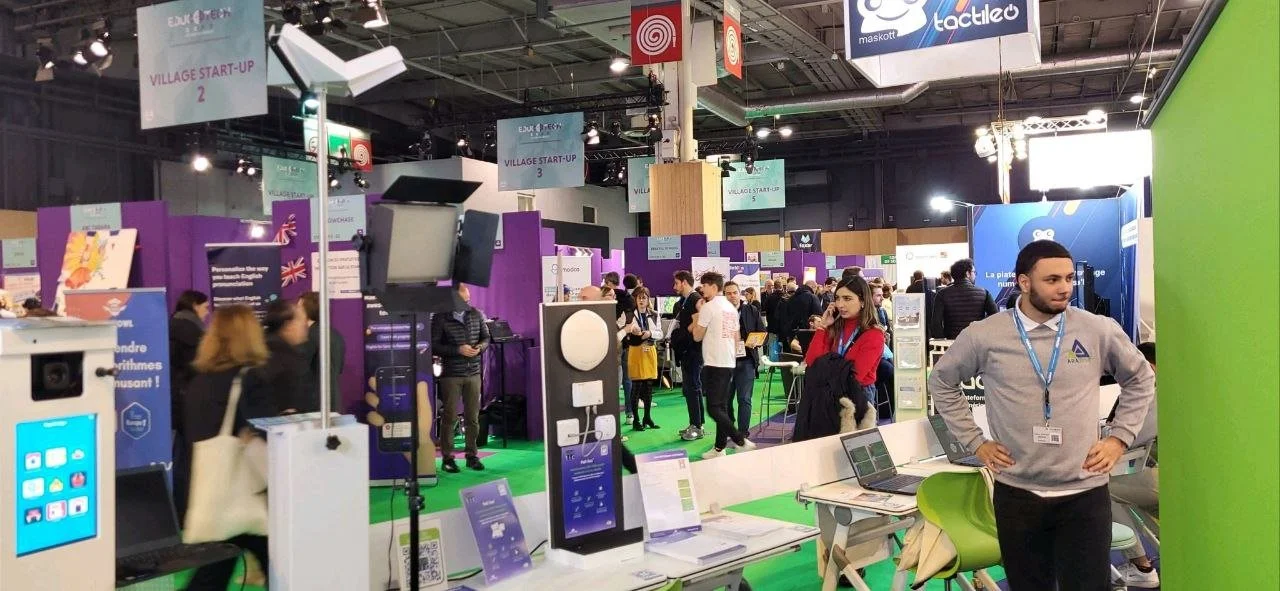
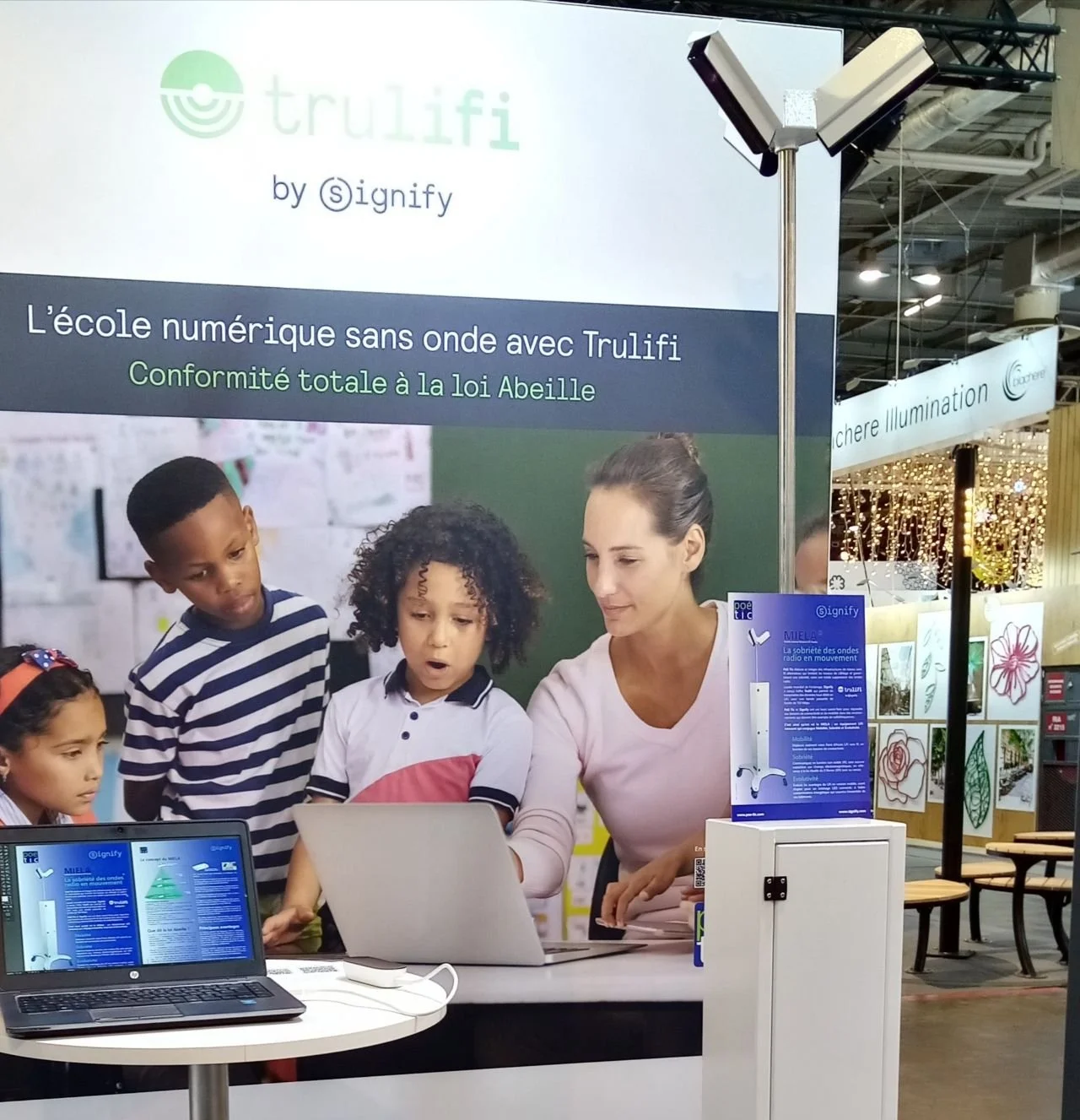
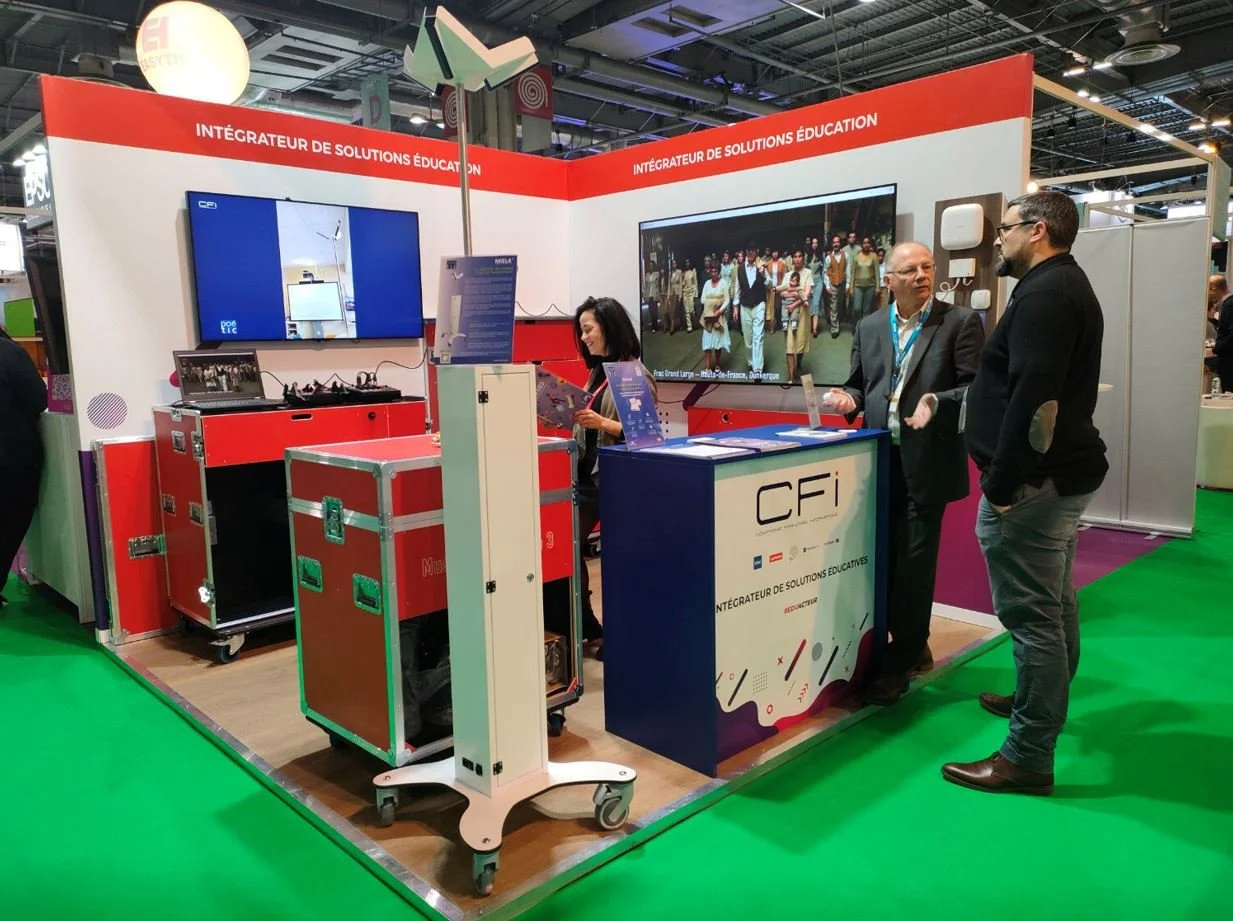
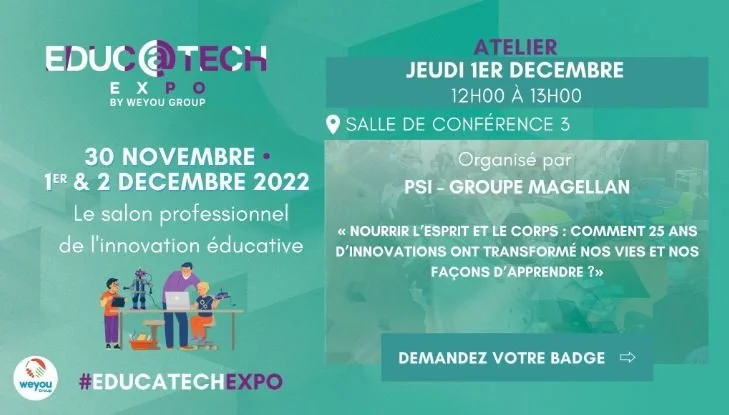
          PoE-Tic and CFI presented the MIELA at the recent Educ@tech Expo 2022 Edition in Porte de Versailles, Paris.

          The 2022 edition of Educ@tec Expo was held at Paris Expo Porte de Versailles, Paris between the 30th Nov to the 2nd Dec 2022. It was a 3-day event organised by WEYOU GROUP.

          For more than 25 years, Educatec-Educatice has established itself as the reference trade fair for discussing and building the future of education. Today, technology, multimedia and collaborative tools reign supreme. Each year, it brings together nearly 12,000 professionals around a major societal issue: the transformation of schools through digital and new technologies.

          Dominique LeBourse, CEO of PoE-Tic, said: “Thank you again for participating in the success of this conference and the success of this edition of Educatech Expo where we learned about many wireless infrastructure projects aimed at reducing exposure to radio waves and energy consumption.”

          Sylvain Leroux, Smart Buildings & Light Communications Marketing Director at Orange, commented the following: “Delighted with this conference in Educatech Expo where we were able to discuss connectivity in schools in the service of the educational project. During these fascinating exchanges, there was talk of pooling, hybridization, energy sobriety, the Bee law, IoT & connected buildings. Multiple complementary solutions are already available and depend on each use and each context. It was also an opportunity to see concrete and accessible solutions such as detachable Wi-Fi & LiFi.”


          Below are some photos taken by ARATICE:

          1 - MIELA Display - Photo credit to ARATICE and PoE-Tic

          2 - MIELA Display - Photo credit to ARATICE and PoE-Tic


          OLEDCOMM


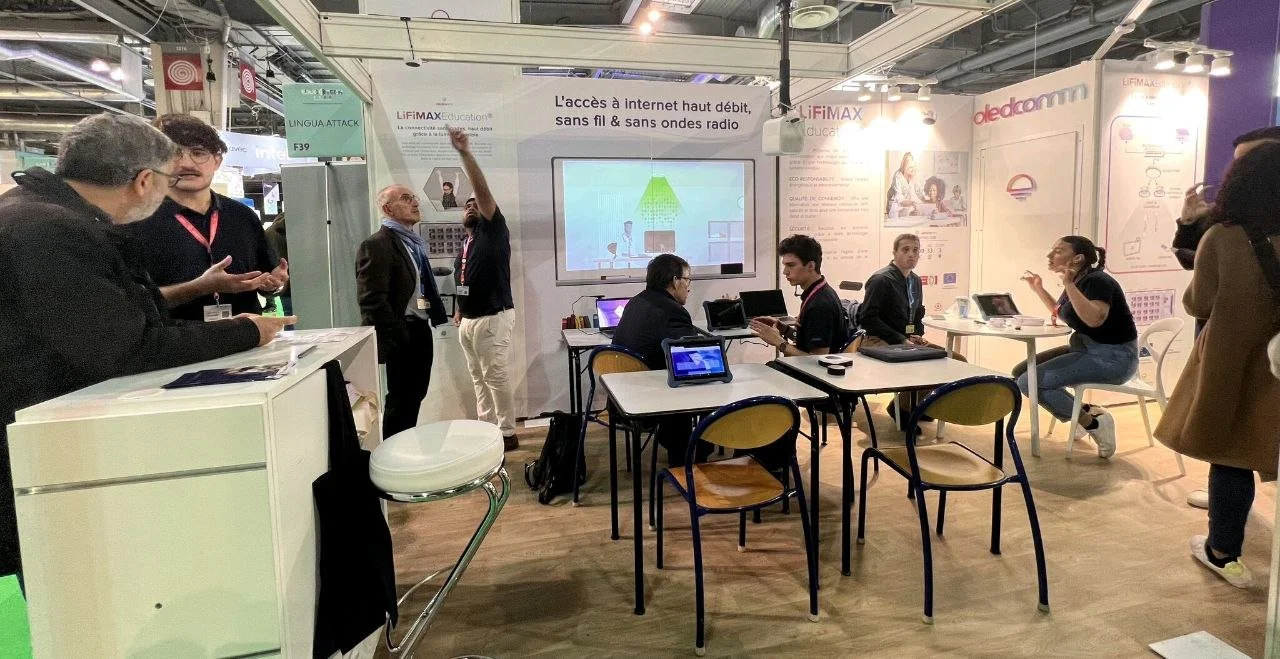
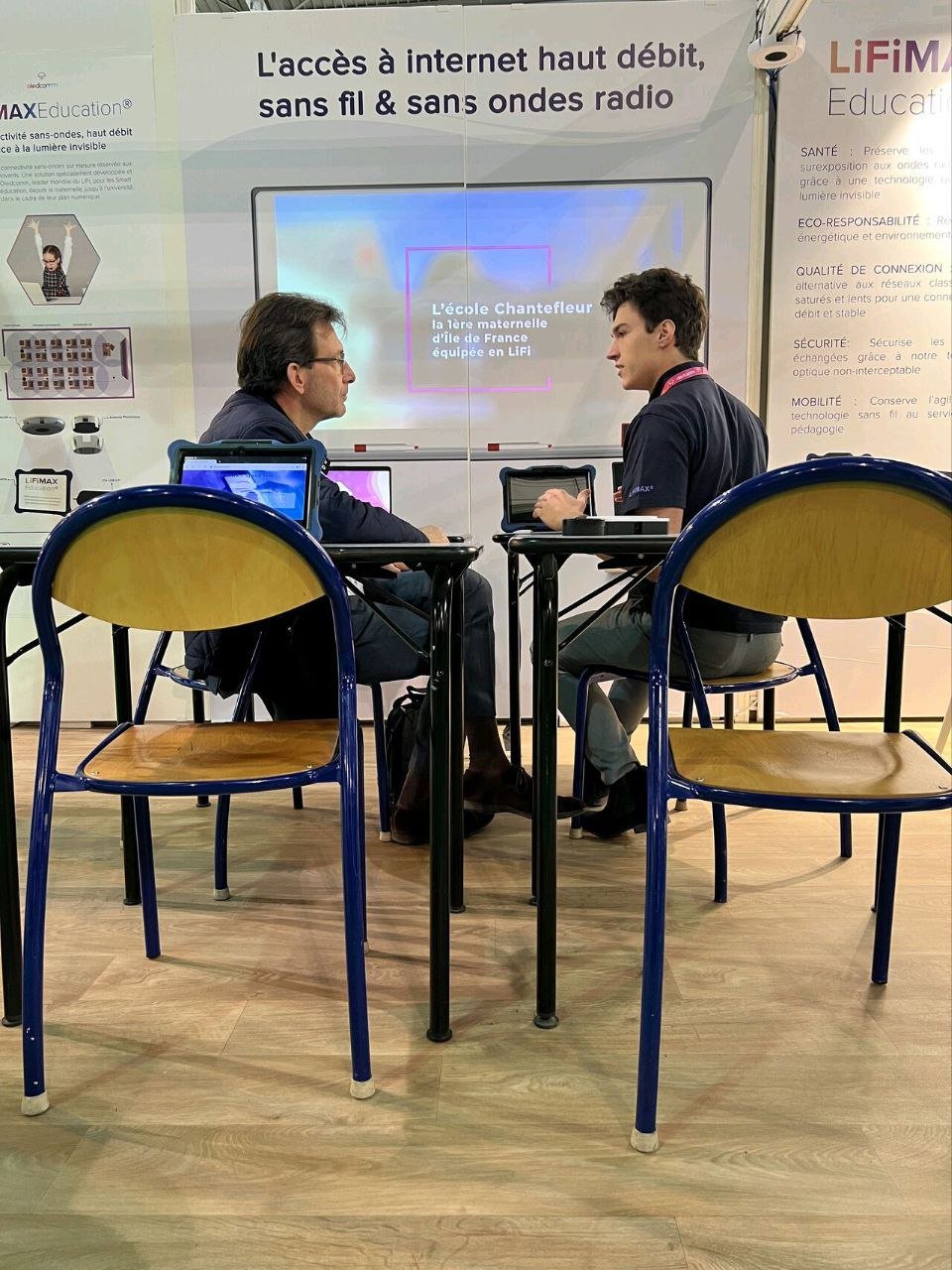
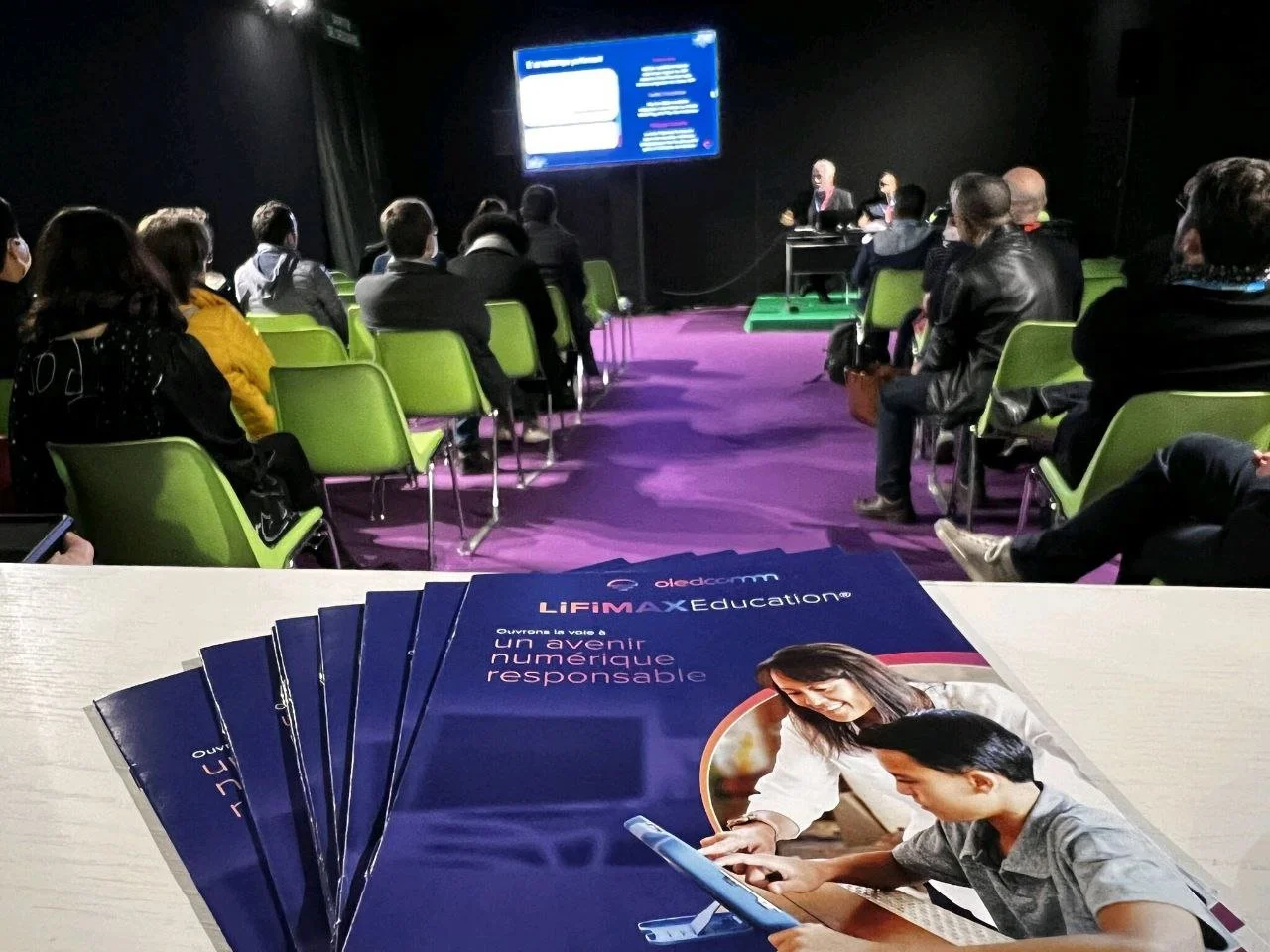
          Oledcomm was also in attendance as an exhibitor at the Educ@tech expo 2022 edition. They demonstrated to visitors their LiFi products, which include their LIFIMAX systems and LIFIMAX Tab.

          Photo credit to Oledcomm

          Photo credit to Oledcomm

          Photo credit to Oledcomm

          Oledcomm designs and develops LiFi network interface devices that enable high-speed wireless data communication. It also serves LiFi equipment in the telecom, datacom, personal electronics, and industrial markets. The company’s product portfolio includes hubs, routers, switches, adapters, drivers, power supplies, and more.

          Oledcomm was founded in 2012 and is based in Paris, France. Oledcomm's adventure began in 2005 in the research laboratories of the University of Versailles-Saint-Quentin with the first work on communication by visible light.

          Following years of research & development and a passion for innovation, Oledcomm became the pioneer of LiFi (Light Fidelity) solutions and innovation on a global scale.

          Based in the Paris region, Oledcomm employs around 20 people and designs complete solutions for LiFi operation, including microcontrollers, LiFi photoreceivers and software platforms.

          Today, after more than 28 patents, 15 years of R&D, over 500 trusted clients and several awards, Oledcomm is pursuing a strong mission: to transform the 14 billion points of light in the world into a powerful communication network.

          Educatech Expo Highlights

          The Educ@tech Expo ended in style with highlights and countless meetings between visitors and exhibitors.

          Here are a few highlights:

          • The visit of the Minister of National Education and Youth Mr. Pap Ndiaye

          • The learning workshop "molecular cuisine" with Michelin-starred chef Thierry Marx - Thierry Marx College

          • The meeting of the students of the Région Île-de-France with the Minister of Education, presentation of the stand by the high school students who participated in its design and realization.

          • The different initiations of digital professions with children

          • Innovation Hub workshops

          • The educational, digital and innovative solutions of the Village des startups

          • Conferences and workshops with experts who dealt with emblematic topics of digital education: inclusivity, equipping students and teachers, parity in the tech sector, improving working conditions, the environmental impact of digital technology and many other issues punctuated the debates.

          • PoE-Tic and Oledcomm were the LiFi representatives at the expo. The interest in LiFi in the Education sector in France has been growing.

          • And above all the super conviviality and ingenuity of all the exhibitors

          PoE-Tic

          PoE-Tic was founded in 2019. PoE-Tic offers its expertise in the implementation of alternative wireless infrastructures: BPL and BPL/LiFi (PoE-BPL and PoE-LiFi).

          Dominique Le Bourse is the CEO and Founder of Poe-Tic. He is also a LiFi expert and the Designer and Manufacturer of PoE-Sea and MIELA: both innovative devices to moderate or totally suppress the exposure of young pupils to radio waves.

          Dominique Le Bourse is an experienced Sales Manager with a demonstrated history of working in the information technology and services industry as well as skilled in Partner Relationship Management, Go-to-market Strategy, Management, Product Marketing.

          He is an expert in alternative networks such as CPL pro, BPL (Broadband over Power Lines), BPL/WiFi, BPL/LiFi and LiFi.

          MIELA System

          Photo credit to Dominique LE BOURSE

          The Mobile Internet LiFi Access (MIELA) is made by PoE-Tic in collaboration with Signify.


          THE SOBRIETY OF RADIO WAVES IN MOTION

          PoE-Tic develops and integrates alternative wireless network infrastructures that limit cabling work and guarantee sobriety or even total suppression of radio waves.

          World leader in lighting, Signify has designed the Trulifi offer which allows transmitting high-speed data LiFi, with a bandwidth of around 150 Mbps.

          PoE-Tic and Signify have combined their know-how to meet connectivity and mobility needs in environments that must be free of radio frequencies. This is how the MIELA was born; innovative LiFi equipment that combines Mobility, Sobriety and Scalability.

          Mobility: Easily move your wireless LiFi Access Point, depending on your connectivity needs.

          Sobriety: Communicate in non-visible light (IR), without any exposure to electromagnetic fields, in reference to the Bee law of February 9, 2015.

          Scalability: Evaluate the advantages of LiFi in a mobile version, before opting for connected, low-energy LED lighting that will cover all of your buildings.


          THE CONCEPT OF MIELA

          Photo credit to Dominique LE BOURSE

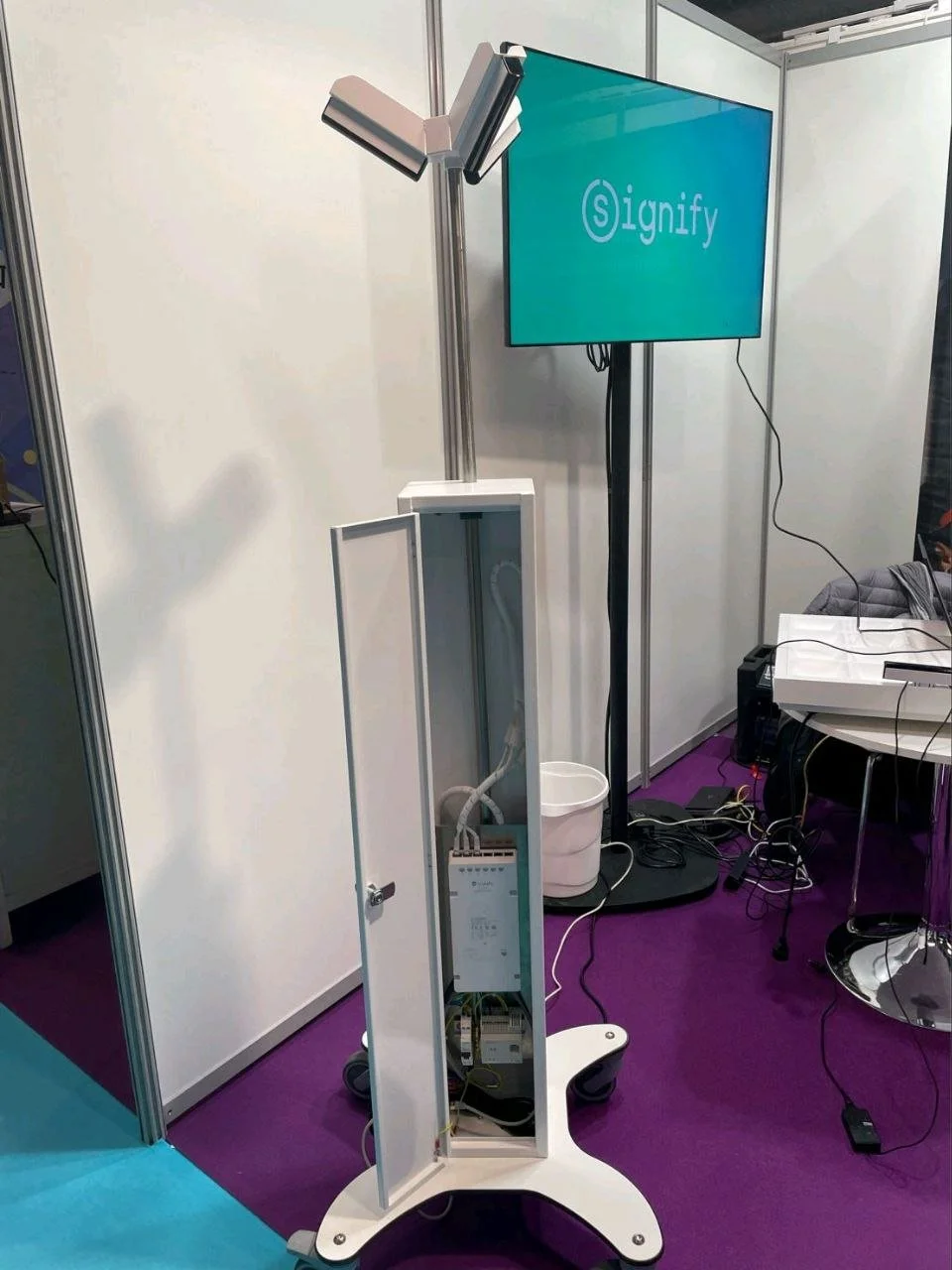
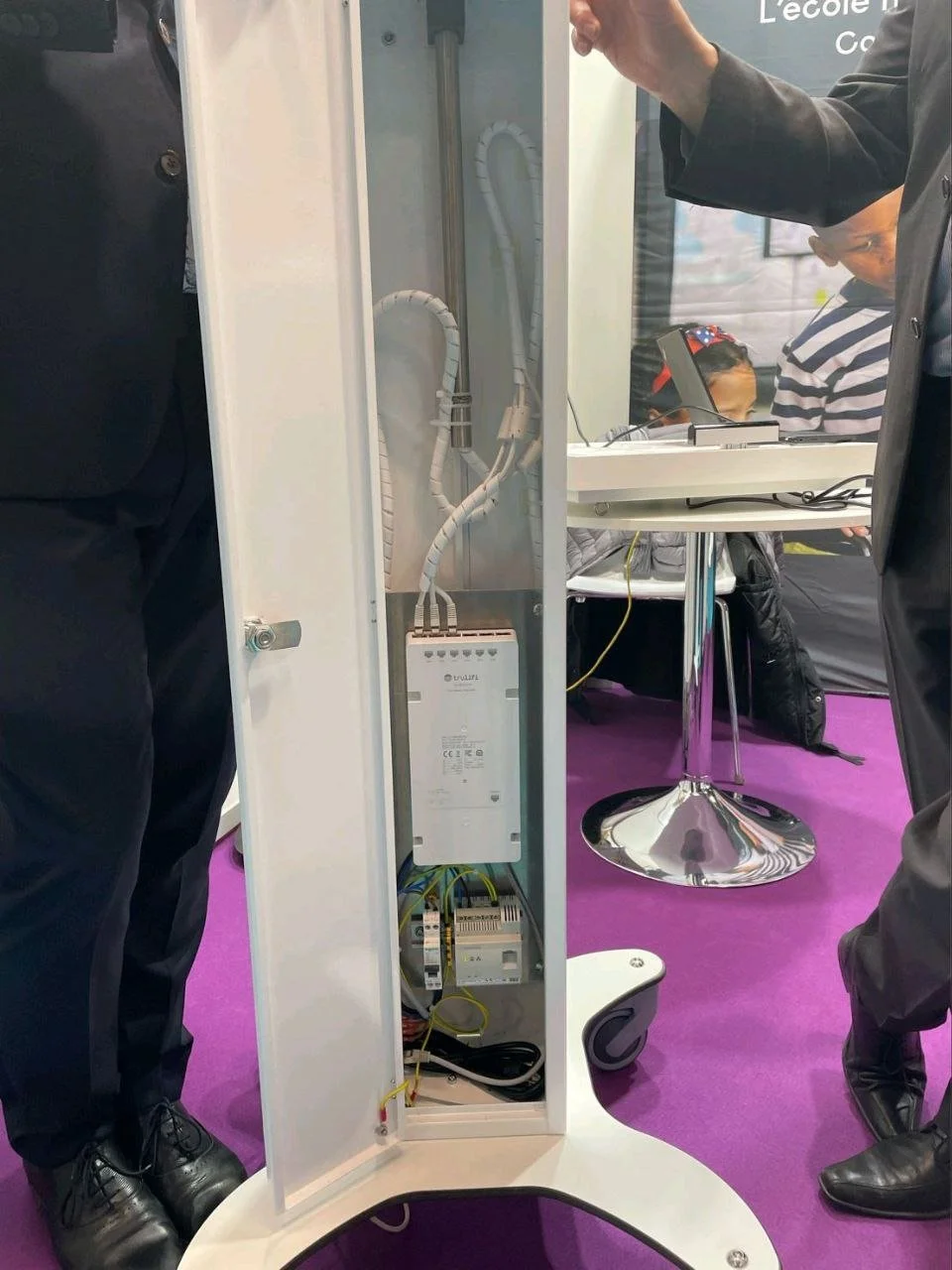
          An Access Point is embedded inside the MIELA.

          Three transceivers are placed at the top of the device which communicate with the USB keys connected to each workstation.

          The Access Point is interconnected to the local wired network (RJ45) or via a Power Line Carrier (CPL) terminal supplied as an option.

          The MIELA is height adjustable from 1.40 to 2.50 m to make it easier to pass through doors.

          Once fully deployed, the MIELA covers an area of about twenty m² in which a maximum of sixteen users can share the high-speed LiFi connection. An optimal speed of 150/140 Mbps is obtained at 1.20 m from the USB key when the MIELA is set at 1.80 m from the ground; with a 60 cm worktop.

          MIELA TECHNICAL CHARACTERISTICS

          Photo credit to Dominique LE BOURSE

          Trulifi configuration (starter kit): an Access Point, three transceivers and a USB key.

          The number of connections per MIELA: a maximum of 16 Trulifi 6002 USB sticks can be managed by one Access Point.

          Electrical protection: chassis electrical socket with switch + 16 A circuit breaker.

          Wired network connection: RJ45 frame F/F socket.

          Height (min/max): 1.40 / 2.50 m.

          Dimensions of the mobile base: 55 x 55 cm

          Wheels Type: Four Ø 95 mm wheels, two of which are fitted with a brake.

          Total weight: 24 kg.

          PLC configuration (optional): a Dinrail G.hn or HPAV2 module.


          MAIN ADVANTAGES

          As stated by Dominique Le Bourse, the MIELA makes it possible to have a LiFi wireless connection as close as possible to the users, without the need to carry out costly and tedious preliminary work. In addition, compatibility with PLC allows the MIELA to have broadband access to all power outlets, without any additional wiring.

          Thanks to MIELA, nurseries, neighbourhood centres, kindergartens and maternity rooms now have a wireless connection that fully complies with legislation.

          Thus, whether for budgetary or health reasons or simply as a precautionary principle, the MIELA is a major asset for adopting LiFi technology without delay.


          MIELA DATASHEET IN ENGLISH

          https://poe-tic.com/wp-content/uploads/2022/08/Plaquette-MIELA_en_v2.1.pdf

          POE-TIC CONTACT DETAILS

          If you are interested in getting more information about their products or purchasing any of their products, you can contact Poe-Tic on the following details:

          Phone: +33 7 64 75 30 28

          Email: info@poe-tic.com

          Address: SAS PoE-Tic | 6, Rue du Bois Sauvage 91000 EVRY-COURCOURONNES

          Li-Fi Conference 2022

          The Li-Fi Conference 2022 Edition was a great success. Li Fi Tech News will very soon write articles on the topics treated at the Conference.

          What is LiFi?

          LiFi, also known as "Light Fidelity" is a wireless optical networking technology, which uses light-emitting diodes (LEDs) to transmit data. In 2011, professor Harald Haas made a LiFi demonstration at the TED (Technology, Entertainment, Design) Global Talk on Visible Light Communication (VLC).

          VLC uses light as a medium to deliver high-speed communication like Wi-Fi and complies with the IEEE standard IEEE 802.15.7. The IEEE 802.15.7 is a high-speed, bidirectional, and fully networked wireless communication technology-based standard similar to Wi-Fi's IEEE 802.11.

          How does LiFi work?

          LiFi is a high speed, bidirectional, and fully networked wireless communication of data using light. LiFi constitutes of several light bulbs that form a wireless network.

          When an electrical current goes through to a LED light bulb, a stream of light (photons) emits from the lamp. LED bulbs are semiconductor devices, which means that the brightness of the light flowing through them can change at extremely high speeds. The signal is sent by modulating the light at different rates. The signal can then be received by a detector that interprets the changes in light intensity (the signal) as data. Also when the LED is ON, you transmit a digital 1, and when it is OFF, you transmit a 0.

          LiFi Benefits

          The primary benefits of LiFi are as follows:

          Security: Provides entirely secure access. Where there is no light there is no data.

          Safety: Does not produce electromagnetic radiation and does not interfere with existing electronic systems.

          Localisation: Allows localisation due to the small coverage area of LiFi access point - localisation can be used for very precise asset tracking.

          Data density: Provides ubiquitous high-speed wireless access that offers substantially greater data density (data rate per unit area) than RF through high bandwidth reuse.

          Credit to Oledcomm

          LiFi Applications

          LiFi can be used for so many applications and the list is increasing every year. You can read our updated list of Li-Fi applications at the following link:

          https://www.lifitn.com/blog/2021/2/13/top-30-li-fi-applications-updated-list-including-potential-applications

          Credit to pureLiFi


          LiFi Systems Reviews by LiFi Tech News


          OLEDCOMM LIFIMAX KIT REVIEW - ONE YEAR IN

          We reviewed the LiFiMax kit produced by the leading French LiFi company Oledcomm. We bought this LiFi kit system at the end of 2020. After over a year of use, we decided to write a review of this LiFi system. We looked briefly at the profile of Oledcomm, a brief history of the LiFiMax system, the Kit box contents, some testing and performance results of this LiFi system, the customer experience and our own verdict (the good and the bad points) of the LiFiMax kit.

          You can read the review on this link:

          https://www.lifitn.com/blog/lifimaxreview


          SIGNIFY TRULIFI 6002.1 STARTER KIT SYSTEM REVIEW


          We also reviewed the Trulifi 6002.1 starter kit produced by Signify, the world leader in lighting for professionals, consumers and lighting for the Internet of Things. We got this LiFi kit system with the help of PCDSI and Signify around August 2021. In a similar fashion done with our previous review of the LiFiMax kit a few months ago, we will look briefly at the profile of Signify, a brief history of the Trulifi 6002.1 kit, the Kit box contents, some testing and performance results of this LiFi system, the customer experience and our own verdict (the good points and the bad points) of the Trulifi 6002.1 kit.

          You can read the review on this link:

          https://www.lifitn.com/blog/trulifi6002review


          In conclusion, if you are also interested to hear more information about the OWNII Coin, you can contact the OWNii Support team at info@ownii.net or use the contact form on the new OWNii website, ownii.net. If you are enquiring about LiFi devices such as the LiFiMax kits and the Trulifi kits, you can contact us through our chatbot or by sending an email through our contact us form. If you enjoyed this post and would like to hear more updates about LiFi technology, subscribe to our newsletter. Don’t forget to subscribe to our social media accounts. You can also join our Telegram group about LiFi technology on this link:

          https://t.me/joinchat/FMzOmsEKyJFrU6Af

          ELIoT (Enhance Lighting for the Internet of Things) H2020 Presents LiFi Solutions For The Mass Market

          Table of Contents


            ELIoT (Enhance Lighting for the Internet of Things) H2020 Presents LiFi Solutions For The Mass Market

            The Fraunhofer HHI announced on their website the completion of the ELiOT project. The coordination of this project was done by the Fraunhofer Heinrich Hertz Institute (HHI). The consortium has developed LiFi solutions for the mass market since 2019, enabling wireless data transmission via light in the Internet of Things (IoT). To conclude the project, the researchers demonstrated a new LiFi infrastructure in real-world application scenarios and presented a roadmap for LiFi in the future IoT.

            To make LiFi commercially viable, the ELIoT consortium has researched core aspects and new functionalities of the LiFi infrastructure. These include precise position detection (positioning), wireless networking between multiple transmitters and multiple receivers (multicast communication), and increased security standards. ELIoT has developed and implemented these features and demonstrated them in real-world application scenarios. The final EU project report firmly stated that ELIoT delivered "exceptional results with significant immediate or potential impact."

            Achievements of the ELIoT project


            The consortium demonstrated the use of LiFi for positioning in the industrial sector, where the focus was particularly on integrating positioning and communication in one unified system. LiFi makes localization much more accurate than was previously possible with radio technologies. Additionally, the integration of LiFi and 5G was also demonstrated in an industrial environment. Such systems combine the advantages of radio solutions, such as high mobility, with the high capacities of LiFi.

            Furthermore, ELIoT has optimised the use of LiFi infrastructures in office environments, addressing the core challenges of the modern workplace. Distributed LiFi MIMO bypasses the data congestion issues of traditional networks and provides improved data protection.

            In the ELIoT demo on fixed wireless access, the researchers also presented a pioneering solution for the last mile of optical network connectivity. In the outdoor area, one possible scenario in the future would be point-to-point connections with high bandwidth from roofs to small radio base stations, between street lamps or to private homes (wireless-to-the-home).

            Mobile authentication is becoming increasingly important not only in industrial but also in private settings. With the help of LiFi, the ELIoT researchers demonstrated an energy-saving LiFi-enabled door lock that can be easily integrated into existing LiFi infrastructures. The lock has an integrated LiFi transceiver that enables secure key exchange with a server on the network. Using LiFi, the key's code can now also be renewed more securely than before via WLAN.

            Finally, ELIoT has been able to significantly reduce the load on wireless networks in the context of digital signage in shopping malls by using LiFi to transmit video to displays in real time.

            ELIOT also improved the manageability of LiFi modules, i.e. their installation and maintenance. LiFi networks use a central module to transport the data signals to several distributed LiFi modules. The researchers in the ELIoT project discovered a more robust and manageable solution for data transport: Plastic Optical Fibers (POF). Different LiFi modules are accessed with different colors of light, which transmit the data simultaneously over the same fiber. This means that one thin plastic fiber can replace a whole bundle of cables, reducing installation costs.

            In addition, the researchers successfully provided an open reference architecture to support the IoT using the existing lighting infrastructure. The architecture is very flexible and can cover a wide variety of applications, which together cover the future mass market. The consortium reached a consensus on the optimal architecture. The milestones in the project contributed significantly to the standardization of lighting and telecommunication infrastructures in ITU-T G.9991, IEEE P 802.15.13 and P802.11bb, and they form the basis of the roadmap for the deployment of LiFi in IoT.

            Partners in this EU project were Signify (formerly Philips Lighting), Nokia, MaxLinear, Deutsche Telekom, KPN, Weidmüller, LightBee, as well as Oxford University, Eindhoven University of Technology and Fraunhofer Institutes HHI and FOKUS.

            Article source:

            https://newsletter.fraunhofer.de/viewonline2/17386/713/1/14SHcBTt/UZjW6ZSTbF/1


            ELIoT H2020 Project

            As stated on their website, ELIoT is an EU Horizon 2020 project. It is led by the Fraunhofer Heinrich Hertz Institute. The central aim of the project is the development of mass-market Internet of Things (IoT) solutions using LiFi, a next-generation wireless communication network, that travels over light instead of radio waves. With LiFi, the ELIoT consortium will explore a networked wireless communication technology operating in the previously unused light spectrum, besides WiFi and cellular radio.

            ELIoT has started in 2019 as a project funded by the EU’s biggest Research and Innovation programme, Horizon 2020. This programme promises more breakthroughs by taking great ideas from lab to the market. ELIoT receives €6 million funding from the Public-Private Partnership ‘Photonics21’ and is formed by the partners Signify (formerly Philips Lighting), Nokia, MaxLinear, Deutsche Telekom, KPN, Weidmüller, LightBee, the University of Oxford, Eindhoven Technical University and the two Fraunhofer Institutes; Heinrich Hertz Institute and FOKUS. Even more, companies will shortly be added to the consortium as associated partners.

            Fraunhofer HHI

            The Fraunhofer , Heinrich Hertz Institute, HHI, also known as Fraunhofer HHI or Fraunhofer Heinrich Hertz Institute, is an organisation of the Fraunhofer Society based in Berlin. The institute engages in applied research and development in the fields of physics, electrical engineering and computer sciences.

            The Fraunhofer Heinrich Hertz Institute develops mobile and stationary broadband communication networks and multimedia systems. Focal points of independent and contract research conducted by Fraunhofer HHI are photonic components and systems, fiber optic sensor systems, and image signal processing and transmission. Future applications for broadband networks are developed as well. Research in this area focuses on 3D displays, UHD panorama video production, human-machine interaction through gesture control, optical satellite communication and data transmission technologies such as visible light communications.

            Li-Fi Conference 2022

            The Li-Fi Conference 2022 Edition was a great success. Li Fi Tech News will very soon write articles on the topics treated at the Conference.

            What is LiFi?

            LiFi, also known as "Light Fidelity" is a wireless optical networking technology, which uses light-emitting diodes (LEDs) to transmit data. In 2011, professor Harald Haas made a LiFi demonstration at the TED (Technology, Entertainment, Design) Global Talk on Visible Light Communication (VLC).

            VLC uses light as a medium to deliver high-speed communication like Wi-Fi and complies with the IEEE standard IEEE 802.15.7. The IEEE 802.15.7 is a high-speed, bidirectional, and fully networked wireless communication technology-based standard similar to Wi-Fi's IEEE 802.11.

            How does LiFi work?

            LiFi is a high speed, bidirectional, and fully networked wireless communication of data using light. LiFi constitutes of several light bulbs that form a wireless network.

            When an electrical current goes through to a LED light bulb, a stream of light (photons) emits from the lamp. LED bulbs are semiconductor devices, which means that the brightness of the light flowing through them can change at extremely high speeds. The signal is sent by modulating the light at different rates. The signal can then be received by a detector that interprets the changes in light intensity (the signal) as data. Also when the LED is ON, you transmit a digital 1, and when it is OFF, you transmit a 0.

            LiFi Benefits

            The primary benefits of LiFi are as follows:

            Security: Provides entirely secure access. Where there is no light there is no data.

            Safety: Does not produce electromagnetic radiation and does not interfere with existing electronic systems.

            Localisation: Allows localisation due to the small coverage area of LiFi access point - localisation can be used for very precise asset tracking.

            Data density: Provides ubiquitous high-speed wireless access that offers substantially greater data density (data rate per unit area) than RF through high bandwidth reuse.

            Credit to Oledcomm

            LiFi Applications

            LiFi can be used for so many applications and the list is increasing every year. You can read our updated list of Li-Fi applications at the following link:

            https://www.lifitn.com/blog/2021/2/13/top-30-li-fi-applications-updated-list-including-potential-applications

            Credit to pureLiFi


            LiFi Systems Reviews by LiFi Tech News


            OLEDCOMM LIFIMAX KIT REVIEW - ONE YEAR IN

            We reviewed the LiFiMax kit produced by the leading French LiFi company Oledcomm. We bought this LiFi kit system at the end of 2020. After over a year of use, we decided to write a review of this LiFi system. We looked briefly at the profile of Oledcomm, a brief history of the LiFiMax system, the Kit box contents, some testing and performance results of this LiFi system, the customer experience and our own verdict (the good and the bad points) of the LiFiMax kit.

            You can read the review on this link:

            https://www.lifitn.com/blog/lifimaxreview


            SIGNIFY TRULIFI 6002.1 STARTER KIT SYSTEM REVIEW


            We also reviewed the Trulifi 6002.1 starter kit produced by Signify, the world leader in lighting for professionals, consumers and lighting for the Internet of Things. We got this LiFi kit system with the help of PCDSI and Signify around August 2021. In a similar fashion done with our previous review of the LiFiMax kit a few months ago, we will look briefly at the profile of Signify, a brief history of the Trulifi 6002.1 kit, the Kit box contents, some testing and performance results of this LiFi system, the customer experience and our own verdict (the good points and the bad points) of the Trulifi 6002.1 kit.

            You can read the review on this link:

            https://www.lifitn.com/blog/trulifi6002review


            In conclusion, if you are also interested to hear more information about the OWNII Coin, you can contact the OWNii Support team at info@ownii.net or use the contact form on the new OWNii website, ownii.net. If you are enquiring about LiFi devices such as the LiFiMax kits and the Trulifi kits, you can contact us through our chatbot or by sending an email through our contact us form. If you enjoyed this post and would like to hear more updates about LiFi technology, subscribe to our newsletter. Don’t forget to subscribe to our social media accounts. You can also join our Telegram group about LiFi technology on this link:
            https://t.me/joinchat/FMzOmsEKyJFrU6Af

            OLEDCOMM Awarded The Silver Medal of The Grand Price of Innovation at The CYBERNIGHT Event in Paris

            Table of Contents


              OLEDCOMM Awarded The Silver Medal of The Grand Price of Innovation at The CYBERNIGHT Event in Paris

              EURONAVAL Exhibition 2022 edition

              Photo credit to Jean-Claude Guyard

              CYBER NIGHT, the Night of Cybersecurity, for its second edition brought together more than 800 professionals to celebrate the most beautiful innovations in four categories. The ceremony took place in one of the most beautiful theatres in Paris. Each nominated candidate participated in a grand oral in front of a jury of expert personalities from the world of Cyber ​​a few weeks before the evening.

              CYBER NIGHT 2022 is a unique event that has nothing to do with most awards ceremonies that exist. It's two hours show carried out at a steady pace with multiple testimonies on stage but also in the room thanks to a network of agile cameras broadcasting everything on the big screen.

              ​The CYBER DIRECTORATES highlighted their achievements, but also their teams and their innovations. SERVICE PROVIDERS were able to apply or become a sponsor, participate in the jury and present on stage their companies, services, products, etc...

              Oledcomm was among the 2022 candidates and won the Silver medal for the Grand Price of Innovation. A big CONGRATULATION to Oledcomm for this well-deserved achievement.

              OLEDCOMM

              Oledcomm designs and develops LiFi network interface devices that enable high-speed wireless data communication. It also serves LiFi equipment in the telecom, datacom, personal electronics, and industrial markets. The company’s product portfolio includes hubs, routers, switches, adapters, drivers, power supplies, and more.

              Oledcomm was founded in 2012 and is based in Paris, France. Oledcomm's adventure began in 2005 in the research laboratories of the University of Versailles-Saint-Quentin with the first work on communication by visible light.

              Following years of research & development and a passion for innovation, Oledcomm became the pioneer of LiFi (Light Fidelity) solutions and innovation on a global scale.

              Based in the Paris region, Oledcomm employs around 20 people and designs complete solutions for LiFi operation, including microcontrollers, LiFi photoreceivers and software platforms.

              Today, after more than 28 patents, 15 years of R&D, over 500 trusted clients and several awards, Oledcomm is pursuing a strong mission: to transform the 14 billion points of light in the world into a powerful communication network.


              Li-Fi Conference 2022

              The Li-Fi Conference 2022 Edition was a great success. Li Fi Tech News will very soon write articles on the topics treated at the Conference.

              What is LiFi?

              LiFi, also known as "Light Fidelity" is a wireless optical networking technology, which uses light-emitting diodes (LEDs) to transmit data. In 2011, professor Harald Haas made a LiFi demonstration at the TED (Technology, Entertainment, Design) Global Talk on Visible Light Communication (VLC).

              VLC uses light as a medium to deliver high-speed communication like Wi-Fi and complies with the IEEE standard IEEE 802.15.7. The IEEE 802.15.7 is a high-speed, bidirectional, and fully networked wireless communication technology-based standard similar to Wi-Fi's IEEE 802.11.

              How does LiFi work?

              LiFi is a high speed, bidirectional, and fully networked wireless communication of data using light. LiFi constitutes of several light bulbs that form a wireless network.

              When an electrical current goes through to a LED light bulb, a stream of light (photons) emits from the lamp. LED bulbs are semiconductor devices, which means that the brightness of the light flowing through them can change at extremely high speeds. The signal is sent by modulating the light at different rates. The signal can then be received by a detector that interprets the changes in light intensity (the signal) as data. Also when the LED is ON, you transmit a digital 1, and when it is OFF, you transmit a 0.

              LiFi Benefits

              The primary benefits of LiFi are as follows:

              Security: Provides entirely secure access. Where there is no light there is no data.

              Safety: Does not produce electromagnetic radiation and does not interfere with existing electronic systems.

              Localisation: Allows localisation due to the small coverage area of LiFi access point - localisation can be used for very precise asset tracking.

              Data density: Provides ubiquitous high-speed wireless access that offers substantially greater data density (data rate per unit area) than RF through high bandwidth reuse.

              Credit to Oledcomm

              LiFi Applications

              LiFi can be used for so many applications and the list is increasing every year. You can read our updated list of Li-Fi applications at the following link:

              https://www.lifitn.com/blog/2021/2/13/top-30-li-fi-applications-updated-list-including-potential-applications

              Credit to pureLiFi


              LiFi Systems Reviews by LiFi Tech News


              OLEDCOMM LIFIMAX KIT REVIEW - ONE YEAR IN

              We reviewed the LiFiMax kit produced by the leading French LiFi company Oledcomm. We bought this LiFi kit system at the end of 2020. After over a year of use, we decided to write a review of this LiFi system. We looked briefly at the profile of Oledcomm, a brief history of the LiFiMax system, the Kit box contents, some testing and performance results of this LiFi system, the customer experience and our own verdict (the good and the bad points) of the LiFiMax kit.

              You can read the review on this link:

              https://www.lifitn.com/blog/lifimaxreview


              SIGNIFY TRULIFI 6002.1 STARTER KIT SYSTEM REVIEW


              We also reviewed the Trulifi 6002.1 starter kit produced by Signify, the world leader in lighting for professionals, consumers and lighting for the Internet of Things. We got this LiFi kit system with the help of PCDSI and Signify around August 2021. In a similar fashion done with our previous review of the LiFiMax kit a few months ago, we will look briefly at the profile of Signify, a brief history of the Trulifi 6002.1 kit, the Kit box contents, some testing and performance results of this LiFi system, the customer experience and our own verdict (the good points and the bad points) of the Trulifi 6002.1 kit.

              You can read the review on this link:

              https://www.lifitn.com/blog/trulifi6002review


              In conclusion, if you are also interested to hear more information about the OWNII Coin, you can contact the OWNii Support team at info@ownii.net or use the contact form on the new OWNii website, ownii.net. If you are enquiring about LiFi devices such as the LiFiMax kits and the Trulifi kits, you can contact us through our chatbot or by sending an email through our contact us form. If you enjoyed this post and would like to hear more updates about LiFi technology, subscribe to our newsletter. Don’t forget to subscribe to our social media accounts. You can also join our Telegram group about LiFi technology on this link:
              https://t.me/joinchat/FMzOmsEKyJFrU6Af


              aeroLiFi, a German LiFi Company and a pureLiFi Partner Who Specialises in LiFi solutions For The Aerospace Industry

              Table of Contents

                aeroLiFi, a German LiFi Company and a pureLiFi Partner Who Specialises in LiFi solutions For The Aerospace Industry

                aeroLiFi gmbh


                In this article, we will discuss a German LiFi started called aeroLiFi. We will look at the history of the startup, their team, their achievements over the years, and their demonstration of their LiFi systems at AIX 2019 and 2022 as well as at the Robotics Festivals 2022.

                About aeroLiFi

                Photo credit to aeroLiFi

                According to their website, aeroLiFi states that they provide end-to-end solutions for LiFi connectivity including access points and end devices. They offer personalised solutions according to clients' requirements. They are also a pureLiFi partner

                They build on many years of experience in the aeronautic sector, including lighting and connectivity systems development, product and system integration, qualification and certification as well as innovation and technology management.

                They look back to decades of business experience in the high technology sector and have a very good network of contacts in aeronautics and other areas like logistics and medical. Their regular involvement in co-funded research programs provides us with an excellent overview of technology trends and relevant innovations in the wider high-tech ecosystem.

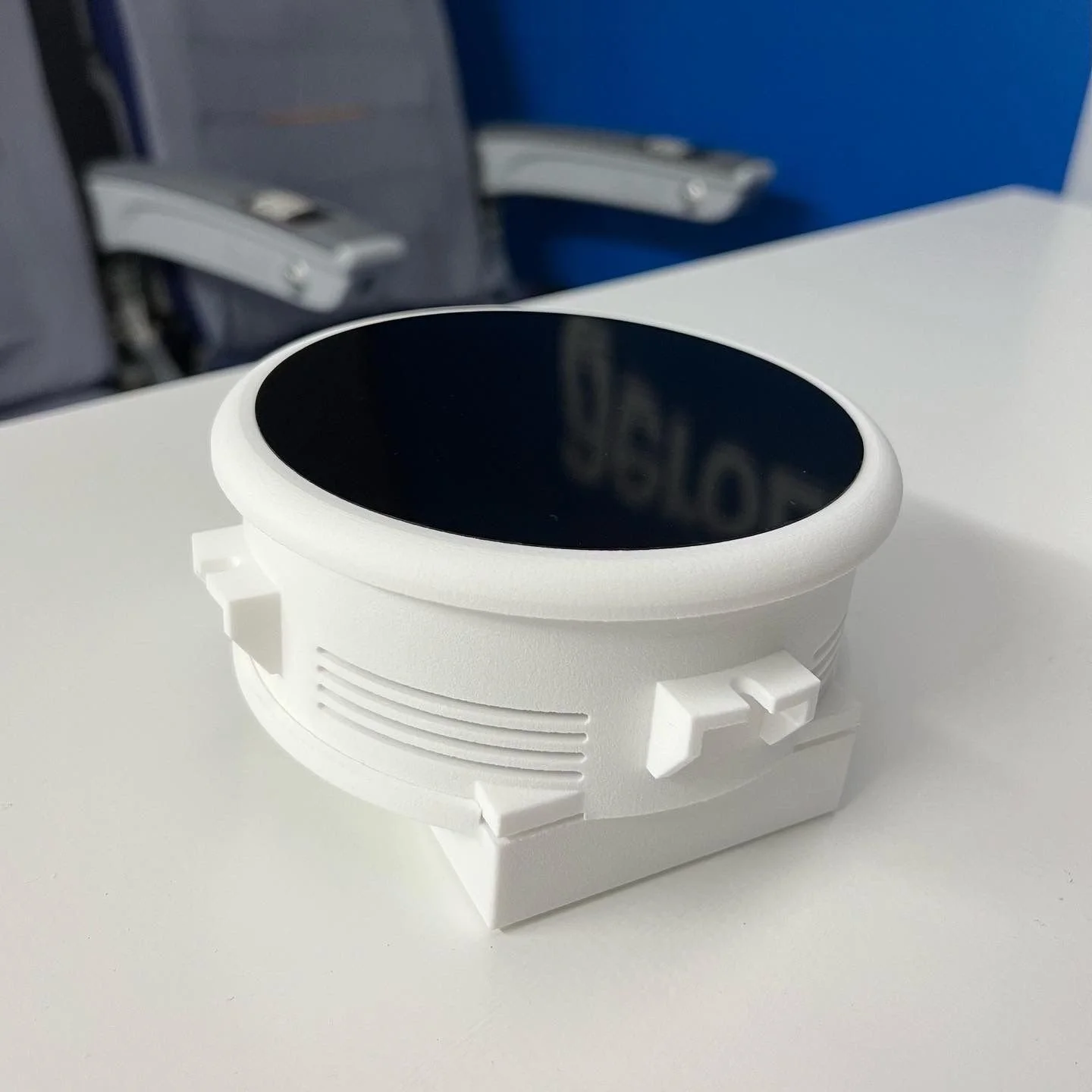
                Photo credit to aeroLiFi

                Photo credit to aeroLiFi

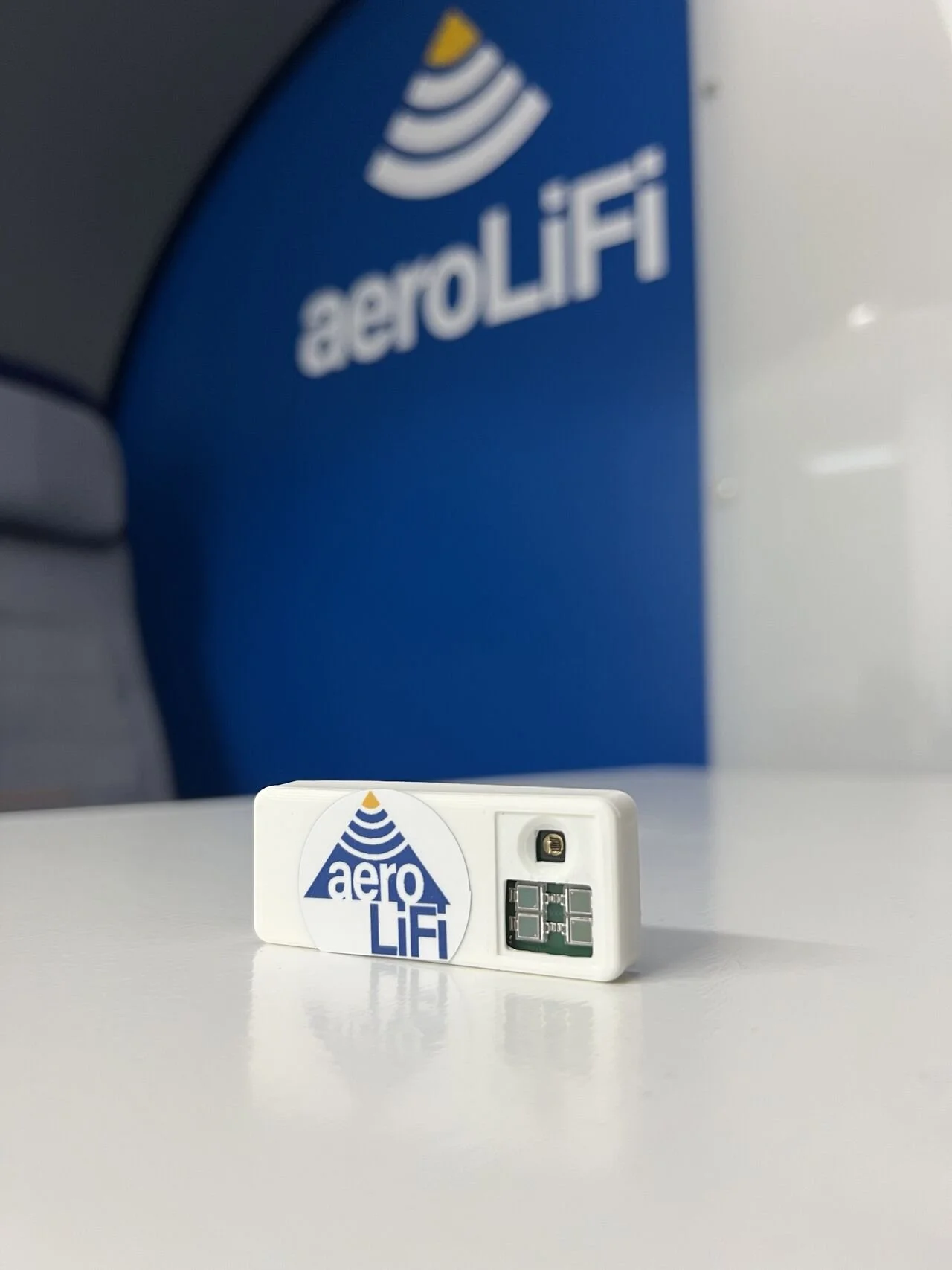
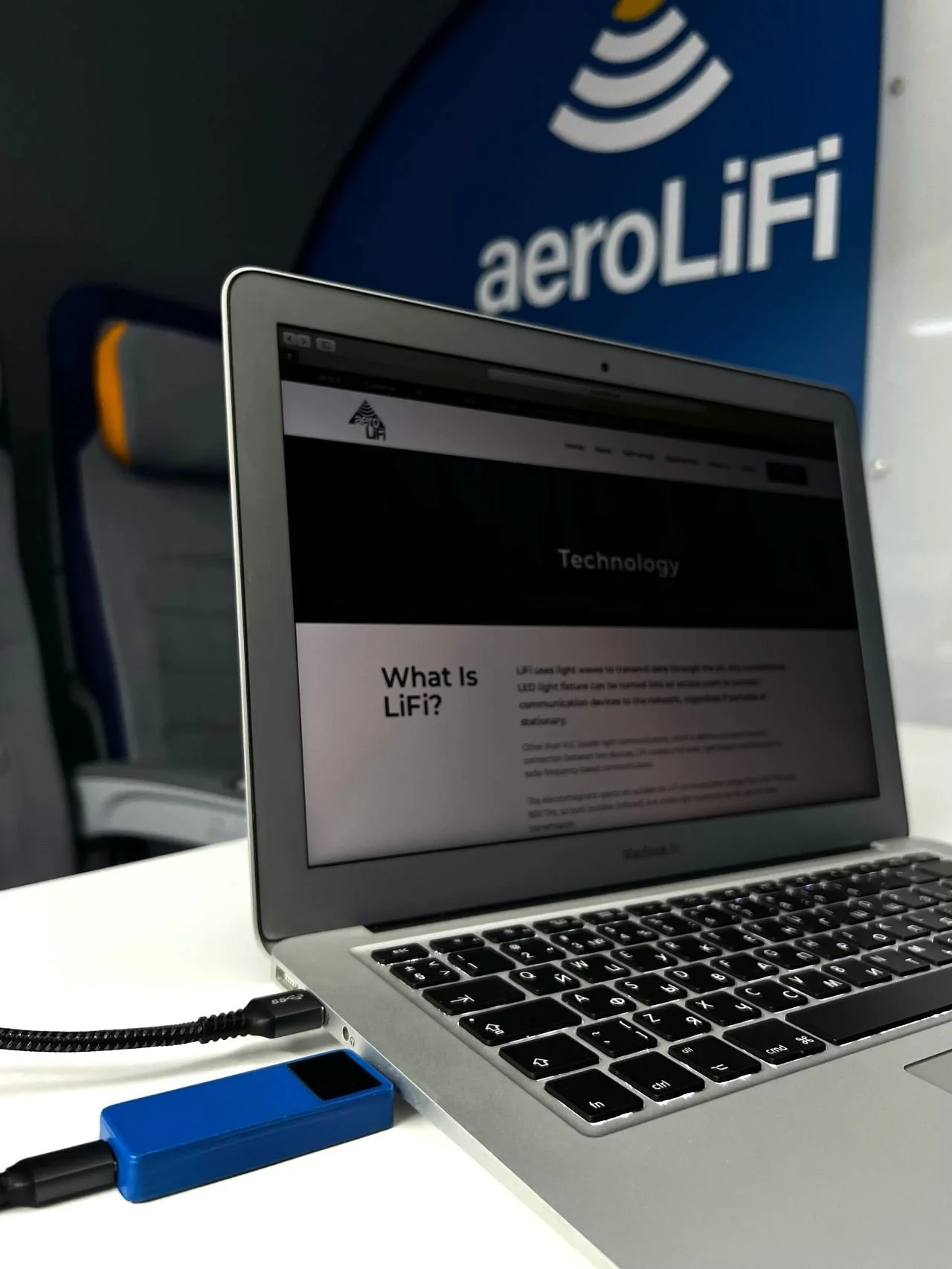
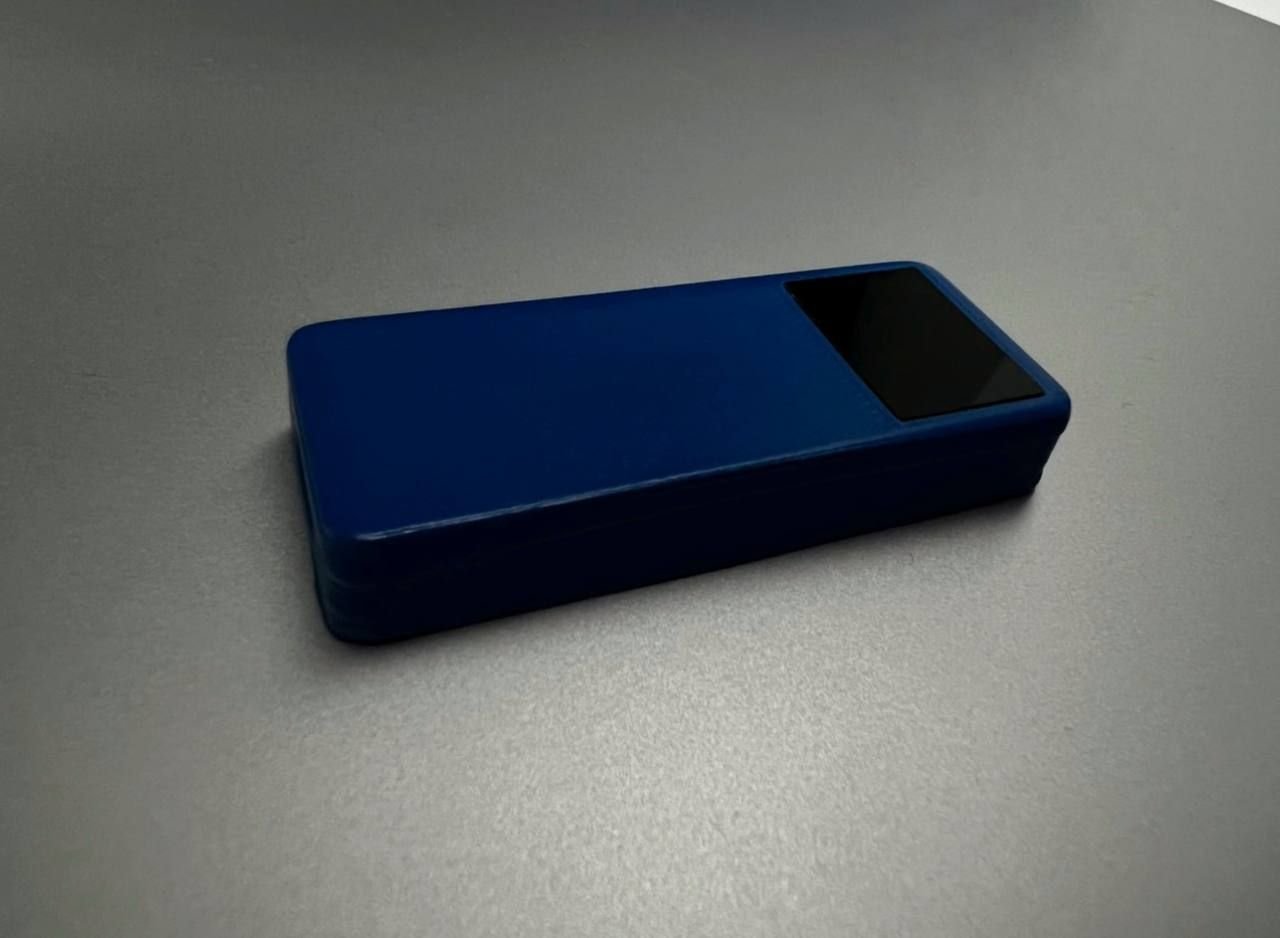
                Photo credit to aeroLiFi - LiFi dongle


                History and Achievements of aeroLiFi


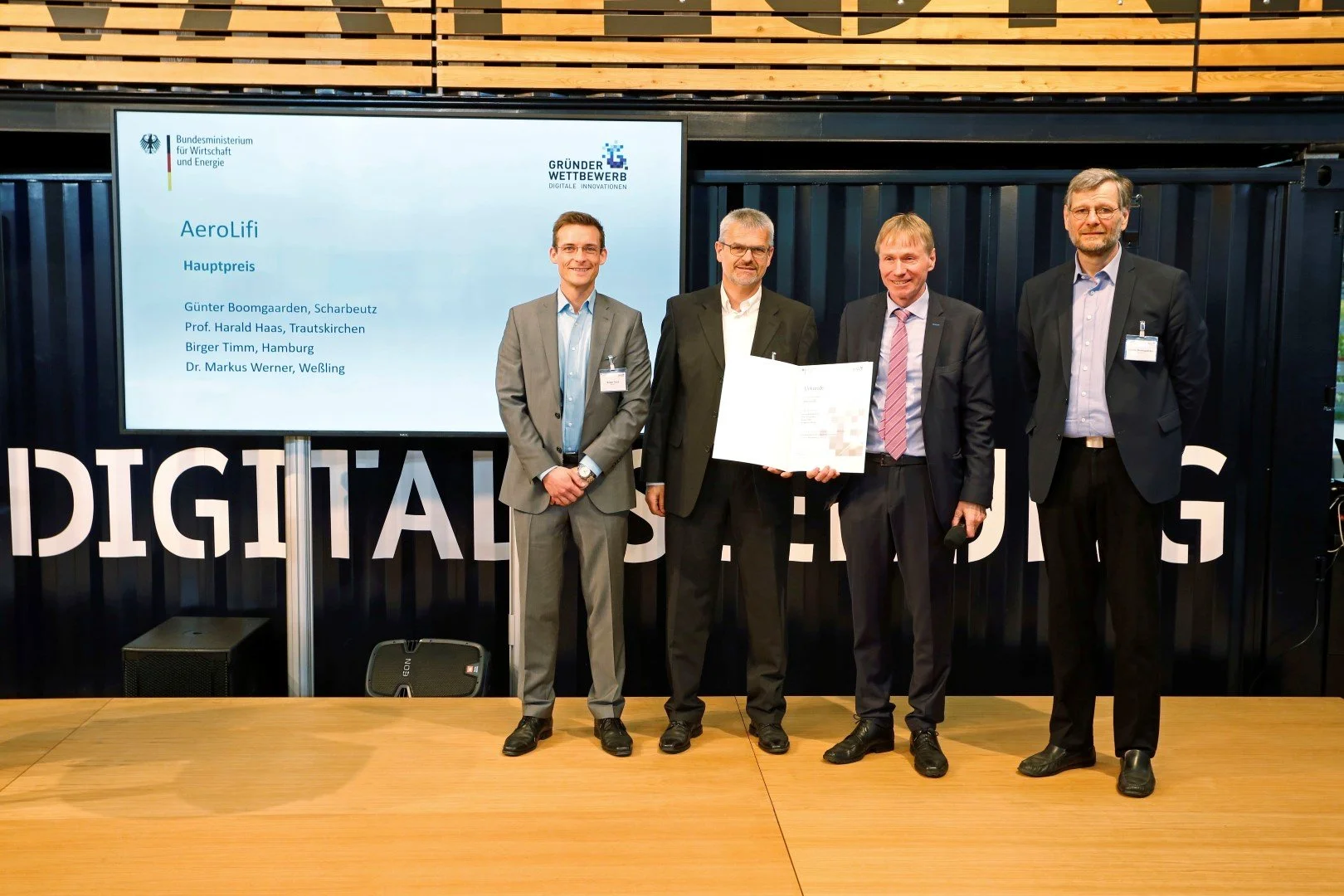
                aeroLiFi was founded in 2018. The company was rated as one of the TOP 50 Startups, by the online and print platform fuer-gruender.de which provides actual information on all topics related to entrepreneurship, startups and investors.

                Photo credit to aeroLiFi


                aeroLiFi won the 1st Price Winner BMWi digital Startup Competition in May 2018. Then, In June 2018, they got their 1st Customer in aviation Project Consulting.

                Their achievement was in January 2019 when they became a partner in 2 aviation-specific research programs.

                The company states that its office is designed to make working as comfortable as possible. They’ve got the basics covered with a good connection to public transport and modern office space equipment, but it’s also a fun place to work, with a seating area in the backyard where you can watch jets taking off all day long, against the backdrop of the Alps.


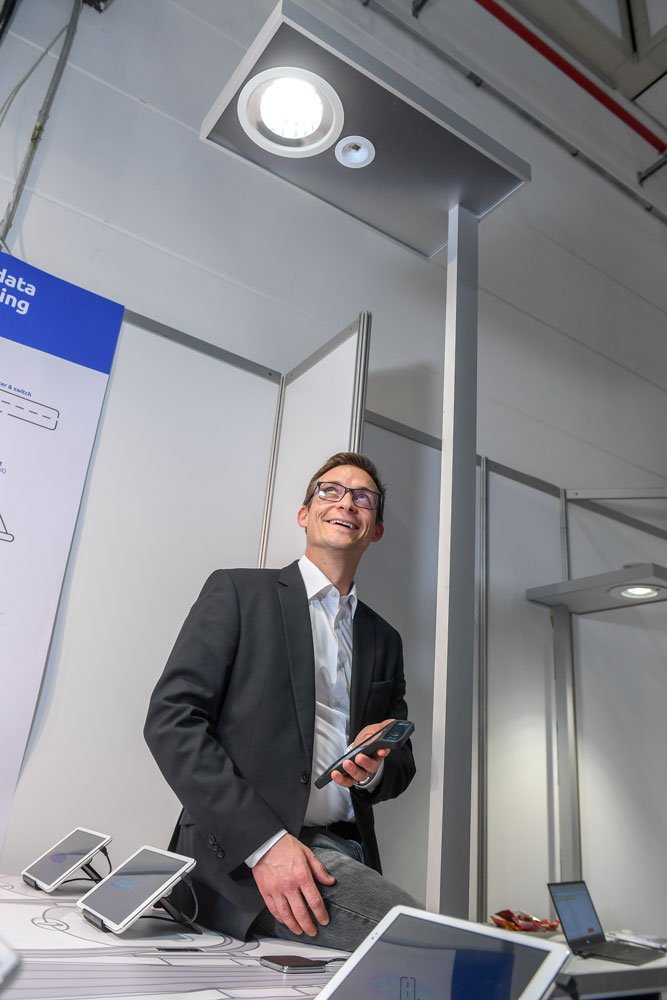
                At the Aircraft Interiors Expo (AIX) 2019, aeroLiFi demonstrated its multimedia LiFi network for an aircraft cabin. Merging standard LiFi technology components with the latest innovations made in multicast network protocols to show the first all-optical multimedia IFE solution for aircraft cabins.

                Photo credit to FlightGlobal

                Birger Timm, Managing Director of aeroLiFi, said, “LiFi provides a stable communications link that doesn’t degrade and that has enough capacity for each passenger to stream HD and 4K content. We do that by reducing the number of people using each cell, giving airlines the ability to provide a consistent data stream to a lot of people in a small area.”

                Timm continued, “It’s not impossible to hack into a LiFi network, just very hard. You have to get between the light source and the receiver. In an aircraft, that effectively means you need to be sitting on someone’s knee and that’s very noticeable.”

                “In fact, LiFi is so secure that it is already being looked for use in the cockpit for flight critical applications.”

                LiFi can use both visible light and infrared. Therefore, access points can continue working during the plane’s local night. Timm concluded,

                “LiFi is perfect for the aircraft cabin because it requires minimal physical infrastructure, it provides stable and consistent data transmission, and it’s safe.”

                aeroLiFi has integrated Cadami’s coded caching technology into its solution. This helps increase the stability of the solution, as well as the size of the video content library available.


                Moving on to September 2019, aeroliFi installed the 1st PoC LiFi Cabin connectivity system for aviation customers.

                In November 2019, they installed the 1st PoC Secure LiFi Office Communication System.


                AEROLIFI TEAM


                Dr Markus Werner - Managing Director Technology and Software Development

                Photo credit to aeroLiFi

                Dr Markus has a PhD in satellite communication technologies, experience in wireless communication systems and software as well as research and development in national and international research programs.

                He is a founder and former CEO of an aerospace company with a focus on wireless communication and software development. He is also a member of IEEE, AIAA, DGLR and VDE/ITG.

                In the below YouTube video, Dr Markus was talking about which public funding programs start-ups need in Germany. The video is in German but we translated some of his statements into English.


                Dr Markus Werner: ”I had already founded a company from a research company, from research institutions from the DLR. This was actually very helpful as a starting position because you actually have a certain security. Proximity to high-tech, research. And at that time, we learned with my fellow colleagues in research how to actually get co-financing, and how to get co-financing for new ideas. This is in fact one of the most important sources and one of the most important ways in which it sometimes falls short. Today, when you see how start-ups are being promoted, there is often a big hype. In the first six months of the year and after that, there is a threshold that is difficult to understand. And one would wish that politics would be more systematic in such an accelerator incubator for phase two.”

                Birger Timm - Managing Director LED Lighting Systems, Product Development

                Photo credit to aeroLiFi

                Birger graduated in medical engineering with a focus on measurement and application technology. Later focused on LED lighting technology.

                He is experienced in product development as well as research and development and light measurement. He also has a lot of experience in lighting system development and project management.


                Birger stated some of the following statements in the video:

                “And that's one of the good things about the LiFi technology. So, what we are doing is, effectively increasing the data rate per passenger, what we call the data density. So, when you imagine, many people can share one WiFi network. So, if you look at your phone, how many WiFi networks are available, it's hundreds, especially in crowded places like here. And all of the passengers, for example, in an aeroplane share, this one network and the data rate effectively per passenger goes down. When using LiFi technology, the effective data rate per passenger rises because less people share one access point. And that's because every light can be an access point. And by physical laws, not hundreds of people can gather under one light. And that's why the data rate is higher.”

                “Yes, so the light path of the light cannot go through walls. And that is, on one hand, a great advantage because it increases the security of the data link massively because nobody can sit behind the wall and hack into your network. On the other hand, of course, you're right. If I block the connection, no data can go to the sensor. But for the IoT application, we have a very smart solution we work together with our colleagues from Cadami, who developed a software solution that enables us to very, very fast and effective cache and buffer the data which comes to the IFP screens so that a blockage or light path of 10, 20 seconds or more does not degrade the performance.”


                Aircraft Interiors Expo (AIX) 2022

                Phot credit to aeroLiFi


                Aircraft Interiors Expo (AIX) is the world’s leading marketplace for airlines and the supply chain to meet.

                The expo brings the whole industry together so we can explore and source the latest products, find practical solutions, collaborate and build relationships with the right people, find the best products to enhance our cabin interiors, and discover those hidden gems to create the ultimate cabin and passenger experience. It is ultimately a professional platform where airlines, designers, engineers, specifiers, and manufacturers come together to share, collaborate, and find practical and innovative solutions took place in Hamburg.

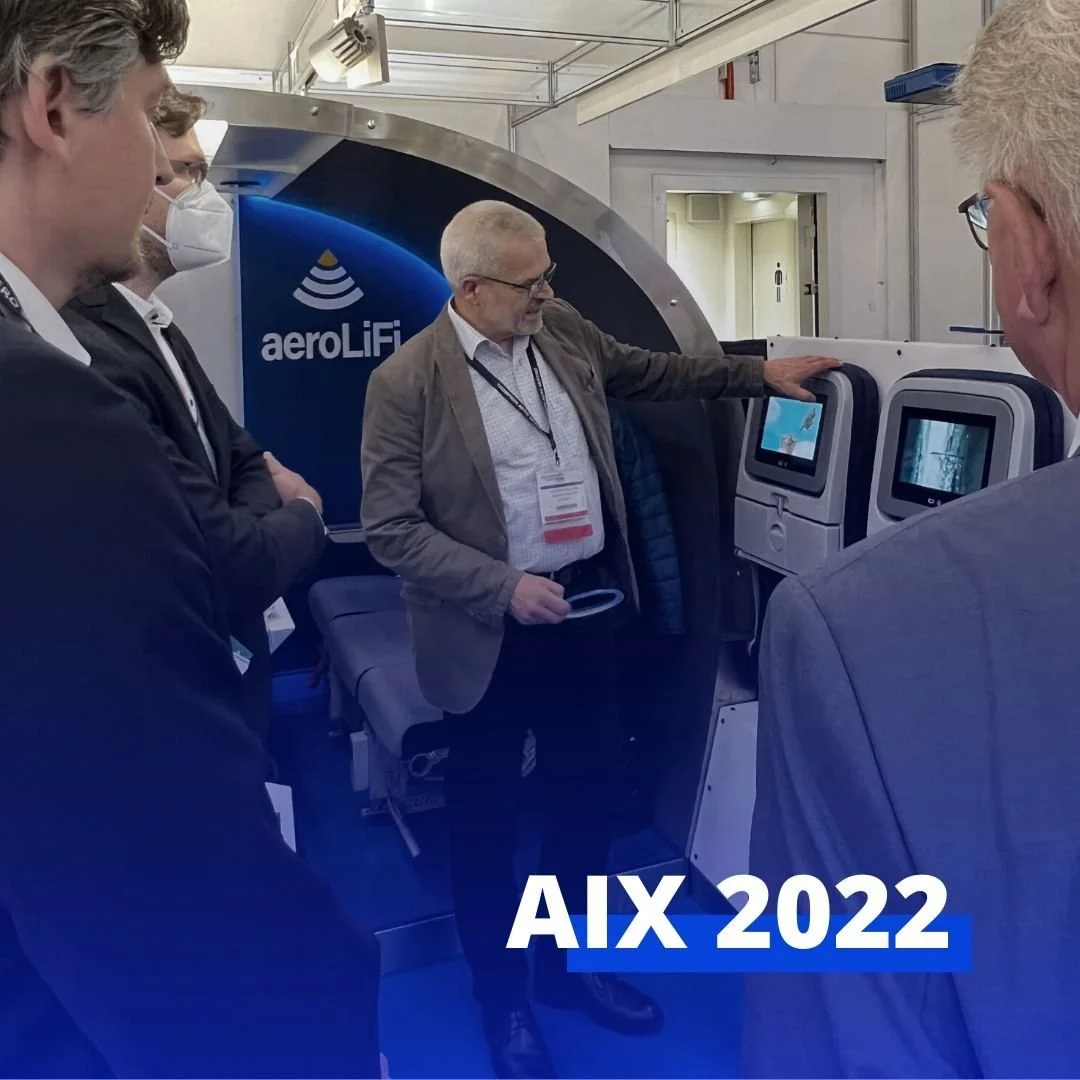
                The AIX 2022 took place between the 14th and 16th of June 2022. aeroLiFi team presented their new prototypes of wireless communication solutions based on LiFi technology. They demonstrated their unique system to visitors using for example a live camera stream to show a high level of security and speed of our access points.

                Visitors were able to see their modern dongles which are used to connect with the access points and can Interface with all common end-user devices such as laptops and tablets.

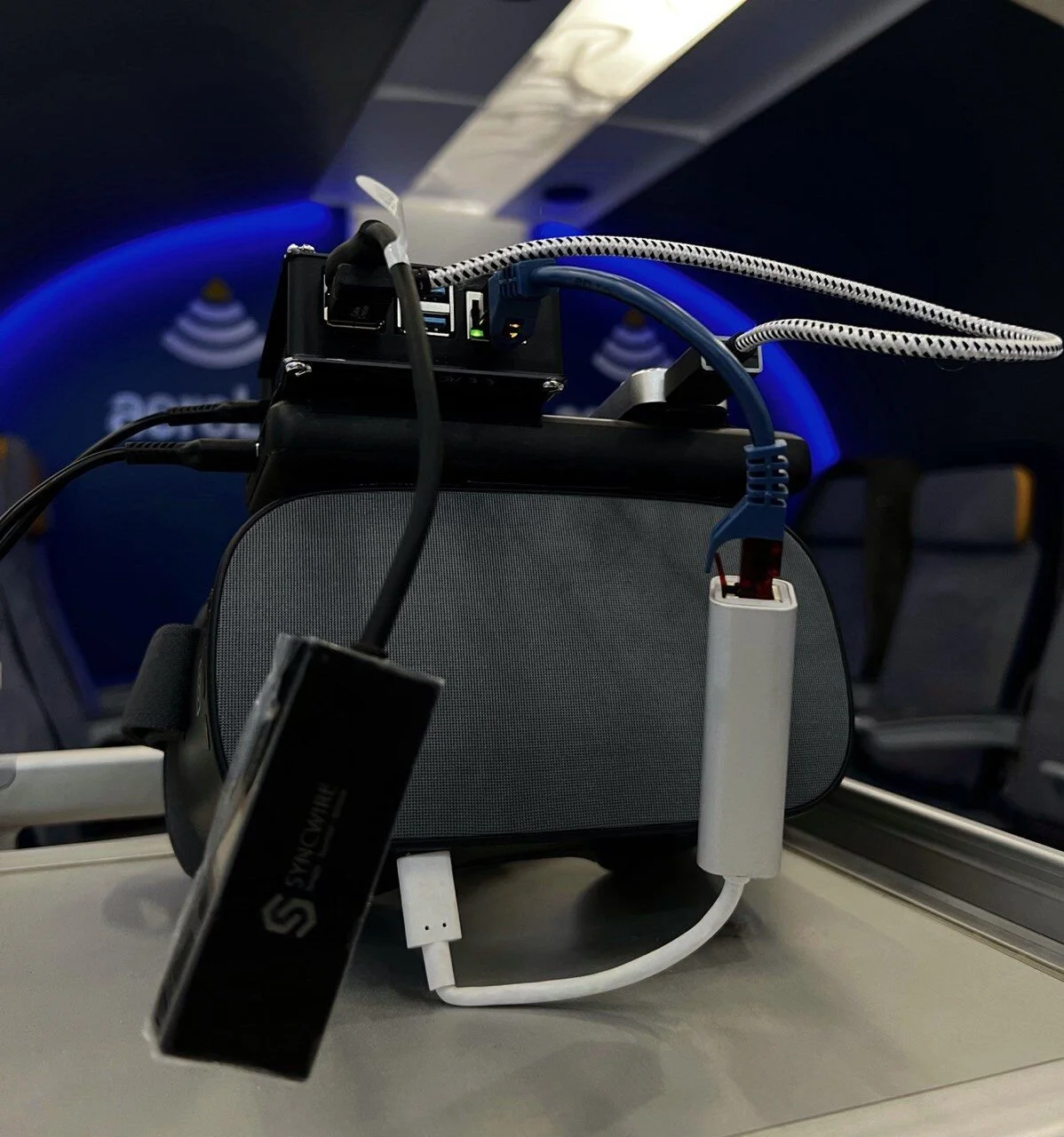
                Using the example of virtual reality headsets, they demonstrated a mix of wireless technologies for data transmission, WiFi and LiFi. The essence of the hybrid lies in the fact that when these two technologies are complementary and if one stops working, the second one is connected to replace it.

                Benefits of the onboard LiFi system

                1. Less wiring - more space for seats and luggage

                The LiFi system may be mounted in a light source (reading lamp, interior lighting, etc.) or may use dedicated infrared transceivers. Thus, to place the technology on board, it is enough to have light sources that are already installed in the cabin by default.

                2. Security

                This technology is perfect for planes as it doesn’t interfere with radio signals in the same way as WiFi, which uses radio waves. Instead, LiFi takes advantage of visible or infrared light. This means that passengers can make calls, use the Internet and access in-flight entertainment systems more easily.


                Robotics Festival 2022


                The Robotics Festival gathers a curated crowd of forward-thinking industry leaders, researchers and entrepreneurs who are truly passionate about robotics and its uplifting potential in the industry and beyond.

                It is an event that helps professionals in the industry and enthusiasts to get insights into what leading researchers and the top voices of the industry think about the future of the robotics & automation sector, and what topics they want to research and invest in over the next years. The Robotics Festival 2022 held from the 13th to the 15th of September 2022.

                Photo credit to Cadami

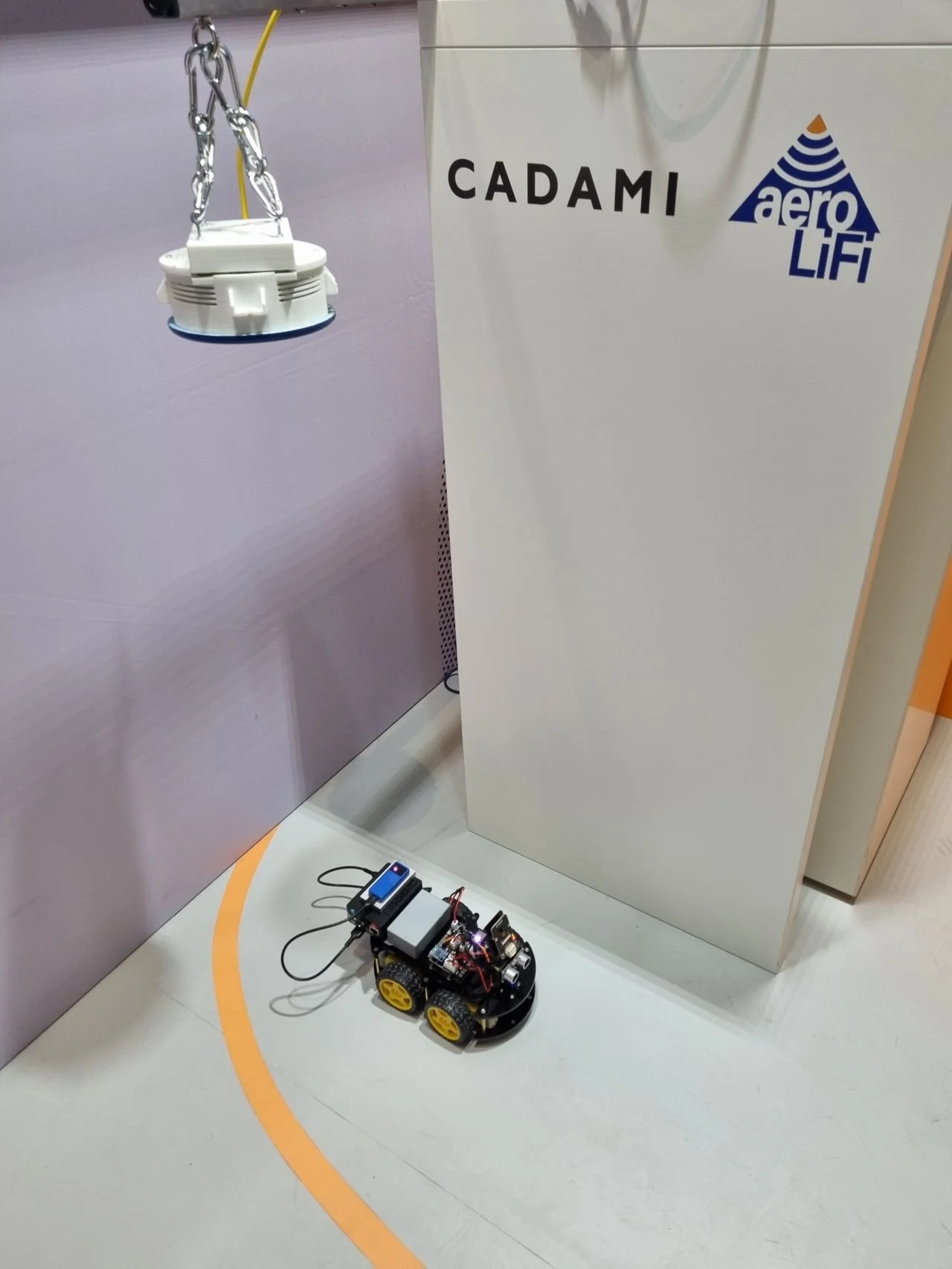
                aeroLiFi team demonstrated their brand new combined WiFi and LiFi demo technology on the robot car in Leipzig from 13th to 15th September together with our partner - Cadami GmbH.

                They demonstrated a mix of wireless technologies for connecting WiFi and LiFi. The essence of the hybrid lies in the fact that when these two technologies are interchangeable and if one stops working, the second one is connected to replace it.

                Photo credit to aeroLiFi

                Photo credit to aeroLiFi

                Photo credit to aeroLiFi

                Photo credit to aeroLiFi

                Photo credit to aeroLiFi - Hybrid LiFi and WiFi system by aeroLiFi


                Contact aeroLiFi

                If you:

                - have any kind of questions concerning LiFi technology;

                - would like to cooperate with aeroLiFi on a LiFi project;

                - would like to book an individual technology demonstration;

                You can contact them via their email address:

                info@aerolifi.com

                You can also contact them on their web page www.aerolifi.com (Contact page).

                Li-Fi Conference 2022

                The Li-Fi Conference 2022 Edition was a great success. Li Fi Tech News will very soon write articles on the topics treated at the Conference.

                What is LiFi?

                LiFi, also known as "Light Fidelity" is a wireless optical networking technology, which uses light-emitting diodes (LEDs) to transmit data. In 2011, professor Harald Haas made a LiFi demonstration at the TED (Technology, Entertainment, Design) Global Talk on Visible Light Communication (VLC).

                VLC uses light as a medium to deliver high-speed communication like Wi-Fi and complies with the IEEE standard IEEE 802.15.7. The IEEE 802.15.7 is a high-speed, bidirectional, and fully networked wireless communication technology-based standard similar to Wi-Fi's IEEE 802.11.

                How does LiFi work?

                LiFi is a high speed, bidirectional, and fully networked wireless communication of data using light. LiFi constitutes of several light bulbs that form a wireless network.

                When an electrical current goes through to a LED light bulb, a stream of light (photons) emits from the lamp. LED bulbs are semiconductor devices, which means that the brightness of the light flowing through them can change at extremely high speeds. The signal is sent by modulating the light at different rates. The signal can then be received by a detector that interprets the changes in light intensity (the signal) as data. Also when the LED is ON, you transmit a digital 1, and when it is OFF, you transmit a 0.

                LiFi Benefits

                The primary benefits of LiFi are as follows:

                Security: Provides entirely secure access. Where there is no light there is no data.

                Safety: Does not produce electromagnetic radiation and does not interfere with existing electronic systems.

                Localisation: Allows localisation due to the small coverage area of LiFi access point - localisation can be used for very precise asset tracking.

                Data density: Provides ubiquitous high-speed wireless access that offers substantially greater data density (data rate per unit area) than RF through high bandwidth reuse.

                Credit to Oledcomm

                LiFi Applications

                LiFi can be used for so many applications and the list is increasing every year. You can read our updated list of Li-Fi applications at the following link:

                https://www.lifitn.com/blog/2021/2/13/top-30-li-fi-applications-updated-list-including-potential-applications

                Credit to pureLiFi


                LiFi Systems Reviews by LiFi Tech News


                OLEDCOMM LIFIMAX KIT REVIEW - ONE YEAR IN

                We reviewed the LiFiMax kit produced by the leading French LiFi company Oledcomm. We bought this LiFi kit system at the end of 2020. After over a year of use, we decided to write a review of this LiFi system. We looked briefly at the profile of Oledcomm, a brief history of the LiFiMax system, the Kit box contents, some testing and performance results of this LiFi system, the customer experience and our own verdict (the good and the bad points) of the LiFiMax kit.

                You can read the review on this link:

                https://www.lifitn.com/blog/lifimaxreview


                SIGNIFY TRULIFI 6002.1 STARTER KIT SYSTEM REVIEW


                We also reviewed the Trulifi 6002.1 starter kit produced by Signify, the world leader in lighting for professionals, consumers and lighting for the Internet of Things. We got this LiFi kit system with the help of PCDSI and Signify around August 2021. In a similar fashion done with our previous review of the LiFiMax kit a few months ago, we will look briefly at the profile of Signify, a brief history of the Trulifi 6002.1 kit, the Kit box contents, some testing and performance results of this LiFi system, the customer experience and our own verdict (the good points and the bad points) of the Trulifi 6002.1 kit.

                You can read the review on this link:

                https://www.lifitn.com/blog/trulifi6002review


                In conclusion, if you are also interested to hear more information about the OWNII Coin, you can contact the OWNii Support team at info@ownii.net or use the contact form on the new OWNii website, ownii.net. If you are enquiring about LiFi devices such as the LiFiMax kits and the Trulifi kits, you can contact us through our chatbot or by sending an email through our contact us form. If you enjoyed this post and would like to hear more updates about LiFi technology, subscribe to our newsletter. Don’t forget to subscribe to our social media accounts. You can also join our Telegram group about LiFi technology on this link:
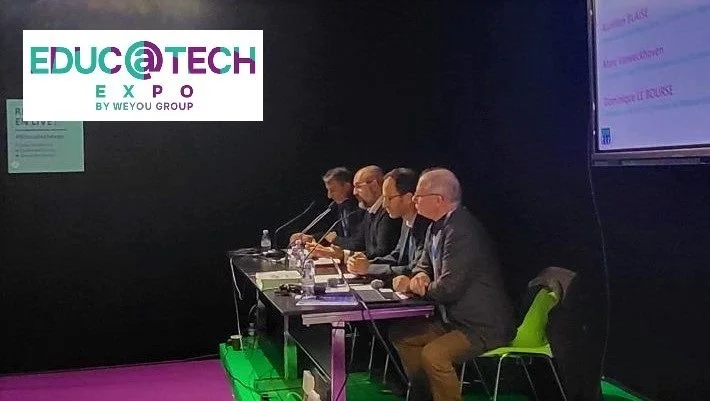
                https://t.me/joinchat/FMzOmsEKyJFrU6Af


                Chantefleur, The First Nursery School in Paris Equipped with LiFi, Feedbacks Their Experience with Oledcomm LiFi system

                Table of Contents

                  Chantefleur, The First Nursery School in Paris Equipped with LiFi, Feedbacks Their Experience with Oledcomm LiFi system

                  Credit to Oledcomm

                  Chantefleur Nursery School


                  Oledcomm released a video showcasing the positive reviews of staff at Chantefleur school in L’Isle-Adam. Chantefleur is the First Nursery School in Paris Equipped with LiFi technology. The nursery school reviewed their experience of using LiFi in the classrooms. Stephan Gardel, IT Manager in L’Isle-Adam, said:

                  “So, Oledcomm recommended and offered me their LiFi solution. It was perfect timing since I was looking for different solutions. Eventually, we went ahead with the LiFi solution, which fulfilled our requirements, especially regarding safety for children and the somewhat ecological aspect. Of course, I learned more about the technology. It consumes about 50% less electricity, so it's energy efficient.”

                  Credit to Oledcomm - Stephan Gardel, IT Manager in L’Isle-Adam, with the LiFiMAX tablet


                  Benjamin Azoulay, CEO of Oledcomm, said:

                  “It's a breakthrough technology because instead of using radio frequency waves, we use photon light to connect to the internet. It's completely new. It uses LEDs, a bit like Morse code, that is to say that we will flash the LEDs at very high speed at 30 MHz, 30 million times per second in order to be able to connect to the Internet.”

                  Florence Berckelaers, Headteacher and Director at Chantefleur school, stated that “With LiFi, we were able to set up educational activities with the little ones, with the very young, which we haven't done until now. We were able to set up activities that allow direct communication via the Internet, via the Benelux, from the school, with the parents or with other classes or with other schools. And since the connection is very reliable and very fast, that opens up fields of activities that we didn't have until then and which are very, very interesting.”

                  Credit to Oledcomm

                  Chrystelle Lacroix Touroude, teacher at Chantefleur school, said in her statement:

                  “The tablet allows fairly simple manipulation of the software and distribution to other classes as well. It makes it possible not to have cables and to allow other classes to have access to this kind of software quite easily. It allows some children in difficulty not to have this barrier of the sheet or let's say that it diversifies our supports. So, it's not the only support in kindergarten, it shouldn't be the only support, but it's a very interesting tool for us and for the children.”

                  Credit to Oledcomm

                  Stephan Gardel, further stated:

                  “The installation went well, there were no issues. Once the wiring was stretched, it came with the accessories and we installed them. It happened very simply. After 12 o'clock, we equipped two rooms to start and it worked right away. So, I am satisfied. We work in complete transparency, that's important. And there is a certain reactivity, indeed. And this is important. I like to work only with companies, with people I work with, who I can trust. In fact.”

                  Credit to Oledcomm

                  Sebastien Poniatowski, Mayor of L’Isle-Adam, concluded with the following statements:

                  “Our city's responsibility, on the other hand, is to equip our schools so that children can teach, learn and grow in the best possible conditions. So, it's both the buildings, the schools, but it's also what there is, the equipment and the technology that is offered to the children. So, the challenge for us is above all to offer the best to children and above all to give them a setting that can be a fulfilling setting for them.”


                  You can watch the following video by Oledcomm. The video is in French:


                  Oledcomm

                  Oledcomm designs and develops LiFi network interface devices that enable high-speed wireless data communication. It also serves LiFi equipment in the telecom, datacom, personal electronics, and industrial markets. The company’s product portfolio includes hubs, routers, switches, adapters, drivers, power supplies, and more.

                  Oledcomm was founded in 2012 and is based in Paris, France. Oledcomm's adventure began in 2005 in the research laboratories of the University of Versailles-Saint-Quentin with the first work on communication by visible light.

                  Following years of research & development and a passion for innovation, Oledcomm became the pioneer of LiFi (Light Fidelity) solutions and innovation on a global scale.

                  Based in the Paris region, Oledcomm employs around 20 people and designs complete solutions for LiFi operation, including microcontrollers, LiFi photoreceivers and software platforms.

                  Today, after more than 28 patents, 15 years of R&D, over 500 trusted clients and several awards, Oledcomm is pursuing a strong mission: to transform the 14 billion points of light in the world into a powerful communication network.


                  Li-Fi Conference 2022


                  The Li-Fi Conference 2022 Edition was a great success. Li Fi Tech News will very soon write articles on the topics treated at the Conference.

                  What is LiFi?

                  LiFi, also known as "Light Fidelity" is a wireless optical networking technology, which uses light-emitting diodes (LEDs) to transmit data. In 2011, professor Harald Haas made a LiFi demonstration at the TED (Technology, Entertainment, Design) Global Talk on Visible Light Communication (VLC).

                  VLC uses light as a medium to deliver high-speed communication like Wi-Fi and complies with the IEEE standard IEEE 802.15.7. The IEEE 802.15.7 is a high-speed, bidirectional, and fully networked wireless communication technology-based standard similar to Wi-Fi's IEEE 802.11.

                  How does LiFi work?

                  LiFi is a high speed, bidirectional, and fully networked wireless communication of data using light. LiFi constitutes of several light bulbs that form a wireless network.

                  When an electrical current goes through to a LED light bulb, a stream of light (photons) emits from the lamp. LED bulbs are semiconductor devices, which means that the brightness of the light flowing through them can change at extremely high speeds. The signal is sent by modulating the light at different rates. The signal can then be received by a detector that interprets the changes in light intensity (the signal) as data. Also when the LED is ON, you transmit a digital 1, and when it is OFF, you transmit a 0.

                  LiFi Benefits

                  The primary benefits of LiFi are as follows:

                  Security: Provides entirely secure access. Where there is no light there is no data.

                  Safety: Does not produce electromagnetic radiation and does not interfere with existing electronic systems.

                  Localisation: Allows localisation due to the small coverage area of LiFi access point - localisation can be used for very precise asset tracking.

                  Data density: Provides ubiquitous high-speed wireless access that offers substantially greater data density (data rate per unit area) than RF through high bandwidth reuse.

                  Credit to Oledcomm

                  LiFi Applications

                  LiFi can be used for so many applications and the list is increasing every year. You can read our updated list of Li-Fi applications at the following link:

                  https://www.lifitn.com/blog/2021/2/13/top-30-li-fi-applications-updated-list-including-potential-applications

                  Credit to pureLiFi


                  LiFi Systems Reviews by LiFi Tech News


                  OLEDCOMM LIFIMAX KIT REVIEW - ONE YEAR IN

                  We reviewed the LiFiMax kit produced by the leading French LiFi company Oledcomm. We bought this LiFi kit system at the end of 2020. After over a year of use, we decided to write a review of this LiFi system. We looked briefly at the profile of Oledcomm, a brief history of the LiFiMax system, the Kit box contents, some testing and performance results of this LiFi system, the customer experience and our own verdict (the good and the bad points) of the LiFiMax kit.

                  You can read the review on this link:

                  https://www.lifitn.com/blog/lifimaxreview


                  SIGNIFY TRULIFI 6002.1 STARTER KIT SYSTEM REVIEW


                  We also reviewed the Trulifi 6002.1 starter kit produced by Signify, the world leader in lighting for professionals, consumers and lighting for the Internet of Things. We got this LiFi kit system with the help of PCDSI and Signify around August 2021. In a similar fashion done with our previous review of the LiFiMax kit a few months ago, we will look briefly at the profile of Signify, a brief history of the Trulifi 6002.1 kit, the Kit box contents, some testing and performance results of this LiFi system, the customer experience and our own verdict (the good points and the bad points) of the Trulifi 6002.1 kit.

                  You can read the review on this link:

                  https://www.lifitn.com/blog/trulifi6002review


                  In conclusion, if you are also interested to hear more information about the OWNII Coin or enquire about LiFi devices such as the LiFiMax and Trulifi, you can contact us through our chatbot or by sending an email through our contact us form. If you enjoyed this post and would like to hear more updates about LiFi technology, subscribe to our newsletter. Don’t forget to subscribe to our social media accounts. You can also join our Telegram group about LiFi technology on this link:
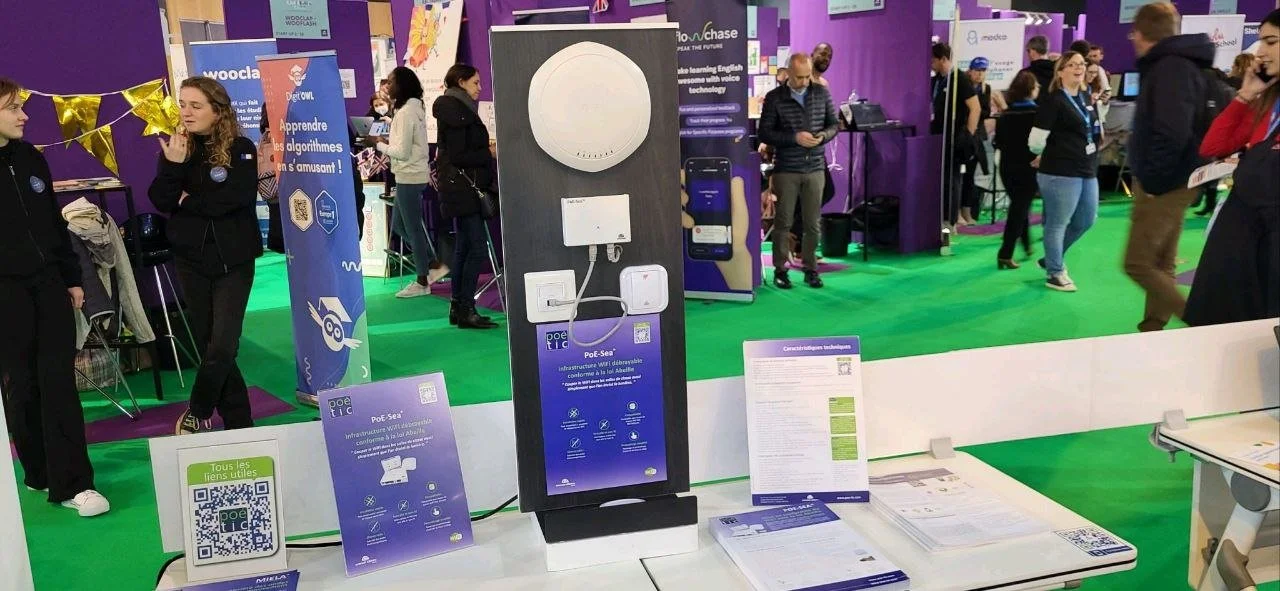
                  https://t.me/joinchat/FMzOmsEKyJFrU6Af