US Podcast Episode 5 - Guest Speaker Fernando DeLosReyes Discusses LiFi Technology on OWNii, LiFi and Blockchain Twitter Space Podcast

Table of Contents

    US Podcast Episode 5 - Guest Speaker Fernando DeLosReyes Discusses LiFi Technology on OWNii, LiFi and Blockchain Twitter Space Podcast

    In today’s article, we revisited the Twitter podcast held on Wednesday 10th August 2022.

    Guest speaker Fernando DeLosReyes, Solutions Architect Manager at Wildflower International, LTD was invited to discuss LiFi technology.


    Below are some of the Podcast conversations. Some of the conversations have been edited:


    Fernando DeLosReyes: “Thank you so much. Hi, everyone. My name is Fernando. I'm a Solutions Architect manager at Wildflower based in southern Arizona. But I've been in federal sales for the last 20 years. We're based out of Albuquerque, and we're a value-added reseller to the federal government.”


    Donovan James: “Great. So Fernando, how did you get into the LiFi space?”


    Fernando DeLosReyes: “So thanks for that's a great question. And, and I'm going to try to go really fast because we got a lot of ground cover. But I’m an Army veteran and I was in the Signal Corps. So, I was you know, in the army, I was fixing networks. So that's my background. And for the last, my last couple of jobs, I've been working at companies that sell network and you know, Wi-Fi test equipment at the top companies actually NetScout slash net ally. And I ended up at Wildflower right before COVID. And so we're you know, we've been doing really good. But we saw that the US Army about two years ago was asking for, they had a request for information for LiFi. And there's a whole history behind that. But you know, we wanted to respond to it. So I got as smart as I could at the time. This is two years ago, I read everything I could about it I read, you know, Harald has his book, The principles of LED light communication. And, well, you know, like with Wildflower, you want to come up with the best solution. And you know, that's good. I want to go into that a little bit deeper. But so I was helping customers for the last seven years, I was helping them with Wi-Fi problems. So you know, I love helping customers with Wi-Fi problems.”

    “And when we saw the request for LiFi, I'm like, Hey, let's go check it out. You know, so I saw it at the TechNet Augusta last year. And I immediately saw the value immediately because it doesn't it's not on the RF spectrum, like I said, for the last seven years, and I got some stories I'll share with you. But for the last seven years, I've been helping people with you know, RF Wi-Fi problems. Okay, I think this is cool. But you know, I've been in situations before where I get it, I think it's cool, but you know, does the customer gonna you know, is the customer going to like it or they're going to buy it that's the main thing. So I brought as many customers as we had and I'll share with you you know I had customers stop by our Wildflower booth and say what does Wildflower do and I would take him around the corner to the pureLiFi booth and I'd say Hey, this is LiFi, Light Fidelity internet and an overlay and, you know, share what I knew about it and talked about it. And then, I'd say wildflower brings you the best technologies. That's what Wildflower do. So anyway, so you know, so I talked to a lot of customers and then We ended up, you know, we ended up selling a multimillion-dollar opportunity to the US Army, who made a huge investment in LiFi. And ever since then I've been taught I probably talked to about 1000 people since last year about LiFi.”


    Donovan James: “Well, that I mean, that is that's phenomenal. Can you just tell us one quick story about like how you helped one of your customers with LiFi?”


    Fernando DeLosReyes: “Okay with LiFi. So, the reason why the US Army made such a huge investment, it's public information, you can actually go to pureLiFi’s website, they got a blog or press about it. But the reason why the US Army in Europe made such a huge investment in LiFi was that depending on the country, the weather, and the season, would determine what Wi-Fi Channel, you were going to be on, you almost had to be an expert at Wi-Fi, just to turn on an access point. But because the light spectrum is unlicensed and 2600 times larger than the RF spectrum, you don't have to be an expert to flip on a light switch.”


    Roger: “I read that a couple of schools in Rome started implementing LiFi into the schools for kids that are under four years old, because of the fact that the radiation from Wi-Fi is so bad for kids that most schools don't have Wi-Fi because of how bad the radiation is, in the Wi-Fi, is that true?”


    Fernando DeLosReyes: “Well, I'll jump in, I always get really nervous about talking about, you know how dangerous radiation is because you know because that still needs to be determined. However, in France, there are laws against RF Wi-Fi has been deployed. They have a problem with their children being bombarded with RF Wi-Fi all day long, you know, so, and what they found that they're having a lot of success with it because they only deploy. And here's something I want everybody to listen to the term because I think it's important that we start getting on the same page of terminology. So, we all start talking the same, but they only deploy the LiFi access points over the workspaces, where they're needed over the children's work areas, over their desks, over the teacher's desk, where the teachers’ work areas, but not in the hallway, not in the cafeteria, not in the bathroom. And you can only get on the network with their equipment or where they're issued equipment or where they issue passwords. And so they're having a lot of success within France.”

    “My final statement would be the call to action is on LiFi. The call to action is, look, we're not trying to compete with Wi-Fi because you got to understand that I'm coming in settling into the federal government where it takes a long time for things to get adopted. There's a lot of regulation. We're talking about highly regulated secure networks on the planet. But, you know, for me selling into the federal government, what I'm sharing and my call to action is, look, we know that there is spectrum congestion, you know, we need to get the high priority users off of the RF spectrum, which we know is easy to manipulate onto a more secure spectrum, which is 2600 times faster, it reconnects faster, you don't even know what's on unless you're in the room.”


    Podcast Recording


    You can also listen and download the full audio recording below:


    You can also listen the podcast on the following Twitter link:

    https://twitter.com/i/spaces/1vAxRkDnraqKl


    Li-Fi Conference 2022


    The Li-Fi Conference 2022 Edition was a great success. Li Fi Tech News will very soon write articles on the topics treated at the Conference.

    What is LiFi?

    LiFi, also known as "Light Fidelity" is a wireless optical networking technology, which uses light-emitting diodes (LEDs) to transmit data. In 2011, professor Harald Haas made a LiFi demonstration at the TED (Technology, Entertainment, Design) Global Talk on Visible Light Communication (VLC).

    VLC uses light as a medium to deliver high-speed communication like Wi-Fi and complies with the IEEE standard IEEE 802.15.7. The IEEE 802.15.7 is a high-speed, bidirectional, and fully networked wireless communication technology-based standard similar to Wi-Fi's IEEE 802.11.

    How does LiFi work?

    LiFi is a high speed, bidirectional, and fully networked wireless communication of data using light. LiFi constitutes of several light bulbs that form a wireless network.

    When an electrical current goes through to a LED light bulb, a stream of light (photons) emits from the lamp. LED bulbs are semiconductor devices, which means that the brightness of the light flowing through them can change at extremely high speeds. The signal is sent by modulating the light at different rates. The signal can then be received by a detector that interprets the changes in light intensity (the signal) as data. Also when the LED is ON, you transmit a digital 1, and when it is OFF, you transmit a 0.

    LiFi Benefits

    The primary benefits of LiFi are as follows:

    Security: Provides entirely secure access. Where there is no light there is no data.

    Safety: Does not produce electromagnetic radiation and does not interfere with existing electronic systems.

    Localisation: Allows localisation due to the small coverage area of LiFi access point - localisation can be used for very precise asset tracking.

    Data density: Provides ubiquitous high-speed wireless access that offers substantially greater data density (data rate per unit area) than RF through high bandwidth reuse.

    Credit to Oledcomm

    LiFi Applications

    LiFi can be used for so many applications and the list is increasing every year. You can read our updated list of Li-Fi applications at the following link:

    https://www.lifitn.com/blog/2021/2/13/top-30-li-fi-applications-updated-list-including-potential-applications

    Credit to pureLiFi


    LiFi Systems Reviews by LiFi Tech News


    OLEDCOMM LIFIMAX KIT REVIEW - ONE YEAR IN

    We reviewed the LiFiMax kit produced by the leading French LiFi company Oledcomm. We bought this LiFi kit system at the end of 2020. After over a year of use, we decided to write a review of this LiFi system. We looked briefly at the profile of Oledcomm, a brief history of the LiFiMax system, the Kit box contents, some testing and performance results of this LiFi system, the customer experience and our own verdict (the good and the bad points) of the LiFiMax kit.

    You can read the review on this link:

    https://www.lifitn.com/blog/lifimaxreview


    SIGNIFY TRULIFI 6002.1 STARTER KIT SYSTEM REVIEW


    We also reviewed the Trulifi 6002.1 starter kit produced by Signify, the world leader in lighting for professionals, consumers and lighting for the Internet of Things. We got this LiFi kit system with the help of PCDSI and Signify around August 2021. In a similar fashion done with our previous review of the LiFiMax kit a few months ago, we will look briefly at the profile of Signify, a brief history of the Trulifi 6002.1 kit, the Kit box contents, some testing and performance results of this LiFi system, the customer experience and our own verdict (the good points and the bad points) of the Trulifi 6002.1 kit.

    You can read the review on this link:

    https://www.lifitn.com/blog/trulifi6002review


    In conclusion, if you are also interested to hear more information about the OWNII Coin or enquire about LiFi devices such as the LiFiMax and Trulifi, you can contact us through our chatbot or by sending an email through our contact us form. If you enjoyed this post and would like to hear more updates about LiFi technology, subscribe to our newsletter. Don’t forget to subscribe to our social media accounts. You can also join our Telegram group about LiFi technology on this link:

    https://t.me/joinchat/FMzOmsEKyJFrU6Af


    Podcast Episode 4 - PCDSI Discusses LiFi Technology on OWNii, LiFi and Blockchain Twitter Space Podcast

    Table of Contents

      Podcast Episode 4 - PCDSI Discusses LiFi Technology on OWNii, LiFi and Blockchain Twitter Space Podcast

      Another Twitter podcast was held on Sunday 07th August discussing a few topics on Blockchain technology, OWNii and LiFi technology. The hosts of the podcast were Roger Williams, Founder of Mobile Blockchain Solutions and Donovan James. Chuks Livinus, Owner of LiFi Tech News and Co-Founder of Li Fi Infinity, Prince Toyese and Blessing Oyediran, Co-founders of Li Fi Infinity were also in attendance. Ken Peterson, CEO of Global Greenology and the Brainchild behind OWNii, and John Shaw, President of PCDSI (Power Community Development Systems, Inc.) were also in attendance as speakers.


      Chuks of LiFi Tech News interviewed John Shaw on LiFi technology.

      Below are some of the Podcast conversations about LiFi technology. Some of the conversations have been edited:


      Chuks: “Once again, thank you for taking the time and joining us on our podcast, Mr John Shaw. We have some few questions for you as we aware that you had a lot of experience when it comes to LiFi installation in US homes. But firstly, Mr John Shaw, would you like to introduce yourself like to our listeners?”


      John Shaw: “Hello to everyone. My name is John Shaw. And my background is in engineering. I'm an entrepreneur, and the founder, CEO and President of PCDSI, Power Community Development Systems, Inc. What our company does is we are in the sustainable sustainability and renewable energy market. And that means initially, we provide market disrupting and breakthrough technology, for housing, for commercial buildings and for any type of structure that you desire to build because in the 21st century, we must stop the insanity. In other words, stop building using traditional methods and move into the 21st century. Our focus is primarily on the catastrophic areas: fire, wind and water. The product is resistant to fire when and water. And the technology is cellulose, magnesium cement. That's over 1200 years old, and we have now perfected it. And the manufacturing process to be able to build with this technology. within that structure is where LiFi comes into play for PCDSI.”


      Chuks: “Awesome. Thank you very much. That was really an interesting introduction about your background and the current work what PCSDI is doing. Thank you very much for this Mr John. I got a few more questions. And the next one is where have you started working on the LiFi? Like, when did it all started? Did it start like recently or a few years ago? Could you tell us more?”


      John Shaw: “Yeah, so we go way back. Because LiFi essentially was introduced to PCDSI, by way of Global Greenology under the auspices of Ken Peterson. We were engaged in partnering with Ken when we were doing pureLiFi. And we were also almost the very next day then after can launch the OWNii token. We partnered with Ken on the OWNii token. But what we see right now, we started last year, and all of us know how restricting COVID has been. But nevertheless, we've been able to prepare, plan and execute even within the COVID environment. So I would say in July of last year, we began purchasing. First, we established an agreement with a different LiFi company, a fourth generation company called Trulifi. Right now, we have over 15 members that have installed LiFi in their residence including myself, as well as our headquarters, so we have 20 installations right now, to begin to understand user perception and user experience. Then, what we just concluded was the first full single family residence that has over 15 transmitters in it and three access points. In other words, the entire 22,100 square foot house, the first in the United States, now has LiFi in it. And we are going through finishing up what we call serviceability tests to make sure we understand what we need to understand especially, that will begin to govern how we talk about LiFi. So that we don't under-represent and don't misrepresent the technology, the breakthrough technology as it is the renewable energy technology. So we're working on the language now. Because if we don't control our own language, somebody else will. And that's critical both from a serviceability standpoint, and from a communication standpoint.”

      “And then, we also have a short term plan, a 3492 square foot house that we're building here in California, that will be the second structure, this is a larger house that will be completely outfitted with LiFi technology. So, within the next two to three months, the second full single family residence will be up and running with LiFi, then we are targeting to bring the LiFi and these are plans for us to begin to understand the serviceability education and training from a usability and user perception perspective.”

      “Before we go full bore, when I say we I'm talking about all of us that we need to understand precisely what we're doing. So we've targeted distribution centres, over 100,000 square feet, that will include LiFi. And within 13 additional cities in the United States will have home offices for the power centres that will not only have LiFi but all of the other renewable energy technologies in it. That to us is a good enough foundation to really began to understand serviceability. So when we get to smart cities, we are way ahead of the curve.”


      Chuks: “Awesome, excellent. Next question is from your own point of view, Mr John, what is needed to Excel for the LiFi infrastructure in the US and abroad?”


      John Shaw: “Oh, you know, that's a very good question. And what we would say is what the real estate company say is location, location, location, location. So, what we mean by location here is that we have to socialise the LiFi technology, which is no different than any other technology that is first usually starts with the government, the federal government and then migrates out to the user community. But the LiFi has to be socialised. So how do you socialise LiFi? First, you got to start to use it. And then you have to begin to market the LiFi to banks, to the federal government.”

      “I mean, we had several conversations in the last two to three weeks, where banks were getting ready to spend billions of dollars to put a physical wire mesh around the building to obtain data security. Well, it just happened that it's a bank and my personal bank and I asked what are you doing? And when they told me what they were doing, I requested a meeting with the branch manager. Well that now has led to us talking about the installation of LiFi. Because you can now have with the LiFi. The LiFi can coexist with the WiFi network. As a matter of fact, LiFi cleans up the entire network and makes WiFi even more efficient.”

      “So, we gotta market it , successfully technical branding market to begin to socialise the LiFi technology. I mean, hospitals, prime targets, Federal government, the schools, yes, yes. It's all prime markets. However, we've got to, we got to put collectively our serviceability plans in place. Because all of us know something about the LiFi. Okay. But there is no comprehensive service ability module that will help all of us even how to sell it. I'll give you a classic example. It used to be stated that LiFi was 100 times faster than WiFi. Well, that's a lie. That's not true. And we, the literature has been changed, but that sentiment is still out there.”


      Chuks: “So from your own opinion, is LiFi in general more faster than Wi Fi?”


      John Shaw: “Okay, so we have to think about sustainability differently in the 21st century. So is it true when we talk about LiFi. So, LiFi has excellent connectivity, it is available. As long as your ISP or your low orbit satellite signal is available, LiFi is available. LiFi does not degrade because more users come online. Whereas you get the opposite effect with the Wi Fi technology. When it comes to speed, you've got to look at speed differently. So, imagine a six lane highway with LiFi where all six cars are running at their optimum speed with no degradation. And as you add more lanes to that highway, the signal does not degrade. So is it faster? Or is it more efficient? It's more efficient, and does not degrade the signal because more users are added. Or look at it. Look at it another way or car versus a bus. LiFi can carry more traffic because of the bus effect versus a car. And when you add more cars to the highway with WiFi, the signal degrades not the case but not with LiFi.”

      “So what we're saying, we just got to think about how we promote the product because it's powerful. And probably the hardest thing that we're going to have to deal with is user perception. Because we all know that the current ISPs. I mean, they sell you on Upload download speed, right? You I was just talking about that before, before I came on. And so and the first thing our users got to do is to check the upload and download.”


      Mr Ken Peterson: “I like to say one thing, though, that John mentioned, about the speed of light phi over WiFi. And it's been quantitatively assumed that, since a radio wave does not travel as fast as a light wave will, then the signal is faster. And then if you put a rabbit in a turtle next to each other within, and you put them on a race, and the rabbit was LiFi, and the turtle was WiFi, well, then you would see at the end of the race, that the rabbit would ultimately win. So the speed is all relative.”


      Podcast Recording


      You can also listen and download the raw audio recording below from the part where LiFi was being conversed:


      You can also listen the podcast on the following Twitter link:

      https://twitter.com/i/spaces/1mnxedAybvaJX


      Li-Fi Conference 2022


      The Li-Fi Conference 2022 Edition was a great success. Li Fi Tech News will very soon write articles on the topics treated at the Conference.

      What is LiFi?

      LiFi, also known as "Light Fidelity" is a wireless optical networking technology, which uses light-emitting diodes (LEDs) to transmit data. In 2011, professor Harald Haas made a LiFi demonstration at the TED (Technology, Entertainment, Design) Global Talk on Visible Light Communication (VLC).

      VLC uses light as a medium to deliver high-speed communication like Wi-Fi and complies with the IEEE standard IEEE 802.15.7. The IEEE 802.15.7 is a high-speed, bidirectional, and fully networked wireless communication technology-based standard similar to Wi-Fi's IEEE 802.11.

      How does LiFi work?

      LiFi is a high speed, bidirectional, and fully networked wireless communication of data using light. LiFi constitutes of several light bulbs that form a wireless network.

      When an electrical current goes through to a LED light bulb, a stream of light (photons) emits from the lamp. LED bulbs are semiconductor devices, which means that the brightness of the light flowing through them can change at extremely high speeds. The signal is sent by modulating the light at different rates. The signal can then be received by a detector that interprets the changes in light intensity (the signal) as data. Also when the LED is ON, you transmit a digital 1, and when it is OFF, you transmit a 0.

      LiFi Benefits

      The primary benefits of LiFi are as follows:

      Security: Provides entirely secure access. Where there is no light there is no data.

      Safety: Does not produce electromagnetic radiation and does not interfere with existing electronic systems.

      Localisation: Allows localisation due to the small coverage area of LiFi access point - localisation can be used for very precise asset tracking.

      Data density: Provides ubiquitous high-speed wireless access that offers substantially greater data density (data rate per unit area) than RF through high bandwidth reuse.

      Credit to Oledcomm

      LiFi Applications

      LiFi can be used for so many applications and the list is increasing every year. You can read our updated list of Li-Fi applications at the following link:

      https://www.lifitn.com/blog/2021/2/13/top-30-li-fi-applications-updated-list-including-potential-applications

      Credit to pureLiFi


      LiFi Systems Reviews by LiFi Tech News


      OLEDCOMM LIFIMAX KIT REVIEW - ONE YEAR IN

      We reviewed the LiFiMax kit produced by the leading French LiFi company Oledcomm. We bought this LiFi kit system at the end of 2020. After over a year of use, we decided to write a review of this LiFi system. We looked briefly at the profile of Oledcomm, a brief history of the LiFiMax system, the Kit box contents, some testing and performance results of this LiFi system, the customer experience and our own verdict (the good and the bad points) of the LiFiMax kit.

      You can read the review on this link:

      https://www.lifitn.com/blog/lifimaxreview


      SIGNIFY TRULIFI 6002.1 STARTER KIT SYSTEM REVIEW


      We also reviewed the Trulifi 6002.1 starter kit produced by Signify, the world leader in lighting for professionals, consumers and lighting for the Internet of Things. We got this LiFi kit system with the help of PCDSI and Signify around August 2021. In a similar fashion done with our previous review of the LiFiMax kit a few months ago, we will look briefly at the profile of Signify, a brief history of the Trulifi 6002.1 kit, the Kit box contents, some testing and performance results of this LiFi system, the customer experience and our own verdict (the good points and the bad points) of the Trulifi 6002.1 kit.

      You can read the review on this link:

      https://www.lifitn.com/blog/trulifi6002review


      In conclusion, if you are also interested to hear more information about the OWNII Coin or enquire about LiFi devices such as the LiFiMax and Trulifi, you can contact us through our chatbot or by sending an email through our contact us form. If you enjoyed this post and would like to hear more updates about LiFi technology, subscribe to our newsletter. Don’t forget to subscribe to our social media accounts. You can also join our Telegram group about LiFi technology on this link:

      https://t.me/joinchat/FMzOmsEKyJFrU6Af


      Latest Linux Kernel Upgrade Release 5.19 Includes pureLiFi’s LiFi Drivers

      Table of Contents

        Latest Linux Kernel Upgrade Release 5.19 Includes pureLiFi’s LiFi Drivers

        pureLiFi released an article today stating that the recent Kernel release 5.19 broadly acknowledged as a sizable upgrade incorporates security and network improvements that include LiFi drivers to support pureLiFi systems. The official Linux Kernel is the basis for all Linux distributions ranging from Ubuntu and Fedora for PCs and servers, to Android for mobile devices.

        Alistair Banham pureLiFi CEO stated the following:

        This marks the first time a major operating system has included a LiFi driver in an upgrade. This is another great endorsement for LiFi and signals a growing maturity and interest in LiFi for broader use. The inclusion of LiFi drivers in the latest Linux upgrade will allow users to plug and play our LiFi system.”

        Edinburgh-based pureLiFi uses light to transmit data unlike conventional radio frequency systems such as WiFi and 5G. By harnessing the light spectrum LiFi is able to provide more reliable wireless communications with unparalleled security.

        LiFi is complementary and additive to the existing WiFi technology, offering more reliable connections, with lower latency and 2,600x greater network capacity. Additionally, when the WiFi and LiFi work together the users across both technologies experience greatly improved connectivity, as LiFi also makes WiFi better by freeing up capacity and reducing interference on the WiFi network.

        pureLiFi announced in 2021 the first-ever large-scale deployment of LiFi with the US ARMY and most recently announced a £10M investment from the Scottish National Investment Bank to expand the technology globally.

        Alistair Banham expands on this recent development:

        The addition of LiFi in the Linux kernel is just the beginning. We look forward to driving the adoption of LiFi and the inclusion of pureLiFi drivers in more operating systems. This is another important milestone in our journey to connecting everything and everyone with LiFi.”

        pureLiFi

        pureLiFi develops technology for communication networks that integrates data and lighting utility infrastructures. It offers a LiFi-enabled device that converts the beam of lights into an electrical signal. The signal is then converted back into data. The company was founded in 2012 and is headquartered in Edinburgh.

        Technologies such as WiFi, 4G and 5G use radio frequencies to transmit data, which produce large areas of radio frequency emissions that are easy to detect, intercept, and can cause overcrowding resulting in slow speeds and unreliable communications due to increased RF congestion. LiFi uses light rather than radio frequencies resulting in wireless communications that are more reliable, significantly more secure, and simpler to deploy.

        Li-Fi Conference 2022

        The Li-Fi Conference 2022 Edition was a great success. Li Fi Tech News will very soon write articles on the topics treated at the Conference.

        What is LiFi?

        LiFi, also known as "Light Fidelity" is a wireless optical networking technology, which uses light-emitting diodes (LEDs) to transmit data. In 2011, professor Harald Haas made a LiFi demonstration at the TED (Technology, Entertainment, Design) Global Talk on Visible Light Communication (VLC).

        VLC uses light as a medium to deliver high-speed communication like Wi-Fi and complies with the IEEE standard IEEE 802.15.7. The IEEE 802.15.7 is a high-speed, bidirectional, and fully networked wireless communication technology-based standard similar to Wi-Fi's IEEE 802.11.

        How does LiFi work?

        LiFi is a high speed, bidirectional, and fully networked wireless communication of data using light. LiFi constitutes of several light bulbs that form a wireless network.

        When an electrical current goes through to a LED light bulb, a stream of light (photons) emits from the lamp. LED bulbs are semiconductor devices, which means that the brightness of the light flowing through them can change at extremely high speeds. The signal is sent by modulating the light at different rates. The signal can then be received by a detector that interprets the changes in light intensity (the signal) as data. Also when the LED is ON, you transmit a digital 1, and when it is OFF, you transmit a 0.

        LiFi Benefits

        The primary benefits of LiFi are as follows:

        Security: Provides entirely secure access. Where there is no light there is no data.

        Safety: Does not produce electromagnetic radiation and does not interfere with existing electronic systems.

        Localisation: Allows localisation due to the small coverage area of LiFi access point - localisation can be used for very precise asset tracking.

        Data density: Provides ubiquitous high-speed wireless access that offers substantially greater data density (data rate per unit area) than RF through high bandwidth reuse.

        Credit to Oledcomm

        LiFi Applications

        LiFi can be used for so many applications and the list is increasing every year. You can read our updated list of Li-Fi applications at the following link:

        https://www.lifitn.com/blog/2021/2/13/top-30-li-fi-applications-updated-list-including-potential-applications

        Credit to pureLiFi


        LiFi Systems Reviews by LiFi Tech News


        OLEDCOMM LIFIMAX KIT REVIEW - ONE YEAR IN

        We reviewed the LiFiMax kit produced by the leading French LiFi company Oledcomm. We bought this LiFi kit system at the end of 2020. After over a year of use, we decided to write a review of this LiFi system. We looked briefly at the profile of Oledcomm, a brief history of the LiFiMax system, the Kit box contents, some testing and performance results of this LiFi system, the customer experience and our own verdict (the good and the bad points) of the LiFiMax kit.

        You can read the review on this link:

        https://www.lifitn.com/blog/lifimaxreview


        SIGNIFY TRULIFI 6002.1 STARTER KIT SYSTEM REVIEW


        We also reviewed the Trulifi 6002.1 starter kit produced by Signify, the world leader in lighting for professionals, consumers and lighting for the Internet of Things. We got this LiFi kit system with the help of PCDSI and Signify around August 2021. In a similar fashion done with our previous review of the LiFiMax kit a few months ago, we will look briefly at the profile of Signify, a brief history of the Trulifi 6002.1 kit, the Kit box contents, some testing and performance results of this LiFi system, the customer experience and our own verdict (the good points and the bad points) of the Trulifi 6002.1 kit.

        You can read the review on this link:

        https://www.lifitn.com/blog/trulifi6002review


        In conclusion, if you are also interested to hear more information about the OWNII Coin or enquire about LiFi devices such as the LiFiMax and Trulifi, you can contact us through our chatbot or by sending an email through our contact us form. If you enjoyed this post and would like to hear more updates about LiFi technology, subscribe to our newsletter. Don’t forget to subscribe to our social media accounts. You can also join our Telegram group about LiFi technology on this link:

        https://t.me/joinchat/FMzOmsEKyJFrU6Af


        France Relance Aims To Put LiFi and Other Technologies and Services Based on Nanosatellites Into Orbit

        Table of Contents

          France Relance Aims To Put LiFi and Other Technologies and Services Based on Nanosatellites Into Orbit

          Photo credit to Chris Watt

          Nanosatellites are at the heart of the last part of the France Relance plan dedicated to the space industry. Endowed with more than 10 million euros, this wave finances in particular the validation of three technological projects and the realisation of as many demonstrators of innovative services. The 22 selected companies and laboratories will complete the deployment of France Relaunch for the space sector, bringing its amount to 515 million euros.

          Three innovative technologies will take off, before 2023, for their first launch into orbit. The first of these aims to apply in space a technology already used on earth: LiFi. This alternative to Wi-Fi, which uses light signals to transmit information, is intended to be "simple, fast and without electromagnetic waves", indicates the Ministry of the Economy. To carry out this mission, the LiFi equipment specialist Oledcomm, based in Vélizy-Villacoublay, is joining forces with the Franco-American start-up Loft Orbital – which raised 125 million euros in funds at the end of 2021.

          Synchrocube, the second project seeks to “provide a complementary or alternative solution to the GNSS [positioning] system for ground time synchronisation functions when the GNSS signals are not usable”, relates Bercy. This alternative positioning system is developed by the Toulouse manufacturer of nanosatellites U-Space, in partnership with the designer of antennas Anywaves, the subcontractor Comat and the specialist in electronics Microtec. “This new innovative service concept based on a nanosatellite platform will make it possible to address markets such as energy, telecommunications, intelligent transport, finance”, anticipates the ministry.

          Larger, the latest project aims to test eight nanosatellite technologies in orbit, the fruit of R&D projects led by Anywaves, Comat, CS Group, Hemeria, Mecano-ID, Steel and Syntony. Without giving details on the nature of these technologies, Bercy indicates that it is carrying out this project to “bring out a sector approach with a view to resilience in the face of competing ecosystems”.

          Services in Nanosatellites

          Further upstream, the other part of the nanosatellite component will support the production of innovative service demonstrators, based on satellites weighing less than 50 kilos. Selected after three months of maturation, these three projects will take off aboard one or two satellites, accompanied by "all the technological bricks on the ground necessary to prefigure the final commercial services in an operational environment", indicates the ministry. finances.

          The first – led by the Ile-de-France engineer Sophie Engineering, the satellite vision specialist Magellium and Onera – aims to deploy a hyperspectral imaging system in orbit, in order to capture very high resolution images of the planet. A service that could be of interest for defence applications, but also the observation of vegetation , the assessment of damage following natural disasters, the study of coastal zones or the monitoring of crops.

          The second project is based on unprecedented connectivity within a constellation to cover a large area of ​​the globe in near real time. Led by the optical component specialist Safran subsidiary Reosc, the LeanSpace cloud service and the CNRS' Laboratory for Analysis and Architecture of Systems (LAAS), this service should enable "the automatic monitoring of sites, borders and extended areas up to several dozen times a day”. All this, with the ability to program alerts from any corner of the globe, adds Bercy.

          Last but not least, the third project "aims to provide characterization of atmospheric aerosols necessary for estimating air quality on a local and global scale", describes the ministry. Led by the CNRS Atmospheric Optics Laboratory (LOA) spin-off, Grasp, the project will be hosted in orbit in a U-Space nugget satellite. The latter will take the opportunity to inaugurate its “satellite-as-a-service” offer, which aims to make nanosatellites available to solution providers.

          In addition to these in-orbit tests, there is the funding of some twenty research projects, carried out by industrial or public laboratories, as well as the creation of a "nano forum" bringing together industrialists, academics and private users. In order to lay the first stones of the emerging sector of nanosatellites.

          Loft Orbital

          Loft Orbital leases space on satellites for any organization to collect information about the Earth, from space. Based in San-Francisco and Toulouse (Haute-Garonne), Loft Orbital offers turnkey services based on its satellites and billed for use. It has already seduced NASA, Darpa in the United States as well as the commercial operator Eutelsat and Onera in France.

          Their mission is to be the fastest, simplest, and most reliable path to orbit for any payload. We fly customer payloads onboard regularly scheduled satellites missions, and we handle the entire mission as a service. With Loft, their customers can focus on what matters most to them: their payload and the data it collects.

          Under the hood, they've developed the software and hardware products that make their satellite missions truly plug and play, eliminating years of painful design and engineering. With qualified, commodity satellite buses procured in advance and available off-the-shelf, they deliver payloads to orbit in months not years.

          France Relance

          In order to address the economic consequences of COVID-19, on 3 September 2020, the French government set out its “France Relance” recovery plan. This is a massive €100 billion investment plan representing the equivalent of one third of the annual state budget, with €40 billion provided by the European Union in order to support businesses, rethink production models, transform infrastructure and invest in training. France was the leading European country in terms of foreign direct investment attractiveness in 2019 and this plan will further bolster its competitiveness and help support its openness to foreign investors.

          France has chosen to upgrade its production facilities, invest heavily in future technologies (including green technologies), reduce production taxes and increase support for research, training and development of skills and existing national expertise.

          These choices should enable France to regain its economic sovereignty, not as a nationalistic withdrawal but as a regained capacity for independence to serve France and Europe. The France Relance plan has allocated €34 billion to this.

          Reshoring industrial production:

          To ensure its economic and technological independence, France is targeting five strategic sectors for its investments:

          • health,

          • inputs (items entering production processes) essential to industry,

          • electronics,

          • the agrifood industry,

          • industrial 5G applications.

          Certain production activities will be relocated to France, significantly reducing our companies’ carbon footprint.

          Investing in future technologies:

          With the Investments for the Future Programme (PIA), the State will support innovation and particularly investment in future technologies, including digital technologies, medical and health-industry research, carbon-free energies, responsible agriculture and food sovereignty, sustainable transport and mobility, and cultural and creative industries.

          The goal is to make France the best country in Europe for research and entrepreneurship.

          Lower production taxes:

          Production taxes inhibit the competitiveness of French companies. In France, they accounted for 3.2% of GDP in 2018, compared to an average of 1.6% across the European Union.

          To make France more attractive and encourage industrial firms to set up, these taxes will be reduced by €10 billion per year from 1 January 2021.

          Li-Fi Conference 2022

          The Li-Fi Conference 2022 Edition was a great success. Li Fi Tech News will very soon write articles on the topics treated at the Conference.

          What is LiFi?

          LiFi, also known as "Light Fidelity" is a wireless optical networking technology, which uses light-emitting diodes (LEDs) to transmit data. In 2011, professor Harald Haas made a LiFi demonstration at the TED (Technology, Entertainment, Design) Global Talk on Visible Light Communication (VLC).

          VLC uses light as a medium to deliver high-speed communication like Wi-Fi and complies with the IEEE standard IEEE 802.15.7. The IEEE 802.15.7 is a high-speed, bidirectional, and fully networked wireless communication technology-based standard similar to Wi-Fi's IEEE 802.11.

          How does LiFi work?

          LiFi is a high speed, bidirectional, and fully networked wireless communication of data using light. LiFi constitutes of several light bulbs that form a wireless network.

          When an electrical current goes through to a LED light bulb, a stream of light (photons) emits from the lamp. LED bulbs are semiconductor devices, which means that the brightness of the light flowing through them can change at extremely high speeds. The signal is sent by modulating the light at different rates. The signal can then be received by a detector that interprets the changes in light intensity (the signal) as data. Also when the LED is ON, you transmit a digital 1, and when it is OFF, you transmit a 0.

          LiFi Benefits

          The primary benefits of LiFi are as follows:

          Security: Provides entirely secure access. Where there is no light there is no data.

          Safety: Does not produce electromagnetic radiation and does not interfere with existing electronic systems.

          Localisation: Allows localisation due to the small coverage area of LiFi access point - localisation can be used for very precise asset tracking.

          Data density: Provides ubiquitous high-speed wireless access that offers substantially greater data density (data rate per unit area) than RF through high bandwidth reuse.

          Credit to Oledcomm

          LiFi Applications

          LiFi can be used for so many applications and the list is increasing every year. You can read our updated list of Li-Fi applications at the following link:

          https://www.lifitn.com/blog/2021/2/13/top-30-li-fi-applications-updated-list-including-potential-applications

          Credit to pureLiFi


          LiFi Systems Reviews by LiFi Tech News


          OLEDCOMM LIFIMAX KIT REVIEW - ONE YEAR IN

          We reviewed the LiFiMax kit produced by the leading French LiFi company Oledcomm. We bought this LiFi kit system at the end of 2020. After over a year of use, we decided to write a review of this LiFi system. We looked briefly at the profile of Oledcomm, a brief history of the LiFiMax system, the Kit box contents, some testing and performance results of this LiFi system, the customer experience and our own verdict (the good and the bad points) of the LiFiMax kit.

          You can read the review on this link:

          https://www.lifitn.com/blog/lifimaxreview


          SIGNIFY TRULIFI 6002.1 STARTER KIT SYSTEM REVIEW


          We also reviewed the Trulifi 6002.1 starter kit produced by Signify, the world leader in lighting for professionals, consumers and lighting for the Internet of Things. We got this LiFi kit system with the help of PCDSI and Signify around August 2021. In a similar fashion done with our previous review of the LiFiMax kit a few months ago, we will look briefly at the profile of Signify, a brief history of the Trulifi 6002.1 kit, the Kit box contents, some testing and performance results of this LiFi system, the customer experience and our own verdict (the good points and the bad points) of the Trulifi 6002.1 kit.

          You can read the review on this link:

          https://www.lifitn.com/blog/trulifi6002review


          In conclusion, if you are also interested to hear more information about the OWNII Coin or enquire about LiFi devices such as the LiFiMax and Trulifi, you can contact us through our chatbot or by sending an email through our contact us form. If you enjoyed this post and would like to hear more updates about LiFi technology, subscribe to our newsletter. Don’t forget to subscribe to our social media accounts. You can also join our Telegram group about LiFi technology on this link:

          https://t.me/joinchat/FMzOmsEKyJFrU6Af


          Trulifi Signify Discussed LiFi Technology on OWNii, LiFi and Blockchain Twitter Space Podcast

          Table of Contents

            Trulifi Signify Discussed LiFi Technology on OWNii, LiFi and Blockchain Twitter Space Podcast

            Another Twitter podcast was held on Wednesday 13th of July discussing a few topics on Blockchain technology, OWNii and LiFi technology. The hosts of the podcast were Roger Williams, Founder of Mobile Blockchain Solutions and Donovan James. Chuks Livinus, Owner of LiFi Tech News, was in attendance. Ken Peterson, CEO of Global Greenology and the Brainchild behind OWNii, and Glenda Chambliss, Vice President of PCDSI (Power Community Development Systems, Inc.) were also in attendance as speakers.

            Tom Setaro, Head of Sales, Americas - IT LiFi Wireless Network Division at Signify, was a guest speaker on the Twitter Space Podcast discussing and answering questions about LiFi technology. Tom's current role at Signify is to work extensively with C-Suite at End Customers, Partners, and Internal Executives to bring this new tech to market. His main responsibilities include: achieving the ambitious revenue targets, building partner and OEM channels, hiring and coaching the Sales Team – Americas, and collaborating with internal teams to develop tools and processes.

            Below are some of the Podcast conversations about LiFi technology. Some of the conversations have been edited by Chuks from LiFi Tech News:

            Mr Ken Peterson: “This is what I guess it's all about where you can take your product, you can work it, you can do great things and ideas with it. But then at the end of the day, it all comes back to the internet. And over the past 33 years or so, since the internet first came on the scene, it's made a lot of billionaires because it's given you a platform that you can work from, and that you can spread the word, if you got news, you can share your products, if you got products, you can do all these things over the internet. And the Internet has proven to be a great asset to anyone who's trying to reach out to customers, you're trying to reach around the world at first, when we had sales territories and what have you, you were confined to your one little area, you one little space, you went out and you did your market and so your goods and what have you, and you will only, I guess, accepted by that smaller group and that smaller territory that you had. But then, with the invention of the internet and the introduction of it, you were able to reach people around the world that you never would have come in contact with had it not been for that. And the internet over the past 33 or so years has slowly evolved, where it's performing a lot better and is providing you all the tools that you need in order to promote your business. But at some point, the internet is getting ready to get bogged down because it's slowing down with so many people relying on it. So many businesses, governments, and everybody now are relying on the internet. And if we aren't fast enough to stay ahead of the curve on all the people that are coming on to the internet within is not going to be of any use to any of us when we eventually get to that peak where we max out. So now you got LiFi because WiFi got us to this point. And it was probably one of the most recognised transitions of the internet when we first started using it because everybody remembers the little dial tone and all the fuzzy and all that stuff that came on when we first got it. And then it evolved into, I guess the landline where you could now have direct access. And then we have fibre optics and all the other things that have evolved the Internet to where it is. And then we got WiFi, which was a radio wave that we were all used to use NG, and we were able to incorporate that into the intranet. And now we're getting ready to incorporate light into the intranet. So LiFi is the new intranet. LiFi has a lot of great benefits that we're going to be able to capitalise off of we're going to create jobs with it and a lot more people out there are going to be reliable on it because we have the connection with a few companies that are promoting all of their products. And we just happen to have one of them on the line tonight. Now this gentleman that we're going to be talking to was introduced to me by a lady by the name of Glenda Chambliss, and she's on call tonight as well. And what I'm going to do now is turn it over to Glenda so she can introduce Tom and where she knows and how we came in contact with him. And then we're gonna let Tom do his thing because he's got a lot of information that I know everybody will be interested in once they hear it. So if Glenda is available, I'll let you take it over to introduce Tom and what he's all about because you guys are gonna be thrilled. Once you learned who Tom is.


            Glenda Chambliss: Amazing. Thank you so much Ken Appreciate it. As he mentioned, my name is Glenda and I'm glad to be here, learning of all of the exciting disruptive technologies, and is just unique, that all of these things will complement each other. And we'll work hand in hand work together. And this is going to be a very unique thing for us to be the pioneers and make it all happen. And as Ken mentioned already, we have a phenomenal guy. His name, of course, is Tom Setaro. And he has been innovative in LiFi technology. As Ken mentioned, there are pretty much three primary companies. And we've been very pleased with this particular company because they're very fast at what they do. They're not only a part of a LiFi technology company but a part of Philips Lighting. So they are involved in quite a few things been around for centuries. And they're just going to make this LiFi technology move faster, and be able to reach around the world and get everything done. Now, of course, I've been involved with Ken with the OWNii, and the LiFi technology. He introduced our company PCDSI to it. And it's been a phenomenal relationship ever since. So we're in partnership together, working on all things to make sure that we're able to supply the market with the LiFi technology and to be able to supply them with whatever solutions that they need for their company. And so who we have on tonight. But he is certainly the head of sales for commercial accounts in all of America. America is I should say because he covers the US, he covered Canada. He covers Central and South America. So he definitely has a broad area that he covers in making sure that everybody gets everything that they need for the LiFi in being able to do what their needs are to provide solutions and smart communities and hospitalities and schools in aeroplanes and I'm not going to steal his thunder.

            Donovan James: “So let's why don't we just let Tom short introduction. I know you've been introduced already, but if he wants to say anything about you know what you specifically and your company specifically do?

            Roger: “Also another question, how did you get into LiFi as well?”


            Tom Setaro: “Okay, so my name is Tom Setaro. I'm the head of sales for all of the Americas for Signify corporation. Signify cooperation is the largest LED manufacturer in the world. We own 16 brands, one of the brands more commonly known as Philips Lighting, Philips to nature connect, and another brand name specifically towards agriculture or commercial video wide spectrum products to LiFi is one of the divisions.

            And so, we're the largest manufacturer globally for LED products. With that being said, I think the question was, why did I join Signify? So I've been with Signify for a little over two years. I was with Cisco for a number of years prior to that. And then a few other networking companies riverbed, Broadcom Brocade. So I've been in the IT networking space throughout my entire 30-year career. And then when I became introduced to LiFi, using, as you described earlier, lightwaves instead of the radio spectrum, I kind of saw where the future this would be going. And so I left Cisco, and I joined, Signify to head of sales for the Americas. I see the total addressable market in the future to be very bright. So I wanted to get myself on my career personally, on a train that was kind of moving north. So that's why I joined.


            Donovan James: “Awesome. So you know, on this podcast, we've talked about what is LiFi, but can you tell our audience, what is LiFi from a company that produces the actual product?


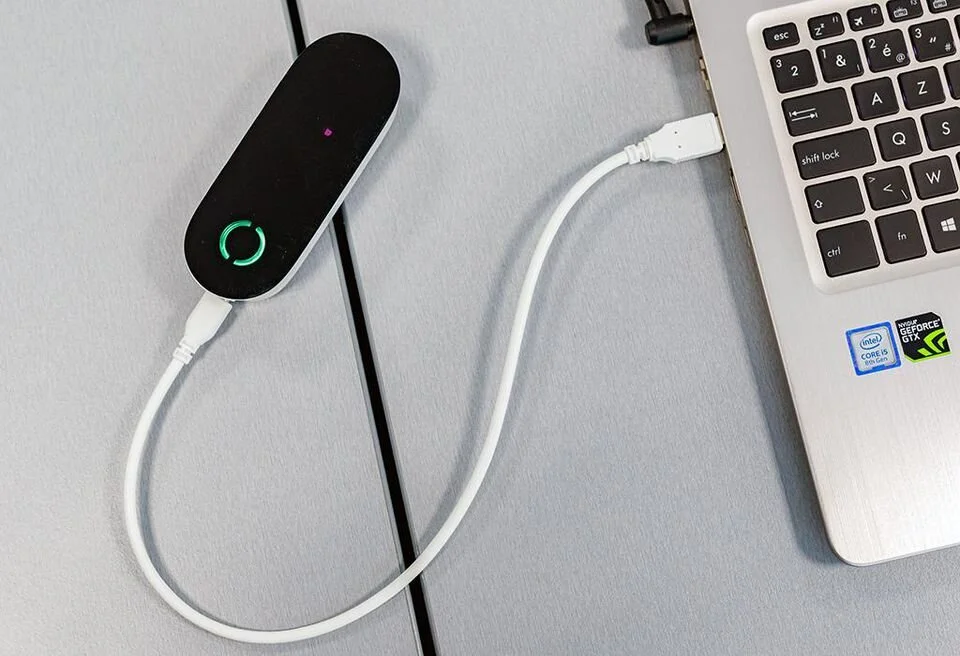
            Tom Setaro: “So LiFi. And I guess I just talked about it from a basic standpoint for this podcast. LiFi is a wireless communication technology. And it uses light waves, instead of radio waves, the radio spectrum is very constrained. LiFi, however, is capable of transmitting data over light at high speeds. And we use the light spectrum tied to visible light or infrared light. LiFi is mostly used in areas where wireless is a must-have. But where the use of radio is not available. Radio doesn't work reliably, or is just flat out by governance not allowed. So devices need a LiFi receiver, like a USB key and a transceiver connected today. Our system works with Windows, it works with Mac OS. And then we proceed in the future that the LiFi technology will be available on tablets, smartphones, AR, VR, and XR. Which is virtual reality mixed reality, or augmented reality, where LiFi is integrated directly into the device. So that's what LiFi is, it's basically a wireless communication for sending data packets. And instead of using radio, it uses light.

            Donovan James: “Okay, okay. So is, what do you think? Is LiFi ready for the world? You know, in terms of like supply and demand?

            Tom Setaro: “Well, yes, the product is readily available for sale. And it's been installed in a lot of locations around the globe, but the footprint of LiFi is extremely small compared to what WiFi is. So, there is an immense total addressable market which can be penetrated yet. So as this product continues to grow in awareness, and as a normal evolution of IT products would go, we will see a much larger market share. But the research and development have been done over the last number of years, and we're starting to ship to the second generation.


            Roger Williams: “I got a quick question. How do you think LiFi is gonna match up with the Internet of Things? I know the Internet of Things is a very big industry right now. And where do you see LiFi, helping the Internet of Things, blockchain mining and inexpensively the gaming community? How is it going to have an effect on all these industries that are getting ready to open up the internet, per se?

            Tom Setaro: “Yeah, that's a good question. So to us, you know, we look at the data globally, and the worldwide data volume for Internet traffic doubles every two years. So you know, we go back to let's say 2018, You're looking at about 20,000 petabytes per month. Now you're looking at close to 80,000 petabytes per month in data traffic. So when you start seeing cars coming online, and you have to see that you know what, well talk to me about cars coming online. Well, if we're gonna have autonomous driving or driverless vehicles, they have to communicate with their environment and continue to know where they're going, what maps they're going to announce, they're going to take or they're going to be safe for people. And so you're going to have an internet connection tied to every lamppost, every highway sign, every Tollbooth, every car, and then for the drivers inside the car, what are they going to be doing, someone's not going to be driving, they're going to be sitting, communicating, whether it be on a, on a wireless device for data, or communicating, you know, via the internet, video conferences, or other people and other cars are doing commuting. Then you have all the wireless remote workers.

            As we started moving after COVID to a lot of remote environments, the amount of internet traffic that has moved to the household has tripled. And so now your Xbox is connected, your desktop workstation is connected, your refrigerator, your stovetop, every all of these devices are connected and communicating in the background, consistently. So as that data continues to grow, you start to say, well, how can we handle all that network traffic? As I heard described earlier, the cellular 4g bandwidth is getting close to maximum capacity.

            And so 5g has been created to create more bandwidth. Well, one of the concerns about cellular on the 5g side is the cost of it. The government sell to the wireless carriers, and there's bandwidth for billions of dollars, which they, in turn, pass on to the users. And that's why a lot of times people will turn off their cellular data connection or will only receive the internet wirelessly because they don't want to pay that cost for how many gigs per month they transfer on their phone.

            So then WiFi is another way to connect wirelessly. Well, that works great except it's only using radio for how many times have you gone into an area where they said well don't turn your cell phone on, on a plane, in surgical intensive care inside of the hospital. The military and the government fulfilled positions concerned about people hacking them, or jamming them.

            The airports with the FAA just told Verizon and ATT not to put any 5g towers near the Airports Worldwide because the planes have an altimeter, which is a radio altimeter and it uses radio frequency to determine how hard the plane is from takeoff and landing. And if it was to interfere with someone who was connecting to Facebook, on their 5g phones, that can be a life and death scenario. So they just say you know what, no 5g Around, around the towers and around the airport landing strips. So, 5g does have interference, it does have concerns. There are also a number of studies out there that you can Google about the safety of 5g and 5g to be able to work outside the 4g spectrum. It has increased the amplitude and the frequency of those radio waves. So basically, if you would have a stereo system 4g would be at a level two-volume, and with 5g, it turns it up to a level 10 volume. And so it's blasting the airwaves with the 5g things, schools out in Europe, in Italy, in Germany and France, they're starting to prevent them from going inside the school systems because of health reasons. There are a number of groups out there and you're starting to investigate how safe is 5g or not. You know, having confidence in the amount of billions of dollars that are put into these technologies, they'll figure out a way to make sure that it's safe. But they are rolling it out fast and there are concerns that go around it.

            So you know, LiFi uses visible light and uses infrared light. These have been used for many years like in their television remote, infrared, you know a fibre optics really using light to transmit data. But this isn't really the first time it was a commercial application for using light to transmit data packets wirelessly. So it's not a replacement for cellular. It's not a replacement for wireless. Think of it as a replacement for hardwire cable. Think of it as it another flavour of ice cream. It's not chocolate. It's Rocky Road or strawberry, but it gives you more options. Each has its advantages. And each has its concerns, which makes it another great possible solution. Where the technology is today, we're finding niche markets that see its use cases and the applications for it. As time goes on, and the product continues to develop and evolve, as you would expect with any IoT product, it gets miniaturised, the price gets commoditized, and the speed gets increased, no more expecting a substantial increase in adoption as we go forward.


            Donovan James: “Okay, so, when do you think LiFi will be more mainstream?

            Tom Setaro: “Yeah, that's a good question. So, you know, from my viewpoint, LiFi is the technology that enables those groups that you just described like gaming, and those kinds of areas, it's like kind of talking about the highway, you know, people talk about the cars on the highway and how fast they go, they don't talk about the highway itself. So we're the technology that enables, those are the areas I like to describe it as a use case, versus applications. So for the use case, we would say our technology allows you to have a consistent stream of data. Light is much more stable than radio, it doesn't respond to electromagnetic interference. So it stays consistent. It doesn't have latencies that radio waves will have from bouncing off metal objects. So with a stable connection, well, that would be the use case, the application that might want to support that use case, or find that use case, beneficial, would be gaming, you don't want to be on a game. And all of a sudden, in the middle of Halo, your player freezes up, because your WiFi connection froze up, whether it be someone turned on a microwave, or your neighbour has a very noisy WiFi IoT device, and then yours freezes up. And then because of it, you lose your advantage in the game. And for gamers that use that application need is very important to them. And so how could they fix an inconsistent data stream with latencies and drops that they're getting on WiFi? Well, they can use, they can, they can convert their, their highway to LiFi. And they don't have the starts and stops. So besides streets, they would be on the highway, there will be high speed, it would be consistent, it would be stable. So we're kind of the pavement to enable these other applications that are out there supporting IoT gaming, things of that sort. So you don't hear about it as much in the application. But the networking groups who are very tied to the infrastructure of it, that's where the sound bites are, and the communication itself.


            Roger: “I also want to kind of jump behind you and talk about also traders. You know, trading is like a big thing in our country. You know, whether it be crypto or whether it be, you know, just regular stocks. LiFi probably would definitely affect trading as well, right?

            Tom Setaro: “Yeah. So again, so what you would do is you would put up a use case to say, who would desire a high-speed, stable connection? That would be the question that would be posed. And then every industry is going to have some kind of response. You're right for financial institutions that are involved in trading. Yeah, I don't, you know, if I'm someone who is doing arbitrage, and they're transacting deals, you know, 1000s per second, or hundreds of 1000s per minute, they have a drop in technology they can monetize with that drop cost them, they couldn't do 10,000 trades that minute, and in trade with another than $1. And they all of a sudden drop their connection for one minute. Well, that just cost them $10,000. So they can monetize that very directly. And that would be their application and their cost. And the gaming world as we just used an example that would cost a user a life. And again, that may not mean that much monetarily, but emotionally to the user, that could be substantial. So again, so we put the use case out there. That can go for military, you can go for federal, it can go for a lot of areas where having no downtime is important. And you hear about things like even on the cloud, on the web, and you hear those terms, you know, five nines or four nines that determine how much downtime they have in the course of the year. And then can you convert that downtime into minutes, which then time is money and then into dollars? So how much does that downtime cost you monetarily? And then those are the folks who would say, yeah, consistent high-speed cable was paramount to me and my business. One of them is that LiFi plays well.


            Donovan James: “Okay, so along the lines of those downtimes, you're talking about, I mean, I've been watching, as much as America, I'm sure when it comes to streaming, I'm not as big as in gaming, but I love watching movies. And I know my WiFi is not the best, you know, all the time, I'm in the middle of a movie and it goes down. But what do you think? You know, when when you're comparing the two? What do you think? Like, do you think LiFi is better than WiFi? And if so, why?


            Tom Setaro: “So there's a lot of reasons why your TV set can put up those three dots and not be connected. It could be because of your ISP provider, it could be your routers having problems, there can be a number of reasons why that happening, and your wireless connection is just one of many. But if that is what the cause of it is, then yes, then you can be in an environment where maybe your WiFi access point needs to be replaced, because it's an older version, and it's not keeping up. Or it could be the fact that you have a microwave. A lot of people don't have shielded microwaves or turn the microwaves on and the WiFi goes down for a period of time if you have a lot of noise. So the more IoT devices that you have your refrigerator, your stove, your Xbox, your wireless laptop, your tablet, your phone, these are all hitting the antenna have the WiFi simultaneously. And then the antenna has to try to juggle all of them. And it gets overloaded with the number of people that want to send and receive it. And so because of that, it can't accommodate all signals simultaneously. And so then all of a sudden, your phone doesn't get the response. And so maybe that website hangs for a couple of seconds, which you may or may not notice, or your refrigerator can communicate on its temperature, probably not that big of a deal.

            But now you're streaming a movie, and then your movie holds up. You notice that immediately in every pore stop, pause, stop. And as a business user, I noticed that in my Zoom meetings, or MIT's meetings, and the video pauses, or gets choppy. So So one of the use cases, and there is only one of the use cases that we're describing where LiFi has benefited over WiFi is in the consistency of the segment. And then those are some of the applications that are tied to the other use cases that are out there. Security. It provides a physical layer of security that WiFi doesn't provide. It has a wider bandwidth, the waves are shorter. And by having shorter ways you can handle a lot more data on it. So a lot of people talk about speed. Oh, is it faster? Well, if you were to tell me you're going to put a car on the highway and the car goes 55 miles an hour, and I put my car on the highway. And it also does 55 miles an hour. is one faster than the other? Well, the answer is no. But LiFi because it has 10 times the bandwidth. So are the cars going faster now, but am I carrying more data, a substantial amount, and that 10 times more data. So now if you're uploading and downloading data, that movie can buffer a lot more data and have it sitting there local on your TV set. So even if it did have some level of interruption, you would never know because it's already buffered enough to character not the next two to three seconds, but maybe 20 or 30 minutes. And that's because you can do this throughput in the background. And so again, the user experience is improved. So throughput is better, security is better. Consistency of connection is better. And then those are the use cases and the applications that come with it. I think the other party questions do I think, life algorithm washroom or WiFi as new technology. And as new technology goes through a normal evolution curve.

            As time and Development continued with the products, as I mentioned before, they get miniaturised and commoditized. And then eventually, the big thing for the big jump was the one they get integrated into the devices where when you buy an iPhone, or you buy a Dell laptop, it's just gonna have WiFi in it. That's not the case today. So today, we have to use a USB key. And we use a transceiver for the infrastructure and the connection between the two. But the technology by far is a great innovation, it's kind of like when we were back in the late 90s. And people had those SD cards that they put in with the antenna on the laptop so they can communicate. And then eventually they integrated those circuits, they made them a lot smaller. So they're just they're the size of a thumb. Now, they're integrated into laptops. And so you just buy and when you buy a laptop, you get it out of the box, that's where this technology needs to go if it's going to get caught on fully mainstream. But the technology is a great innovation, it's got a fantastic future ahead of it. And so that's where we see the total addressable market. And then the long-term vision is where there is light, there's data. And you don't have to think about it to come into a room. You know, light bulbs are on or even if they're off, they don't need to be on for LiFi to work. It works with infinite infrared, which is not visible light. But wherever you would have light, you would have data, you don't have to think about, oh, I have to have an access point. And I have to have radio, I want to have lights over my desk where I work, wherever there's like there's data, that's where it's gone. And LiFi is the way to go.”


            Roger: “So basically, you're saying is LiFi, mainly a rural area solution for service? Is it going to penetrate the urban markets?


            Tom Setaro: “Yeah, so right now it's more of a business solution than it is a more of a consumer solution. It'll become a consumer solution. When you walk into a Starbucks, and they have LiFi infrastructure in place, then you'll be able to say, I've got a LiFi enabled device, and I can use it there. So it's not there yet. So it's not a mass adoptable consumer solution today. And I say today, in terms of why would LiFi exists, or as a solution. Yeah, so everything offers a different thing. But the way that I received that question is, you know, is a car you know, gonna get replaced by a bus. And that's kind of what LiFi and WiFi are, there will always be WiFi. And there always be a place for WiFi. WiFi is ubiquitous today with anyone who says kind of wireless outside of cellular. So those are the two wireless solutions. There are other ones out there, right? There's Bluetooth, there's NFR there's a new one that Apple just pushed out when you go on iPhone or an iPhone and you transfer massive pockets. Each one has benefit and use. So it's where it is a carve out the market. What is the total addressable market that these solutions can have? Wireless WiFi we know one of its Achilles heels, has been kind of explained already is that there's an inconsistent connection. And there's latency, the speed that you get to your Desktop is determined by your ISP. So, urban areas or rural areas even more so that have slow internet speeds, it's more a function of the service provider putting out slow speed than it is their WiFi connection.

            In fact, in most meetings, most videos, and the movies that you're talking about, it's not the speed that you're transferring at, that's causing the problem. It's the WiFi dropping coming back online, dropping and coming back online because it's juggling multiple wireless devices simultaneously. So, it drops for a millisecond, you don't say it drops for a second, maybe you pick up on it drops for a half a minute, now, you'll begin to notice that the drops are two to three minutes or five minutes or five minutes. Now you're frustrated, and you're calling someone. So these continue constantly because the interference is constant. And so the devices continually try to work ways around it. And the latest solution because it's gotten so congested is to come out with 5g. And it's just a way of just turning up the amplitude of 4g. That's really simplifying what 5g is, but in essence that whether it is to LiFi just says forget it, let's get off the streets, I got a whole brand new empty Highway over here that you can travel on, you can't go further than the speed limit that's set by the government, let's say making an artificial analogy. But the road is empty. There are no potholes, there's no stop signs, there's no red lights, you get on and you go. And so that's where LiFi is kind of coming to market. But it can't replace WiFi today, you can't use it on any endpoint or device that doesn't have a USB port, because it needs that USB key to be attached to it. When that eventually gets integrated, then you don't have to worry about that. So today business users who see the advantage of both paying for LiFi and WiFi together in a hybrid environment, it makes sense for the individual user for the home users. We have a lot of executives who are saying you know what, I want LiFi on my home. My kid comes home from school. And every time he gets on the Xbox, my Zoom meetings, crash, or, Hey, you know what I'm transferring, very secure private data, my financials, my r&d, whatever, I don't want someone outside my building, or outside my house, stealing my wireless data packets, and creating a security problem for me.

            So with LiFi, they know they're never going to have interference from the Xbox or the refrigerator, or the noisy neighbours whatever. And they're never going to have a security problem working wirelessly because it works with line or line of sight security. So again, what is your application in need? And what is the best technology that's going to support that need? And LiFi certainly supports those multiple areas, those use cases that I said are better than WiFi. Now he turned to me and said, I just want cheap, cheap wireless, WiFi is not the answer. WiFi is a much better solution. It's less expensive because it's been commoditized for the last two decades. And radio, you only have to put up one access point. Because radio goes through walls, it goes through windows, it goes through floors. So you put one up and you can cover your entire building. That's great. If you're worried about infrastructure costs. It's not great if you're worried about security, and people pulling packets out of the air because that part that CFO or that executive working from home is at his desk. His signal can be seen from 10 feet, 100 feet, and 100 yards. And so that's where the security leak or the breach comes through. If you go out there and Google, NSA, national security, NSA, no WiFi, they just put a public out there just put a post out there publicly on Eric called zero trust and WiFi and they will not allow any federal agency or military person to now using guest WiFi because they recognise the threat of data being stolen.”


            Roger: “Also, I guess safety. I mean with the radio waves. I mean, that's another issue as well having that, you know, strung up throughout the whole house or you know if that's something that you're willing to risk. You know, having the radio waves throughout your whole house as well. Right?


            Tom Setaro: “Yeah with 5g because 5g Now is a technology that also doesn't go through walls, which actually there they find as a detriment If you have to put 5g transmitters in all of your rooms, and the amplitude is getting turned up, I mean, it's exponential the number of radio waves that you're bombarding your body with. With 5g versus the 4g that's out there today, it's exponential. And we don't know what that's going to do for a long time. There are studies, and there's a lot of posts, and there's a lot of communities talking about that, that you can go research.


            Roger: “What economic opportunities come from that?"


            Tom Setaro: “Well, so everything works backwards, you know, ROI, and our I'm gonna allow, I guess, you know, everyone to identify what their own individual benefit and both financial or you know, performance or whatever capabilities that they determine are beneficial for them. From my standpoint, the total addressable market of LiFi is enormous. I moved my personal career from a well-established 800-pound gorilla networking, which is Cisco, to come to Signify. And so I believe in the technology and where it's going to where it's gonna go. It's in the early stages. And so for some people, that could be scary, because well, hey, is not a proven solution yet. But I'll tell you, the alternative is once it becomes a proven solution, then it's going to be well, hey, there's, there's not a lot of everybody's selling it, and everybody has been, where's my opportunity? Why? So we're in the early adopters' phase or the product development is moving leaps and bounds. We, a few years ago, didn't have a product itself and we came up with our second generation. The third generation should be out beginning of the New Year potentially. We have competitors who are entering the marketplace, which is good because the more awareness that gets of the technology, the more the public will know about it, and the more adoption that will be. So we are absolutely in an innovative and awareness space. So I have not come across anyone that I've spoken to when I begin to explain the technology that doesn't get excited about it. And where there's excitement, generally, people are going to want to say how can I have it? And where can I use it? And we continually have and again, I break it down to use case applications. I have a lot of applications that come back to me that I didn't even think of our will do you know, inside of bank vaults. The door is magnetically sealed. We can't use WiFi and I didn't know that. You know, you can make DVDs. So we can transmit wirelessly from inside the bank bowl. Well, that's great, because we keep running in and out of the bank wall to enter. Again, I have no idea. Okay, so I've worked for banks over casinos that had bank walls, also. And so now that there's a whole other application. So, you know, there's so much out there that can be done. We're not even the eyedropper of the iceberg at this point. So I'm just leaving it at that in terms of opportunity.”


            Roger: “And then I got one more question. From a Trulifi perspective, what are the challenges in bringing LiFi systems and other LiFi products to the mass market users?


            Tom Setaro: “It's just a matter of time. The product is still going through its innovation phase. It'll continue to get smaller and miniaturised into existing products, tablets, smartphones, and laptops out of the box, it'll increase the speed; the opportunity for light to be faster than radio is, I think obvious. Light travels substantially faster than radio could ever travel. You hear about planes, travelling at Mach one, Mach two, Mach three, where mach two is two times the speed of sound, that's 780 miles per second, light travels at 186,000 miles per second, but it's, it's substantially fast. So, it can outperform radio in so many different capacities, also, because the light wave is shorter if you carry 10 times the amount of data. So you think about it yourself. I've got a technology which is safer, faster, and can carry more data. Cheaper, light spectrum versus a cellular spectrum? Yeah, I think it's just a question of when, how fast can you get these products to evolve? Where the components are not in a USB key, but integrated into the device? How could before we ramped up the speeds commoditization, as we get more manufacturers and competitors who are selling these same integrated circuits will commoditize and bring the price down? All those things will lead to faster adoption.


            Podcast Recording


            You can also listen ad download the raw audio recording below from the part where LiFi was being conversed:


            Li-Fi Conference 2022


            The Li-Fi Conference 2022 Edition was a great success. Li Fi Tech News will very soon write articles on the topics treated at the Conference.

            What is LiFi?

            LiFi, also known as "Light Fidelity" is a wireless optical networking technology, which uses light-emitting diodes (LEDs) to transmit data. In 2011, professor Harald Haas made a LiFi demonstration at the TED (Technology, Entertainment, Design) Global Talk on Visible Light Communication (VLC).

            VLC uses light as a medium to deliver high-speed communication like Wi-Fi and complies with the IEEE standard IEEE 802.15.7. The IEEE 802.15.7 is a high-speed, bidirectional, and fully networked wireless communication technology-based standard similar to Wi-Fi's IEEE 802.11.

            How does LiFi work?

            LiFi is a high speed, bidirectional, and fully networked wireless communication of data using light. LiFi constitutes of several light bulbs that form a wireless network.

            When an electrical current goes through to a LED light bulb, a stream of light (photons) emits from the lamp. LED bulbs are semiconductor devices, which means that the brightness of the light flowing through them can change at extremely high speeds. The signal is sent by modulating the light at different rates. The signal can then be received by a detector that interprets the changes in light intensity (the signal) as data. Also when the LED is ON, you transmit a digital 1, and when it is OFF, you transmit a 0.

            LiFi Benefits

            The primary benefits of LiFi are as follows:

            Security: Provides entirely secure access. Where there is no light there is no data.

            Safety: Does not produce electromagnetic radiation and does not interfere with existing electronic systems.

            Localisation: Allows localisation due to the small coverage area of LiFi access point - localisation can be used for very precise asset tracking.

            Data density: Provides ubiquitous high-speed wireless access that offers substantially greater data density (data rate per unit area) than RF through high bandwidth reuse.

            Credit to Oledcomm

            LiFi Applications

            LiFi can be used for so many applications and the list is increasing every year. You can read our updated list of Li-Fi applications at the following link:

            https://www.lifitn.com/blog/2021/2/13/top-30-li-fi-applications-updated-list-including-potential-applications

            Credit to pureLiFi


            LiFi Systems Reviews by LiFi Tech News


            OLEDCOMM LIFIMAX KIT REVIEW - ONE YEAR IN

            We reviewed the LiFiMax kit produced by the leading French LiFi company Oledcomm. We bought this LiFi kit system at the end of 2020. After over a year of use, we decided to write a review of this LiFi system. We looked briefly at the profile of Oledcomm, a brief history of the LiFiMax system, the Kit box contents, some testing and performance results of this LiFi system, the customer experience and our own verdict (the good and the bad points) of the LiFiMax kit.

            You can read the review on this link:

            https://www.lifitn.com/blog/lifimaxreview


            SIGNIFY TRULIFI 6002.1 STARTER KIT SYSTEM REVIEW


            We also reviewed the Trulifi 6002.1 starter kit produced by Signify, the world leader in lighting for professionals, consumers and lighting for the Internet of Things. We got this LiFi kit system with the help of PCDSI and Signify around August 2021. In a similar fashion done with our previous review of the LiFiMax kit a few months ago, we will look briefly at the profile of Signify, a brief history of the Trulifi 6002.1 kit, the Kit box contents, some testing and performance results of this LiFi system, the customer experience and our own verdict (the good points and the bad points) of the Trulifi 6002.1 kit.

            You can read the review on this link:

            https://www.lifitn.com/blog/trulifi6002review


            In conclusion, if you are also interested to hear more information about the OWNII Coin or enquire about LiFi devices such as the LiFiMax and Trulifi, you can contact us through our chatbot or by sending an email through our contact us form. If you enjoyed this post and would like to hear more updates about LiFi technology, subscribe to our newsletter. Don’t forget to subscribe to our social media accounts. You can also join our Telegram group about LiFi technology on this link:

            https://t.me/joinchat/FMzOmsEKyJFrU6Af


            pureLiFi Secures £10 Million From The Scottish National Investment Bank

            Table of Contents

              pureLiFi Secures £10 Million From The Scottish National Investment Bank

              Photo credit to Chris Watt

              In today’s article, pureLiFi announced an investment of £10 million from the Scottish National Investment Bank.

              The investment aligns with the Bank’s mission to invest in innovation and industries of the future, creating high-value jobs in world-class businesses.

              pureLiFi CEO Alistair Banham stated the following statements:

              “The Bank’s investment will help us achieve our vision to connect everyone and everything with LiFi.

              “We introduced our technology to the world from Scotland and it is important for us to grow our company and ecosystem from here.

              “Our vision is for Scotland to be a recognised centre of excellence for LiFi. In the future customers from around the world will come to us for our innovative technology and leverage the wider photonics ecosystem that already exists here in Scotland.”

              The Bank’s investment will allow pureLiFi to further develop new technologies while opening up additional markets in areas such as mobile phones, tablets, wearables and other connected devices.

              LiFi solves the biggest challenges faced by current wireless communications technologies by decreasing congestion, improving security and quality of connection

              Jimmy Williamson, Executive Director, at the Scottish National Investment Bank stated the following:

              “The Bank’s investment will support pureLiFi as they look to scale up their operation, allowing them to take the innovative technology to the global market.

              “By backing them the Bank is also investing in highly skilled research and development jobs in Scotland and endorsing pureLiFi’s vision to create a centre of excellence for LiFi.

              “We are excited to provide them with the growth capital that will help them reach the next stage in their development.”

              pureLiFi

              pureLiFi develops technology for communication networks that integrates data and lighting utility infrastructures. It offers a LiFi-enabled device that converts the beam of lights into an electrical signal. The signal is then converted back into data. The company was founded in 2012 and is headquartered in Edinburgh.

              Technologies such as WiFi, 4G and 5G use radio frequencies to transmit data, which produce large areas of radio frequency emissions that are easy to detect, intercept, and can cause overcrowding resulting in slow speeds and unreliable communications due to increased RF congestion. LiFi uses light rather than radio frequencies resulting in wireless communications that are more reliable, significantly more secure, and simpler to deploy.

              The Scottish National Investment Bank

              The Scottish National Investment Bank is a development investment bank, established and funded by Scottish Ministers on behalf of the people of Scotland.

              Development banks seek to invest where the private sector is not providing sufficient investment to businesses or projects that support the development of a country's economy.

              The Bank has been established to operate commercially and is operationally independent of the government.

              The Bank was launched in November 2020 to be a development investment bank for Scotland, delivering patient, mission impact investment to the Scottish economy.

              The Bank will provide patient (long-term) capital to businesses and projects throughout Scotland to support the development of a fairer, more sustainable economy.

              The Bank has the ambition to not only invest its allocated public capital but to encourage additional private capital to invest alongside it, to support the delivery of the missions.

              Scottish National Investment Bank plc is a public limited company incorporated and domiciled in Scotland under the Companies Act 2006 whose shares are not publicly traded. The company registration number is SC677431. The registered address is Waverley Gate, 2-4 Waterloo Place, Edinburgh EH1 3EG.

              The Scottish National Investment Bank has three legal entities in its structure. The Scottish National Investment Bank plc, a holding company for the group; Scottish Investments Limited, the company through which all investments are made and Scottish Investment Services Limited, the operational services company to the group.

              The Bank invests in Scottish businesses, projects and communities to deliver environmental, social and financial returns for the people of Scotland.

              Investments in debt and equity are made on commercial terms based on the needs of individual projects or businesses. The Bank seeks to invest widely and diversely and approaches every opportunity on an individual basis so that the financing offered is tailored to the needs of the individual business or project seeking support.

              The Bank invests in businesses based in Scotland, projects based in Scotland, or businesses seeking to move to Scotland. Typically the Bank will invest in businesses and projects seeking more than £1m in investment support (debt or equity).

              All investments must deliver both commercial returns and mission impact returns that support at least one of the Bank's missions.

              Li-Fi Conference 2022

              The Li-Fi Conference 2022 Edition was a great success. Li Fi Tech News will very soon write articles on the topics treated at the Conference.

              What is LiFi?

              LiFi, also known as "Light Fidelity" is a wireless optical networking technology, which uses light-emitting diodes (LEDs) to transmit data. In 2011, professor Harald Haas made a LiFi demonstration at the TED (Technology, Entertainment, Design) Global Talk on Visible Light Communication (VLC).

              VLC uses light as a medium to deliver high-speed communication like Wi-Fi and complies with the IEEE standard IEEE 802.15.7. The IEEE 802.15.7 is a high-speed, bidirectional, and fully networked wireless communication technology-based standard similar to Wi-Fi's IEEE 802.11.

              How does LiFi work?

              LiFi is a high speed, bidirectional, and fully networked wireless communication of data using light. LiFi constitutes of several light bulbs that form a wireless network.

              When an electrical current goes through to a LED light bulb, a stream of light (photons) emits from the lamp. LED bulbs are semiconductor devices, which means that the brightness of the light flowing through them can change at extremely high speeds. The signal is sent by modulating the light at different rates. The signal can then be received by a detector that interprets the changes in light intensity (the signal) as data. Also when the LED is ON, you transmit a digital 1, and when it is OFF, you transmit a 0.

              LiFi Benefits

              The primary benefits of LiFi are as follows:

              Security: Provides entirely secure access. Where there is no light there is no data.

              Safety: Does not produce electromagnetic radiation and does not interfere with existing electronic systems.

              Localisation: Allows localisation due to the small coverage area of LiFi access point - localisation can be used for very precise asset tracking.

              Data density: Provides ubiquitous high-speed wireless access that offers substantially greater data density (data rate per unit area) than RF through high bandwidth reuse.

              Credit to Oledcomm

              LiFi Applications

              LiFi can be used for so many applications and the list is increasing every year. You can read our updated list of Li-Fi applications at the following link:

              https://www.lifitn.com/blog/2021/2/13/top-30-li-fi-applications-updated-list-including-potential-applications

              Credit to pureLiFi


              LiFi Systems Reviews by LiFi Tech News


              OLEDCOMM LIFIMAX KIT REVIEW - ONE YEAR IN

              We reviewed the LiFiMax kit produced by the leading French LiFi company Oledcomm. We bought this LiFi kit system at the end of 2020. After over a year of use, we decided to write a review of this LiFi system. We looked briefly at the profile of Oledcomm, a brief history of the LiFiMax system, the Kit box contents, some testing and performance results of this LiFi system, the customer experience and our own verdict (the good and the bad points) of the LiFiMax kit.

              You can read the review on this link:

              https://www.lifitn.com/blog/lifimaxreview


              SIGNIFY TRULIFI 6002.1 STARTER KIT SYSTEM REVIEW


              We also reviewed the Trulifi 6002.1 starter kit produced by Signify, the world leader in lighting for professionals, consumers and lighting for the Internet of Things. We got this LiFi kit system with the help of PCDSI and Signify around August 2021. In a similar fashion done with our previous review of the LiFiMax kit a few months ago, we will look briefly at the profile of Signify, a brief history of the Trulifi 6002.1 kit, the Kit box contents, some testing and performance results of this LiFi system, the customer experience and our own verdict (the good points and the bad points) of the Trulifi 6002.1 kit.

              You can read the review on this link:

              https://www.lifitn.com/blog/trulifi6002review


              In conclusion, if you are also interested to hear more information about the OWNII Coin or enquire about LiFi devices such as the LiFiMax and Trulifi, you can contact us through our chatbot or by sending an email through our contact us form. If you enjoyed this post and would like to hear more updates about LiFi technology, subscribe to our newsletter. Don’t forget to subscribe to our social media accounts. You can also join our Telegram group about LiFi technology on this link:

              https://t.me/joinchat/FMzOmsEKyJFrU6Af


              Invitation To Attend and Listen to a Twitter Space Podcast on LiFi Technology and Blockchain Technology

              Table of Contents

                Invitation To Attend and Listen to a Twitter Space Podcast on LiFi Technology and Blockchain Technology

                In today’s article, we will discuss a podcast focusing on LiFi technology and Blockchain technology. Since the beginning of this week, a podcast has been set up on a Twitter space. This Twitter space aims to be a platform where people can have conversations on any topic in relation to LiFi and blockchain.

                As stated by Twitter, Twitter Spaces are where live audio conversations happen. These ephemeral, live audio conversations allow for open, authentic, and unfiltered discussions, and there's a Space for any and every topic and conversation, from small and intimate to millions of listeners.

                The next podcast episode is coming up on Sunday 10th July between 6 pm and 7 pm UK and Nigeria Time. For those based in Europe, the podcast will start at 7 pm. A few selected speakers will discuss their journey and some projects on LiFi technology. Other speakers will talk about Blockchain, NFTs and the upcoming launching of the OWNii coin.

                You are invited to join the podcast space tomorrow at the following link:

                https://twitter.com/i/spaces/1gqGvlldmvqxB

                Li-Fi Conference 2022

                The Li-Fi Conference 2022 Edition was a great success. Li Fi Tech News will very soon write articles on the topics treated at the Conference.

                What is LiFi?

                LiFi, also known as "Light Fidelity" is a wireless optical networking technology, which uses light-emitting diodes (LEDs) to transmit data. In 2011, professor Harald Haas made a LiFi demonstration at the TED (Technology, Entertainment, Design) Global Talk on Visible Light Communication (VLC).

                VLC uses light as a medium to deliver high-speed communication like Wi-Fi and complies with the IEEE standard IEEE 802.15.7. The IEEE 802.15.7 is a high-speed, bidirectional, and fully networked wireless communication technology-based standard similar to Wi-Fi's IEEE 802.11.

                How does LiFi work?

                LiFi is a high speed, bidirectional, and fully networked wireless communication of data using light. LiFi constitutes of several light bulbs that form a wireless network.

                When an electrical current goes through to a LED light bulb, a stream of light (photons) emits from the lamp. LED bulbs are semiconductor devices, which means that the brightness of the light flowing through them can change at extremely high speeds. The signal is sent by modulating the light at different rates. The signal can then be received by a detector that interprets the changes in light intensity (the signal) as data. Also when the LED is ON, you transmit a digital 1, and when it is OFF, you transmit a 0.

                LiFi Benefits

                The primary benefits of LiFi are as follows:

                Security: Provides entirely secure access. Where there is no light there is no data.

                Safety: Does not produce electromagnetic radiation and does not interfere with existing electronic systems.

                Localisation: Allows localisation due to the small coverage area of LiFi access point - localisation can be used for very precise asset tracking.

                Data density: Provides ubiquitous high-speed wireless access that offers substantially greater data density (data rate per unit area) than RF through high bandwidth reuse.

                Credit to Oledcomm

                LiFi Applications

                LiFi can be used for so many applications and the list is increasing every year. You can read our updated list of Li-Fi applications at the following link:

                https://www.lifitn.com/blog/2021/2/13/top-30-li-fi-applications-updated-list-including-potential-applications

                Credit to pureLiFi


                LiFi Systems Reviews by LiFi Tech News


                OLEDCOMM LIFIMAX KIT REVIEW - ONE YEAR IN

                We reviewed the LiFiMax kit produced by the leading French LiFi company Oledcomm. We bought this LiFi kit system at the end of 2020. After over a year of use, we decided to write a review of this LiFi system. We looked briefly at the profile of Oledcomm, a brief history of the LiFiMax system, the Kit box contents, some testing and performance results of this LiFi system, the customer experience and our own verdict (the good and the bad points) of the LiFiMax kit.

                You can read the review on this link:

                https://www.lifitn.com/blog/lifimaxreview


                SIGNIFY TRULIFI 6002.1 STARTER KIT SYSTEM REVIEW


                We also reviewed the Trulifi 6002.1 starter kit produced by Signify, the world leader in lighting for professionals, consumers and lighting for the Internet of Things. We got this LiFi kit system with the help of PCDSI and Signify around August 2021. In a similar fashion done with our previous review of the LiFiMax kit a few months ago, we will look briefly at the profile of Signify, a brief history of the Trulifi 6002.1 kit, the Kit box contents, some testing and performance results of this LiFi system, the customer experience and our own verdict (the good points and the bad points) of the Trulifi 6002.1 kit.

                You can read the review on this link:

                https://www.lifitn.com/blog/trulifi6002review


                In conclusion, if you are also interested to hear more information about the OWNII Coin or enquire about LiFi devices such as the LiFiMax and Trulifi, you can contact us through our chatbot or by sending an email through our contact us form. If you enjoyed this post and would like to hear more updates about LiFi technology, subscribe to our newsletter. Don’t forget to subscribe to our social media accounts. You can also join our Telegram group about LiFi technology on this link:

                https://t.me/joinchat/FMzOmsEKyJFrU6Af


                Signify Talked About The Use of LiFi To Deliver Wireless Data for XR at The AWE USA 2022

                Table of Contents

                  Signify Talked About The Use of LiFi To Deliver Wireless Data for XR at The AWE USA 2022


                  John Parsons, Global Director for GTM Device Integration for LiFi - Augmented and Virtual Real at Signify, delivered a presentation on using LiFi instead of WiFi to deliver wireless data for XR at the AWE USA 2022 event. LiFi is a technology that provides high-speed data wirelessly to XR devices using light waves. Signify is connecting XR devices with stable speeds of 250 Mbps, with ultra-low latency that is stable, safe and secure.

                  John Parsons started his career in technology working for Microsoft EMEA HQ, managing Tier 1 Partners such as Accenture, SAP and Deloitte. John has held positions in fast-growth technology companies within communications and enterprise software applications. For the past 7 years, he has been focused on the Augmented Reality space, working as the lead for PTC (Vuforia) within the Military and Defense segments for the Americas as well as start-ups within this space.

                  John stated the following statements during his presentation at the AWE USA 2022:

                  “So what's our goal? What do we want to do? My goal with working with this technology is to untether VR. I don't want to carry a backpack and neither does anyone else. I don't want to carry a side piece, no one else does either. I want to have full connectivity, I want to be at two to three, probably gigabytes, upload, download, lightweight, and it's running VR.

                  And that's where we're going to push this into this market because we believe that that is the future. And so I don't believe that Wi-Fi can enable that at this point in time. And I don't think that it will get there if you have multiple users on the same system. And so that gives you a little bit about what we're doing now. We've got a prototype at the V6 booth running on an M400. So you can go by and look at it. It is on their M400 series, but it also will work on their blade and they're the 4000s. We've got the HoloLens 2 working on LiFi, so you have upload, and download capability on HoloLens 2.

                  And we're working with just a couple of other XR device manufacturers in order to bring this into the market. As far as us taking this and adding it on to one of your laptops, we can do that today. We have a dongle, plug it in. It's a transceiver that hits the ceiling, and away you go. So that's easy to do. It's this technology here that we're working on. And it really has to do with microbeam steering. And it has to do with high speeds and has to do with thermals and how we're going to develop this. And untether all XR devices so that you can then have a lightweight device”.


                  You can watch the following YouTube video of the presentation:


                  AWE USA 2022


                  The following information has been taken from the AWE website.


                  Since 2010 over 5,000 companies and 60,000 professionals have trusted AWE to learn, connect and grow their business in the XR ecosystem.

                  Join this inspiring community of XR professionals that brings together:

                  • End-users and solution providers,

                  • Investors and startups,

                  • Creators, developers and brands,

                  • Job seekers and recruiters.


                  What is AWE?


                  The AWE community now operates online and offline around the world, 365 days a year to offer:


                  The HQ for everything Spatial Computing, including Augmented Reality (AR), Virtual Reality (VR), and Mixed Reality (MR), collectively referred to as Extended Reality (XR); as well as enabling technologies such as Artificial Intelligence (AI), bio-interfaces, haptics, 5G, streaming and more.

                  Every minute engaged in AWE contributes to the acceleration of the XR industry, ultimately driving us closer to the goal declared by AWE's cofounder:


                  "If we are able to harness the power of XR and AI to help fight some of the greatest challenges facing humanity, then by 2030 Spatial Computing will be a trillion-dollar industry. The XR community is therefore faced with a moral responsibility to further human progress through technology, and with that comes a huge economic opportunity.”

                  Ori Inbar, AWE co-founder

                  mission

                  Its mission is to help the XR community advance Augmented Reality and Virtual Reality technology in order to further human progress. With the industry successfully reaching the milestone of 1 billion active users of AR in 2020, over the next decade AWE aims to guide the industry’s attention towards our own core objectives of enabling people across the globe to learn, connect and grow within the XR industry.

                  The AWE community is committed to pursuing the goal of building a 1 trillion dollar XR industry by 2030, while ensuring the outcome is a world worth living in.

                  values

                  • Passion for XR

                  • Collaboration and respect to everyone in the community

                  • Openness, diversity and inclusion

                  • Security, safety and privacy

                  • Making a difference in the world


                  Brief History of AWE

                  AWE was first organised in 2010 by augmentereality.org and the primary mission was to accelerate the adoption of augmented reality by bringing together the industry: developers, creators, founders, product leads, C-level executives, enthusiasts, media and analysts.

                  The first AWE event started with only 300 attendees and a handful of exhibitors. Today, AWE events have grown to thousands of attendees from around the world, hundreds of sponsors and exhibitors and an extensive network of professionals in Augmented Reality, Virtual Reality and other immersive technologies.

                  In 2015, the first AWE ASIA event was organised, in 2016 the first AWE Europe event was held in Germany, and AWE Tel Aviv followed in 2018. AWE also introduced its long-running ‘AWE Nite’ series and chapters have since been created in 8 countries and 19 cities around the world.

                  AWE’s annual Auggie Awards continue to be the most recognised AR & VR industry awards in the world since they began in 2010, and today continue to showcase the best solutions and innovations in Augmented, Virtual and Mixed Reality.


                  Over the past decade, AWE has become the most valuable AR/VR global community, always striving to help its members learn and connect, whilst facilitating new business opportunities.


                  The AWE Council

                  The AWE Advisory Council comprises industry luminaries, thought leaders and influencers who share AWE’s aspiration of seeing XR enter the mainstream and become an essential part of our lives and work. AWE harnesses the Council’s depth and expertise in XR to curate the most important and influential people, products and ideas shaping the Spatial Computing industry and form a strong, inclusive and positive force for the future of humanity. Learn more about the council.


                  Signify

                  Signify is the new brand name of Philips Lighting. The name change occurred in March 2018 to represent the transformation from an analogue lighting company into a digital lighting and Internet of Things (IoT) company. Signify is the world leader in lighting for professionals, consumers and lighting for the Internet of Things. The company provides lighting solutions for professional segments such as automotive, healthcare, horticulture, office, outdoor, phototherapy, petrol stations, solar, purification, schools, fashion, cinema, and more. These lighting solutions include indoor and outdoor luminaries, lamps, electronics, lighting controls, lighting control software, IoT systems and platforms.

                  Credit to Signify

                  Signify has also other brands under its belt such as Philips, Interact, Modular Lighting Instruments, Luceplan, Color Kinetics, ILTI Luce and Philips Hue.


                  Trulifi system

                  Signify launched a LiFi system called “Trulifi” back in 2019. Trulifi uses light waves to enable highly reliable, secure two-way wireless communications at speeds far above most conventional workplace wireless technologies.

                  Trulifi uses optical wireless transceiver technology built, or retrofitted, into Philips luminaires. This means customers do not have to replace their existing lighting infrastructure to receive great quality light and wireless connectivity.

                  Trulifi 6002 dongle and USB cable - Credit to Signify

                  The LiFi system comprises of a USB Network Access adapter, LiFi-enabled LED lights and a Trulifi-6002 Plug-In Optical Transceiver. The Trulifi-enabled luminaires can provide wireless connectivity at speeds up to 150 Megabits per second (Mbps) over large spaces, such as meeting rooms and office floors. There is seamless handover between each Trulifi-enabled luminaire enabling users to roam around. The speed is fast enough to stream simultaneously 30 1080p HDTV movies. A USB-access key, plugged into a laptop, is needed to receive the LiFi signal and acts as an emitter to send data back to the luminaire.

                  The Trulifi range also includes a fixed point-to-point system, up to 250 Mbps speed, which acts like a wireless cable. This is ideal for mobile device connectivity. This LiFi system can also be useful to connect robots or machines in radio frequency (RF) harsh environments like industrial plants, or hospitals where RF communications may not be permitted, or where there’s a need to send and receive large data files securely and quickly. Currently, Trulifi is aimed at professional markets, including offices, hospitality, retail, industry, construction and healthcare.

                  Benefits of Trulifi

                  Signify claimed the following three benefits of their Trulifi system:

                  RELIABLE

                  Trulifi is ideal for busy areas, such as multi-tenancy buildings, stations, airports and public areas. Network availability and overload are no longer an issue. Trulifi provides guaranteed bandwidth without interference from other radio communication systems.

                  What’s more, it works in places where radio frequencies are not permitted, restricted or could cause interference – such as in hospitals, some schools, aircraft and industrial plants. It also works where radio frequencies don’t work well or at all.

                  Trulifi actively coordinates traffic, ensuring good quality of service for all users, at all times. It uses the ITU G.9991 LiFi standard. 

                  The new standard, ITU G.9991, describes the system architecture, physical layer and data link layer specification for ‘high-speed indoor VLC transceivers’, the VLC access points within light bulbs.

                  SECURE

                  Trulifi uses AES 128-bit encryption. The Advanced Encryption Standard (AES) is a symmetric block cipher chosen by the U.S. government to protect classified information and is implemented in software and hardware throughout the world for the encryption of sensitive data. Information is accessed using a USB access key. What’s more, an extra layer of security is built-in, as light waves cannot penetrate walls. This all helps to make Trulifi as secure as wired communication. Perfect for applications where security is paramount:

                  • Financial institutions

                  • Government

                  • Police

                  • Military

                  • Data centres

                  • Corporate organisations

                  FAST

                  Trulifi 6002 series has a net data rate of up to 150 Mbps for the downlink and the uplink. That’s fast enough to stream simultaneously 30 1080p HDTV movies.

                  It’s perfect for offices and large spaces as each luminaire transceiver hands-off seamlessly to another. And unlike other LiFi systems, it works with the lights on, dimmed or off.

                  Trulifi 6013 is a fixed point-to-point system. It acts like a wireless cable with a guaranteed net data rate of up to 250 Mbps for the downlink and uplink. It can be used in a host of environments – from connecting machines in a factory to sending large image files in a hospital. Trulifi 6013 is available with Blue, Red and Green lights.


                  Li-Fi Conference 2022

                  The Li-Fi Conference 2022 Edition was a great success. Li Fi Tech News will very soon write articles on the topics treated at the Conference.

                  What is LiFi?

                  LiFi, also known as "Light Fidelity" is a wireless optical networking technology, which uses light-emitting diodes (LEDs) to transmit data. In 2011, professor Harald Haas made a LiFi demonstration at the TED (Technology, Entertainment, Design) Global Talk on Visible Light Communication (VLC).

                  VLC uses light as a medium to deliver high-speed communication like Wi-Fi and complies with the IEEE standard IEEE 802.15.7. The IEEE 802.15.7 is a high-speed, bidirectional, and fully networked wireless communication technology-based standard similar to Wi-Fi's IEEE 802.11.

                  How does LiFi work?

                  LiFi is a high speed, bidirectional, and fully networked wireless communication of data using light. LiFi constitutes of several light bulbs that form a wireless network.

                  When an electrical current goes through to a LED light bulb, a stream of light (photons) emits from the lamp. LED bulbs are semiconductor devices, which means that the brightness of the light flowing through them can change at extremely high speeds. The signal is sent by modulating the light at different rates. The signal can then be received by a detector that interprets the changes in light intensity (the signal) as data. Also when the LED is ON, you transmit a digital 1, and when it is OFF, you transmit a 0.

                  LiFi Benefits

                  The primary benefits of LiFi are as follows:

                  Security: Provides entirely secure access. Where there is no light there is no data.

                  Safety: Does not produce electromagnetic radiation and does not interfere with existing electronic systems.

                  Localisation: Allows localisation due to the small coverage area of LiFi access point - localisation can be used for very precise asset tracking.

                  Data density: Provides ubiquitous high-speed wireless access that offers substantially greater data density (data rate per unit area) than RF through high bandwidth reuse.

                  Credit to Oledcomm

                  LiFi Applications

                  LiFi can be used for so many applications and the list is increasing every year. You can read our updated list of Li-Fi applications at the following link:

                  https://www.lifitn.com/blog/2021/2/13/top-30-li-fi-applications-updated-list-including-potential-applications

                  Credit to pureLiFi


                  LiFi Systems Reviews by LiFi Tech News


                  OLEDCOMM LIFIMAX KIT REVIEW - ONE YEAR IN

                  We reviewed the LiFiMax kit produced by the leading French LiFi company Oledcomm. We bought this LiFi kit system at the end of 2020. After over a year of use, we decided to write a review of this LiFi system. We looked briefly at the profile of Oledcomm, a brief history of the LiFiMax system, the Kit box contents, some testing and performance results of this LiFi system, the customer experience and our own verdict (the good and the bad points) of the LiFiMax kit.

                  You can read the review on this link:

                  https://www.lifitn.com/blog/lifimaxreview


                  SIGNIFY TRULIFI 6002.1 STARTER KIT SYSTEM REVIEW


                  We also reviewed the Trulifi 6002.1 starter kit produced by Signify, the world leader in lighting for professionals, consumers and lighting for the Internet of Things. We got this LiFi kit system with the help of PCDSI and Signify around August 2021. In a similar fashion done with our previous review of the LiFiMax kit a few months ago, we will look briefly at the profile of Signify, a brief history of the Trulifi 6002.1 kit, the Kit box contents, some testing and performance results of this LiFi system, the customer experience and our own verdict (the good points and the bad points) of the Trulifi 6002.1 kit.

                  You can read the review on this link:

                  https://www.lifitn.com/blog/trulifi6002review


                  In conclusion, if you are also interested to hear more information about the OWNII Coin or enquire about LiFi devices such as the LiFiMax and Trulifi, you can contact us through our chatbot or by sending an email through our contact us form. If you enjoyed this post and would like to hear more updates about LiFi technology, subscribe to our newsletter. Don’t forget to subscribe to our social media accounts. You can also join our Telegram group about LiFi technology on this link:

                  https://t.me/joinchat/FMzOmsEKyJFrU6Af