Lucibel is invited by the French Army to participate at the Defense Innovation Agency

Lucibel is invited by the French Army to participate at the Defense Innovation Agency

Lucibel is a french company specialising in the design and manufacturing of new generation lighting products and solutions from LED technology. Lucibel sees that LED revolution goes far beyond lighting and provides access to new markets. For several years, the group has decided to position itself on new uses of LED, namely in well-being (circadian lighting, cosmetics) and light-based communication (LiFi, VLC). Lucibel announces that it has won the contest issued by the French Army in June 2018 for LiFi equipment in the Technical Section of the Army, to test its technology of access to the internet by light.

Following this success, twenty LiFi luminaires were delivered to evaluate the relevance of this solution during an operational readiness exercise.

Lieutenant-Colonel Julien said: “LiFi has great potential for improving the agility and stealth of our command posts. Indeed, this wireless technology can significantly reduce deployment times while ensuring a very strong electromagnetic discretion."

In addition, the Army wanted Lucibel to participate in the Innovation Defense Forum, which is being held on November 22, 23 and 24 at the Cité de la Mode and Design in Paris. The 1 st edition of this forum will present innovative projects led by the French Department of the Army, in the fields of scientific and technological innovation, operational innovation, and innovation in all areas of the necessary support to the armed forces .

It is at the heart of the Forum that the Defense Innovation Agency will present the "LiFi by Lucibel" solution and will offer a demonstration of this technology, in the presence of Lucibel group employees.

Frédéric Granotier, Chief Executive Officer of Lucibel, statess: "The interest of the French Army in LiFi technology offered by Lucibel solution is excellent news. This confirmation of interest opens promising prospects for Lucibel, while Lucibel has just launched its 2nd generation LiFi luminaires, with improved performance and a retail price divided by more than 2 ".

Li-Fi has a very bright future in the many years to come.

Signify releases their Li-Fi system

Signify releases their Li-Fi system

Signify is the new brand name of Philips Lighting. The name change occurred in March 2018 to represent the transformation from an analogue lighting company into a digital lighting and Internet of Things (IoT) company. Signify is the world leader in lighting for professionals, consumers and lighting for the Internet of Things. The company provides lighting solutions for professional segments such as automotive, healthcare, horticulture, office, outdoor, phototherapy, petrol stations, solar, purification, schools, fashion, cinema, and more. These lighting solutions include indoor and outdoor luminaries, lamps, electronics, lighting controls, lighting control software, IoT systems and platforms.

Signify recently released their Li-Fi system. The Li-Fi kit comes with a Li-Fi modem, Signify Philips PowerBalance gen2 luminaires, Ethernet cables and a Li-Fi dongle. You can watch the video blow from TechARP unboxing the Li-Fi kit system from Signify.

With a bandwidth of 30 Mbps, Signify Li-Fi system allows a stable broadband connection for its users. It allows 15 simultaneous users to benefit from a secure connection, under the cone of light. Signify claims their Li-Fi system delivers sufficient speed to make a video call and download and play two HD movies simultaneously.

Signify Li-Fi dongle. Photo from TechARP

Signify Li-Fi dongle. Photo from TechARP

Screenshot from Signify video

Screenshot from Signify video

Screenshot from Signify video

Screenshot from Signify video

Screenshot from Signify video

Screenshot from Signify video

Screenshot from Signify video

Screenshot from Signify video

Screenshot from Signify video

Screenshot from Signify video

Mr Ed Huibers, the head of Business Development Li-Fi at Signify, stated that their Li-Fi system offers fast internet connectivity with no compromise in lighting quality as well. Li-Fi is suited for areas where Wi-Fi connectivity is poor or unavailable. Signify Li-Fi system can be implemented in schools, banks, clinics, hospitals, factories, planes and underground. Li-Fi has a very bright future in the many decades and centuries to come.

Presentation of Li-Fi Technology to President Xi Jinping

Presentation of Li-Fi Technology to President Xi Jinping

China is currently holding its inaugural International Import Expo (CIIE) this week in Shanghai, bringing together a host of participants from around the world from 5-10 November to discuss the current and future landscape of trade and investment. 

The six-day event, the event focuses mainly on imports and brings together thousands of governmental representatives, business leaders, and top officials from international organisations, and also featured speeches from the heads of the International Monetary Fund (IMF), World Bank Group (WBG), and World Trade Organisation (WTO). 

Dame Barbara Woodward, British Ambassador to China, presented the Li-Fi light bulb to China president Xi Jinping. The Li-Fi light bulb was created by pureLiFi, a pioneering Li-Fi company engaged in the research and development of Li-Fi and visible light communication technologies.

From left to right: Dame Barbara Woodward; President Xi Jinping; Dr Liam Fox MP, UK International Trade Secretary; HRH The Duke of York. Credit to pureLiFi

From left to right: Dame Barbara Woodward; President Xi Jinping; Dr Liam Fox MP, UK International Trade Secretary; HRH The Duke of York. Credit to pureLiFi

Alistair Banham, CEO of pureLiFi stated:

LiFi is a connectivity platform that will revolutionise wireless communications for 5G and beyond. China has the highest number of internet users in the world, and LiFi could make a significant impact on China’s wireless infrastructure, providing high-speed, efficient data transfer with unprecedented bandwidth”.

The China Li-Fi market is predicted to be around worth £10.7 billion in 2021 and is expected to grow for the next five years. This new disruptive innovation is also expected to grab a high portion of Wi-Fi market especially in commercial use segment. China is going to be the largest Li-Fi in the world.

Upcoming LuxLive 2018 Conference

Upcoming LuxLive 2018 Conference

LuxLive 2018 event, Europe biggest annual conference, will be held in Excel London on Wednesday 14Th November and Thursday 15th November.  It is also a platform to access the latest innovations, lighting trends and educational and informational seminars to stay up-to-date with the industry today.

LuxLive 2018 is expected to the largest and busiest event of its series.  This event gives the opportunity to network and share best practices with peers from a variety of industries such as education, energy / utilities, building / facilities management, healthcare, government, leisure, hospitality, industrial, retail, real estate, smart buildings and transport.

You can register at the following link: https://luxlive.co.uk/

LUCIBEL LAUNCHES 2ND GENERATION LI-FI PRODUCTS

LUCIBEL Launches 2nd Generation Li-Fi Products

Convinced of the very high potential of light data transmission technologies in the coming years, Lucibel, a major player in Li-Fi technology, is stepping up its technological developments in this field. Thus, four months after the formalization by the international organization IEEE of the creation of the future standard LiFi 802.11bb, Lucibel puts on the market a 2nd generation of products, resulting with his partner, the pureLiFi Scottish company. This 2nd generation will be marketed by Lucibel to its customers from November 2018.

While the global market for Led lighting is estimated at 39 billion euros (£34 billions) in 2023, the global market for light data transmission technologies, including Li-Fi (Light Fidelity, Internet access solution by light), should represent 65 billion euros (£57 billions), according to a study by Research and Markets.

Lucibel is a french company specialising in the design and manufacturing of new generation lighting products and solutions from LED technology. Lucibel sees that LED revolution goes far beyond lighting and provides access to new markets. For several years, the group has decided to position itself on new uses of LED, namely in well-being (circadian lighting, cosmetics) and light-based communication (LiFi, VLC).

In September 2016, Lucibel launched the first industrialised Li-Fi luminary in the world. Since then, this 1st generation Li-Fi has been marketed to more than 100 different customers (end customers such as banks, defense companies, R & D centres, head offices, factories, hospitals, nurseries, ...). These first users of the Li-Fi have confirmed the interest of this lighting solution that allows a wireless Internet connection, secure, without radio waves and offering excellent quality of service.

While the 1st generation has been deployed on pilot projects (experimentation phase), the second will allow a wider deployment (acceleration / expansion phase), thanks to improved performances and a significantly lower commercialisation price.

Lucibel 1st generation dongle - photo credit from Sarath Murukappan

Lucibel 1st generation dongle - photo credit from Sarath Murukappan

With a bandwidth increase of nearly 30% (54 Mbps against 42 Mbps for the 1st generation), the 2nd generation Li-Fi Lucibel will allow an even more comfortable use in Internet access. In addition, this 2nd generation now allows 16 simultaneous users to benefit from a secure connection, under the cone of light, against 8 so far. The product design has been revised to allow better integration of lighting and connectivity features. Two patents have been filed by Lucibel on these new methods of integration between these functions.

Finally, "Power over Ethernet " (PoE) technology, which foreshadows a profound change in building architecture, is now integrated natively in Li-Fi luminaires. This feature eliminates the need for an electrical cable and is a major advance in the evolution of the network architecture of buildings.

Price is a decisive element in the deployment of disruptive technology. The transition from FPGA electronic card technology to an Asic card allows Lucibel to divide the price of its Li-Fi solution by more than 2. Indeed, while the 1st generation was offered at a public price of €2500 (£2200) for a luminaire and a key Li-Fi, the 2nd generation will be marketed €1100 (€ 750 (£662) for the luminaire and €350 (£309) for the key).

These improved technical performance, coupled with a lower selling price, will allow LiFi to position itself as the ideal solution for providing connectivity in all environments where Wi-fi is technically not very or not deployable.

First available in "downlight" version, the range will be expanded at the end of 2018 with the arrival of a Li-Fi panel and, during the first half of 2019, a standing luminaire. Lucibel will therefore offer, from the end of the first half of 2019, a complete range of luminaires to adapt to the broadest needs of its customers.

pureLiFi Products Overview

pureLiFi Products Overview

Since its establishment, pureLiFi developed and released a small number of Li-Fi products. Here is a quick overview of pureliFi’s products over the past five years.

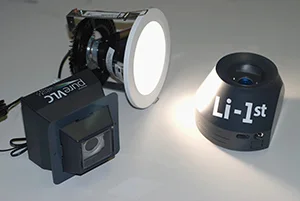
Li-1st

Li 1st.jpg

Li-1st was the first product of pureLiFi released in 2013. The Li-1st marked the introduction of a groundbreaking wireless communication technology. This system became the world’s first LiFi technology available on the market. The Li-1st offered full duplex communication with a capacity of 11.5 Mbps and provided a cost effective avenue to develop Light Communications solutions using off the shelf LEDs. Li-1st had a range of up to 3 meters.

Li-1st Ceiling Unit is connected to the data network via a standard Ethernet RJ45 port. It encodes and transmit the data through the modulation of the intensity of the LED light. The Li-1st ceiling unit receives and decodes the uplink signal using an infra-red detector and optics.

A visible light decoder captures the continuous sequence of light intensity changes. The Li-1st desktop unit decoded the binary stream and transmit it to the client device via an USB connection. The desktop unit receives data from the client device, encodes it and transmits it to the ceiling unit using an infra-red emitter.

Li-Flame

Li flame.jpg

The Li-Flame was released in 2015. The Li-Flame system turns off-the shelf light fixtures into LiFi access  points that can simultaneously communicate with multiple users in a bi-directional fashion. It also consists of the world’s first battery  powered LiFi mobile unit that is attached to a laptop screen and allows user roaming within a room, or indeed an entire building.

The Li-Flame Ceiling Unit connects to an LED light fixture to form an atto-cell, providing communication in that fixture’s illuminated area. The Li-Flame system is unique in that it covers a wide area with multiple ceiling unit access points. The system operates in conjunction with the Li-Flame mobile transceiver unit, which features an infrared uplink and connects via a standard USB to the host device to allow full mobility.

Li-Fi X

534097-purelifi-s-lifi-x-dongle.jpg

In 2016, pureLiFi released their first Li-Fi dongle called “Li-Fi X”. The LiFi-X system consists of an LED light fixture and a dongle that you can plug into a USB port on your laptop. It’s capable of delivering speeds of up to 42 Mbps up and down. It’s already available and in use through various business partnerships.

Harald Burchardt, COO of pureLiFi said: "The LiFi-X is a key step in the future of wireless communications. The product shows the tremendous progress pureLiFi has made over the last 12 months to create a fully USB 2.0 powered dongle that is smaller than a credit card and can be used with tablets. Looking forward, the LiFi-X will provide a state-of-the-art basis for future LiFi products with our partners."

Harald Haas, CEO of pureLiFi, stated: "It's exciting that so many of the tech giants are now engaging directly with LiFi through pureLiFi technologies.  The miniaturisation and world's first integration of high-performance LiFi in a dongle is ground-breaking progress towards a LiFi connected world. We have witnessed rumors that Apple is investigating 'LiFi-Capabilities' in their latest iOS 9.0. I am excited that we have exceeded our technical roadmap, and with LiFi-X we can develop large-scale pilots. We now have a rail-track technology for the lighting industry to develop exciting and new business models around light as a service (LaaS)."

Li-Fi XC

photo shot from Gadgetsboy

photo shot from Gadgetsboy

Li-Fi XC is the 2nd generation dongle released in 2017 by pureLiFi. It is three times smaller than the Li-Fi X dongle and provides lightweight, high speed, secure and fully networked wireless communications through light.  It is the world first certified Li-Fi system. It is compatible with USB 2.0 devices and support Windows 10, Windows 8, Windows 7, Linux and Mac operating systems.  It is capable of an uplink rate and downlink rate of 43 Mbps.

The Li-Fi XC Station Overview

The Li-Fi XC Station Overview

Photo from GadgetsBoy video about Li-Fi XC

Photo from GadgetsBoy video about Li-Fi XC

PureLiFi is a pioneering Li-Fi company engaged in the research and development of Li-Fi and visible light communication technologies.  PureLiFi seeks to resolve the global struggle for diminishing wireless capacity resulting in the Spectrum Crunch. The company is currently developing and delivering technology for secure, reliable, high-speed communication networks that seamlessly integrate data and lighting utility infrastructures and significantly reduce energy consumption.

Over the past seven years, PureLiFi has released a range of Li-Fi products such as the Li-1st, Li-Flame and Li-X.  Their most recent product is the Li-Fi XC. It is three times smaller than the Li-Fi X dongle and provides lightweight, high speed, secure and fully networked wireless communications through light.  It is the world first certified Li-Fi system. It is compatible with USB 2.0 devices and support Windows 10, Windows 8, Windows 7, Linux and Mac operating systems.  It is capable of an uplink rate and downlink rate of 43 mbps.


Alistair Banham, CEO of pureLiFi said:

“Over the past year we have been driving adoption of Li-Fi and deploying real-world applications of Li-Fi for our customers globally. We have now reached the point in miniaturization where we will see Li-Fi move beyond the dongle and be integrated. The Li- Fi XC is a big step towards getting this disruptive technology into every bulb and every mobile device"

Mostafa Afgani, CTO of pureLiFi comments:

“The Li-Fi XC is not just an accomplishment in reduced form factor, we have also made substantial leaps in delivering a great user experience. The Li-Fi XC offers plug and play connectivity out of the box and supports an even wider range of off the shelf LEDs. We have not just improved the design with Li-Fi XC – we have also delivered a module that can enable smart devices and appliances to be Li-Fi connected today.”


Li-Fi XC Station Full list of Features from pureLiFi

  • Fully networked LiFi system providing end-to end IP connectivity

  • Full-duplex wireless link providing up to 43 Mbps in downlink and uplink

  • A single access point (AP) supports up to 8 stations (STAs)

  • PoE/PoE+ and Cisco UPOE support

  • Capable of working with a range of LED luminaires

  • TR-069 remote management as well as SNMP v3

  • DALI building management support

  • Analog dimming control interface

  • EnergyWise support

  • Proprietary protocol for power management/dimming

  • pureLiFi user roaming between APs on the same subnet

  • USB 2.0 powered STA unit allows complete mobility

  • Supports WPA2-Personal and Enterprise (802.1X) authentication

  • Compact design for improved mobility and handling

  • Link status

You can watch about Li-Fi XC station from the top management of pureLiFi at the link below:

An overview of pureLiFi's LiFi-XC System with the CCO Harald Burchardt & Business Development Manager Stefan Ross - Video from pureLiFi

A Li-Fi XC system beta testing will soon be carried out in a residential home in London.  Subscribe for updates about the upcoming Li-Fi beta testing. 

Is Li-Fi safer than Wi-Fi?

Is Li-Fi safer than Wi-Fi?


Wi-Fi

Wi-Fi is currently the most popular communication technology in wireless local area networks (WLANs).

Wi-Fi devices must be fitted with antennas that transmit and receive radio waves in order to allow wireless connections. The devices function in certain frequency bands near 2.4 and 5 gigahertz (GHz).

People using or in close proximity of Wi-Fi, are exposed to the radio signals it emits and some of the transmitted energy in the signals is absorbed in their bodies. The Public Health England (PHE), an executive agency for the Department of Health and Social Care in the UK, published a report from the Advisory Group of Non-Ionising Radiation (AGNIR) about Wi-Fi exposure and its effects on human health.  There are five key points from the report.

Firstly, there was no consistent evidence to date that that exposure to RF signals from Wi-Fi and WLANs adversely affect the health of the general population. Secondly, the signals from Wi-Fi are very low power, typically 0.1 watt (100 milliwatts), in both the computer and the router and resulting exposures should be well within internationally-accepted guidelines.  Thirdly, the frequencies used are broadly the same as those from other RF applications.  Fourthly, based on current knowledge, RF exposures from Wi-Fi are likely to be lower than those from mobile phones. Fifthly, on the basis of current scientific information, exposures from Wi-Fi equipment satisfy international guidelines. There was no consistent evidence of health effects from RF exposures below guideline levels and no reason why schools and others should not use Wi-Fi equipment.

You can read the comprehensive report here.

Li-Fi

The source of light waves used by Li-Fi are LED bulbs.  In contrast to Wi-Fi, Li-Fi does not penetrate walls and hence provide enhanced security in data transmission.  Some experts are concerned that LED exposure can be potentially harmful to health or even damage eyesight. 

CELMA is the Federation of National Manufacturers Associations for Luminaires and Electrotechnical components in the European Union. CELMA carried out a study on the comparison of photo-biological safety of LED-based light sources to non-LED light sources.
It was published that LED-based lighting sources are as safe to use as incandescent bulbs and fluorescent bulbs and that the amount of blue light emitted from them is no different than that emitted from non-LED light sources.   While recognizing the potential issues with excess blue-light levels, the paper staed that the “portion of blue in LED is not different from that in lamps using other technologies at the same color temperature.”  LED lighting is considered safe when used as intended.  The report also discusses optical safety such as the hazards of looking directly into bright, point-like sources, as well as other potential eye and skin hazards.

You can read the paper here.

Unlike other energy-efficient types of lighting, the LED bulb does not emit polluting radiation and therefore does not pose a health hazard.

LED bulbs operate at low voltage and are therefore considered safe compared to any other lighting systems (LED operates at low DC voltage 12 V).

LED lighting also does not emit UV or infrared radiation, it does not contain mercury and is resistant to shocks and vibration even in a particularly cold environment.

In conclusion, Li-Fi can be considered safer than being exposed to an ocean of radio waves.  However, more research studies should be carried out to monitor the effects of LED exposure on human health.