Nadabet Gets Internet Powered By LiFi Technology From Ahmedabad-Based NAV Wireless Technologies Pvt Ltd

Table of Contents

    Nadabet Gets Internet Powered By LiFi Technology From Ahmedabad-Based NAV Wireless Technologies Pvt Ltd

    From a recent article written by The Indian Express, Ahmedabad-based NAV Wireless Technologies Pvt Ltd has been providing LiFi technology and improving the internet broadband needs of Border Security Force (BSF) and tourists at Nadabet, which is the farthest and one of the most secluded points on the India-Pakistan border in Gujarat, since the last nine months.

    Hardik Soni, a co-founder of NAV Wireless Technologies Pvt Ltd, stated the following:

    “Nadabet is located on the border and it is connected by a small road to Suigam (in Banaskantha district) located 30 kilometres away. The saline ecosystem does not allow the laying of underground or overhead optic fibre cables. Radio frequencies cannot be used as it is near Pakistan. So state government was facing an issue in providing Internet connectivity to Nadabet which is now being developed as a tourist location,”

    “Since last nine months, internet provided by this technology is being used by soldiers of BSF and tourists alike. Around 15,000 people visit Nadabet every month and they are able to use the high-speed internet. This is the first big project taken up by the state and central governments to deploy LiFi technology at a spot having difficult terrain and security concerns,”

    “We have connected the optic fibre cable in Suigam to our LiFi devices in Suigam and Nadabet to provide high bandwidth Internet. Multiple users and 100 MBPS (megabits per second) will not be sufficient. So this technology provides speeds in gigabytes,” the official said adding that the telecom infrastructure of BSNL and Gujarat Informatics Ltd has also been used to provide this service.

    “We are not the telecom or internet service provider. We only handle the technology and the equipment,” he added.

    Article source: https://indianexpress.com/article/cities/ahmedabad/lifi-technology-from-ahmedabad-firm-powers-internet-at-nadabet-7928544/

    Nav Wireless Technologies Pvt Ltd

    According to its website, Nav Wireless Technologies Pvt Ltd is a global leading solutions and services provider of wireless and information communications systems with its own R&D facilities, manufacturing base, and sales and service teams. The company offers a comprehensive suite of products and services including Optical Wireless Communication Systems, Wireless Electricity Transmission systems, Electronic Tattoo for Healthcare Monitoring systems, Wireless enhancement products, and subsystems and wireless transmission systems to its global customers.

    NavTech is a technology company focused on Research, Design and Development in the field of Optical Wireless Communications, Electronic Materials, Renewable Energy – Nanoscale to develop high-efficiency photovoltaic devices. NavTech's R&D initiative brings advanced wireless technologies to improving lives with projects that strengthen economic and social development.

    NavTech product portfolio includes Optical Wireless Communication, Smart LED Lights, Advanced Wireless Transmission Systems, Wireless Broadband and Wireless Access Equipment. NavTech's services range includes consultation, product & network design, optimisation and commissioning.

    Li-Fi Conference 2022

    The next Li-Fi Conference is coming up on the 28th of June 2022 between 10 am and 4.30 pm CET.

    It is interesting to realise that lights that illuminate offices, homes, cars, factories, our streets and more locations also can connect us to data and hence power the growing demand for connectivity and speed.

    At this conference professionals from all over the globe will gather together in order to share applications, ideas, new developments and ways to integrate Li-Fi in services, both for consumers and professionals.

    This conference will be held Live and Online. The venue will be the High Tech Campus 1, The Strip 5656 AE Eindhoven The Netherlands.

    Online tickets can be bought at the following link:

    https://tikcit.com/register/61e002336d7fc4b6745cab83/

    What is LiFi?

    LiFi, also known as "Light Fidelity" is a wireless optical networking technology, which uses light-emitting diodes (LEDs) to transmit data. In 2011, professor Harald Haas made a LiFi demonstration at the TED (Technology, Entertainment, Design) Global Talk on Visible Light Communication (VLC).

    VLC uses light as a medium to deliver high-speed communication like Wi-Fi and complies with the IEEE standard IEEE 802.15.7. The IEEE 802.15.7 is a high-speed, bidirectional, and fully networked wireless communication technology-based standard similar to Wi-Fi's IEEE 802.11.

    How does LiFi work?

    LiFi is a high speed, bidirectional, and fully networked wireless communication of data using light. LiFi constitutes of several light bulbs that form a wireless network.

    When an electrical current goes through to a LED light bulb, a stream of light (photons) emits from the lamp. LED bulbs are semiconductor devices, which means that the brightness of the light flowing through them can change at extremely high speeds. The signal is sent by modulating the light at different rates. The signal can then be received by a detector that interprets the changes in light intensity (the signal) as data. Also when the LED is ON, you transmit a digital 1, and when it is OFF, you transmit a 0.

    LiFi Benefits

    The primary benefits of LiFi are as follows:

    Security: Provides entirely secure access. Where there is no light there is no data.

    Safety: Does not produce electromagnetic radiation and does not interfere with existing electronic systems.

    Localisation: Allows localisation due to the small coverage area of LiFi access point - localisation can be used for very precise asset tracking.

    Data density: Provides ubiquitous high-speed wireless access that offers substantially greater data density (data rate per unit area) than RF through high bandwidth reuse.

    Credit to Oledcomm

    LiFi Applications

    LiFi can be used for so many applications and the list is increasing every year. You can read our updated list of LiFi applications at the following link:

    https://www.lifitn.com/blog/2021/2/13/top-30-li-fi-applications-updated-list-including-potential-applications

    Credit to pureLiFi

    In conclusion, if you are also interested to hear more information about the OWNII Coin or enquire about LiFi devices such as the LiFiMax and Trulifi, you can contact us through our chatbot or by sending an email through our contact us form. If you enjoyed this post and would like to hear more updates about LiFi technology, subscribe to our newsletter. Don’t forget to subscribe to our social media accounts. You can also join our Telegram group about LiFi technology on this link:

    https://t.me/joinchat/FMzOmsEKyJFrU6Af


    The Mobile Internet Extranet LiFi Access (MIELA) System By PoE-Tic

    Table of Contents

      The Mobile Internet Extranet LiFi Access (MIELA) System By PoE-Tic

      Today, we are going to talk about the The Mobile Internet LiFi Access (MIELA) made by PoE-Tic in collaboration with Signify. We will discuss about the company PoE-Tic, its CEO and founder and the MIELA system.

      PoE-Tic

      PoE-Tic was founded in 2019. PoE-Tic offers its expertise in the implementation of alternative wireless infrastructures: BPL and BPL/LiFi (PoE-BPL and PoE-LiFi).

      To limit radio waves in schools or hospitals, PoE-Tic has designed an exclusive device -PoE-Sea- which allows teachers to cut WiFi terminals at the end of a teaching activity; in accordance with the legislation (Bee law).

      To completely eliminate electromagnetic emissions, PoE-Tic has selected the best LiFi offers that use light to transmit data bidirectionally, with an upload speed of around 100 Mbps.

      The BPL (Broadband over Power Lines) or Courant Porteur pro broadcasts broadband access through power outlets or the lighting circuit. This high-performance technology significantly facilitates the networking of LiFi and/or WiFi wireless access points by avoiding the need to pull RJ45 or FO cables.

      Industries (M2M, IoT), the Smart City, schools or hospitals as well as businesses are among the sectors where the demand for alternative connectivity solutions is growing the fastest.

      With the credit of its founder, Dominique Le Bourse, several hundred schools and numerous installations in industrial and hospital environments; PoE-Tic transmits its know-how to its partners.

      Approved under the “PoE-T” brand; these installers, resellers and integrators established in France take advantage of these innovative alternative technologies by bringing added value to their own offers to win and retain new customers: JOIN THEM NOW!


      The CEO and Founder of PoE-Tic


      Dominique Le Bourse is the CEO and Founder of Poe-Tic. He is also a LiFi expert and the Designer and Manufacturer of PoE-Sea and MIELA: both innovative devices to moderate or totally suppress the exposure of young pupils to radio waves.

      Dominique Le Bourse is an experienced Sales Manager with a demonstrated history of working in the information technology and services industry as well as skilled in Partner Relationship Management, Go-to-market Strategy, Management, Product Marketing.

      He is an expert in alternative networks such as CPL pro, BPL (Broadband over Power Lines), BPL/WiFi, BPL/LiFi and LiFi.

      We asked Mr Dominique Le Bourse some few additional questions about its company and the MIELA product.

      Question 1. Could you tell me more about your business?

      Dominique Le Bourse: I integrate, design and manufacture solutions and products that decrease or eliminate radiowaves in 1st degree schools.

      There is a specific law in France called “Loi Abeille – the name of the ecological deputy” that requires WiFi to be switch off at the end of pedagogic activities.

      Question 2. A summary of your background

      Dominique Le Bourse: Strongly involved in the Education market where I deploy hundreds of PLC (Power Lines) infrastructures inside schools that have been difficult to wire.

      Question 3. Your passion for LiFi technology

      Dominique Le Bourse: an alternative and efficient solution to totally suppress radiowaves when taking benefit of performance wireless access

      Question 4. More information about MIELA like price,et

      Dominique Le Bourse: you can read more information about MIELA on this link:

      https://bit.ly/plaquetteMIELA1

      Though it is in French.

      Question 5. How did the idea of MIELA came to be?

      Dominique Le Bourse: LiFi is expensive for collectivities in charge of school equipment. Equipment installation in ceiling of classrooms can be very costly. Comparing with the use of mobile furniture that houses tablets, I had the idea to actualize a LiFi connection by transforming fixed installation into a mobile one.

      I contacted some LiFi manufacturers and an industrial specialist in medical furniture. I wanted something looking as a pole of perfusion that would be able to rolling and passing doors.

      Question 6. What about your partnership with Signify to produce MIELA?

      Dominique Le Bourse: I had the chance to meet the right guy in Signify that trusted in that “exotic” idea.

      Question 7. Do you have a website about your products?

      Dominique Le Bourse: yes, I do have a website, www.poe-tic.com


      MIELA System

      The sobriety of radio waves in motion

      PoE-Tic develops and integrates alternative wireless network infrastructures that limit cabling work and guarantee sobriety, or even total suppression of radio waves.

      World leader in lighting, Signify has designed the Trulifi offer which allows transmit high-speed data LiFi, with a bandwidth of around 150 Mbps.

      PoE-Tic and Signify have combined their know-how to meet connectivity and mobility needs in environments that must be free of radio frequencies. This is how the MIELA was born; innovative LiFi equipment that combines Mobility, Sobriety and Scalability.

      Mobility : Easily move your wireless LiFi Access Point, depending on your connectivity needs.

      Sobriety: Communicate in non-visible light (IR), without any exposure to electromagnetic fields, in reference to the Bee law of February 9, 2015.

      Scalability: Evaluate the advantages of LiFi in a mobile version, before opting for connected, low-energy LED lighting that will cover all of your buildings.

      What does the Bee Law (Loi Abeille) say?

      LAW n° 2015-136 of February 9, 2015 relating to sobriety, transparency, information and consultation in terms of exposure to electromagnetic waves - known as the Bee law (Loi Abeille), named after the deputy Laurence Abeille whose scope states in article 7 (excerpt):

      I. - [...] the installation of fixed terminal equipment equipped with wireless access [Wi-Fi, editor's note] to the internet is prohibited in spaces dedicated to the reception, rest and activities of children under three years old.

      II. - In primary school classes, wireless access [...] is disabled when not in use for digital educational activities.

      III. - In primary schools, any new installation of a radio network is subject to prior information from the school council.

      THE CONCEPT OF MIELA

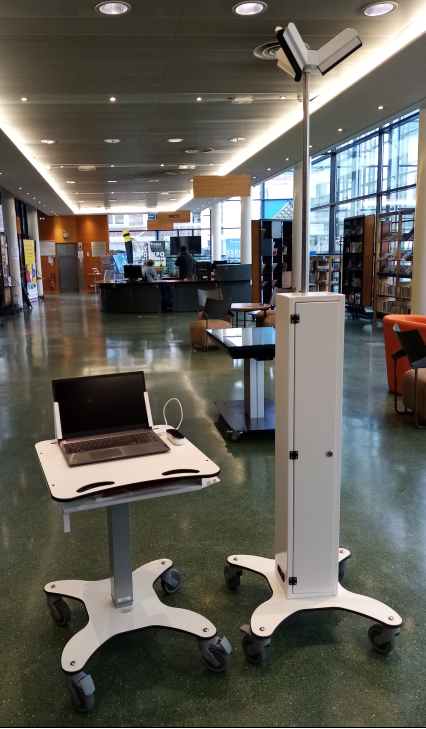
      An Access Point is embedded inside the MIELA.

      Three transceivers are placed at the top of the device which communicate with the USB keys connected to each workstation.

      The Access Point is interconnected to the local wired network (RJ45) or via a Power Line Carrier (CPL) terminal supplied as an option.

      The MIELA is height adjustable from 1.40 to 2.50 m to make it easier to pass through doors.

      Once fully deployed, the MIELA covers an area of ​​about twenty m² in which a maximum of sixteen users can share the high-speed LiFi connection. An optimal speed of 150/140 Mbps is obtained at 1.20 m from the USB key when the MIELA is set at 1.80 m from the ground; with a 60 cm worktop.

      MIELA TECHNICAL CHARACTERISTICS

      Trulifi configuration (starter kit): an Access Point, three transceivers and a USB key.

      Number of connections per MIELA: a maximum of 16 Trulifi 6002 USB sticks can be managed by one Access Point.

      Electrical protection: chassis electrical socket with switch + 16 A circuit breaker.

      Wired network connection: RJ45 frame F/F socket.

      Height (min / max): 1.40 / 2.50 m.

      Dimensions of the mobile base: 55 x 55 cm

      Wheels Type: Four Ø 95 mm wheels, two of which are fitted with a brake.

      Total weight: 24 kg.

      PLC configuration (optional): a Dinrail G.hn or HPAV2 module.

      Main advantages

      As stated by Dominique Le Bourse, the MIELA makes it possible to have a LiFi wireless connection as close as possible to the users, without the need to carry out costly and tedious preliminary work. In addition, compatibility with PLC allows the MIELA to have broadband access to all power outlets, without any additional wiring.

      Thanks to MIELA, nurseries, neighborhood centres, kindergartens and maternity rooms now have a wireless connection that fully complies with legislation.

      Thus, whether for budgetary or health reasons or simply as a precautionary principle, the MIELA is a major asset for adopting LiFi technology without delay.

      MIELA DATASHEET IN ENGLISH

      https://poe-tic.com/wp-content/uploads/2022/08/Plaquette-MIELA_en_v2.1.pdf

      POE-TIC contact details

      If you are interested in getting more information about their products or purchasing any of their products, you can contact Poe-Tic on the following details:

      Phone: +33 7 64 75 30 28

      Email: info@poe-tic.com

      Address: SAS PoE-Tic | 6, Rue du Bois Sauvage 91000 EVRY-COURCOURONNES

      Li-Fi Conference 2022

      The next Li-Fi Conference is coming up on the 28th of June 2022 between 10 am and 4.30 pm CET.

      It is interesting to realise that lights that illuminate offices, homes, cars, factories, our streets and more locations also can connect us to data and hence power the growing demand for connectivity and speed.

      At this conference professionals from all over the globe will gather together in order to share applications, ideas, new developments and ways to integrate Li-Fi in services, both for consumers and professionals.

      This conference will be held Live and Online. The venue will be the High Tech Campus 1, The Strip 5656 AE Eindhoven The Netherlands.

      Online tickets can be bought at the following link:

      https://tikcit.com/register/61e002336d7fc4b6745cab83/

      What is LiFi?

      LiFi, also known as "Light Fidelity" is a wireless optical networking technology, which uses light-emitting diodes (LEDs) to transmit data. In 2011, professor Harald Haas made a LiFi demonstration at the TED (Technology, Entertainment, Design) Global Talk on Visible Light Communication (VLC).

      VLC uses light as a medium to deliver high-speed communication like Wi-Fi and complies with the IEEE standard IEEE 802.15.7. The IEEE 802.15.7 is a high-speed, bidirectional, and fully networked wireless communication technology-based standard similar to Wi-Fi's IEEE 802.11.

      How does LiFi work?

      LiFi is a high speed, bidirectional, and fully networked wireless communication of data using light. LiFi constitutes of several light bulbs that form a wireless network.

      When an electrical current goes through to a LED light bulb, a stream of light (photons) emits from the lamp. LED bulbs are semiconductor devices, which means that the brightness of the light flowing through them can change at extremely high speeds. The signal is sent by modulating the light at different rates. The signal can then be received by a detector that interprets the changes in light intensity (the signal) as data. Also when the LED is ON, you transmit a digital 1, and when it is OFF, you transmit a 0.

      LiFi Benefits

      The primary benefits of LiFi are as follows:

      Security: Provides entirely secure access. Where there is no light there is no data.

      Safety: Does not produce electromagnetic radiation and does not interfere with existing electronic systems.

      Localisation: Allows localisation due to the small coverage area of LiFi access point - localisation can be used for very precise asset tracking.

      Data density: Provides ubiquitous high-speed wireless access that offers substantially greater data density (data rate per unit area) than RF through high bandwidth reuse.

      Credit to Oledcomm

      LiFi Applications

      LiFi can be used for so many applications and the list is increasing every year. You can read our updated list of LiFi applications at the following link:

      https://www.lifitn.com/blog/2021/2/13/top-30-li-fi-applications-updated-list-including-potential-applications

      Credit to pureLiFi

      In conclusion, if you are also interested to hear more information about the OWNII Coin or enquire about LiFi devices such as the LiFiMax and Trulifi, you can contact us through our chatbot or by sending an email through our contact us form. If you enjoyed this post and would like to hear more updates about LiFi technology, subscribe to our newsletter. Don’t forget to subscribe to our social media accounts. You can also join our Telegram group about LiFi technology on this link:

      https://t.me/joinchat/FMzOmsEKyJFrU6Af


      Signify Announced A Strategic Technology Partnership With Intelligent Waves, Award-Winning, Cyber-Defense Solution, GRAYPATH

      Table of Contents

        Signify Announced A Strategic Technology Partnership With Intelligent Waves, Award-Winning, Cyber-Defense Solution, GRAYPATH

        Trulifi 6002 transceiver - Photo Credit to mobilegeeks

        Signify and Intelligent Waves

        Signify announced a strategic technology partnership with Intelligent Waves, developer of the award-winning, cyber-defense solution, GRAYPATH. Signify LiFi system, Trulifi, and the GRAYPATH software use invisible light waves to allow reliable, secure, two-way wireless data communication, which in turn provide defense personnel with mission-critical connectivity.

        “We are thrilled to partner with Signify, a pioneer in lighting and light-based communication. Together, we will be able to better serve the most demanding and secure special operators in austere environments, and we look forward to integrating Signify’s innovation into the platform.”

        Signify’s unique Trulifi solution provides physical security via dedicated USB access keys and a consistent, high-speed wireless connection through light, while GRAYPATH uses the cloud to randomise and distribute data across multiple paths and encrypted channels. The technology integration enables the secure transmission of data from high-risk operational locations without the danger of information being jammed, intercepted or disrupted.

        Richard Honey, Head of Trulifi by Signify sales, US Defense sector  stated that: "We are excited to offer our solution, in partnership with Intelligent Waves, to the defense industry. Light-based communication, unlike conventional radio technologies such as Wi-Fi and 4G/5G, offers a critical, extra layer of security; it can be controlled within a restricted space and does not penetrate through walls. This benefit has already been recognised by defence customers, with the US Army, Navy and Marines adopting our game-changing LiFi technology."

        John Hammes, Chief Strategy Officer of Intelligent Waves, said: "We are thrilled to partner with Signify, a pioneer in lighting and light-based communication. Together, we will be able to better serve the most demanding and secure special operators in austere environments, and we look forward to integrating Signify’s innovation into the platform."

        According to Joe Vano, Transmission Group Lead, Program Management Office – Tactical Network, Technical Management Division of the US Army, “LiFi can enhance the Low Probability of Intercept/Low Probability of Detection attribute on the battlefield. This helps securing the Tactical Operations Center (TOC) to a higher degree due to its insignificant and largely undetectable RF signature while maintaining high-speed connectivity within the TOC. Reducing our adversaries’ ability to intercept and jam the battlefield Commander’s network while still maintaining a network cable-free environment within the TOC is advantageous.”

        Article source: https://www.businesswire.com/news/home/20220516005122/en/Signify-and-Intelligent-Waves-Enter-Into-Strategic-Collaboration-to-Deliver-Mission-critical-Light-Waves-based-Wireless-Connectivity

        Intelligent Waves

        Intelligent Waves delivers mission-focused multi-domain operational expertise and innovation to the Government through high-impact technology solutions in cybersecurity, data science, enterprise network engineering, software development, and platform mission support. Always ready. Anytime. Anywhere. Any domain.

        Since 2006, they have proudly served federal agencies including the Department of Defense. Their ability to operate globally in a wide range of environments coupled with their deep understanding of customer needs and requirements enables them to provide cost-effective solutions and support the most complex missions.

        Intelligent Waves brings an enterprise perspective to IT infrastructure. Their systems engineers understand the complexities of sophisticated technologies, platforms and user-facing applications and use a disciplined approach to addressing system-of-systems architectures to enable system adaptability, scalability and sustainment. Their comprehensive understanding of IT/IS allows customers to promote a common technical framework and vision across the organization, promoting a better institutional understanding of IT operations and decreasing total cost of ownership for deployed solutions.

        Intelligent Waves supports numerous systems engineering projects for the Department of Defense (DoD) and the Department of Veterans Affairs (VA). Their centralised engineering services include management of their customers technical framework. This includes supporting system optimisation, design, testing, and integration to critical application deployments across an enterprise. Their agile approach to enterprise systems engineering practices help them to deliver higher quality software solutions faster in response to diverse customer needs.

        GRAYPATH

        GRAYPATH (GP) is the award winning, next generation of expeditionary communications. Through its patented IP Spread Spectrum technology, GP leverages the cloud to randomize and distribute message packets through the simultaneous use of multiple transport paths and encrypted channels. GP algorithms optimize throughput by continuously sensing and adjusting the message flow according to channel availability and bandwidth capacity creating a smoother connection even for HD video transmissions. GP dramatically lowers the risk of detection and interception and is nearly impervious to disruption.

        Signify

        Signify is the new brand name of Philips Lighting. The name change occurred in March 2018 to represent the transformation from an analogue lighting company into a digital lighting and Internet of Things (IoT) company. Signify is the world leader in lighting for professionals, consumers and lighting for the Internet of Things. The company provides lighting solutions for professional segments such as automotive, healthcare, horticulture, office, outdoor, phototherapy, petrol stations, solar, purification, schools, fashion, cinema, and more. These lighting solutions include indoor and outdoor luminaries, lamps, electronics, lighting controls, lighting control software, IoT systems and platforms.

        Credit to Signify

        Signify has also other brands under its belt such as Philips, Interact, Modular Lighting Instruments, Luceplan, Color Kinetics, ILTI Luce and Philips Hue.


        Trulifi system

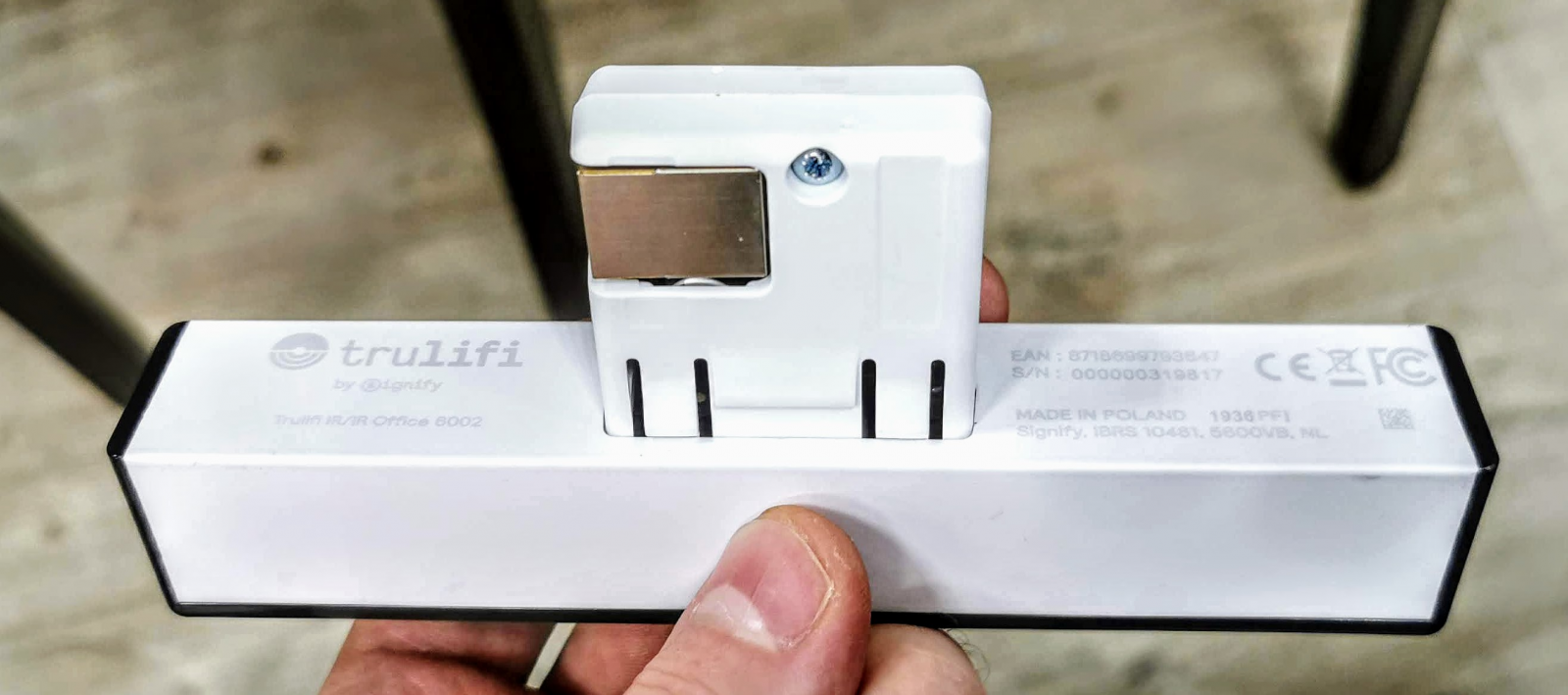
        Signify launched a LiFi system called “Trulifi” back in 2019. Trulifi uses light waves to enable highly reliable, secure two-way wireless communications at speeds far above most conventional workplace wireless technologies.

        Trulifi uses optical wireless transceiver technology built, or retrofitted, into Philips luminaires. This means customers do not have to replace their existing lighting infrastructure to receive great quality light and wireless connectivity.

        Trulifi 6002 dongle and USB cable - Credit to Signify

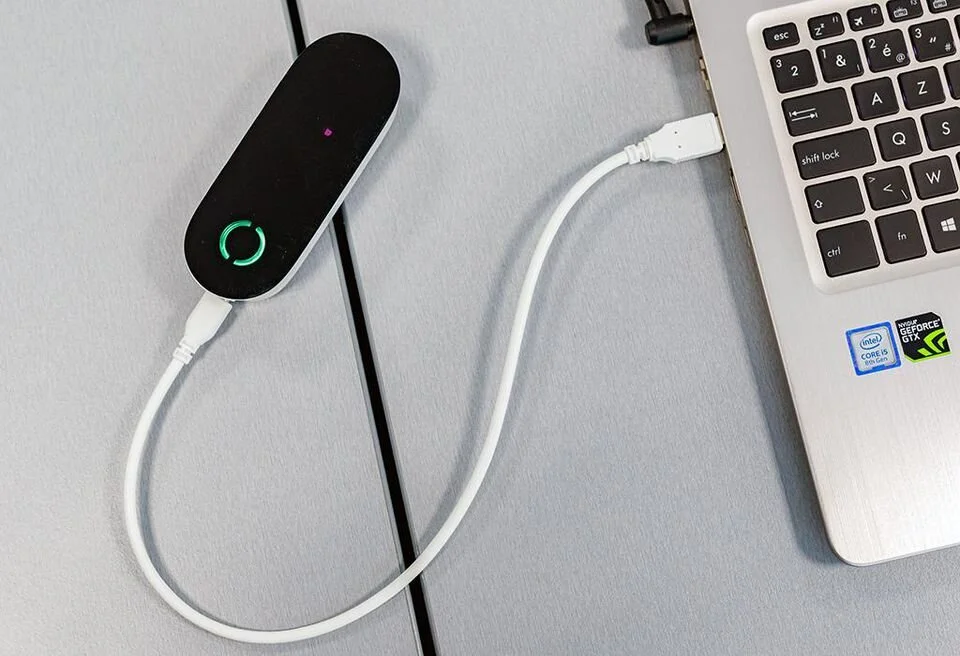
        The LiFi system comprises of a USB Network Access adapter, LiFi enabled LED lights and a Trulifi-6002 Plug-In Optical Transceiver. The Trulifi-enabled luminaires can provide wireless connectivity at speeds up to 150 Megabits per second (Mbps) over large spaces, such as meeting rooms and office floors. There is seamless handover between each Trulifi-enabled luminaire enabling users to roam around. The speed is fast enough to stream simultaneously 30 1080p HDTV movies. A USB-access key, plugged into a laptop, is needed to receive the LiFi signal and acts as an emitter to send data back to the luminaire.

        The Trulifi range also includes a fixed point-to-point system, up to 250 Mbps speed, which acts like a wireless cable. This is ideal for mobile devices connectivity. This LiFi system can also be useful to connect robots or machines in radio frequency (RF) harsh environments like industrial plants, or hospitals where RF communications may not be permitted, or where there’s a need to send and receive large data files securely and quickly. Currently, Trulifi is aimed at professional markets, including offices, hospitality, retail, industry, construction and healthcare.

        Benefits of Trulifi

        Signify claimed the following three benefits of their Trulifi system:

        RELIABLE

        Trulifi is ideal for busy areas, such as multi-tenancy buildings, stations, airports and public areas. Network availability and overload are no longer an issue. Trulifi provides guaranteed bandwidth without interference from other radio communication systems.

        What’s more, it works in places where radio frequencies are not permitted, restricted or could cause interference – such as in hospitals, some schools, aircraft and industrial plants. It also works where radio frequencies don’t work well or at all.

        Trulifi actively coordinates traffic, ensuring good quality of service for all users, at all times. It uses the ITU G.9991 LiFi standard. 

        The new standard, ITU G.9991, describes the system architecture, physical layer and data link layer specification for ‘high-speed indoor VLC transceivers’, the VLC access points within light bulbs.

        SECURE

        Trulifi uses AES 128-bit encryption. The Advanced Encryption Standard (AES) is a symmetric block cipher chosen by the U.S. government to protect classified information and is implemented in software and hardware throughout the world for the encryption of sensitive data. Information is accessed using a USB access key. What’s more an extra layer of security is built-in, as light waves cannot penetrate walls. This all helps to make Trulifi as secure as wired communication. Perfect for applications where security is paramount:

        • Financial institutions

        • Government

        • Police

        • Military

        • Data centres

        • Corporate organisations

        FAST

        Trulifi 6002 series has a net data rate up to 150 Mbps for the downlink and the uplink. That’s fast enough to stream simultaneously 30 1080p HDTV movies.

        It’s perfect for offices and large spaces as each luminaire transceiver hands off seamlessly to another. And unlike other LiFi systems, it works with the lights on, dimmed or off.

        Trulifi 6013 is a fixed point-to-point system. It acts like a wireless cable with a guaranteed net data rate up to 250 Mbps for the downlink and uplink. It can be used in a host of environments – from connecting machines in a factory to sending large image files in a hospital. Trulifi 6013 is available with Blue, Red and Green light.


        Li-Fi Conference 2022

        The next Li-Fi Conference is coming up on the 28th of June 2022 between 10 am and 4.30 pm CET.

        It is interesting to realise that lights that illuminate offices, homes, cars, factories, our streets and more locations also can connect us to data and hence power the growing demand for connectivity and speed.

        At this conference professionals from all over the globe will gather together in order to share applications, ideas, new developments and ways to integrate Li-Fi in services, both for consumers and professionals.

        This conference will be held Live and Online. The venue will be the High Tech Campus 1, The Strip 5656 AE Eindhoven The Netherlands.

        Online tickets can be bought at the following link:

        https://tikcit.com/register/61e002336d7fc4b6745cab83/


        What is LiFi?

        LiFi, also known as "Light Fidelity" is a wireless optical networking technology, which uses light-emitting diodes (LEDs) to transmit data. In 2011, professor Harald Haas made a LiFi demonstration at the TED (Technology, Entertainment, Design) Global Talk on Visible Light Communication (VLC).

        VLC uses light as a medium to deliver high-speed communication like Wi-Fi and complies with the IEEE standard IEEE 802.15.7. The IEEE 802.15.7 is a high-speed, bidirectional, and fully networked wireless communication technology-based standard similar to Wi-Fi's IEEE 802.11.

        How does LiFi work?

        LiFi is a high speed, bidirectional, and fully networked wireless communication of data using light. LiFi constitutes of several light bulbs that form a wireless network.

        When an electrical current goes through to a LED light bulb, a stream of light (photons) emits from the lamp. LED bulbs are semiconductor devices, which means that the brightness of the light flowing through them can change at extremely high speeds. The signal is sent by modulating the light at different rates. The signal can then be received by a detector that interprets the changes in light intensity (the signal) as data. Also when the LED is ON, you transmit a digital 1, and when it is OFF, you transmit a 0.

        LiFi Benefits

        The primary benefits of LiFi are as follows:

        Security: Provides entirely secure access. Where there is no light there is no data.

        Safety: Does not produce electromagnetic radiation and does not interfere with existing electronic systems.

        Localisation: Allows localisation due to the small coverage area of LiFi access point - localisation can be used for very precise asset tracking.

        Data density: Provides ubiquitous high-speed wireless access that offers substantially greater data density (data rate per unit area) than RF through high bandwidth reuse.

        Credit to Oledcomm

        LiFi Applications

        LiFi can be used for so many applications and the list is increasing every year. You can read our updated list of Li-Fi applications at the following link:

        https://www.lifitn.com/blog/2021/2/13/top-30-li-fi-applications-updated-list-including-potential-applications

        Credit to pureLiFi

        In conclusion, if you are also interested to hear more information about the OWNII Coin or enquire about LiFi devices such as the LiFiMax and Trulifi, you can contact us through our chatbot or by sending an email through our contact us form. If you enjoyed this post and would like to hear more updates about LiFi technology, subscribe to our newsletter. Don’t forget to subscribe to our social media accounts. You can also join our Telegram group about LiFi technology on this link:

        https://t.me/joinchat/FMzOmsEKyJFrU6Af


        LiKEY LiFi System By LiNA

        Table of Contents

          LiKEY LiFi System By LiNA

          In this article, we will talk about the LiKEY LiFi system made by LiNA. We will first talk about the company LiNA, its CEO and founder and the LiKEY system.

          LiNA

          LiNA is a french LiFi company founded in 2018 and is currently based in Palaiseau, Île-de-France. LiNA is an innovative company specialising in LiFi technology (Data transmission via light). It develops and deploys hardware and software solutions to improve business performance. LiNA's offer currently revolves around three solutions:

          LiKEY: ultra-secure access control management solution via smartphone;

          LiSA: innovative lighting control solution (smart lighting);

          LiMAP: indoor way finding and indoor space management solution using indoor geolocation technology.

          Thanks to its multi-technical expertise, LiNA offers companies turnkey solutions.

          LiNA's ambition is to become a world leader in LiFi, thanks to its progressively expanding portfolio of services. In a context of ever-increasing connectivity, security and environmental constraints, LiNA aims to create a digital ecosystem from light to meet the challenges of tomorrow.

          LiNA Vision

          Today under-exploited, light has the particularity of being everywhere and of being a harmless and most secure means of communication. Moreover, LiNA believe that the best technological solutions must be based on existing infrastructures and installations.

          This is why their solutions are based on the most universal of networks: lighting. The LED is gradually establishing itself as the preferred means of lighting with energy savings as a result. Due to its remarkable physical properties, LED today offers new possibilities, thus opening a new era for lighting.

          As a result, LiNA's solutions reduce the carbon impact of buildings while offering innovative services to its occupants and visitors.


          The CEO and Founder


          LiNA was founded by Théo Lazuech. A graduate in photonics engineering and then in management (MBA), Théo Lazuech is now one of the few experts in LiFi technology in the world.

          After having worked in the Technical and Financial management of IT & Telecom services, he embarked on this entrepreneurial adventure. LiFi is a technology that he encountered during his engineering graduation project. He then ended up with a prototype operating at a level close to the commercial state of the art at the time.

          Théo Lazuech holds the position of CEO of LiNA, with the current main missions of strategy, finance, product marketing, commercial prospecting and the technical architecture of solutions.

          Committed by nature, Théo Lazuech is determined to create innovative solutions that bring benefits to humans and the environment.


          LiKEY LiFi System

          According to their site, the LiKEY system is an innovative access control solution powered by LiFi technology. LiNA further states the following benefits of the LiKEY system:

          -Plug and Play system

          -Smartphone app (Android & iOS)

          -Secure hosting of applications and data

          -LiKEY hardware for network and access control

          -Web-based access control management platform

          -Software and user support

          -Security and Serenity: Unlike NFC and Bluetooth, it is impossible to hack access.

          -Accessibility: Our solution is compatible with 100% of smartphones.

          -Practicality: No need for a key! Your accesses are unlocked with the flash of your smartphone.

          USER DEVICE REQUIREMENTS

          Android & iOS

          PRICE

          The LiKEY device alone can cost around 400 euros (£340; $415). Other accessories and devices come at different prices.

          How it works

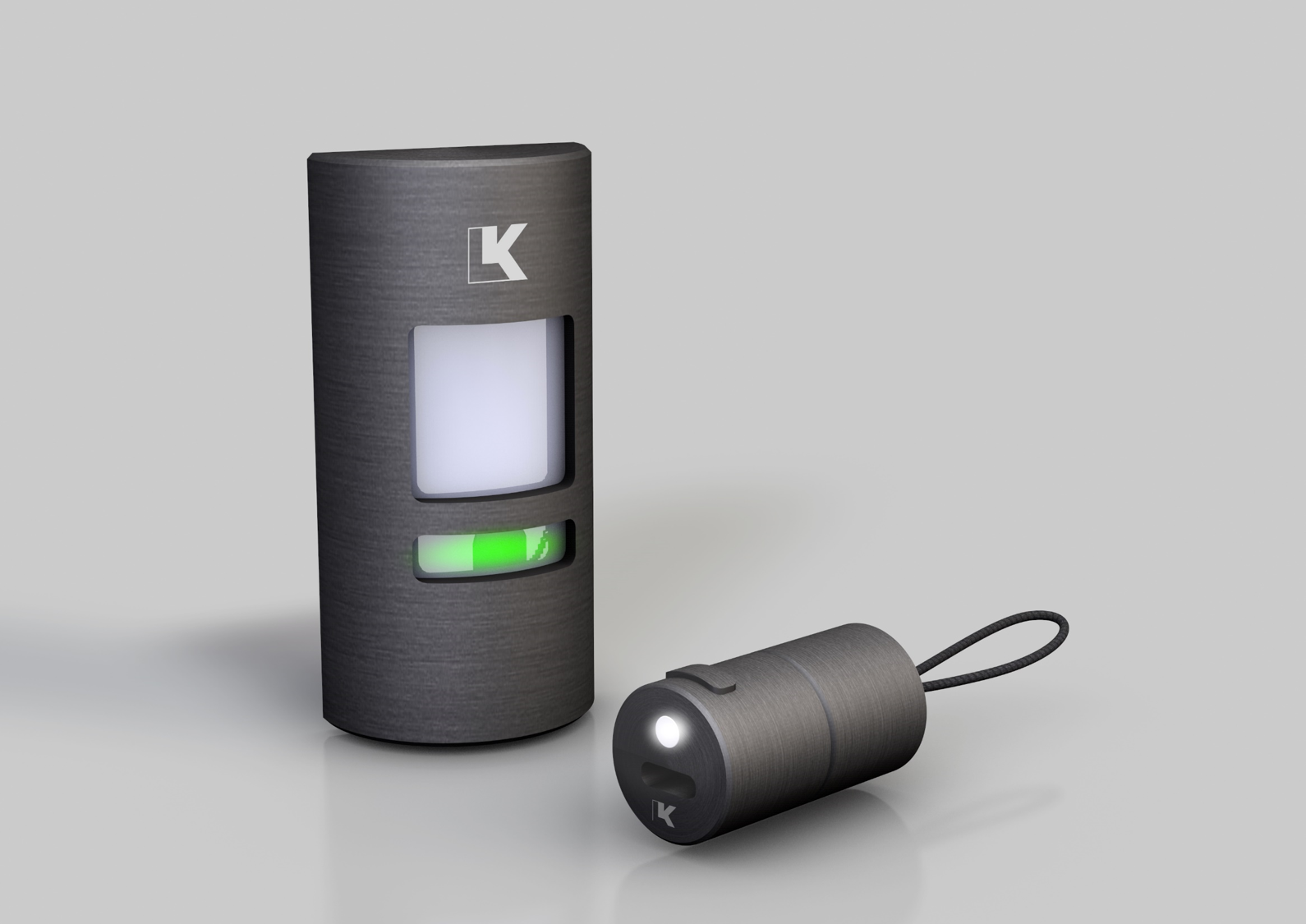
          To activate the lock, you will need to have an application downloaded on your smartphone that will trigger a sequence of light specific to your lock to trigger the opening. This flash allows you to authenticate securely. It's very simple, just place your smartphone in front of the lock to open or close the door, it's simple, convenient and secure. If you don’t have a smartphone, LiNA has also designed a smart key to unlock your accesses.

          Credit to LiNA SAS - Smart key to open LiKEY locks.

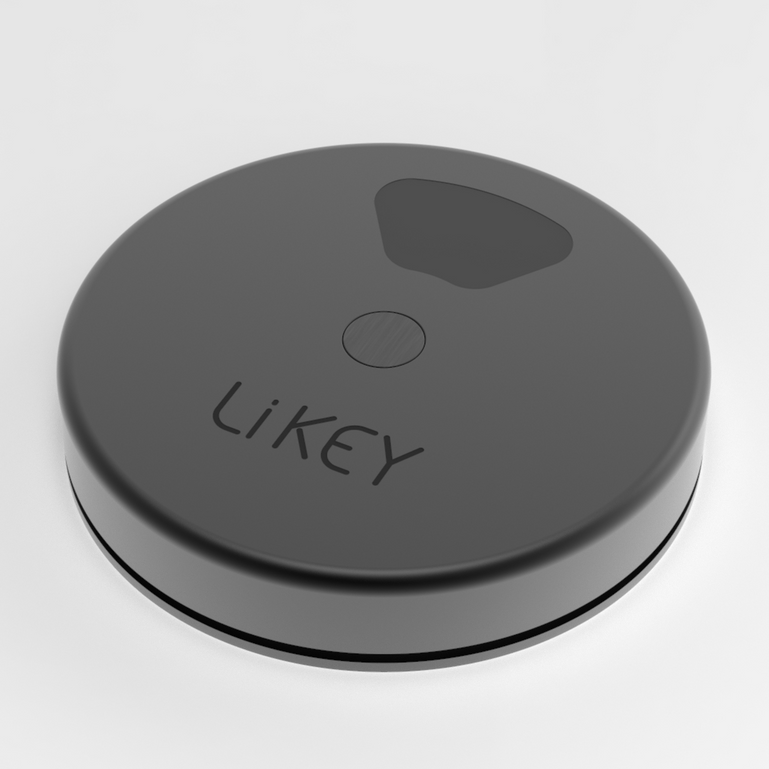
          LiNA SAS also stated that they are aware the perfect product can only have harmonious shapes. There are also different designs available to choose.

          Credit to LiNA SAS

          Credit to LiNA SAS

          Credit to LiNA SAS

          You can also watch the following video to see a demonstration by Mr Théo Lazuech on how the LiKEY system works. The video is in french however we managed to translate the original transcript in English.

          English Translation

          “Hello, I am Théo Lazuech, founder of the start-up LiNA, a start-up specialised in Li-Fi technology which is the transmission of data by light. So today I'm going to introduce you to the access control solution we call LiKEY. So today, to do access control, we essentially use three types of media, which are keys, badges and even remote controls. And as everyone has been able to experience it, we have relatively many of them that we constantly follow. So it's relatively bulky and maybe it's not that. The current main defect is that today, what is expected of an access control solution? It really secures access to premises. Except that today, there are many limits with respect to current solutions. On one hand, in use, can keys, badges and others be treated or easily stolen? And on the other hand, techniques and technological which is only a key or a badge. One can easily copy them in a pirated way or even not for that matter. And that is a real problem. And on the other hand, we can use other types of solutions which are biometrics. Except that it is extremely expensive and legally very complex to use on a large scale for an organisation. So, the LiKEY solution is an access control solution that relies on the smartphone as a badge. The particularity is that, instead of using RFID and NFC technology to establish communication, the smartphone camera flash is used. This has several advantages”.

          “On the one hand is that the smartphone. All smartphones are already compatible since they are all equipped with a flash and on the other hand we know that the telecommunication that we are going using flash is going to be totally interesting. Without further delay, I will simply demonstrate. I take my smartphone, I'm going to approach the access control reader. There is a communication that is established between the reader and the smartphone and a door is simply unlocked. So you see, it's a pretty common pattern that exists in access control. So we have an access reader which is on the wall, connected behind with an exit button. With manual trigger and door concept. And there, the type of bike we use is a fairly classic lock since it's a suction cup type lock. So here is a solution that relies on hardware but also on a whole software suite. There is a SAS web application on which you can manage all access, configure door locations on a card, take it remotely, take it in hand remotely, open the door and delegate access management to any type of manager and obviously manage access rights to all users. It is a solution that is aimed at companies, facility management or coworking spaces or business hotel, business incubator, but also on other markets such as the hotel industry or the collective residential sector. It is a very innovative solution, patented at European level, which I hope will attract your attention”.

          French original transcript

          “Bonjour, je suis Théo Lazuech, fondateur de la start up LiNA, une start up spécialisée dans la technologie Li-Fi qui est la transmission de données par la lumière. Donc aujourd'hui, je vais vous présenter la solution de contrôle d'accès que nous appelons LiKEY. Donc aujourd'hui, pour faire du contrôle d'accès, on utilise essentiellement trois types de supports qui sont les clés, les badges et même les télécommandes. Et comme chacun a pu en faire l'expérience, on en a relativement beaucoup que l'on fait suivre en permanence. Donc c'est relativement encombrant et c'est peut être pas ça. Le défaut principal actuel, c'est que aujourd'hui, qu'est ce qu'on attend d'une solution de contrôle d'accès? C'est qu'elle sécurise vraiment l'accès à des locaux. Sauf qu'aujourd'hui, il y a beaucoup de limites vis à vis des solutions actuelles. D'une part, à l'usage, est ce que les clés, les badges et autres, on peut les traiter ou se les faire voler facilement? Et d'autre part, techniques et technologiques qui est qu'une clé, un badge. On peut facilement les copier de manière pirate ou même pas d'ailleurs. Et ça, c'est un vrai problème. Et d'autre part, on peut utiliser d'autres types de solutions qui sont de la biométrie. Sauf que c'est extrêmement coûteux et juridiquement très complexe à utiliser à grande échelle pour une pour une organisation. Donc la solution LiKEY, c'est une solution de contrôle d'accès qui s'appuie sur le smartphone en tant que badge. La particularité, c'est que, au lieu d'utiliser la technologie RFID et NFC pour établir une communication, on utilise le flash de la caméra du smartphone. Serre a plusieurs avantages”.

          “D'une part, c'est que le smartphone. Tous les smartphones sont déjà compatibles puisqu'ils sont tous équipés d'un flash et d'autre part on sait que la télécommunication que l'on va. Faire grâce au flash va être totalement intéressant. Sans plus attendre, je vais procéder à une démonstration. Tout simplement, je prends mon smartphone, je vais l'approcher du lecteur de contrôle d'accès. Il y a une communication qui s'établit entre le lecteur et le smartphone et on déverrouille une porte tout simplement. Donc vous voyez donc c'est un schéma assez commun qui existe dans le contrôle d'accès. Donc on a un lecteur d'accès qui est au mur, connecté derrière avec un bouton de sortie. Avec un déclencheur manuel et un concept de portes. Et là, le type de vélo qu'on utilise, c'est un verrou assez classique puisque c'est un verrou de type ventouse. Voilà donc une solution qui se repose sur du hardware mais aussi sur toute une suite logicielle. Il y a une application web en SAS sur lesquels on peut gérer tous les accès, configurer les emplacements de porte sur une carte, prendre à distance, la prendre en main à distance, l'ouverture de la porte et déléguer la gestion des accès à tout type de manager et évidemment gérer les droits d'accès à tous les utilisateurs. C'est une solution qui s'adresse aux entreprises, au facility management ou aux espaces de coworking ou hôtel d'entreprises, pépinière d'entreprises, mais aussi sur d'autres marchés comme l'hôtellerie ou alors le secteur résidentiel collectif. C'est une solution très innovante, brevetée au niveau européen, que j'espère vous attirer votre attention”.

          LIna contact details

          If you are interested in getting more information about their products or purchasing any of their products, you can contact LiNA on the following details:

          Phone: +33 6 98 70 93 87

          Email: contact@lina.lighting

          Address: 42 Cours Pierre Vasseur, 91120 Palaiseau, France

          Li-Fi Conference 2022

          The next Li-Fi Conference is coming up on the 28th of June 2022 between 10 am and 4.30 pm CET.

          It is interesting to realise that lights that illuminate offices, homes, cars, factories, our streets and more locations also can connect us to data and hence power the growing demand for connectivity and speed.

          At this conference professionals from all over the globe will gather together in order to share applications, ideas, new developments and ways to integrate Li-Fi in services, both for consumers and professionals.

          This conference will be held Live and Online. The venue will be the High Tech Campus 1, The Strip 5656 AE Eindhoven The Netherlands.

          Online tickets can be bought at the following link:

          https://tikcit.com/register/61e002336d7fc4b6745cab83/

          What is LiFi?

          LiFi, also known as "Light Fidelity" is a wireless optical networking technology, which uses light-emitting diodes (LEDs) to transmit data. In 2011, professor Harald Haas made a LiFi demonstration at the TED (Technology, Entertainment, Design) Global Talk on Visible Light Communication (VLC).

          VLC uses light as a medium to deliver high-speed communication like Wi-Fi and complies with the IEEE standard IEEE 802.15.7. The IEEE 802.15.7 is a high-speed, bidirectional, and fully networked wireless communication technology-based standard similar to Wi-Fi's IEEE 802.11.

          How does LiFi work?

          LiFi is a high speed, bidirectional, and fully networked wireless communication of data using light. LiFi constitutes of several light bulbs that form a wireless network.

          When an electrical current goes through to a LED light bulb, a stream of light (photons) emits from the lamp. LED bulbs are semiconductor devices, which means that the brightness of the light flowing through them can change at extremely high speeds. The signal is sent by modulating the light at different rates. The signal can then be received by a detector that interprets the changes in light intensity (the signal) as data. Also when the LED is ON, you transmit a digital 1, and when it is OFF, you transmit a 0.

          LiFi Benefits

          The primary benefits of LiFi are as follows:

          Security: Provides entirely secure access. Where there is no light there is no data.

          Safety: Does not produce electromagnetic radiation and does not interfere with existing electronic systems.

          Localisation: Allows localisation due to the small coverage area of LiFi access point - localisation can be used for very precise asset tracking.

          Data density: Provides ubiquitous high-speed wireless access that offers substantially greater data density (data rate per unit area) than RF through high bandwidth reuse.

          Credit to Oledcomm

          LiFi Applications

          LiFi can be used for so many applications and the list is increasing every year. You can read our updated list of LiFi applications at the following link:

          https://www.lifitn.com/blog/2021/2/13/top-30-li-fi-applications-updated-list-including-potential-applications

          Credit to pureLiFi

          In conclusion, if you are also interested to hear more information about the OWNII Coin or enquire about LiFi devices such as the LiFiMax and Trulifi, you can contact us through our chatbot or by sending an email through our contact us form. If you enjoyed this post and would like to hear more updates about LiFi technology, subscribe to our newsletter. Don’t forget to subscribe to our social media accounts. You can also join our Telegram group about LiFi technology on this link:

          https://t.me/joinchat/FMzOmsEKyJFrU6Af


          Interview with Marc Fleschen, Chairman, Light Communications Alliance (LCA) by Pieter Hermans, JakajimaTV, About Li-Fi And More

          Table of Contents

            Interview with Marc Fleschen, Chairman, Light Communications Alliance (LCA) by Pieter Hermans, JakajimaTV, About Li-Fi And More

            Li-Fi Conference 2021

            Happy new month everyone. Last month, we did a recap article series on last year ONLINE Li-Fi Conference. The conference was organised by the Jakajima, the global High Tech Conference organiser, and the Light Communications Alliance.

            Jakajima, Matchmaker for Innovators in the high tech industry, organises many events, ranging from LiFi Technology industry trends, 3D Printing to the Internet of Things, from Unmanned Cargo Aircraft to Health Tech, from 4D Printing to Photonics and from Vertical Farming to Sustainable Materials.

            The online Li-Fi Conference included live presentations from researchers, executives and industry specialists from pureLiFi, Nokia, Signify, Orange, Radiocommunications Agency Netherlands, Velmenni, OLEDCOMM, HomeGrid Forum and Weidmüller Deutschland.

            In today’s article, we revisited an interview between Mark Fleschen,Chairman of the Light Communications Alliance (LCA) and Pieter Hermans, CEO of JakajimaTV. This interview was conducted few weeks prior to last year Li-Fi conference.

            Interview on Light Communications Alliance and LiFi

            Pieter Hermans: Welcome back JakajimaTV. Today, I have an interview with Mark Fleschen. He is the chairman of the Light Communications Alliance. So welcome Mark, thank you very much for being here. Let's start immediately. Can you explain to us the motivation for a light communication line and how it was created and why it exists?


            Mark Fleschen: The reason behind the Light Communication Alliance is to actually help promoting light communication technology and overall, educate the market about this technology, how we operate, how it works, the benefits and how it could be implemented. So, the main reason we decided to create this LCA was definitely to be able to do market education and promote by default I mean use cases, white paper and gather an ecosystem on this technology in particular.


            Pieter Hermans: Okay. And this alliance consists of members, so could you tell us a bit about the broadness of the members you have.


            Mark Fleschen: Here now the LCA was officially created in December of 2019. Since then, we have had different groups of companies that joined the LCA. The companies that joined from the very beginning are founding members, and they are well known companies such as Orange, pureLiFi, Nokia Bell Labs, which is part of it, the IMT, Zero1. And then we have strategic members that newly joined the FCA after it's been officially created and we have also very prominent companies such as Signify, Oledcomm that join the LCA lately and the PLC is working for membership fees so it's an annual membership fees and that you access monthly meetings, quarterly meeting, Annual General Meeting, access to white paper on even participation to whitepaper. 

            Pieter Hermans: And what is the scope exactly, because in light communication is for the standard person very vague. So, could you explain a bit what it is and what is the technology scope?


            Mark Fleschen: Officially, the three different angles that the light communication is working on as of today is FSO which stands for Free Space Optics, which is a technology that we know and has been existing for now, a little bit while even though it's not the technology that we focus on as many of the key partners are actually into LIFI, which is then using visible and invisible light that comes for free bidirectional network system which is basically Internet access by visible and invisible light and the third one, which is OCC which is another technology which is more very low data right you need a directional system, which is basically a broadcast system that light can be sending data and be received by CMOS which is basically your camera off a mobile device, which is those three aspects are that we expect that is your scope of work of the LCA.


            Pieter Hermans: Okay so OCC stands for optical camera communication,


            Mark Fleschen: This is correct.


            Pieter Hermans: So, what are the, when you start talking about the technological scope, what are the key advantages of light communication?


            Mark Fleschen: Well, light communication first and foremost the most important part of the LCA message is that the light communication and LIFI are actually alongside with any other technology, I mean, the light communication is not here to replace or to compete with any type of radiofrequency technology or any other type of technologies. Light communication has a lot of benefits due to his physical aspects. For example, security is one of them because the beam of light and the dimension of the beam offline makes it very hard to intercept because you are between two different points. It has a greener spectrum energy because obviously, it's using light which is sometimes already in place. And the third one is audio frequency, which is again based on the physical aspect of light communication in general. So those aspects make that  a larger bandwidth, a low latency and actually can bring much more physical benefits to services where other technologies such as audio frequencies based technologies cannot access. 

            Pieter Hermans: Okay. And could you mention or could you give some examples like use cases where other technologies cannot be used?

            Mark Fleschen: Well, for example, hospital is one of them. I mean, if you talk about hospital or hospital in general are not the best place for our radiomagnetics or electromagnetics and LIFI therefore would have a huge benefits in the Industry 4.0, car to car communications, smart cities, V to X on V two infrastructure and education, education is the reason behind is that schools have a very specific type of place. And obviously, sometimes communication could actually bring a lot of benefits.

            Pieter Hermans: Okay, okay. So a broad range of applications or possible.

            Mark Fleschen: Yes, use cases, mainly, we focus on the most useful ones as well as implementing the technology and the most obvious one, obviously, like education and the hospital and the Industry 4.0, which are very well known to have very specific needs.

            Pieter Hermans: Okay. And so if I am a CEO of a company, why should I, why should I become a member of the Light Communication Alliance, and why is it good for me?

            Mark Fleschen: The good thing about the Light Communication Alliance, it's that we create an ecosystem of a lot of different partners and the range of partners are very wide. Obviously, there are LIFI key partners, which are LIFI vendors and manufacturers. We have the manufacturers, we have people in Quantum Cryptography, and we have mobile, and manufacturer or terminal manufacturers or device manufacturers. So obviously, if you want to be part of a new generation of technology, such as light communication, and you are looking for an ecosystem, where you can have access to partners that obviously could sometimes need you. It's definitely a good place to be because you've got access to a really wide range of ideas here from applications to solutions oriented. This is where you can benefit.

            Pieter Hermans: I understand that light communication is really your passion. So, can you explain to me why you have this passion? What was special about this technology,

            Mark Fleschen: The technology is really something that personally passionate is the passion, passion of me, because I've been I've been seeing technologies and there is multiple cycle that was 20 years ago in that context and that technological cycle, and now we're going through another cycle again, and more than ever, this period of time, I think the main problem we have is the pressure on infrastructure and more than ever we go through a lot of different problematics such as as energy efficiency, sustainability and more pressure on technology right now, because there is so much more coming like cryptocurrency, artificial intelligence, augmented reality, virtual reality, but the problem is that the infrastructure has been optimised but we haven't really inventing something new in the past 20 years. We optimise something which was already existing, but the pressure is even more up to date. And those concerned make that light communication a huge opportunity because obviously, it has a larger, wider bandwidth. It's Lightspeed and it's green. And when you look at all the advantages of light communications, you just wonder why it's not going to be the one of the answers to today's problems and to these problems are bigger than they were 20 years ago.

            Pieter Hermans: Okay. And is there also a specific, let's say, geo political reason also?

            Mark Fleschen: I think for the first time, we have the opportunity in Europe to have a huge ecosystem there is many, many companies which are already part of the LCA such as Signify, Oledcomm, pureLiFi and we have a nest in Europe which is really well advanced right now in like communication and of course, we are including Wi-Fi international companies but behind it we have so many companies in Europe right now so well advanced. So many companies working alongside, we have a huge advantage right now at European level and we want to promote that and so we want to really gather all those companies and try to push it because we have a European advantage currently in light communication and that has to be promoted as well. 


            Pieter Hermans: Okay. Well, thank you very much, Mark for your explanation of the light communication line and look forward to hearing more about it at the upcoming Li-Fi conference. So thank you very much.


            Light Communication Alliance

            The Light Communication Alliance (LCA) is the authority on light communication. The LCA states that they are the most extensive light communications alliance in the world, a recognised leader. They are building demand for light communication through collaboration. As an alliance, they leverage partnerships between industry leaders to validate use cases and build functioning ecosystems. With the aim of ultimately inspiring global investment in light communication.

            The LCA is an open, non-profit association of members who aim to promote Light Communications technology with a consistent, focused and concise approach. The LCA highlights the benefits, use cases and timelines for Light Communications adoption. The organisation aligns innovative leaders across the industries that light and communications touches, defining standards for education, communication, and interoperability.

            The founding members of the LCA are Nokia, Emirates Integrated Telecommunications Company (du), Liberty Global, Lucibel,  pureLiFi, LiFi Research & Development Centre, Velmenni, Zero.1, CEA Leti, and Institut Mines-Télécom.

            Light Communication technologies include Light Fidelity (LiFi) and Optical Camera Communications (OCC) both of which have been attracting increased attention over recent years within several industries, such as smart cities and homes, industry 4.0 and manufacturing environments, as well as retail and tourism.

            Global Market Insights predicts that the LiFi market will be worth $75 billion by 2025, creating broad, far-reaching opportunities for the related industries to benefit from Visible Light Communications.

            Founding Members of the LCA

            Nokia

            Nokia creates the technology to connect the world. They develop and deliver the industry’s only end-to-end portfolio of network equipment, software, services and licensing that is available globally. Their customers include communications service providers whose combined networks support 6.1 billion subscriptions, as well as enterprises in the private sector and public sector that use their network portfolio to increase productivity and enrich lives.

            Through their research teams, including the world-renowned Nokia Bell Labs, they are leading the world to adopt end-to-end 5G networks that are faster, more secure and capable of revolutionizing lives, economies and societies. Nokia adheres to the highest ethical business standards as they create technology with social purpose, quality and integrity.

            nokia.com

            pureLiFi

            pureLiFi is a Light Communications company that was founded by Prof. Harald Haas and Dr Mostafa Afgani in 2012 as a spin out of the University of Edinburgh. pureLiFi offers both LiFi systems and Gigabit LiFi light antennas to OEM’s for integration. The company formed in response to the exponential growth in global demand for wireless bandwidth. pureLiFi has grown its international customer base with more than 130 deployments of LiFi in over 24 countries. The firm has also secured international partnerships with organisations such as Cisco, Wipro and O2 Telefonica.

            pureLIFi.com

            Zero.1

            Zero.1 is a Hardware and Software provider specialising in Optical Camera Communication founded in 2016. Through its unique driver, any LED can become compatible, a simple app downloadable on the IOS and Android Store will allow cameras of mobiles devices to receive OCC signal, Zero.1 provides Cloud and services associated such as but not limited to, Indoor positioning system, localisation based services, geolocalised information’s, crowd management and data analytics etc.

            zero1.zone

            du

            Emirates Integrated Telecommunications Company (du) is a vibrant and multiple award-winning telecommunications service provider in the United Arab Emirates serving 9 million individual customers with its mobile, fixed-line, broadband internet, and Home services over its 4G LTE network. du also caters to over 100,000 UAE businesses with its vast range of ICT and managed services.

            du.ae/personal

            Velmenni

            Velmenni has been working on LiFi Technology for the past 5 years. It has achieved multiple research and development milestones within Optical Wireless Communication including the development of the Optical Wireless Mesh Network. Today, Velmenni’s main focus is on the optimisation of speed, efficiency and seamless connectivity within the LiFi domain. Having held successful runs of LiFi technology in multiple locations, we’re presently conducting pilot projects to utilise bidirectional Light Communication in diverse industrial conditions. The goal remains to integrate LiFi and Wi-Fi to create impeccable, efficient and productive networks.

            velmenni.com

            Lucibel

            LUCIBEL is an innovative French group that designs and manufactures in France new generation LED lighting products and solutions. LUCIBEL is also a pioneer in the development and marketing of LiFi, a light internet access solution co-developed with its pureLiFi partner in Scotland.

            lucibel.io

            LiFi Research & Development Centre (LiFi R&D Centre)

            The LiFi R&D Centre translates internationally leading fundamental research to high technology readiness levels and conducts research in collaboration with, and on behalf of the industry. It aims to accelerate society’s adoption of LiFi and emerging wireless technology through engagement with major industrial partners, to fully harness the commercial and innovative potential of LiFi, and to help establish a major new LiFi industry. The LiFi R&D Centre includes 40 researchers including three academics.

            lifi-centre.com

            IMT

            Institut Mines-Télécom is a public institution dedicated to higher education and research for innovation in the fields of engineering and digital technology. Always tuned in to the economic world, it combines high academic and scientific legitimacy with close business relations and a unique positioning in 3 major transformations of the 21st century: Digital Affairs, Energy and Ecology, and Industry. Its training and research for innovation are conducted in the Mines and Télécom Graduate Schools under the supervision of the Minister for Industry and Electronic Communications, in two subsidiaries and in institutions that are associate partners or under contract. Institut Mines-Télécom is a founding member of the Industry of the Future Alliance. It has two Carnot labels for the quality of its research partnerships. Every year, around one hundred startup companies leave its incubators.

            imt.fr

            About Liberty Global

            Liberty Global (NASDAQ: LBTYA, LBTYB and LBTYK) is the world’s largest international TV and broadband company, with operations in 10 European countries under the consumer brands Virgin Media, Unitymedia, Telenet and UPC. They invest in the infrastructure and digital platforms that empower our customers to make the most of the video, internet and communications revolution. Their substantial scale and commitment to innovation enable us to develop market-leading products delivered through next-generation networks that connect 21 million customers subscribing to 45 million TV, broadband internet and telephony services. We also serve 6 million mobile subscribers and offer Wi-Fi service through 12 million access points across our footprint.

            In addition, Liberty Global owns 50% of VodafoneZiggo, a joint venture in the Netherlands with 4 million customers subscribing to 10 million fixed-line and 5 million mobile services, as well as significant investments in ITV, All3Media, ITI Neovision, Casa Systems, LionsGate, the Formula E racing series and several regional sports networks.

            libertyglobal.com

            CEA Leti

            Leti, a technology research institute at CEA Tech, pioneers micro and nanotechnologies, tailoring differentiating applicative solutions that ensure competitiveness in a wide range of markets. Leti developed a high-speed bi-directional LiFi solution successfully transferred to Luciom, where each LED lamp can connect up to 15 users to the Internet. Leti is also conducting cutting-edge research on LED sources combined with advanced wireless communication processing targeting very high throughput LiFi systems.

            leti-cea.com/cea-tech/leti/english

            Li-Fi Conference 2022
            The next Li-Fi Conference is coming up on the 28th of June 2022 between 10 am and 4.30 pm CET.

            It is interesting to realise that lights that illuminate offices, homes, cars, factories, our streets and more locations also can connect us to data and hence power the growing demand for connectivity and speed.

            At this conference professionals from all over the globe will gather together in order to share applications, ideas, new developments and ways to integrate Li-Fi in services, both for consumers and professionals.

            This conference will be held Live and Online. The venue will be the High Tech Campus 1, The Strip 5656 AE Eindhoven The Netherlands.

            Online tickets can be bought at the following link:

            https://tikcit.com/register/61e002336d7fc4b6745cab83/

            What is LiFi?

            LiFi, also known as "Light Fidelity" is a wireless optical networking technology, which uses light-emitting diodes (LEDs) to transmit data. In 2011, professor Harald Haas made a LiFi demonstration at the TED (Technology, Entertainment, Design) Global Talk on Visible Light Communication (VLC).

            VLC uses light as a medium to deliver high-speed communication like Wi-Fi and complies with the IEEE standard IEEE 802.15.7. The IEEE 802.15.7 is a high-speed, bidirectional, and fully networked wireless communication technology-based standard similar to Wi-Fi's IEEE 802.11.

            How does LiFi work?

            LiFi is a high speed, bidirectional, and fully networked wireless communication of data using light. LiFi constitutes of several light bulbs that form a wireless network.

            When an electrical current goes through to a LED light bulb, a stream of light (photons) emits from the lamp. LED bulbs are semiconductor devices, which means that the brightness of the light flowing through them can change at extremely high speeds. The signal is sent by modulating the light at different rates. The signal can then be received by a detector that interprets the changes in light intensity (the signal) as data. Also when the LED is ON, you transmit a digital 1, and when it is OFF, you transmit a 0.

            LiFi Benefits

            The primary benefits of LiFi are as follows:

            Security: Provides entirely secure access. Where there is no light there is no data.

            Safety: Does not produce electromagnetic radiation and does not interfere with existing electronic systems.

            Localisation: Allows localisation due to the small coverage area of LiFi access point - localisation can be used for very precise asset tracking.

            Data density: Provides ubiquitous high-speed wireless access that offers substantially greater data density (data rate per unit area) than RF through high bandwidth reuse.

            Credit to Oledcomm

            LiFi Applications

            LiFi can be used for so many applications and the list is increasing every year. You can read our updated list of Li-Fi applications at the following link:

            https://www.lifitn.com/blog/2021/2/13/top-30-li-fi-applications-updated-list-including-potential-applications

            Credit to pureLiFi

            In conclusion, if you are also interested to hear more information about the OWNII Coin or enquire about LiFi devices such as the LiFiMax and Trulifi, you can contact us through our chatbot or by sending an email through our contact us form. If you enjoyed this post and would like to hear more updates about LiFi technology, subscribe to our newsletter. Don’t forget to subscribe to our social media accounts. You can also join our Telegram group about LiFi technology on this link:

            https://t.me/joinchat/FMzOmsEKyJFrU6Af


            Li-Fi Conference 2021 - Recap Part 10 - Optical Wireless As A New Comfort For Telecom? A Regulator's Perspective

            Table of Contents

              Li-Fi Conference 2021 - Recap Part 10 - Optical Wireless As A New Comfort For Telecom? A Regulator’s Perspective

              Li-Fi Conference 2021

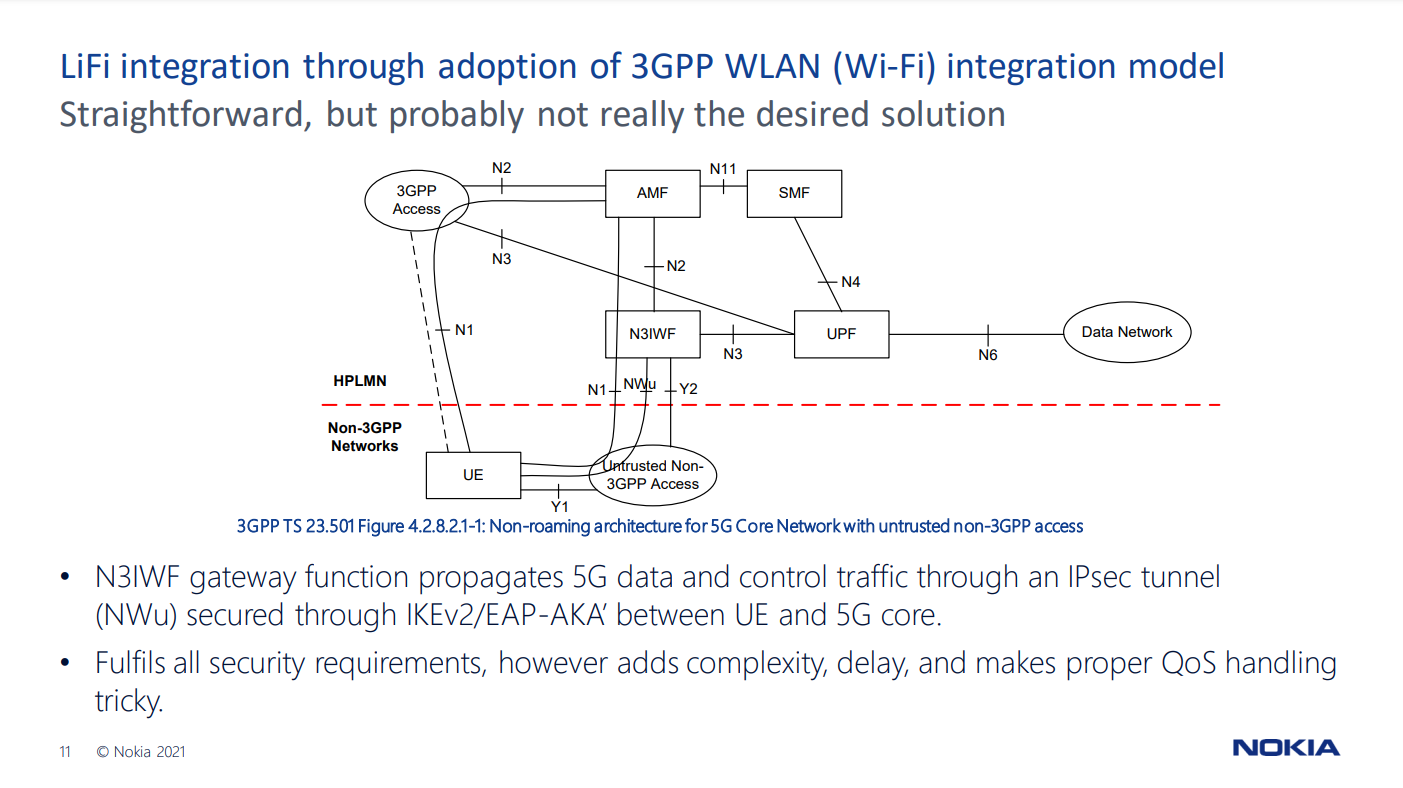
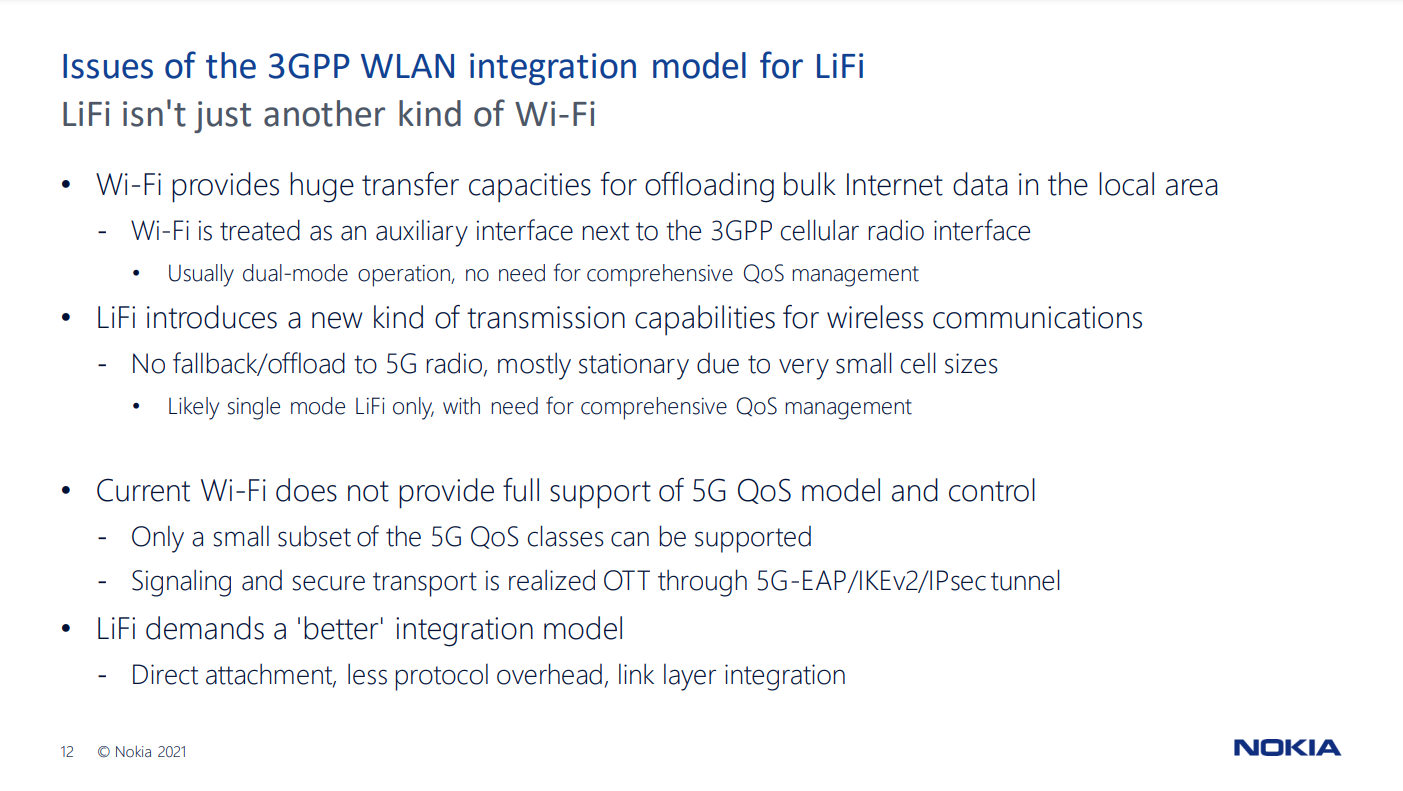
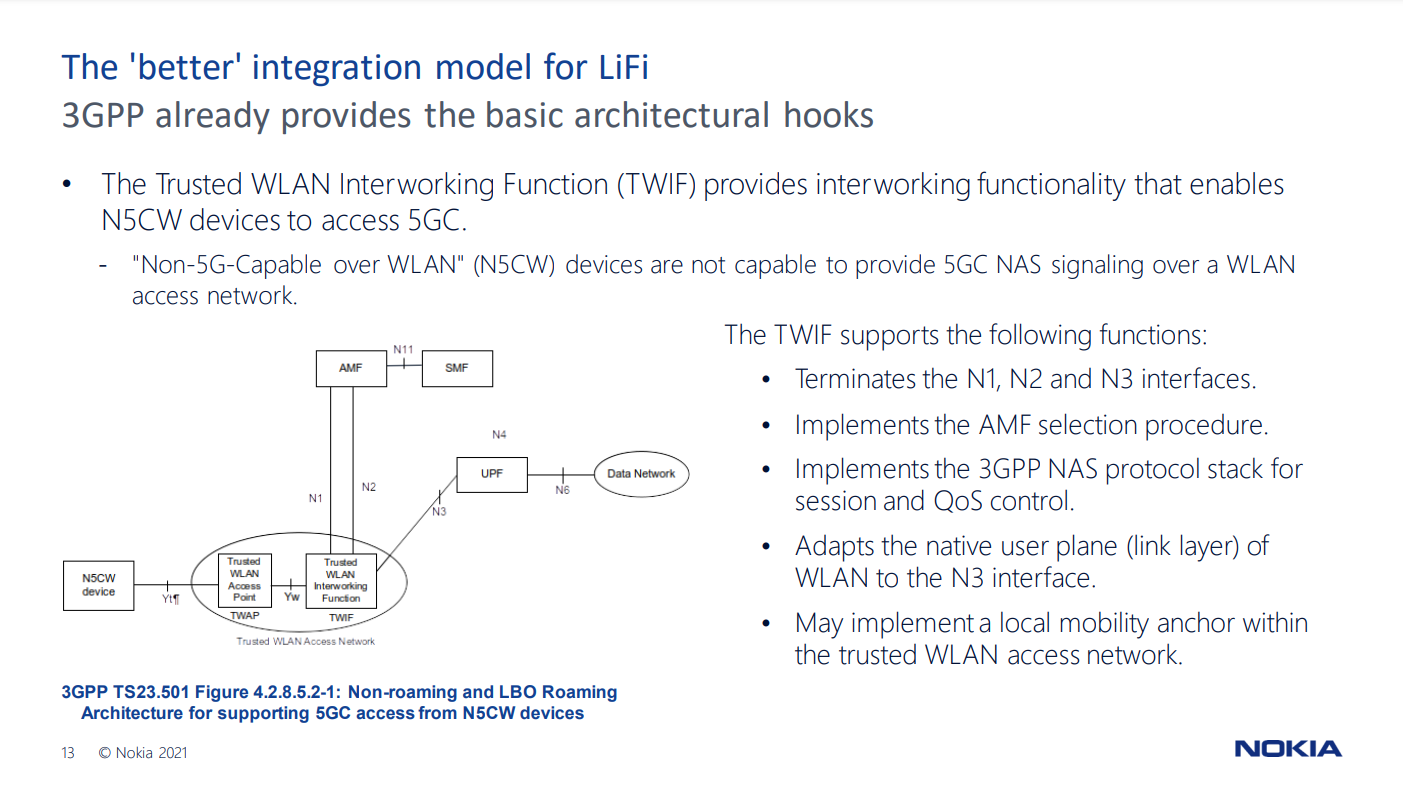
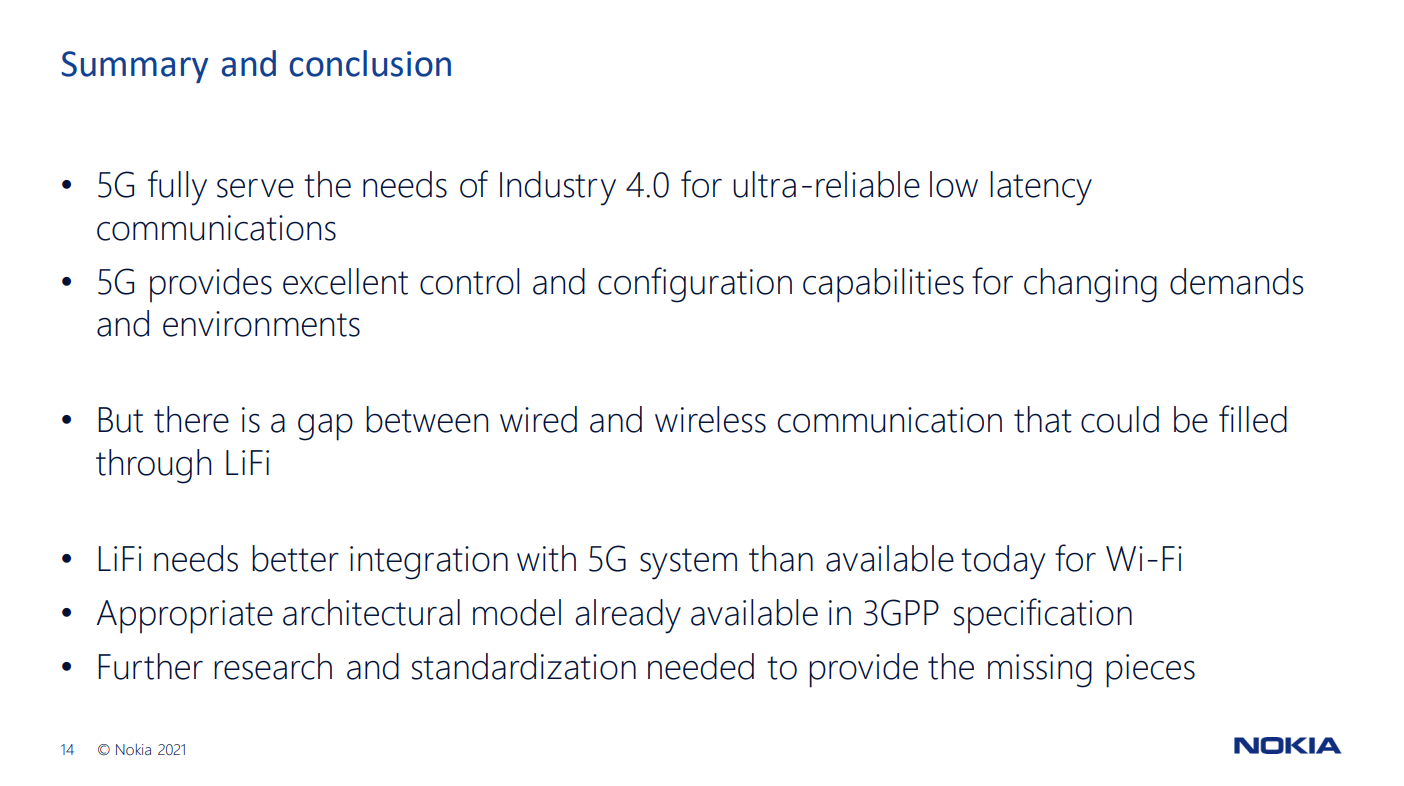
              In our last article from our ONLINE Li-Fi Conference 2021 recap series, we discussed the duo presentation on Fully Leveraging LiFi Capabilities Through Enhanced Integration With 5G Core And Services delivered by Maximilian Riegel from Nokia. The conference was organised by the Jakajima, the global High Tech Conference organiser, and the Light Communications Alliance.

              Jakajima, Matchmaker for Innovators in the high tech industry, organises many events, ranging from LiFi Technology industry trends, 3D Printing to the Internet of Things, from Unmanned Cargo Aircraft to Health Tech, from 4D Printing to Photonics and from Vertical Farming to Sustainable Materials.

              The online Li-Fi Conference included live presentations from researchers, executives and industry specialists from pureLiFi, Nokia, Signify, Orange, Radiocommunications Agency Netherlands, Velmenni, OLEDCOMM, HomeGrid Forum and Weidmüller Deutschland.

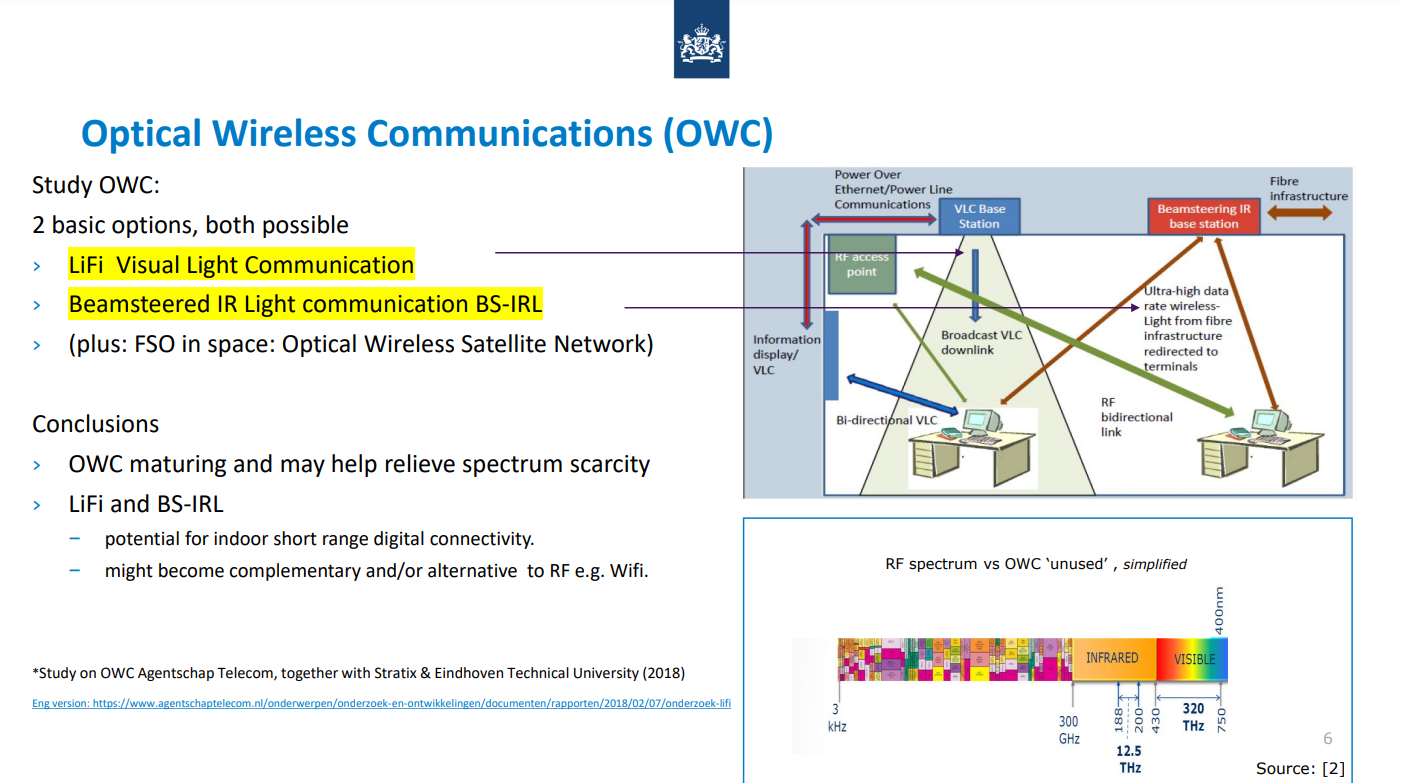
              In this last article recap series, we will talk about the presentation on Optical Wireless As A New Comfort For Telecom? A Regulator’s Perspective delivered by René Vroom from Agentschap Telecom. Before this, we will talk about Agentschap Telecom.

              Agentschap Telecom

              Agentschap Telecom is a Dutch government organisation that regulates and monitors the use of radio frequencies in the Netherlands. Telecom Agency is part of the Ministry of Economic Affairs and Climate. The organisation is located in Groningen and Amersfoort.

              The service draws up guidelines and issues licenses for the use of frequency space and also has a monitoring task here. The service also monitors the trade in electronic equipment, tapping, data retention and the Information Exchange of Underground Networks Act (WION). With regard to trade in electronic equipment, the agency is responsible for verifying that equipment complies with the obligations of the EMC Directive and the R&TTE Directive. In addition, the service investigates and handles fault reports from citizens and license holders in the field of EMC† The WION regulates the exchange of information between excavation contractors, clients and network operators when digging in the subsoil.

              The service was founded in 1929 as the Radio Control Service of the Staatsbedrijf der PTT (RCD) with its head office in The Hague. The listening station was located in Nederhorst den Berg . In the mid-1970s, the government decided to reduce unemployment in the northern provinces by spreading government responsibilities. The PTT Department of Cable and Connections Directorate (DKV), later + Radio (DKRV), was therefore moved to Amersfoort and the RCD head office was moved to Groningen. In 1982 regional branches of the RCD were opened in Zwolle for the north of the Netherlands and in Eindhoven for the south of the Netherlands. Nederhorst den Berg became the location for the Central Netherlands.

              The Radio Control Service had several tasks, but was particularly feared by radio pirates, who code-named the service "the white mice". From 1976 to 1981, listening posts of the Special Radio Service (BRD) were integrated into the RCD. In 1989, KSR ( Coastal and Ship Radio ) was added, with its headquarters at Capelle aan den IJssel. When the PTT was privatized, the RCD was split off and placed with the Ministry of Transport, Public Works and Water Management and the name was changed to Operational Affairs Directorate, part of the General Directorate of Telecommunications and Post (HDTP). Later this name was changed to Rijksdienst voor Radiocommunicatie (RDR) and Telecom Division as part of the Transport, Public Works and Water Management Inspectorate (IVW). In July 2002, the service was transferred to the Ministry of Economic Affairs as an independent agency. In a reorganisation in 2005, they again opted for centralisation. Amersfoort now became the central location with Groningen as the head office. The local district offices in Zwolle, Eindhoven and Capelle aan den IJssel and the historic RCD fortress Nederhorst den Berg (NERA) were closed.

              Agentschap Telecom is authorised to detect illegal broadcasts and to impose administrative fines. Much attention is paid to radio pirate broadcasts in the FM broadcast band. For the investigation, cars with radio direction finders are used and use is made of the nationwide measuring network of the Telecom Agency, which records the use of radio frequencies at all times. This proactive approach against radio pirates started with Operation Ether Flash in 2003. Previously, the agency only responded to complaints about interference. The fines for illegal use of FM broadcasting frequencies can amount to more than €15,000.

              The above approach was evaluated until mid-2011, proved effective and was subsequently maintained. Most broadcasters without a valid license give up after a warning from the Telecom Agency. Previously (late 20th century) people got away with confiscation of the equipment and possibly everything attached to it, followed by a fine of a few hundred guilders. After that, the policy was made stricter to an immediate fine of €1300, which deterred some of the unlicensed channels. The government still thought this did not go far enough and wanted a system to permanently shut down almost all channels on this radio band.

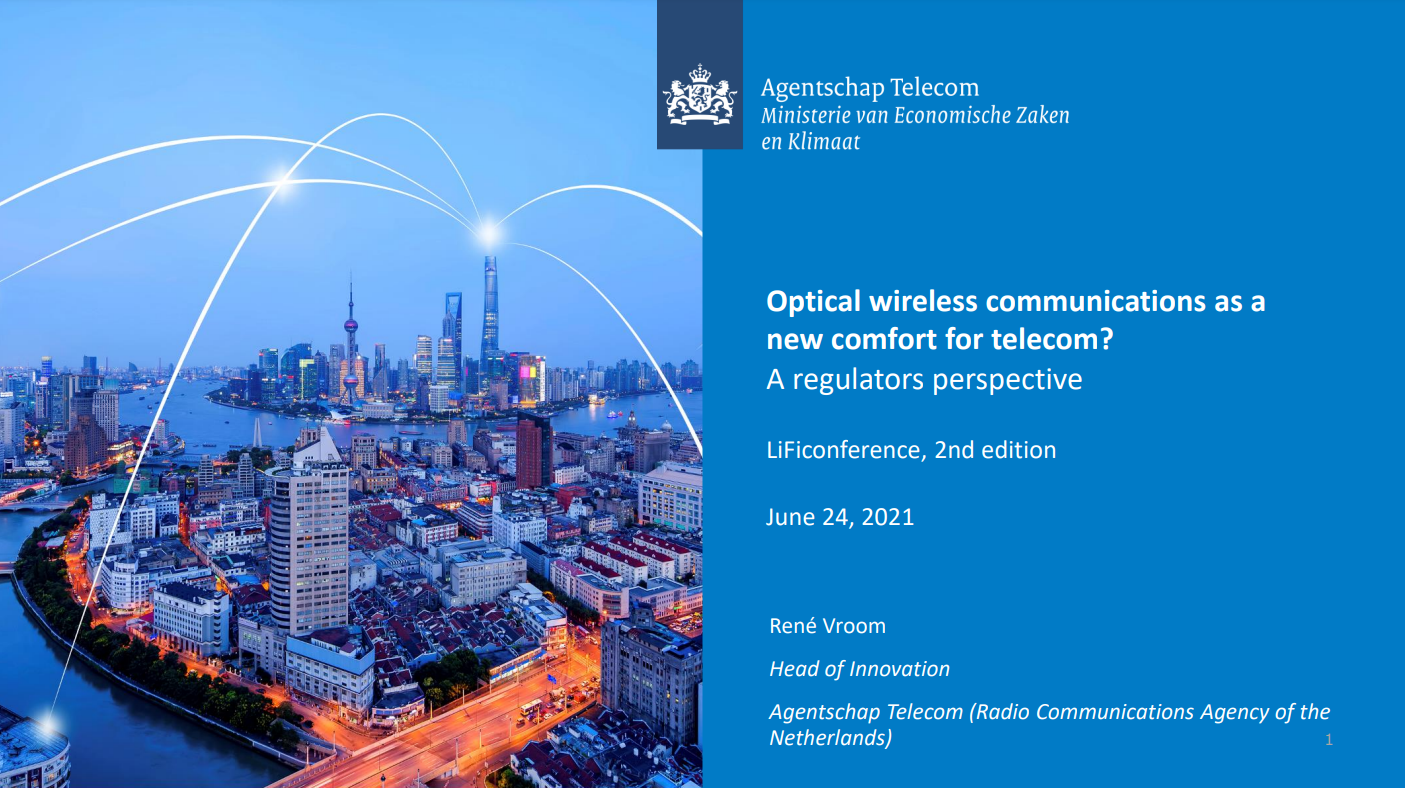
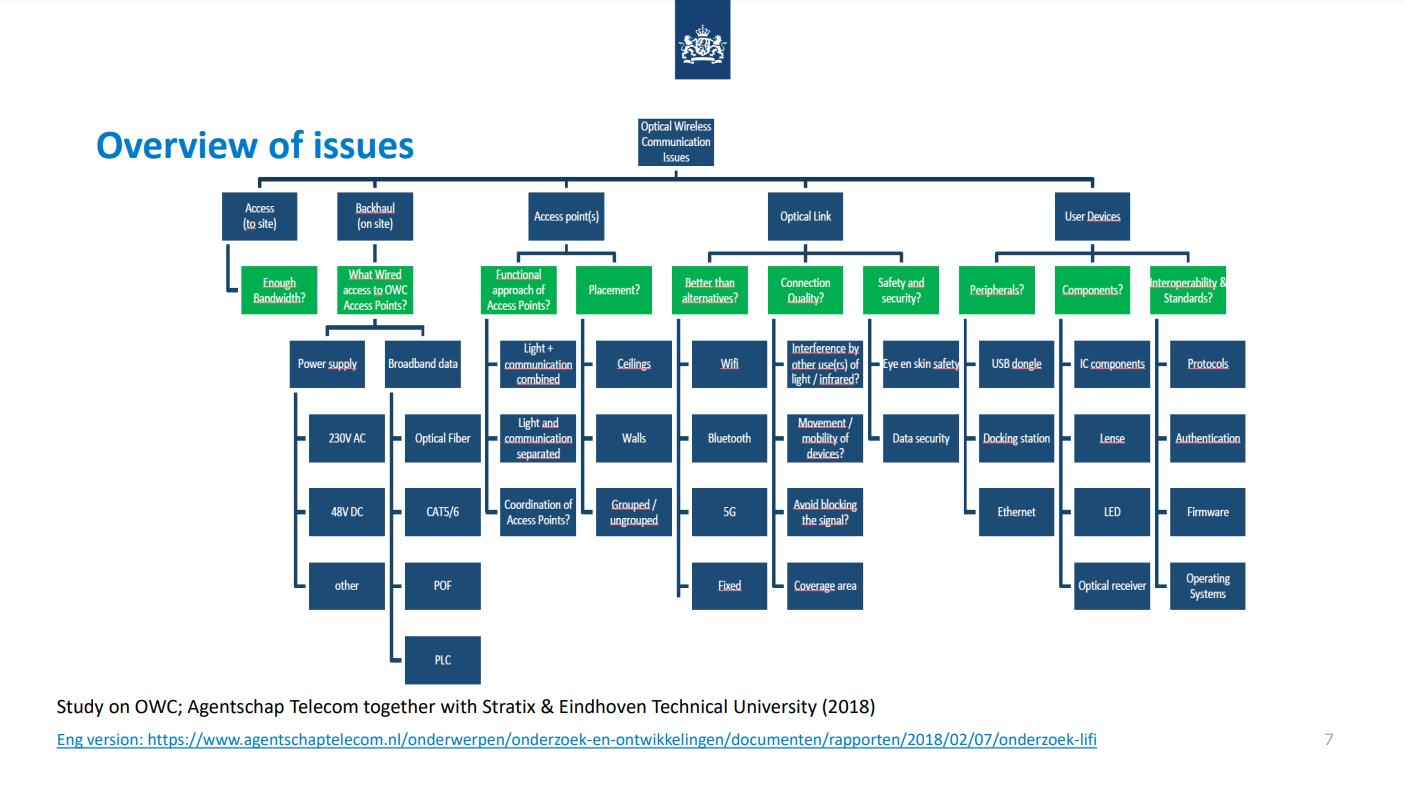
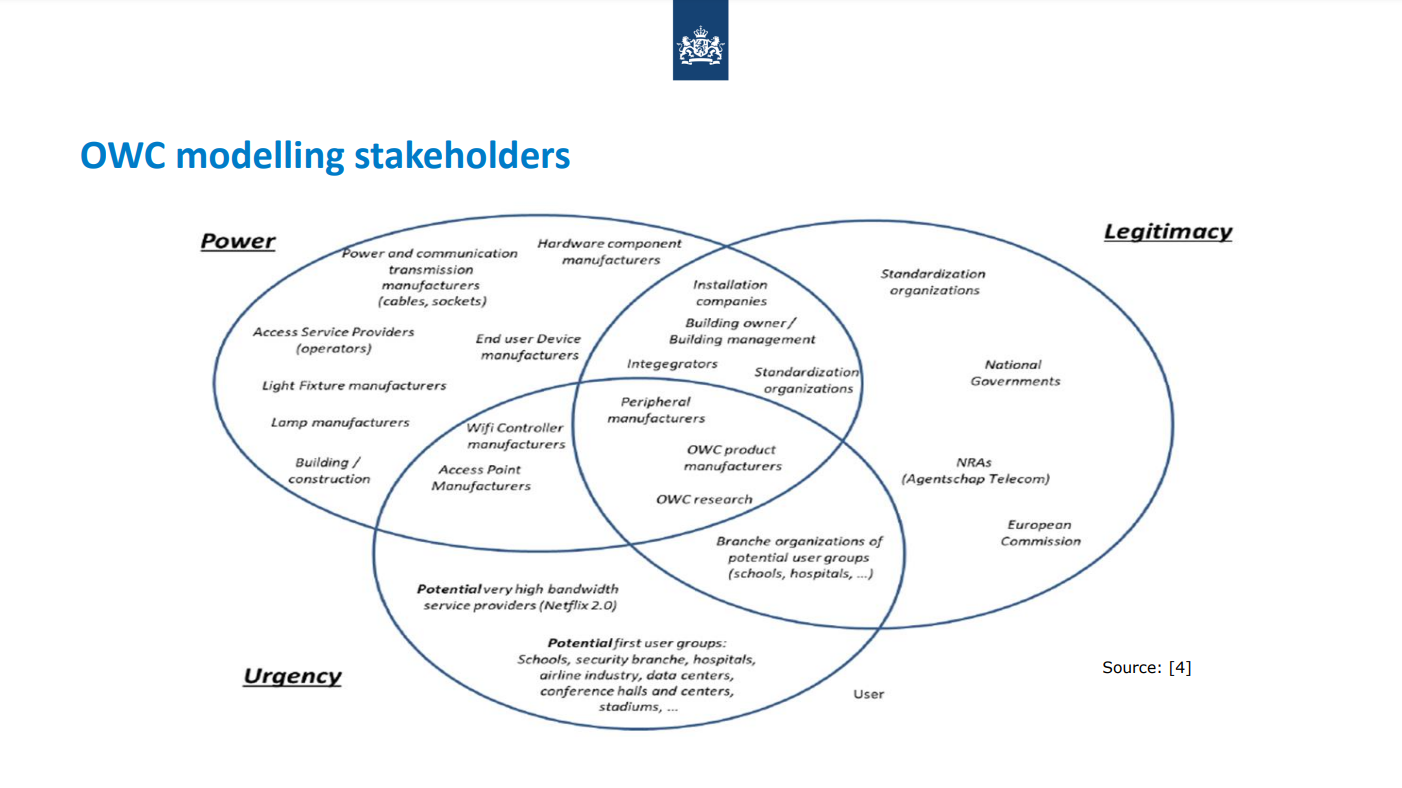
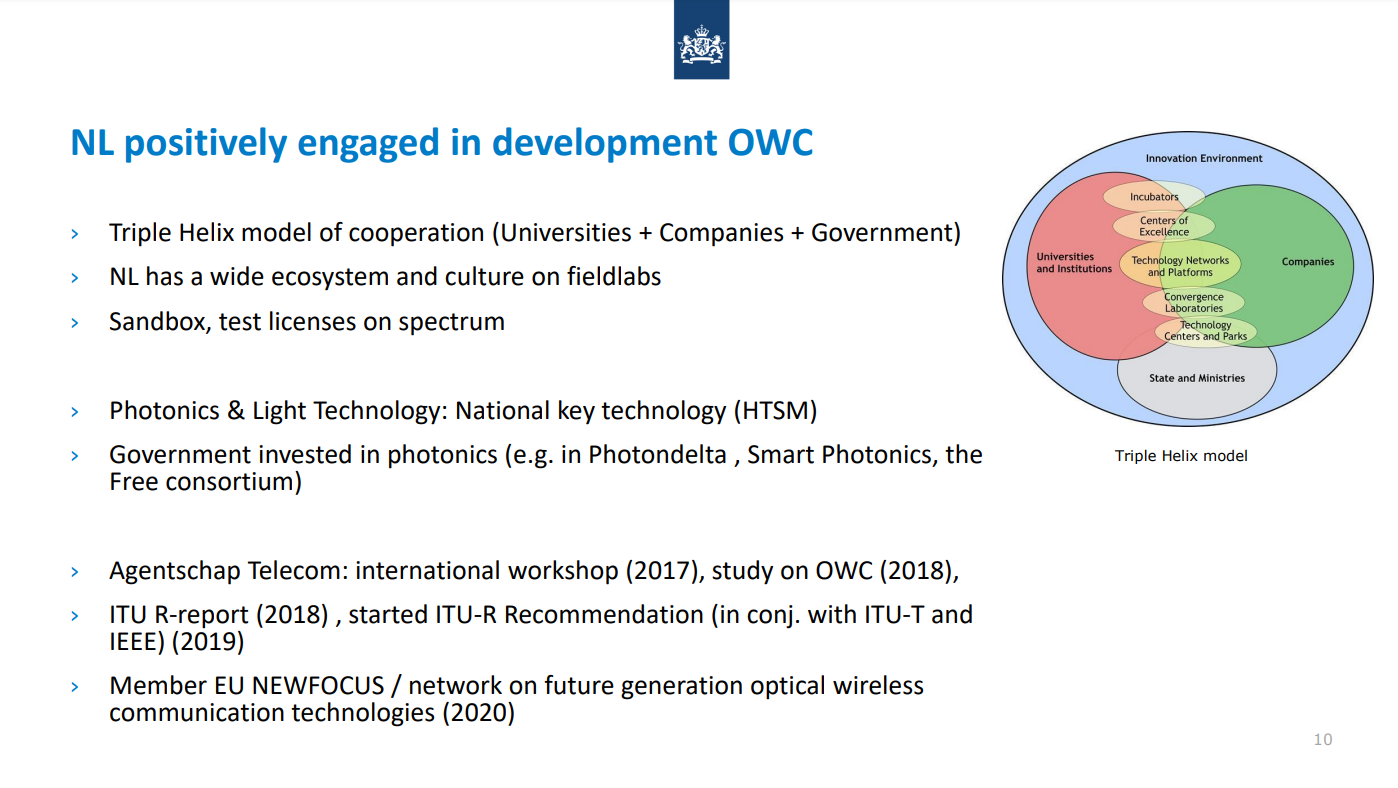
              Optical Wireless As A New Comfort For Telecom? A Regulator’s Perspective By René Vroom

              René Vroom from Agentschap Telecom was the tenth and final presenter at the online Li-Fi Conference 2021. He discussed in his presentation the topic of Optical Wireless As A New Comfort For Telecom? A Regulator’s Perspective.

              Below are some points discussed in this presentation.:

              René Vroom started his presentation by saying the following:

              My view is of course a little bit different. We are a regulator and we are very much interested in optical wireless communications. So I will lead you through my presentations.” 

              CONTENT

              As a regulator, I will tell you a little bit about a handful of telecom, the Delta radio communications agency. I will talk about digitalization and developments in telecom, optical wireless for us with this new spectrum new technology and some conclusive reflections."

              Agentschap Telecom


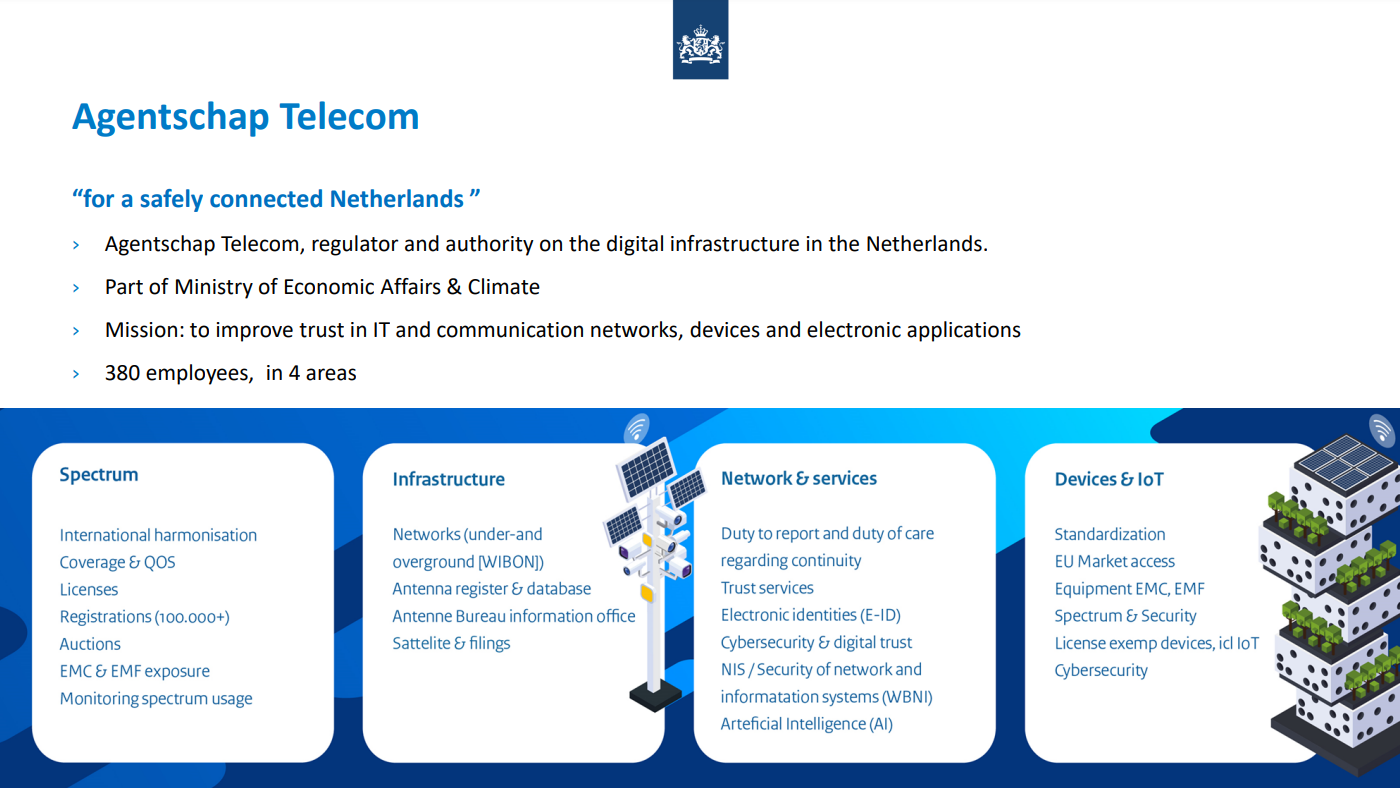
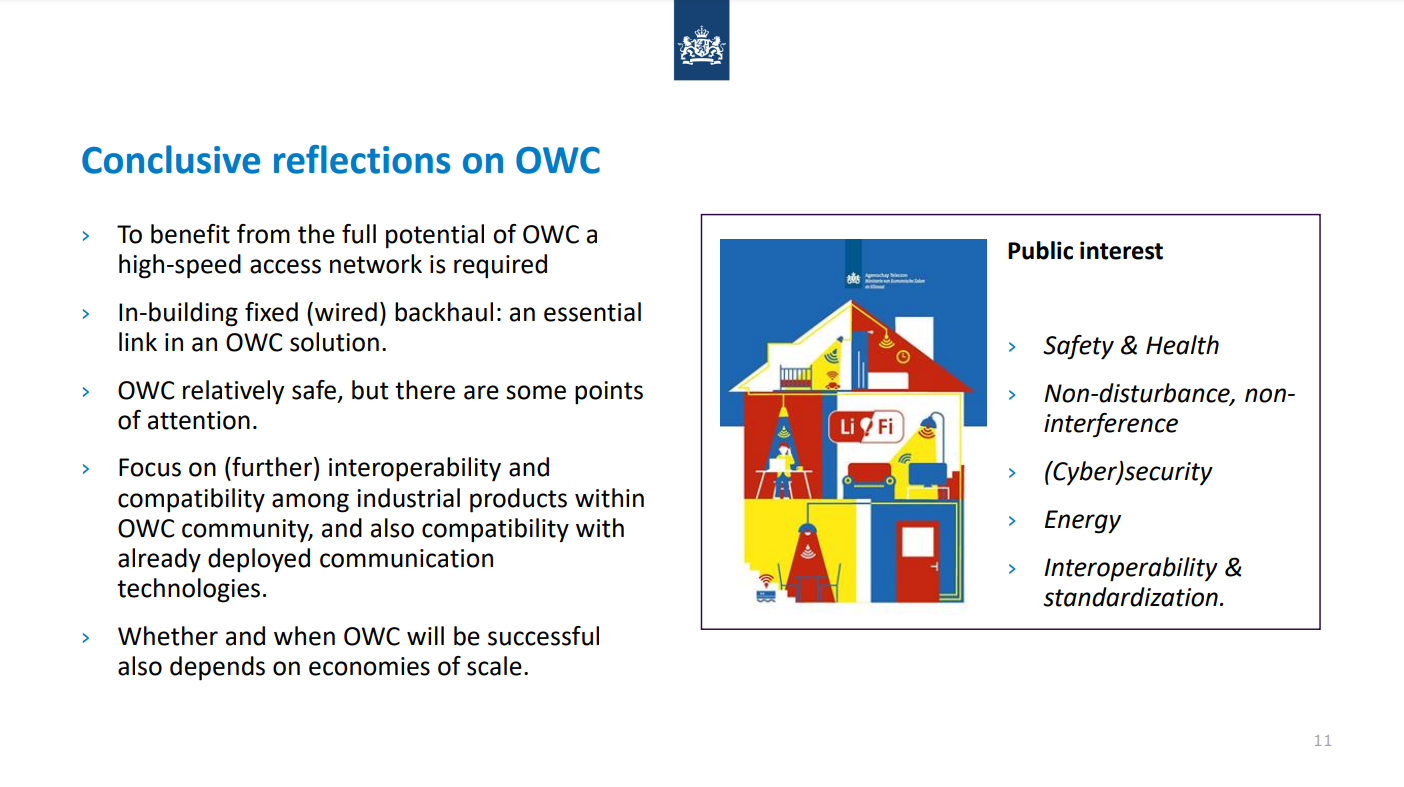
              AGENTSCHAP TELECOM for a safely connected Netherlands, we are a regulator and an authority on the digital infrastructure in the Netherlands and part of the Ministry of Economic Affairs and climate policy. And our mission is to improve trust in IoT and communication network devices in electronic applications. Roughly 400 employees in four areas and I will lead you in a few seconds through those four areas. It's about spectrum. We are doing regulating and law enforcement on Spectrum infrastructure, networking services, devices and IoT. We are an organisation like Ofcom in the UK or the Bundesnetzagentur in Germany or FCC in the United States. Out of these slides in the left box, you will find international harmonisation of all spectrum and that is of course also important for 5g Wi-Fi etc and we will come back later on how it will reflect to LIFI infrastructure and going to the right box, devices and IoT. We are dealing with some standardisation organisations, EU market access equipment, electromagnetic compatibility and EMF etc. So for us, it's important that whatever is going on through the market it is reliable, safe and secure.” 


              NL & digital connectivity

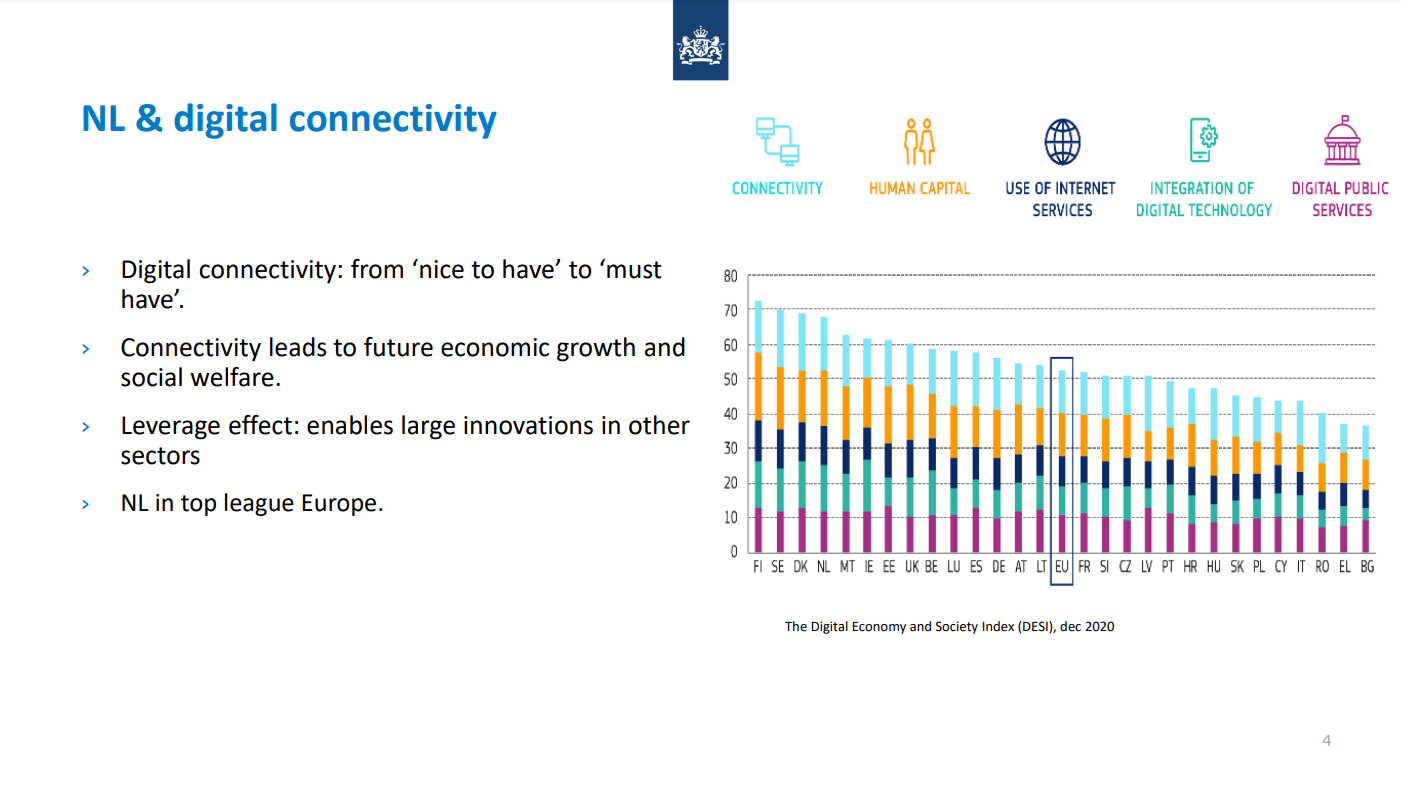
              About Holland very shortly, digital connectivity we see it from a nice to have to a must have digital connectivity leads to economic growth and social welfare and also with the COVID pandemic we have seen how important it is that we have digital connectivity everywhere. But we also expect quite some leverage effects from digital connectivity into other sectors like the agricultural logistics and so on. If you see here the DESI index from Europe, you can see the evidence from Europe. When it comes to connectivity, human capital use of Internet services integration of digital technology and digital public service in a country the DESI for Europe is roughly 52 and in Holland, we are in good shape with Denmark, Sweden and Finland on 70, 68 Something like that.

              Strategic developments

              Strategic developments which we see upcoming are still and it is not a surprise an increase in communication data transmission ongoing. For us as a regulator, we are very much busy on the 5G rollout ongoing we are thinking about beyond 5g and 6G is upcoming. But we see still and that is why we are so interested in new technology like LIFI radio spectrum is very much occupied and solutions are looked for. And we are looking at them in three different areas. One is to use the existing spectrum more dynamic and sharing. The other one is creating a higher efficiency on accessing existing spectrum with new technologies like 5G And you can think about edge computing and slicing. And the third option we are looking for is complete new technology on the new spectrum. And then we are coming to back to optical wireless communication. So that's the reason why we are interested in optical wireless communication. But also it's important that social impacts on telecom are becoming more and more important. And then you have to think about sustainability, health, privacy and data integrity and cybersecurity. And of course, as a country, we are not loosely coupled with the rest of the world and extremely important for us is the Europe digital strategy, which you can see here in the left box. And I will just shortly touch on the graph to the REITsright. You can see this is the retail mobile data used in Holland is going up from 200 billion in 2016, up to 1 trillion megabytes in 2020. So it's five times more in four years. And it's important also to notice that the main part is still used inside offices or inside buildings or inside houses. And then, of course, LIFI and I come back to that later is an option to use to accommodate this data transmission.

              Optical Wireless Communications (OWC)

              Optical wireless communication, we did a study already in 2018 on this together with the Stratics and the ICT of Technical University and basically, we have this spend up to two different basic options, LIFI as official light communication and beam stay at infrared light communication. You can see over to the right, you can see the blue field sea base which is LIFI and the other one is the red ones beams, the base stations pencil beams, which is, for example, sorry the icon in the red wall in the picture to the right. Also, it was already mentioned by some other speakers there is free space optics. The conclusions of that report are that optical wireless is maturing and may help relieve spectrum scarcity. And the next one is LIFI and certain beams like the infrared can become a potential for indoor short-range digital connectivity with extreme low latency and it might become also a complementary and or an alternative to RF like or eg on Wi-Fi. In the bottom right, you see a spectrum very much simplified. The radio spectrum is very much occupied. And as I said already in my intro, infrared invisible is hardly used for communication. So, there are I think up to 2600 times more spectrum available frequencies available than in the whole radio spectrum.”

              Overview of issues

              We created in this report, and it is available with a link which I can send later on an overview of the issues which need to be solved or addressed. Going to the left, you see it's about access to the site and the backhaul on-site, you have to think about power supply, optical fibres. And this whole backhaul needs to be in place to make use of the LIFI qualities. In the middle, you'll see also the access points, where do you place them on the ceilings on the walls? How will you locate them? Will it be light or will it be a combination or will be separated this kind of issues needs to be solved? And then, of course, the quality of the optical link which you see more to the right then you have to think about is it better or is it complimentary? And we have already taken that conclusion at least you have to think about what is on Wi-Fi Bluetooth, 5G fixed what is already there? And how will these be fixed that and then, of course, there should be no interference with other communication devices. It should now also when you move it, should not immediately lose the signal or block the signal. And when it comes to safety and security, It's it's about eye and skin safety and also all data integrity and data security and the use of devices. Then I go to the complete right of this table, it's about interoperability and standardisation. So the protocols that authentication, the firmware everything have to be in place in the same study.” 


              OWC modelling stakeholders

              We have talked and also other speakers have talked about the ecosystem. And in this study, we have created a picture of the ecosystem, you see power, urgency and legitimacy. Legitimacy distributes at least the regulation part. Power is the ones who can create and Urgency is the one who can use it and buy it. And on the regulation side, it's about the standards, the rules and the regulations and the law enforcement. And of course, it’s important to see what is in the middle of those three circles. And then you'll see the companies or organisations that are important and overlapping are the building owners and the building management, the standardisation organisations, manufacturers, the access point manufacturers and the branch organisations, think about schools, hospitals, airline industries, conferences and so on. And again, we have to think about how we can get the data bandwidth also in houses and in offices and then we are coming back to the building owners and the building management.”


              OWC regulations

              There are many regulations on equipment and devices in general, but coming to spectrum, this is above 300 gigahertz and we expect it to be non-regulated and or licenced exempt. The ITU will consider normally not up to or higher than 3000 gigahertz. So, that is, let's say kind of freedom books. But there is also radio equipment directive in Europe. And then you have to think about EMF, so the protection on health and ICNIRP electromagnetic compatibility, the efficient use of frequencies, and also as from 2024 onwards, cybersecurity. This radio equipment directive is only valid when the optical wireless devices include RF modules, eg for on and off switching or location or any other reasons. The EMC directive is here already right now for optical wireless and then you have, of course, General Product Safety and then condition on light density and eye safety and the low voltage directive. So, these kinds of things are to be considered and are important to check with also when you're producing these products.


              NL positively engaged in development OWC

              In the Netherlands, we are positively engaged in the development of optical wireless. In general, we have in Holland, the so-called Triple Helix model. And in this case, we are working very much together with the technical universities of Eindhoven centre, Delft and other universities and companies. In general, we have a wide ecosystem of field labs, and we are also able to create sandboxes and test licences on Spectrum. More specific the middle ones, photonics and light technology have become in Holland One of the national key technologies in the top sectors for knowledge and innovation. The government has invested in photonics like for example, in the photon Delta consortium, smart photonics as a company and also in a free Consortium, which is run by the TCU Technical University of Delft. So we have really invested money in this because we think this complete development should not be looked only upon the last part. So LIFI, with also the fibre, but also the integrated circuits which are then at the end complete chain of communication lines. So as our radio communications agency, we did a study on optical wireless in 2017. We did an international workshop, we created an ITU report in 2018. And we took the initiative for recommendation in ITU R in 2019. In conjunction with ITU t and I triple E. And last but not least, we have become members of the EU cost. New focus on the EU network on future generation optical wireless communications technologies. And also here together with the University of Eindhoven, John Paulina, who is also working with Signify, we are heading up for creating more usage of optical wireless.

              Conclusive reflections on OWC

              The benefits from the full potential of optical wireless or high-speed access network is required and maybe not the technique is the bottleneck anymore or soon, but the way the data gets there. So, an in-building fixed-wired backhaul is an essential link in the complete optical wireless solution and it should be installed as we are also installing water pipes, gas pipes and electricity in houses. For as far as we can see, optical wireless is relatively safe, there are some points of attention, for example, on lights, eyes, safety, and light density, but needs to be addressed in a good way. And further on. The interoperability between products in the optical wireless community needs to be guaranteed, or at least we would prefer that. But also the compatibility with other already deployed communication technologies like Wi-Fi and 5G. So whether optical will become successful depends on economies of scale, and the market picking up. For us, it's important that attention is paid to public interests like safety and health, that it is not disturbing and not interfering or creating interference with other devices. And cybersecurity is becoming more and more important. So we will look upon that one, as a regulator. Energy consumption is already mentioned, but that's an European policy. So take that into account. And last but not least interoperability and centralisation are extremely important.”

              So to conclude, we cannot innovate frequencies but we can innovate the way we use them. That's what we say. Thank you for your attention”.

              You can also watch the full video presentation on the following YouTube link from Jakajima YouTube channel.

              Li-Fi Conference 2022
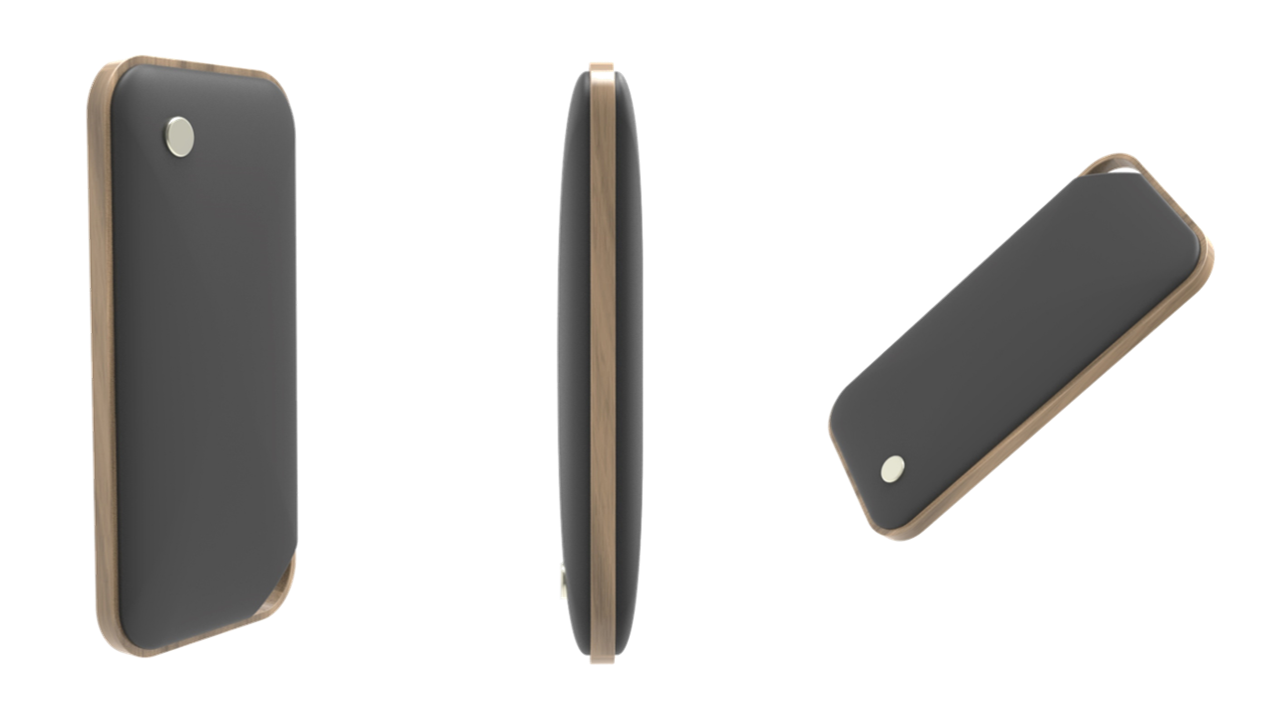
              The next Li-Fi Conference is coming up on the 28th of June 2022 between 10 am and 4.30 pm CET.

              It is interesting to realise that lights that illuminate offices, homes, cars, factories, our streets and more locations also can connect us to data and hence power the growing demand for connectivity and speed.

              At this conference professionals from all over the globe will gather together in order to share applications, ideas, new developments and ways to integrate Li-Fi in services, both for consumers and professionals.

              This conference will be held Live and Online. The venue will be the High Tech Campus 1, The Strip 5656 AE Eindhoven The Netherlands.

              Online tickets can be bought at the following link:

              https://tikcit.com/register/61e002336d7fc4b6745cab83/

              What is LiFi?

              LiFi, also known as "Light Fidelity" is a wireless optical networking technology, which uses light-emitting diodes (LEDs) to transmit data. In 2011, professor Harald Haas made a LiFi demonstration at the TED (Technology, Entertainment, Design) Global Talk on Visible Light Communication (VLC).

              VLC uses light as a medium to deliver high-speed communication like Wi-Fi and complies with the IEEE standard IEEE 802.15.7. The IEEE 802.15.7 is a high-speed, bidirectional, and fully networked wireless communication technology-based standard similar to Wi-Fi's IEEE 802.11.

              How does LiFi work?

              LiFi is a high speed, bidirectional, and fully networked wireless communication of data using light. LiFi constitutes of several light bulbs that form a wireless network.

              When an electrical current goes through to a LED light bulb, a stream of light (photons) emits from the lamp. LED bulbs are semiconductor devices, which means that the brightness of the light flowing through them can change at extremely high speeds. The signal is sent by modulating the light at different rates. The signal can then be received by a detector that interprets the changes in light intensity (the signal) as data. Also when the LED is ON, you transmit a digital 1, and when it is OFF, you transmit a 0.

              LiFi Benefits

              The primary benefits of LiFi are as follows:

              Security: Provides entirely secure access. Where there is no light there is no data.

              Safety: Does not produce electromagnetic radiation and does not interfere with existing electronic systems.

              Localisation: Allows localisation due to the small coverage area of LiFi access point - localisation can be used for very precise asset tracking.

              Data density: Provides ubiquitous high-speed wireless access that offers substantially greater data density (data rate per unit area) than RF through high bandwidth reuse.

              Credit to Oledcomm

              LiFi Applications

              LiFi can be used for so many applications and the list is increasing every year. You can read our updated list of Li-Fi applications at the following link:

              https://www.lifitn.com/blog/2021/2/13/top-30-li-fi-applications-updated-list-including-potential-applications

              Credit to pureLiFi

              In conclusion, if you are also interested to hear more information about the OWNII Coin or enquire about LiFi devices such as the LiFiMax and Trulifi, you can contact us through our chatbot or by sending an email through our contact us form. If you enjoyed this post and would like to hear more updates about LiFi technology, subscribe to our newsletter. Don’t forget to subscribe to our social media accounts. You can also join our Telegram group about LiFi technology on this link:

              https://t.me/joinchat/FMzOmsEKyJFrU6Af


              Li-Fi Conference 2021 - Recap Part 9 - Fully Leveraging LiFi Capabilities Through Enhanced Integration With 5G Core And Services

              Table of Contents

                Li-Fi Conference 2021 - Recap Part 9 - Fully Leveraging LiFi Capabilities Through Enhanced Integration With 5G Core And Services

                Li-Fi Conference 2021

                In our last article from our ONLINE Li-Fi Conference 2021 recap series, we discussed the duo presentation on LiFi At The Heart Of Future Intelligent Communications Networks delivered by Sylvain Leroux, FoodTech & Light Communications Director, Orange and Micheline Perrufel, Researcher/Project manager Innovation, Orange. The conference was organised by the Jakajima, the global High Tech Conference organiser, and the Light Communications Alliance.

                Jakajima, Matchmaker for Innovators in the high tech industry, organises many events, ranging from LiFi Technology industry trends, 3D Printing to the Internet of Things, from Unmanned Cargo Aircraft to Health Tech, from 4D Printing to Photonics and from Vertical Farming to Sustainable Materials.

                The online Li-Fi Conference included live presentations from researchers, executives and industry specialists from pureLiFi, Nokia, Signify, Orange, Radiocommunications Agency Netherlands, Velmenni, OLEDCOMM, HomeGrid Forum and Weidmüller Deutschland.

                In another article recap series, we will talk about the presentation on Fully Leveraging LiFi Capabilities Through Enhanced Integration With 5G Core And Services delivered by Maximilian Riegel from Nokia. Before this, we will talk about Nokia.

                Nokia

                Nokia Corporation (natively Nokia Oyj, referred to as Nokia; stylized as NOKIA) is a Finnish multinational telecommunications, information technology, and consumer electronics company, founded in 1865. Nokia's main headquarters are in Espoo, Finland, in the greater Helsinki metropolitan area, but the company's actual roots are in the Tampere region of Pirkanmaa. In 2020, Nokia employed approximately 92,000 people across over 100 countries, did business in more than 130 countries, and reported annual revenues of around €23 billion. Nokia is a public limited company listed on the Helsinki Stock Exchange and New York Stock Exchange. It is the world's 415th-largest company measured by 2016 revenues according to the Fortune Global 500, having peaked at 85th place in 2009. It is a component of the Euro Stoxx 50 stock market index.

                The company has operated in various industries over the past 150 years. It was founded as a pulp mill and had long been associated with rubber and cables, but since the 1990s has focused on large-scale telecommunications infrastructure, technology development, and licensing. Nokia made significant contributions to the mobile telephony industry, assisting in the development of the GSM, 3G, and LTE standards. For a decade beginning in 1998, Nokia was the largest worldwide vendor of mobile phones and smartphones. In the later 2000s, however, Nokia suffered from a series of poor management decisions, and soon saw its share of the mobile phone market drop sharply.

                After a partnership with Microsoft and Nokia's subsequent market struggles,Microsoft bought its mobile phone business, creating Microsoft Mobile as its successor in 2014. After the sale, Nokia began to focus more on its telecommunications infrastructure business and on Internet of things technologies, marked by the divestiture of its Here mapping division and the acquisition of Alcatel-Lucent, including its Bell Labs research organization. The company then also experimented with virtual reality and digital health, the latter through the purchase of Withings. The Nokia brand returned to the mobile and smartphone market in 2016 through a licensing arrangement with HMD Global. Nokia continues to be a major patent licensor for most large mobile phone vendors. As of 2018, Nokia is the world's third-largest network equipment manufacturer.

                The company was viewed with national pride by Finns, as its mobile phone business made it by far the largest worldwide company and brand from Finland.

                Fully Leveraging LiFi Capabilities Through Enhanced Integration With 5G Core And Services By Maximilian Riegel

                Maximilian Riegel from Nokia, was the ninth presenter at the online Li-Fi Conference 2021. He discussed in his presentation the topic of Fully Leveraging LiFi Capabilities Through Enhanced Integration With 5G Core And Services.

                Maximilian Riegel received his Dipl.-Ing. degree in Electrical Engineering from TU Munich, Germany and is currently responsible for IEEE & Wi-Fi standardization within Nokia. He participies in IEEE 802 and other Wi-Fi related standardization for more than 15 years and led the development of IEEE 802.1CF-2019 specification. He was NWG vice chair in the WiMAX Forum, led the Ethernet over cellular work in IETF 16ng WG, and chaired the OmniRAN SG/TG activities in IEEE 802. He regularly acts as lecturer for Wi-Fi and as speaker at technical conferences. Formerly, he held R&D management positions within Siemens Communications and Philips Communication Industry.

                Below are some points discussed about Fully Leveraging LiFi Capabilities Through Enhanced Integration:

                Maximilian Riegel started his presentation by saying the following:

                What we are currently in is in the middle of a fourth industrial revolution, driven by the move of the industry to digitisation and optimise control. So, deploying IT technology to get production more enhanced, and really investing a huge amount of money now in enhancing industrial production capabilities and methods.” 

                Industry 4.0 use cases enabled by 3GPP 5G evolution

                And we see that this opens a new market. And it's not only opening a new market, it's already driving the standardisation and the development and the whole idea of 5G and the evolution of 5G, which started initially from doing much better Broadband now is going into machine type communication, ultra-light low latency communication techniques, enhancements, which are very important for control in factories, machineries, all this IoT stuff, industrial IoT stuff, where nowadays, we are not talking about the gigabits, but more about the milliseconds. And that's what's critical."

                Challenging connectivity options to address Industry 4.0 needs


                And where this industry 4.0 needs are really putting a burden on our communication technologies. And I have here on the right side, a table with different applications and a little bit of characterization of what's needed in terms of communication capabilities. If you're doing monitoring, if you're just collecting data, then yes, you are getting a huge amount of data. But what's not so critical is the delay. And it's also not so critical. When a bit is transferred incorrectly, you have always the possibility to retransmit. So that's where you can do a huge amount of pipe data without high precision transmission capabilities, it's getting a little bit more challenging when you're doing starting to control equipment like autonomous robots, where you may have to go down to some transmission capabilities challenging and where it stand finally, really starting to become challenging if you're doing modern things like augmented reality, where short delays are extremely important. People are really becoming seasick when there's too much delay. And we're we have also another way, where reliability is going up orders of magnitudes when doing robotic control, or when sitting with telecommunications or communications in control loops, extreme time-critical control loops when systems have to provide delay times millisecond or below a millisecond. That's where our technology our wireless technology currently has difficulties where the industry currently is doing. Wire, as you see it on the left side, but yeah, wire is excellent transmission capabilities, but has challenged in mobility flexibility, also in the economics, when setting up wire.” 


                Connectivity performance comparison in an industrial environment

                And what we did is a little bit of comparison, where are the different technologies, where are different standards located when you're comparing latency and reliability and I have a figure here showing Ethernet 4G/5G, ci and Wi-Fi. And what you see is Ethernet is extremely low delay, up to extremely high reliability. And when our doing our most used radio technology, meanwhile was 4G/5G. We are coming down in the range of 20 milliseconds to 10 milliseconds. That's something we can do. But what's really desired and you have seen the applications is we have to go even shorter delays at high reliability at much lower transmission delays. And the assumption is just from the physics, LIFI could fill us, could provide us solutions, which are really suited for this industrial IoT, industrial control loaded low latency. Something going in that direction, we would like to have a wire but without a wire from transmission capabilities. So that's where LIFI could fit in.

                How to integrate LiFi into 5G?

                Now, LIFI into 5G. LIFI into 5G provides a comprehensive environment for doing complex communications of various applications. And what we have to think about is now we have to get LIFI into this overall 5G architecture.

                5G Architecture: Reference Point Representation

                5G architecture is mainly dominated or created, focused around session control, quality of service control, which provides a huge complexity. The 5G architecture has also the capabilities to be completely implemented in software. So it's not done this hardware functional architecture, it's functional architecture, where functional units are interoperating not saying anything about implementation. And when thinking about the integration of LIFI, we have to think about how we are getting LIFI on this end through N2 and N3 interfaces. We're currently with the 5G run, that's where we have to think about.

                5G QoS model to provide fine-grain service differentiation

                Why we are doing it as 5G provides the QoS model, the QoS control the need for industrial control. So 5G has an extremely comprehensive, sophisticated QoS model with a fine grain control capability. And 5G has the technology to do multiple different QoS flows on a common infrastructure, things really need it for industry, industrial applications and the industry 4.0 in the broad scope, if you'd like to do everything required in this industrial 4.0 area, you need a universal system, which has a huge variety of doing it.” 


                LiFi integration through adoption of 3GPP WLAN (Wi-Fi) integration model

                So the first approach to adoption to do the inclusion of LIFI into 5G would be oh, there is a nice model for Wi-Fi. Yeah, let's use the Wi-Fi model, we are also having a standardisation approach where we are getting a Wi-Fi or 802.11 variant with light, straightforward. And that would be the shortest path together into integration. This Wi-Fi integration model, the primary Wi-Fi integration model currently is based on an N3 IWF gateway. Now technically speaking, that's gateway and VPN gateway setting up an IPsec tunnel between the 5G core system and wireless LAN user equipment tunnelling the data through and tunnelling also signalling through and this Wi-Fi model, that's currently Wi-Fi model. This VPN connectivity is highly flexible in the deployment of what's needed currently for Wi-Fi. It fulfils all the security requirements. But we're now going into we like to do pure essence, stream handling and something like that. And we like to have the lowest delay, then it's becoming really tricky because a VPN tunnel always adds additional delays.” 

                Issues of the 3GPP WLAN integration model for LiFi

                So this is what we should keep in mind when doing Wi-Fi, LIFI integration into N3 or switching up to 5G core. The first thing is to consider what's Wi-Fi and what is LIFI. And that's the difference, LIFI isn't just a Wi-Fi. Wi-Fi is used as a huge transfer capability, offloading internet traffic in the local area. So it's an auxiliary interface to a primary switch up Key radio interface where you can just take off leverage cheaper channel when being in the local area. The terminals are usually dual-mode, they have all the 5g signalling, they have different signalling paths and they have no need for doing really a comprehensive QoS management. Now, when you have seen what we are thinking about LIFI, we see a new kind of transmission capability for wireless communication. No, a 5G radio is not just an alternative solution. LIFI is a new kind of quality. So, it's not necessary that there is a 5G radio interface in all LIFI interfaces. And we also expect that the LIFI interface devices are not such mobile, because LIFI cells are very small, so mostly stationary. So we have to think about a single-mode LIFI terminal. But we need a very comprehensive QoS management. So we have really to have access to the lower layer data not being encrypted on our IPsec tunnel where all service differentiation is really becoming challenging. And what we see is that the Wi-Fi integration model does not provide all this 5G QoS model and control. Only a small subset of 5G QoS can be supported in Wi-Fi, and we have the issue of the IPsec tunnel. So we need a kind of better integration model direct attachment, less overhead, less protocol overhead. And in particular link-layer integrations that we have access to the data streams.


                The 'better' integration model for LiFi

                And such a model already exists. But it's not fully out or deployed for LIFI. But it's probably a hint on how to proceed. There is a definition of a trusted wireless LAN interworking function, which is terminating N2 to N3 interfaces into a non three GPP technology, not demanding the IPsec tunnel doing and allowing for all the functional integration, having link-layer access to the user plane, maybe support local mobility, which is important in the LIFI area with the small coverage zones. And that's the proposal here for going forward when thinking about LIFI, thinking about a more core s focused integration model than we currently have for LIFI and working on further enhancements to get this model adopted for LIFI but also LIFI addressing the need of industry 4.0 that means providing high reliability, low latency communication, that may also work a little already with the standard coming out of 802.11bb by avoiding congestion and allowing a higher control.”

                Summary and conclusion

                And then I'm coming to the end of my presentation but I've shown 5G is a system that really serves the needs of industry 4.0 for all this critical communication. In particular, 5G provides the control and configuration capabilities that are needed in industrial deployments. Frequently, configuration has to be adopted. What we also discovered or what we found is that there is a technology gap between wired and wireless. And we are looking forward to a domain where LIFI could excel. But finally, to deploy LIFI in this industrial environment, we see the need for better integration. And we see the need for leveraging or basing it on a different approach than what we have currently on Wi-Fi. And yeah what's asked for is further research standardisation to get this LIFI deployment really working. Currently, we have just the hints of the framework, but there are so many technologies still missing to get it working.

                You can also watch the full video presentation on the following YouTube link from Jakajima YouTube channel.

                Li-Fi Conference 2022
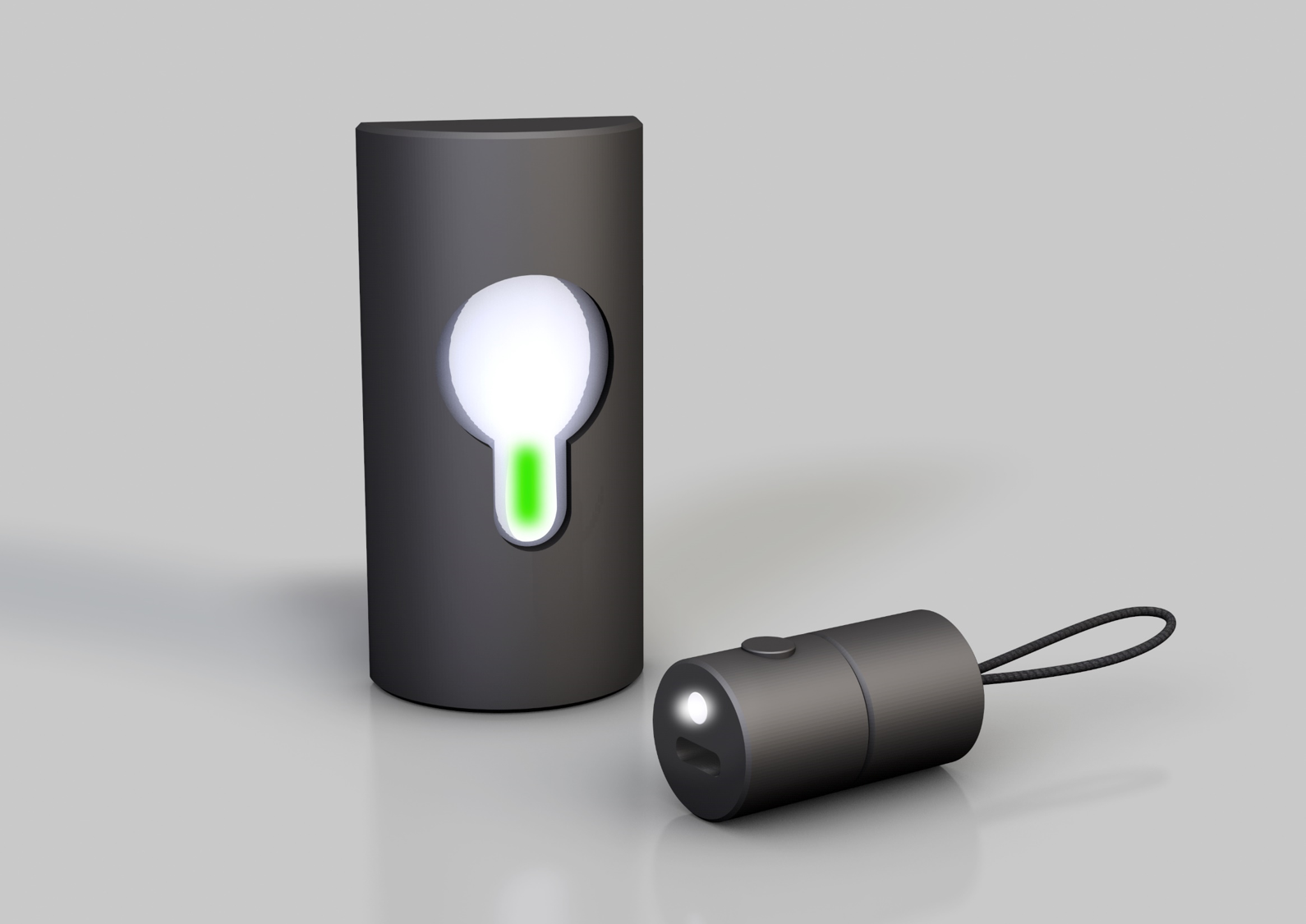
                The next Li-Fi Conference is coming up on the 28th of June 2022 between 10 am and 4.30 pm CET.

                It is interesting to realise that lights that illuminate offices, homes, cars, factories, our streets and more locations also can connect us to data and hence power the growing demand for connectivity and speed.

                At this conference professionals from all over the globe will gather together in order to share applications, ideas, new developments and ways to integrate Li-Fi in services, both for consumers and professionals.

                This conference will be held Live and Online. The venue will be the High Tech Campus 1, The Strip 5656 AE Eindhoven The Netherlands.

                Online tickets can be bought at the following link:

                https://tikcit.com/register/61e002336d7fc4b6745cab83/

                What is LiFi?

                LiFi, also known as "Light Fidelity" is a wireless optical networking technology, which uses light-emitting diodes (LEDs) to transmit data. In 2011, professor Harald Haas made a LiFi demonstration at the TED (Technology, Entertainment, Design) Global Talk on Visible Light Communication (VLC).

                VLC uses light as a medium to deliver high-speed communication like Wi-Fi and complies with the IEEE standard IEEE 802.15.7. The IEEE 802.15.7 is a high-speed, bidirectional, and fully networked wireless communication technology-based standard similar to Wi-Fi's IEEE 802.11.

                How does LiFi work?

                LiFi is a high speed, bidirectional, and fully networked wireless communication of data using light. LiFi constitutes of several light bulbs that form a wireless network.

                When an electrical current goes through to a LED light bulb, a stream of light (photons) emits from the lamp. LED bulbs are semiconductor devices, which means that the brightness of the light flowing through them can change at extremely high speeds. The signal is sent by modulating the light at different rates. The signal can then be received by a detector that interprets the changes in light intensity (the signal) as data. Also when the LED is ON, you transmit a digital 1, and when it is OFF, you transmit a 0.

                LiFi Benefits

                The primary benefits of LiFi are as follows:

                Security: Provides entirely secure access. Where there is no light there is no data.

                Safety: Does not produce electromagnetic radiation and does not interfere with existing electronic systems.

                Localisation: Allows localisation due to the small coverage area of LiFi access point - localisation can be used for very precise asset tracking.

                Data density: Provides ubiquitous high-speed wireless access that offers substantially greater data density (data rate per unit area) than RF through high bandwidth reuse.

                Credit to Oledcomm

                LiFi Applications

                LiFi can be used for so many applications and the list is increasing every year. You can read our updated list of Li-Fi applications at the following link:

                https://www.lifitn.com/blog/2021/2/13/top-30-li-fi-applications-updated-list-including-potential-applications

                Credit to pureLiFi

                In conclusion, if you are also interested to hear more information about the OWNII Coin or enquire about LiFi devices such as the LiFiMax and Trulifi, you can contact us through our chatbot or by sending an email through our contact us form. If you enjoyed this post and would like to hear more updates about LiFi technology, subscribe to our newsletter. Don’t forget to subscribe to our social media accounts. You can also join our Telegram group about LiFi technology on this link:

                https://t.me/joinchat/FMzOmsEKyJFrU6Af


                Li-Fi Conference 2021 - Recap Part 8 - LiFi At The Heart Of Future Intelligent Communications Networks

                Table of Contents

                  Li-Fi Conference 2021 - Recap Part 8 - LiFi At The Heart Of Future Intelligent Communications Networks

                  Li-Fi Conference 2021

                  In our last article from our ONLINE Li-Fi Conference 2021 recap series, we discussed the presentation on “Light Communication As A Part Of 5G And Beyond” delivered by Deepak Solanki from Velmenni. The conference was organised by the Jakajima, the global High Tech Conference organiser, and the Light Communications Alliance.

                  Jakajima, Matchmaker for Innovators in the high tech industry, organises many events, ranging from LiFi Technology industry trends, 3D Printing to the Internet of Things, from Unmanned Cargo Aircraft to Health Tech, from 4D Printing to Photonics and from Vertical Farming to Sustainable Materials.

                  The online Li-Fi Conference included live presentations from researchers, executives and industry specialists from pureLiFi, Nokia, Signify, Orange, Radiocommunications Agency Netherlands, Velmenni, OLEDCOMM, HomeGrid Forum and Weidmüller Deutschland.

                  In another article recap series, we will talk about the duo presentation on LiFi At The Heart Of Future Intelligent Communications Networks delivered by Sylvain Leroux, FoodTech & Light Communications Director, Orange and Micheline Perrufel, Researcher/Project manager Innovation, Orange. Before this, we will talk about Orange Telecommunications.

                  Orange

                  Orange S.A., rebranded as Orange, formerly France Télécom S.A., stylized as France telecom, is a French multinational telecommunications corporation. It has 266 million customers worldwide and employs 89,000 people in France, and 59,000 elsewhere. It is the 11th largest mobile network operator in the world and the 4th largest in Europe after Vodafone, Telefónica, and Deutsche Telekom. In 2015, the group had a revenue of €40 billion. The company's head office is located in the 15th arrondissement of Paris.

                  Orange has been the company's main brand for mobile, landline, internet and Internet Protocol television (IPTV) services since 2006. It originated in 1994 when Hutchison Whampoa acquired a controlling stake in Microtel Communications during the early 1990s and rebranded it as "Orange". It became a subsidiary of Mannesmann in 1999 and was acquired by France Télécom in 2000. The company was rebranded as Orange on 1 July 2013.

                  Orange is also a leading provider of global IT and telecommunication services to multinational companies, under the brand Orange Business Services. In December 2019, the Group presented its new "Engage 2025" strategic plan, which, guided by social and environmental accountability, aims to reinvent its operator model. While accelerating in growth areas and placing data and AI at the heart of its innovation model, the Group will be an attractive and responsible employer, adapted to emerging professions.

                  LiFi At The Heart Of Future Intelligent Communications Networks Delivered By Sylvain Leroux and Micheline Perrufel

                  Sylvain Leroux, FoodTech & Light Communications Director, Orange and Micheline Perrufel, Researcher/Project manager Innovation, Orange, were the eighth presenters at the online Li-Fi Conference 2021. He discussed in his presentation the topic of Light Communication As A Part Of 5G And Beyond.

                  Sylvain Leroux is a seasoned Marketing and communication professional with over 20 years of knowledge and experience in the telecom/internet industry from strategy in complex ecosystems, to operational project management for one of the world’s leading telecommunications operators. He currently works on IoT Program (B2B & B2B2C).

                  He previously worked as Strategy of Services & Partnerships Marketing Manager focusing on change management, digital transformation and innovation. His mission was about to structure or manage game changing partners / ecosystems / services.

                  Micheline Perrufel is currently Research Engineer and Innovation Project Manager at Orange Labs. She supports digital innovation by deploying light communication technology in addition to radio and ultrasound technologies. Her role also involves in responding to the new expectations of business and private customers with simple, ethical and environmentally friendly solutions. She also leads in the preparation of new user interaction services based on Beacon, LIFI, NFC, Lora technologies...using UCI (User Centric Innovation) design Thinking methods.

                  Below are some points discussed about LiFi At The Heart Of Future Intelligent Communications Networks:

                  Sylvain Leroux started the presentation by saying the following:

                  My name is Sylvain Leroux and I'm working at Orange Innovation. and I'm working on different innovation programmes such as light communication and I'm working in pairs with Micheline who is also part of Orange innovation. So, today I'm happy to talk with you and to talk about future intelligence communication networks. And why it really matters on the chair of intelligent communication networks.”. 

                  We have reached a very symbolic tipping point four years ago, as we get more objects that were connected on the earth, rather than human beings, approximately more than 8 billion of connected objects on Earth".

                  Connected devices sold in 2020 in the world


                  And we could see that the connected devices market also has grown very fast. Thanks to different connectivity, and new technology arriving on the market, you could see an interesting point here is that all of them are growing very fast. 


                  Volume of data/information created, captured, copied, and consumed worldwide from 2010 to 2024 (in zettabytes)

                  Connected devices are booming, but also the volume of consumer data is growing very, very fast. And the interesting thing that you can see on this chart,the consumption of data will be multiplying by two and the question is how can we face this explosion of data consumption. So, we know that there is currently a very big pressure on the availability of the radio spectrum. And this is why we are looking for some alternatives on the optical spectrum.”

                  LIMITS OF EACH TECHNOLOGY

                  As we are experts on this field because we run between networks, from space to the sea to your living room. But you know that edge technology has its own benefits but its own limits and you have various possible natures such as security limits, electronics interference, places where you are and the material inside places we were talking previously about industry and the presence of metallic environment is very difficult for waves for example, we know that there is no unique solution regarding the different technologies and the combination of different technologies and complementary with the technology will be received in order to deliver the best experience and the best connectivity.”

                  Trends in global traffic and power usage of Wi-Fi access networks

                  And to give you some examples, we are facing some issues regarding, for example, electrical consumption and you get the examples here of going on electrical consumption of Wi-Fi. And even if the gateways and the modems are becoming more energy efficient, we are facing the increasing number of actually increasing traffic on the modem and gateways that increase the consumption of electricity.

                  Environmental certification: more and more buildings certified

                  Another example is that we use applications on the building market, for example. So, this is a very good concept but if you're looking to the quality of connectivity that you could provide the new sound out for low enlisted windows for example, it's checking for new products just to give you a look on the figures with the new type of glazing, it could be the radio signal could be divided into two for example, that's a very interesting challenge for us to get new, because some people have buildings that to get the best of the connectivity inside this visit.” 


                  Future intelligent networks

                  So, this is why we are approaching the future intelligent networks in order to combine different technology in order to have the best connectivity every time on every type of devices that I just told you previously revenue paradigm with richer devices are on the market during high speed connectivity, people ask for connectivity, they need real time, they want autonomous cars in the industry. We've also got cyber street and everyone wants to be connected from all three working for example or have the best connectivity in order to watch the Euro 2021. So, we have to think about the next generation of networks.” 

                  Mobile network evolution

                  These new networks are also evolutive and the interesting thing that I wanted to point out to us today is the different generation of 5g. The 5g router chain is what we call 5g and we says it's an evolution of the existing technologies on the existing core networks and the new generation with the and living a universities out you used to hear a day today on the news all about the little surprising is what we call this 5g standalone as a will have a dedicated 5g core network”.


                  5G cHaracteristics

                  So, this is the the existing frequencies that we are using for 5g most time around and this is within two years what you will see with the new 5g core networks of the 5g standalone and you could see that's very interesting because rich technology as its benefits in its own limits, and I will let you see the difference between indoor coverage throughput and it can be done with the with the 5g.

                  Fiber complementary to 5G, Satellite, Wi-Fi & Light Connectivity

                  Now fibre is in 2021, the basic connectivity network deployed by the telecom operator, it's very important for the Telco to deploy fibre and after the copper the fibre is deployed, why it's to offer to the customer big higher, big throughput, big speed and thanks to fibre, now, user can confirm data, can watch television and the fibre is a strategic vision for the Telco”.

                  Fiber FTTH deployment AND FTTH ARCHITECTURE

                  Deploying fibre is very expensive. And to the Telco as a priority is to choose a good architecture to deploy the FTTH to the residential for example, little enterprise, the Telco choose architect to offer to the customer a signal with the fibre but a fibre share up to 65 customers by each fibre”. 

                  Fiber PON

                  Today's fibre name, GPON, is deployed and offers the customers the possibility to have up to one gigabyte in download. Now today, the customers have the possibility to have a throughput up to one gigabyte by second in download. And, for example with orange, up to 20 up to 200 megabyte by second. In one year, we hope to begin to deploy a new architecture named XGPON. XGPON cost more expensive to deploy that can offer to the customers the possibility to have up to 10 gigabyte by second and it's very relevant to offer more speed, more throughput, more performance, for example, for use Wi-Fi and use on LIFI”.

                  Satellite complementary to 5G, Fiber, Wi-Fi & Light Connectivity

                  Satellite data is also a priority now today for the Telco. In recent years, satellite connectivity has been offered to residential and also to enterprise when neither fibre or mobile network are present. Throughput with satellite is quite correct but look at the latency is very bad to have a good latency with the latency with satellite. And to use satellites, you have to buy and to keep an antenna and the specific books. And a new generation of satellite is coming but look at also as a throughput if it is better is also less good as the actual fibre of mobile network”.

                  Wi-Fi 6 (ax) & Wi-Fi 6E

                  Now when we look at Wi-Fi, we see that Wi-Fi still is the best technology. It is Remarkable. Who has not already used the Wi-Fi in the world, the Wi-Fi is everywhere every time and as mobile networks Wi-Fi evolve technology and each decade as Wi-Fi proposes a new version. And each time, it's a new version that proposes more performance, more throughput and less latency. But now today's this year, we speak about the Wi-Fi 6E extended and so Wi-Fi 6E is associated with both 2.4 GHZ and 5GHz with less interference but also with 6GHz. We hope with this new frequency, we will have less interference with other technology as for example Bluetooth excetera”.

                  Light Connectivity

                  But on the complementary of this access, light technology is complimentary as radio technology radiofrequency technology. And while we have no concrete information on the effective charge of the bandwidths by your institution in each country, we understand that the uses are more and more numerous. And it's time to exploit this bandwidth in the optical electromagnetic spectrum, especially with the LIFI and OCC but also with FA so it's also relevant and we begin to to speak about the FSO in the Telco.

                  Light EQUIPMENTS

                  Light equipments are many as their price are cheaper, and it's very also relevant for the Telco that they are not manufacturer, when we can propose a LIFI solution or OCC solution, we must make partnerships with different actors but we are not manufacturers, okay? We provide to the customers, the LAN access, the one access, but not the equipment. And a lot of arguments against at the beginning of the LIFI was that there were as they were no equipment compatible with Wi-Fi and with OCC. But if we remember, as the beginning of Wi-Fi. In 1999, there was no equipment directly compatible with Wi-Fi. And as today with the LIFI,we used Wi-Fi and also a USB key”.

                  Our vision for a future intelligent communication network

                  So what we see at Orange, when we speak about a lot of technology with our customer, we see that users today are more and more lost. They don't know what is the good solution. And they want they would like a unique solution, a solution capable of giving them an universal signal and access. They need universal access with better throughput, with better latency and they don't know what solutions they have to choose. That's why we identify the opportunity to build projects and to make a solution to begin testing and to create a new network. A network with handover capability between different technologies. For example, when we use the mobile and the signal is bad, you can handover, you can use a new frequency or a new antenna, we speak about horizontal handover. When we speak about handover between different technologies, we speak about vertical handover. And we can manage this vertical handover for an intelligent new network. So we imagine a different architecture in the core network. And now with light, we think and it's my vision that is relevant to build a new architecture based on the 5g as the fibre also better the 5g, the LIFI and the Wi-Fi and the Satellite. So we think today that the vertical handover can be managed both by Fibre and the core network of mobile and PC and that is now a project in orange for example, to deploy this function and to enrich the global network in parallel of this evolution of old technology”.

                  You can also watch the full video presentation on the following YouTube link from Jakajima YouTube channel.

                  Li-Fi Conference 2022

                  The next Li-Fi Conference is coming up on the 28th of June 2022 between 10 am and 4.30 pm CET.
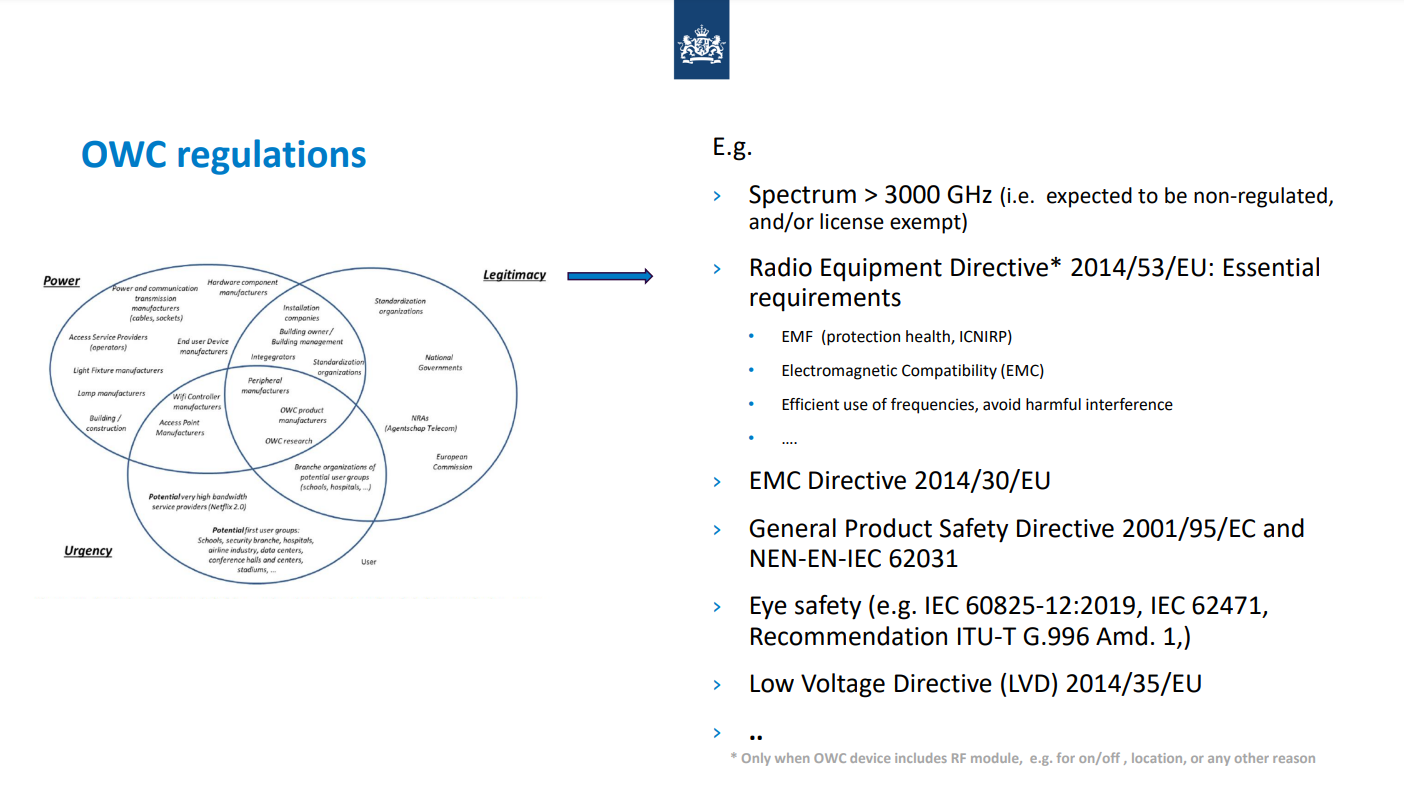
                  It is interesting to realise that lights that illuminate offices, homes, cars, factories, our streets and more locations also can connect us to data and hence power the growing demand for connectivity and speed.

                  At this conference professionals from all over the globe will gather together in order to share applications, ideas, new developments and ways to integrate Li-Fi in services, both for consumers and professionals.

                  This conference will be held Live and Online. The venue will be the High Tech Campus 1, The Strip 5656 AE Eindhoven The Netherlands.

                  Online tickets can be bought at the following link:

                  https://tikcit.com/register/61e002336d7fc4b6745cab83/

                  What is LiFi?

                  LiFi, also known as "Light Fidelity" is a wireless optical networking technology, which uses light-emitting diodes (LEDs) to transmit data. In 2011, professor Harald Haas made a LiFi demonstration at the TED (Technology, Entertainment, Design) Global Talk on Visible Light Communication (VLC).

                  VLC uses light as a medium to deliver high-speed communication like Wi-Fi and complies with the IEEE standard IEEE 802.15.7. The IEEE 802.15.7 is a high-speed, bidirectional, and fully networked wireless communication technology-based standard similar to Wi-Fi's IEEE 802.11.

                  How does LiFi work?

                  LiFi is a high speed, bidirectional, and fully networked wireless communication of data using light. LiFi constitutes of several light bulbs that form a wireless network.

                  When an electrical current goes through to a LED light bulb, a stream of light (photons) emits from the lamp. LED bulbs are semiconductor devices, which means that the brightness of the light flowing through them can change at extremely high speeds. The signal is sent by modulating the light at different rates. The signal can then be received by a detector that interprets the changes in light intensity (the signal) as data. Also when the LED is ON, you transmit a digital 1, and when it is OFF, you transmit a 0.

                  LiFi Benefits

                  The primary benefits of LiFi are as follows:

                  Security: Provides entirely secure access. Where there is no light there is no data.

                  Safety: Does not produce electromagnetic radiation and does not interfere with existing electronic systems.

                  Localisation: Allows localisation due to the small coverage area of LiFi access point - localisation can be used for very precise asset tracking.

                  Data density: Provides ubiquitous high-speed wireless access that offers substantially greater data density (data rate per unit area) than RF through high bandwidth reuse.

                  Credit to Oledcomm

                  LiFi Applications

                  LiFi can be used for so many applications and the list is increasing every year. You can read our updated list of Li-Fi applications at the following link:

                  https://www.lifitn.com/blog/2021/2/13/top-30-li-fi-applications-updated-list-including-potential-applications

                  Credit to pureLiFi

                  In conclusion, if you are also interested to hear more information about the OWNII Coin or enquire about LiFi devices such as the LiFiMax and Trulifi, you can contact us through our chatbot or by sending an email through our contact us form. If you enjoyed this post and would like to hear more updates about LiFi technology, subscribe to our newsletter. Don’t forget to subscribe to our social media accounts. You can also join our Telegram group about LiFi technology on this link:

                  https://t.me/joinchat/FMzOmsEKyJFrU6Af