Li-Fi Conference 2021 - Recap Part 10 - Optical Wireless As A New Comfort For Telecom? A Regulator's Perspective

Table of Contents

    Li-Fi Conference 2021 - Recap Part 10 - Optical Wireless As A New Comfort For Telecom? A Regulator’s Perspective
    Li-Fi Conference 2021

    In our last article from our ONLINE Li-Fi Conference 2021 recap series, we discussed the duo presentation on Fully Leveraging LiFi Capabilities Through Enhanced Integration With 5G Core And Services delivered by Maximilian Riegel from Nokia. The conference was organised by the Jakajima, the global High Tech Conference organiser, and the Light Communications Alliance.

    Jakajima, Matchmaker for Innovators in the high tech industry, organises many events, ranging from LiFi Technology industry trends, 3D Printing to the Internet of Things, from Unmanned Cargo Aircraft to Health Tech, from 4D Printing to Photonics and from Vertical Farming to Sustainable Materials.

    The online Li-Fi Conference included live presentations from researchers, executives and industry specialists from pureLiFi, Nokia, Signify, Orange, Radiocommunications Agency Netherlands, Velmenni, OLEDCOMM, HomeGrid Forum and Weidmüller Deutschland.

    In this last article recap series, we will talk about the presentation on Optical Wireless As A New Comfort For Telecom? A Regulator’s Perspective delivered by René Vroom from Agentschap Telecom. Before this, we will talk about Agentschap Telecom.

    Agentschap Telecom
    Agentschap Telecom is a Dutch government organisation that regulates and monitors the use of radio frequencies in the Netherlands. Telecom Agency is part of the Ministry of Economic Affairs and Climate. The organisation is located in Groningen and Amersfoort.

    The service draws up guidelines and issues licenses for the use of frequency space and also has a monitoring task here. The service also monitors the trade in electronic equipment, tapping, data retention and the Information Exchange of Underground Networks Act (WION). With regard to trade in electronic equipment, the agency is responsible for verifying that equipment complies with the obligations of the EMC Directive and the R&TTE Directive. In addition, the service investigates and handles fault reports from citizens and license holders in the field of EMC† The WION regulates the exchange of information between excavation contractors, clients and network operators when digging in the subsoil.

    The service was founded in 1929 as the Radio Control Service of the Staatsbedrijf der PTT (RCD) with its head office in The Hague. The listening station was located in Nederhorst den Berg . In the mid-1970s, the government decided to reduce unemployment in the northern provinces by spreading government responsibilities. The PTT Department of Cable and Connections Directorate (DKV), later + Radio (DKRV), was therefore moved to Amersfoort and the RCD head office was moved to Groningen. In 1982 regional branches of the RCD were opened in Zwolle for the north of the Netherlands and in Eindhoven for the south of the Netherlands. Nederhorst den Berg became the location for the Central Netherlands.

    The Radio Control Service had several tasks, but was particularly feared by radio pirates, who code-named the service "the white mice". From 1976 to 1981, listening posts of the Special Radio Service (BRD) were integrated into the RCD. In 1989, KSR ( Coastal and Ship Radio ) was added, with its headquarters at Capelle aan den IJssel. When the PTT was privatized, the RCD was split off and placed with the Ministry of Transport, Public Works and Water Management and the name was changed to Operational Affairs Directorate, part of the General Directorate of Telecommunications and Post (HDTP). Later this name was changed to Rijksdienst voor Radiocommunicatie (RDR) and Telecom Division as part of the Transport, Public Works and Water Management Inspectorate (IVW). In July 2002, the service was transferred to the Ministry of Economic Affairs as an independent agency. In a reorganisation in 2005, they again opted for centralisation. Amersfoort now became the central location with Groningen as the head office. The local district offices in Zwolle, Eindhoven and Capelle aan den IJssel and the historic RCD fortress Nederhorst den Berg (NERA) were closed.

    Agentschap Telecom is authorised to detect illegal broadcasts and to impose administrative fines. Much attention is paid to radio pirate broadcasts in the FM broadcast band. For the investigation, cars with radio direction finders are used and use is made of the nationwide measuring network of the Telecom Agency, which records the use of radio frequencies at all times. This proactive approach against radio pirates started with Operation Ether Flash in 2003. Previously, the agency only responded to complaints about interference. The fines for illegal use of FM broadcasting frequencies can amount to more than €15,000.

    The above approach was evaluated until mid-2011, proved effective and was subsequently maintained. Most broadcasters without a valid license give up after a warning from the Telecom Agency. Previously (late 20th century) people got away with confiscation of the equipment and possibly everything attached to it, followed by a fine of a few hundred guilders. After that, the policy was made stricter to an immediate fine of €1300, which deterred some of the unlicensed channels. The government still thought this did not go far enough and wanted a system to permanently shut down almost all channels on this radio band.

    Optical Wireless As A New Comfort For Telecom? A Regulator’s Perspective By René Vroom

    René Vroom from Agentschap Telecom was the tenth and final presenter at the online Li-Fi Conference 2021. He discussed in his presentation the topic of Optical Wireless As A New Comfort For Telecom? A Regulator’s Perspective.

    Below are some points discussed in this presentation.:
    René Vroom started his presentation by saying the following:

    My view is of course a little bit different. We are a regulator and we are very much interested in optical wireless communications. So I will lead you through my presentations.” 

    CONTENT
    As a regulator, I will tell you a little bit about a handful of telecom, the Delta radio communications agency. I will talk about digitalization and developments in telecom, optical wireless for us with this new spectrum new technology and some conclusive reflections."

    Agentschap Telecom
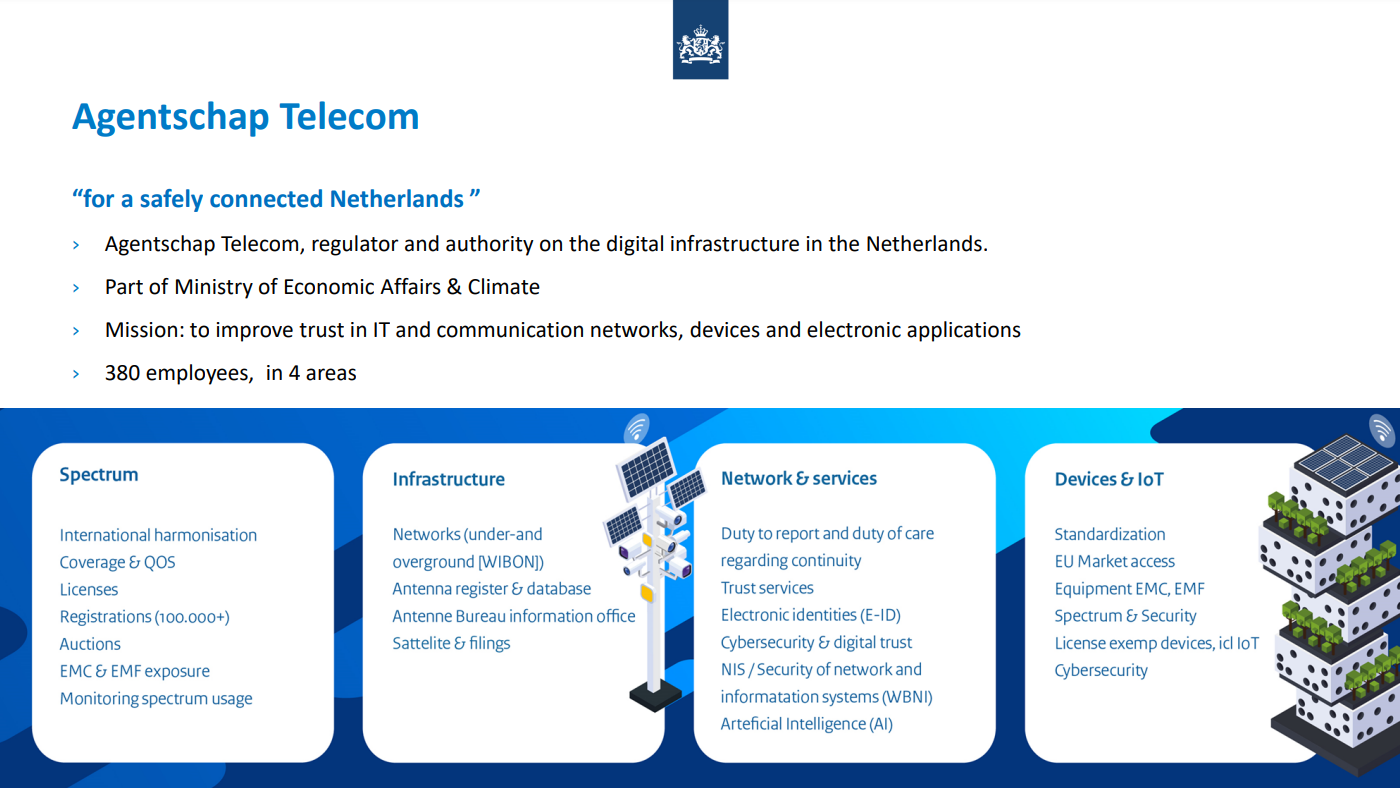

    AGENTSCHAP TELECOM for a safely connected Netherlands, we are a regulator and an authority on the digital infrastructure in the Netherlands and part of the Ministry of Economic Affairs and climate policy. And our mission is to improve trust in IoT and communication network devices in electronic applications. Roughly 400 employees in four areas and I will lead you in a few seconds through those four areas. It's about spectrum. We are doing regulating and law enforcement on Spectrum infrastructure, networking services, devices and IoT. We are an organisation like Ofcom in the UK or the Bundesnetzagentur in Germany or FCC in the United States. Out of these slides in the left box, you will find international harmonisation of all spectrum and that is of course also important for 5g Wi-Fi etc and we will come back later on how it will reflect to LIFI infrastructure and going to the right box, devices and IoT. We are dealing with some standardisation organisations, EU market access equipment, electromagnetic compatibility and EMF etc. So for us, it's important that whatever is going on through the market it is reliable, safe and secure.” 


    NL & digital connectivity
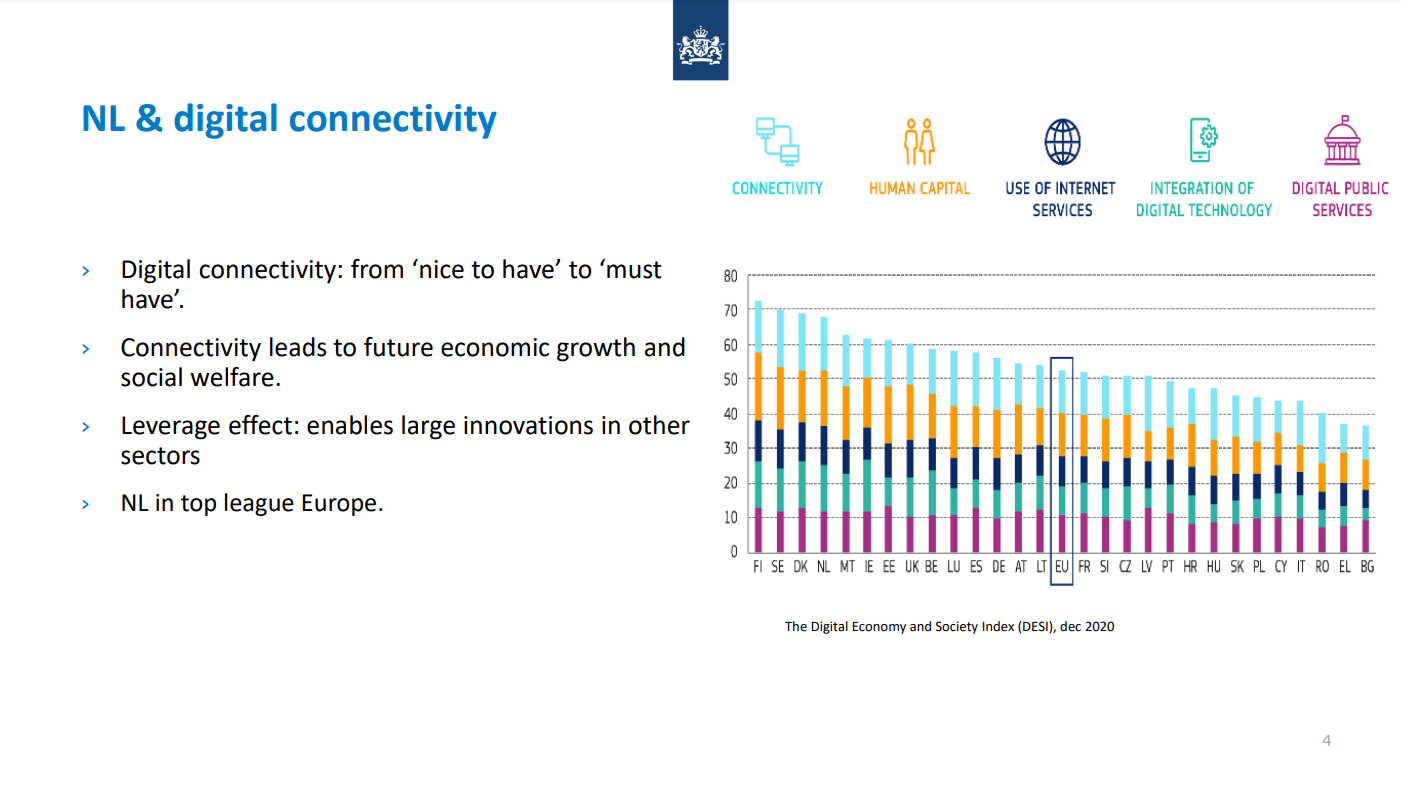
    About Holland very shortly, digital connectivity we see it from a nice to have to a must have digital connectivity leads to economic growth and social welfare and also with the COVID pandemic we have seen how important it is that we have digital connectivity everywhere. But we also expect quite some leverage effects from digital connectivity into other sectors like the agricultural logistics and so on. If you see here the DESI index from Europe, you can see the evidence from Europe. When it comes to connectivity, human capital use of Internet services integration of digital technology and digital public service in a country the DESI for Europe is roughly 52 and in Holland, we are in good shape with Denmark, Sweden and Finland on 70, 68 Something like that.

    Strategic developments

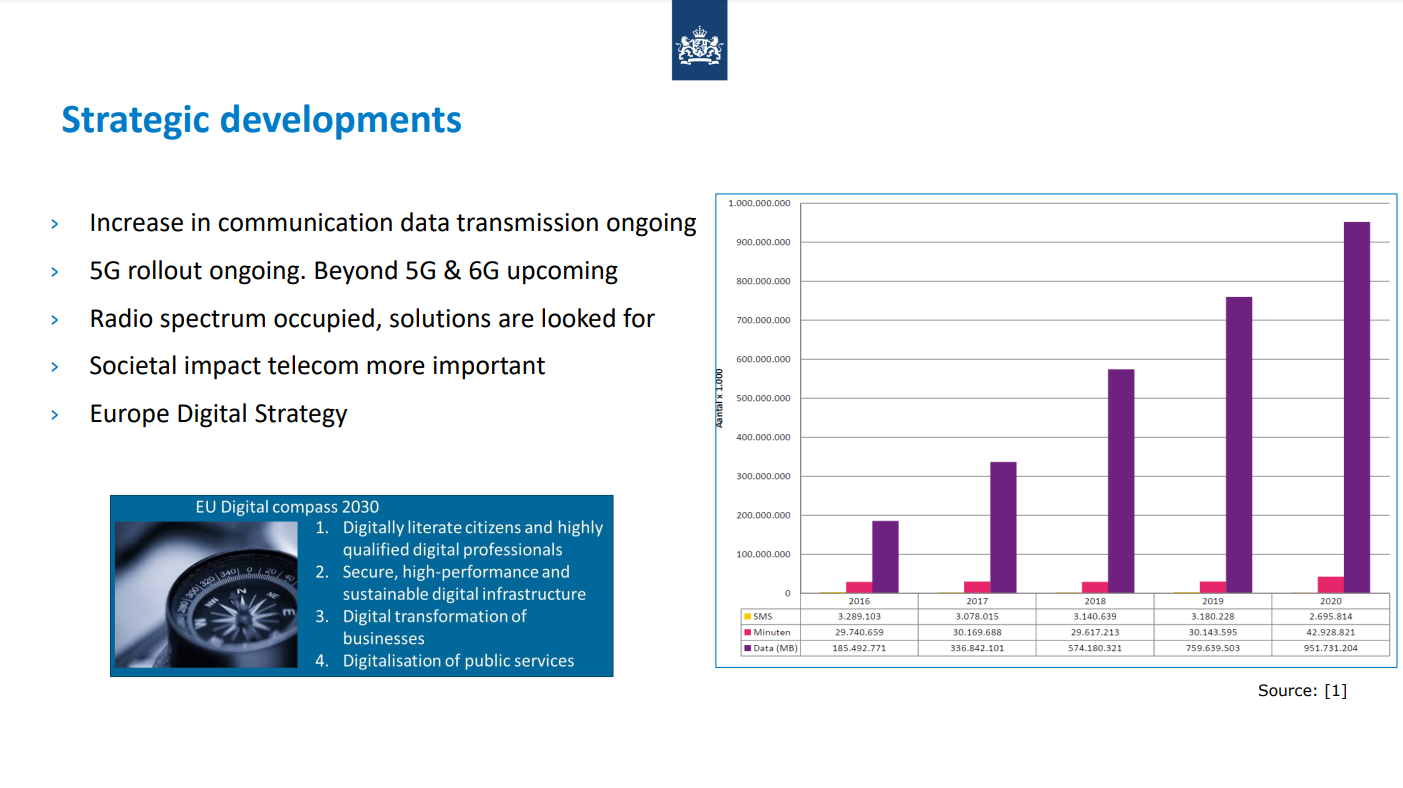
    Strategic developments which we see upcoming are still and it is not a surprise an increase in communication data transmission ongoing. For us as a regulator, we are very much busy on the 5G rollout ongoing we are thinking about beyond 5g and 6G is upcoming. But we see still and that is why we are so interested in new technology like LIFI radio spectrum is very much occupied and solutions are looked for. And we are looking at them in three different areas. One is to use the existing spectrum more dynamic and sharing. The other one is creating a higher efficiency on accessing existing spectrum with new technologies like 5G And you can think about edge computing and slicing. And the third option we are looking for is complete new technology on the new spectrum. And then we are coming to back to optical wireless communication. So that's the reason why we are interested in optical wireless communication. But also it's important that social impacts on telecom are becoming more and more important. And then you have to think about sustainability, health, privacy and data integrity and cybersecurity. And of course, as a country, we are not loosely coupled with the rest of the world and extremely important for us is the Europe digital strategy, which you can see here in the left box. And I will just shortly touch on the graph to the REITsright. You can see this is the retail mobile data used in Holland is going up from 200 billion in 2016, up to 1 trillion megabytes in 2020. So it's five times more in four years. And it's important also to notice that the main part is still used inside offices or inside buildings or inside houses. And then, of course, LIFI and I come back to that later is an option to use to accommodate this data transmission.

    Optical Wireless Communications (OWC)

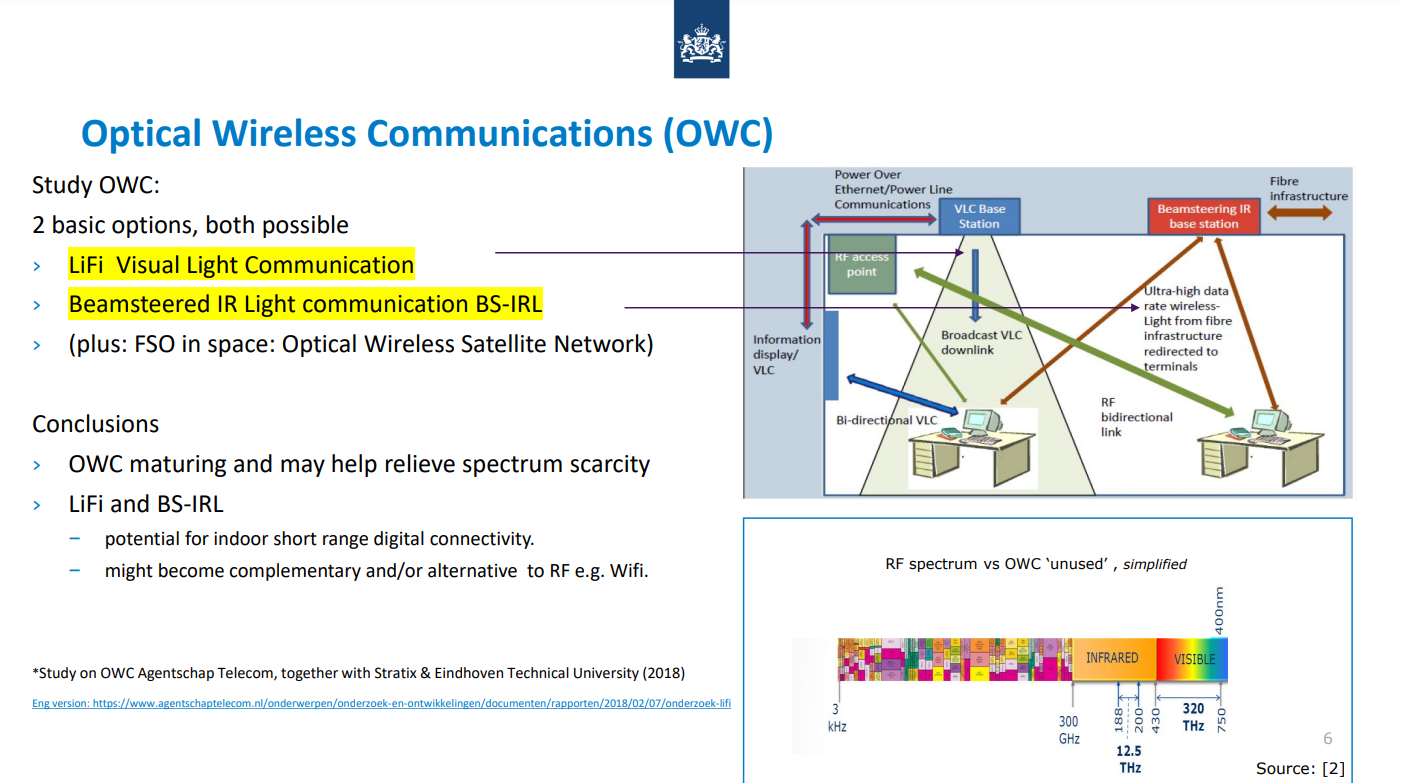
    Optical wireless communication, we did a study already in 2018 on this together with the Stratics and the ICT of Technical University and basically, we have this spend up to two different basic options, LIFI as official light communication and beam stay at infrared light communication. You can see over to the right, you can see the blue field sea base which is LIFI and the other one is the red ones beams, the base stations pencil beams, which is, for example, sorry the icon in the red wall in the picture to the right. Also, it was already mentioned by some other speakers there is free space optics. The conclusions of that report are that optical wireless is maturing and may help relieve spectrum scarcity. And the next one is LIFI and certain beams like the infrared can become a potential for indoor short-range digital connectivity with extreme low latency and it might become also a complementary and or an alternative to RF like or eg on Wi-Fi. In the bottom right, you see a spectrum very much simplified. The radio spectrum is very much occupied. And as I said already in my intro, infrared invisible is hardly used for communication. So, there are I think up to 2600 times more spectrum available frequencies available than in the whole radio spectrum.”

    Overview of issues
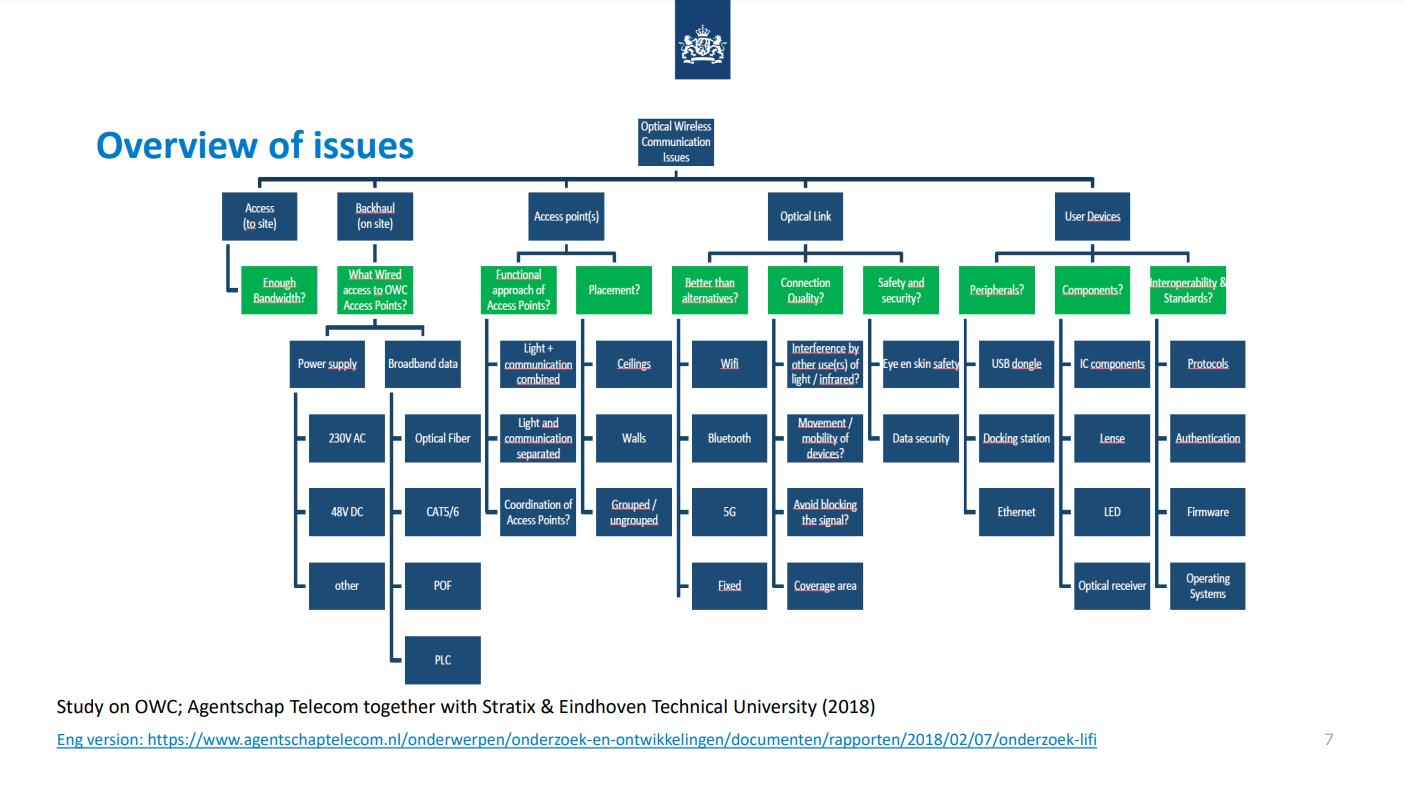
    We created in this report, and it is available with a link which I can send later on an overview of the issues which need to be solved or addressed. Going to the left, you see it's about access to the site and the backhaul on-site, you have to think about power supply, optical fibres. And this whole backhaul needs to be in place to make use of the LIFI qualities. In the middle, you'll see also the access points, where do you place them on the ceilings on the walls? How will you locate them? Will it be light or will it be a combination or will be separated this kind of issues needs to be solved? And then, of course, the quality of the optical link which you see more to the right then you have to think about is it better or is it complimentary? And we have already taken that conclusion at least you have to think about what is on Wi-Fi Bluetooth, 5G fixed what is already there? And how will these be fixed that and then, of course, there should be no interference with other communication devices. It should now also when you move it, should not immediately lose the signal or block the signal. And when it comes to safety and security, It's it's about eye and skin safety and also all data integrity and data security and the use of devices. Then I go to the complete right of this table, it's about interoperability and standardisation. So the protocols that authentication, the firmware everything have to be in place in the same study.” 


    OWC modelling stakeholders
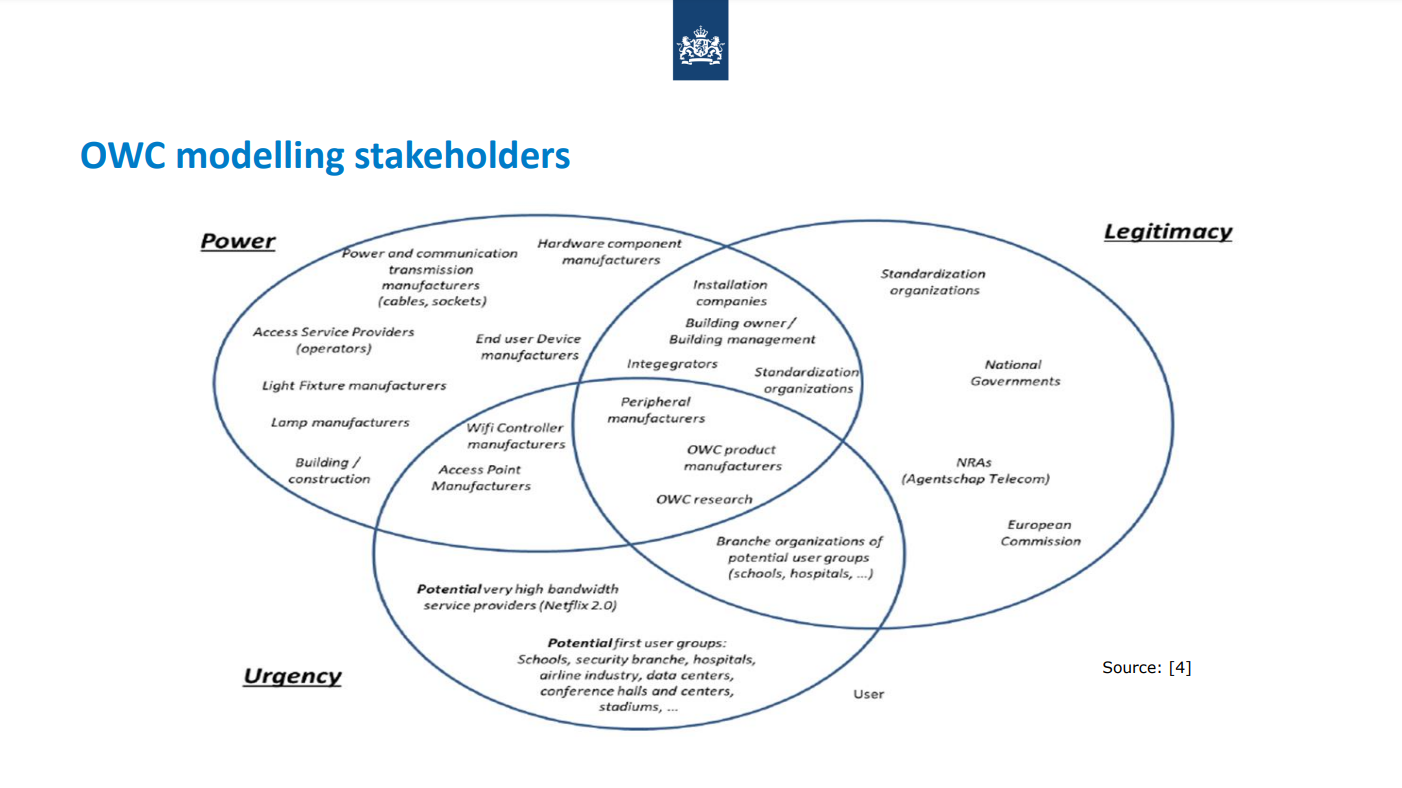
    We have talked and also other speakers have talked about the ecosystem. And in this study, we have created a picture of the ecosystem, you see power, urgency and legitimacy. Legitimacy distributes at least the regulation part. Power is the ones who can create and Urgency is the one who can use it and buy it. And on the regulation side, it's about the standards, the rules and the regulations and the law enforcement. And of course, it’s important to see what is in the middle of those three circles. And then you'll see the companies or organisations that are important and overlapping are the building owners and the building management, the standardisation organisations, manufacturers, the access point manufacturers and the branch organisations, think about schools, hospitals, airline industries, conferences and so on. And again, we have to think about how we can get the data bandwidth also in houses and in offices and then we are coming back to the building owners and the building management.”


    OWC regulations
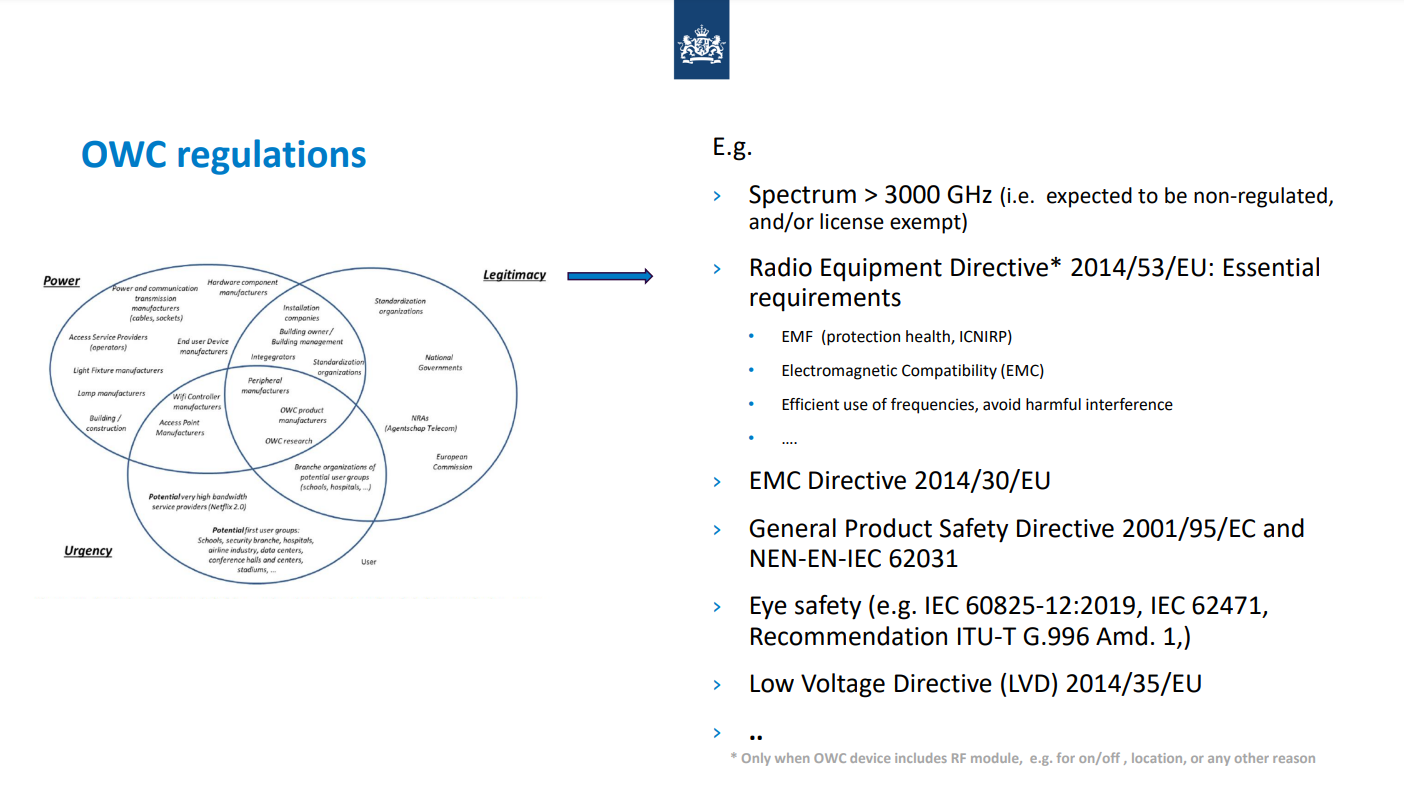
    There are many regulations on equipment and devices in general, but coming to spectrum, this is above 300 gigahertz and we expect it to be non-regulated and or licenced exempt. The ITU will consider normally not up to or higher than 3000 gigahertz. So, that is, let's say kind of freedom books. But there is also radio equipment directive in Europe. And then you have to think about EMF, so the protection on health and ICNIRP electromagnetic compatibility, the efficient use of frequencies, and also as from 2024 onwards, cybersecurity. This radio equipment directive is only valid when the optical wireless devices include RF modules, eg for on and off switching or location or any other reasons. The EMC directive is here already right now for optical wireless and then you have, of course, General Product Safety and then condition on light density and eye safety and the low voltage directive. So, these kinds of things are to be considered and are important to check with also when you're producing these products.


    NL positively engaged in development OWC
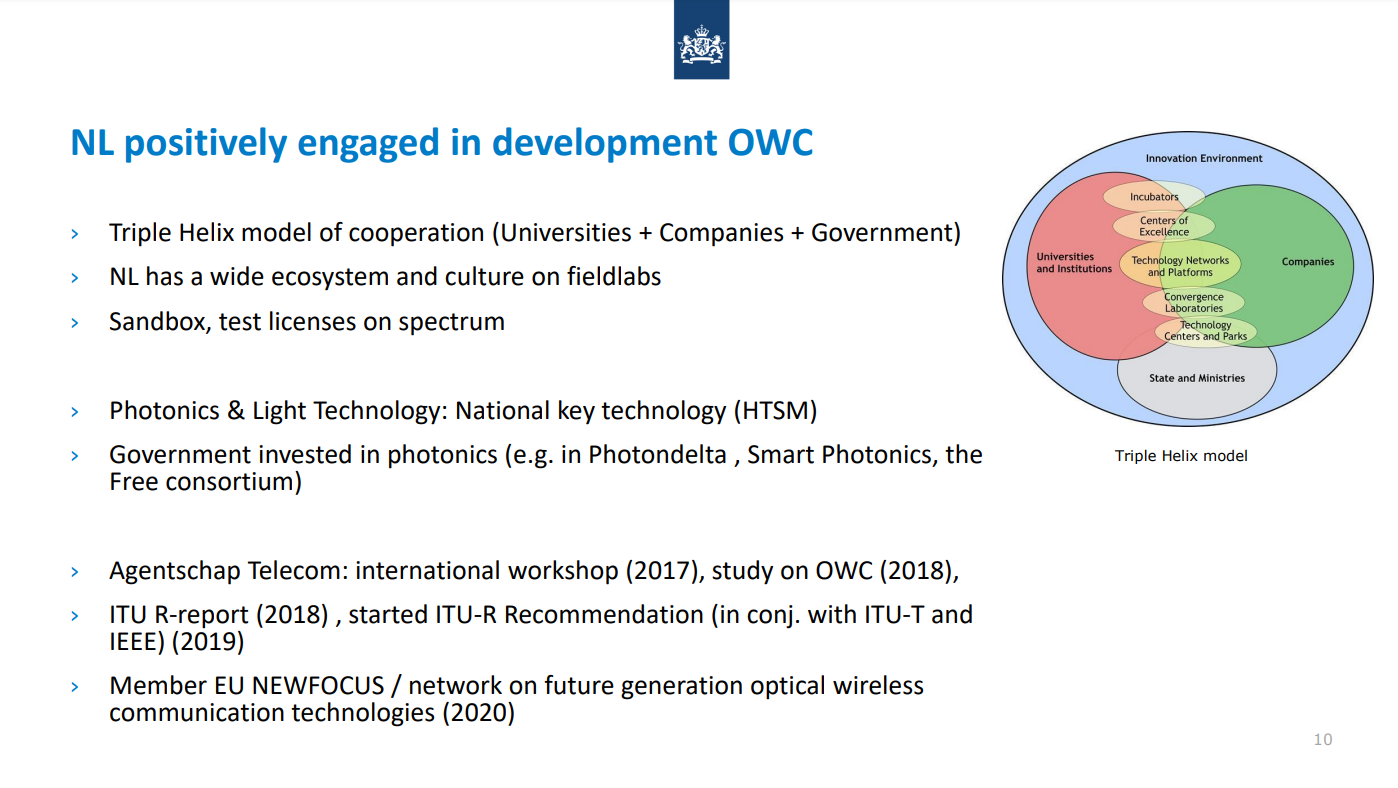
    In the Netherlands, we are positively engaged in the development of optical wireless. In general, we have in Holland, the so-called Triple Helix model. And in this case, we are working very much together with the technical universities of Eindhoven centre, Delft and other universities and companies. In general, we have a wide ecosystem of field labs, and we are also able to create sandboxes and test licences on Spectrum. More specific the middle ones, photonics and light technology have become in Holland One of the national key technologies in the top sectors for knowledge and innovation. The government has invested in photonics like for example, in the photon Delta consortium, smart photonics as a company and also in a free Consortium, which is run by the TCU Technical University of Delft. So we have really invested money in this because we think this complete development should not be looked only upon the last part. So LIFI, with also the fibre, but also the integrated circuits which are then at the end complete chain of communication lines. So as our radio communications agency, we did a study on optical wireless in 2017. We did an international workshop, we created an ITU report in 2018. And we took the initiative for recommendation in ITU R in 2019. In conjunction with ITU t and I triple E. And last but not least, we have become members of the EU cost. New focus on the EU network on future generation optical wireless communications technologies. And also here together with the University of Eindhoven, John Paulina, who is also working with Signify, we are heading up for creating more usage of optical wireless.

    Conclusive reflections on OWC

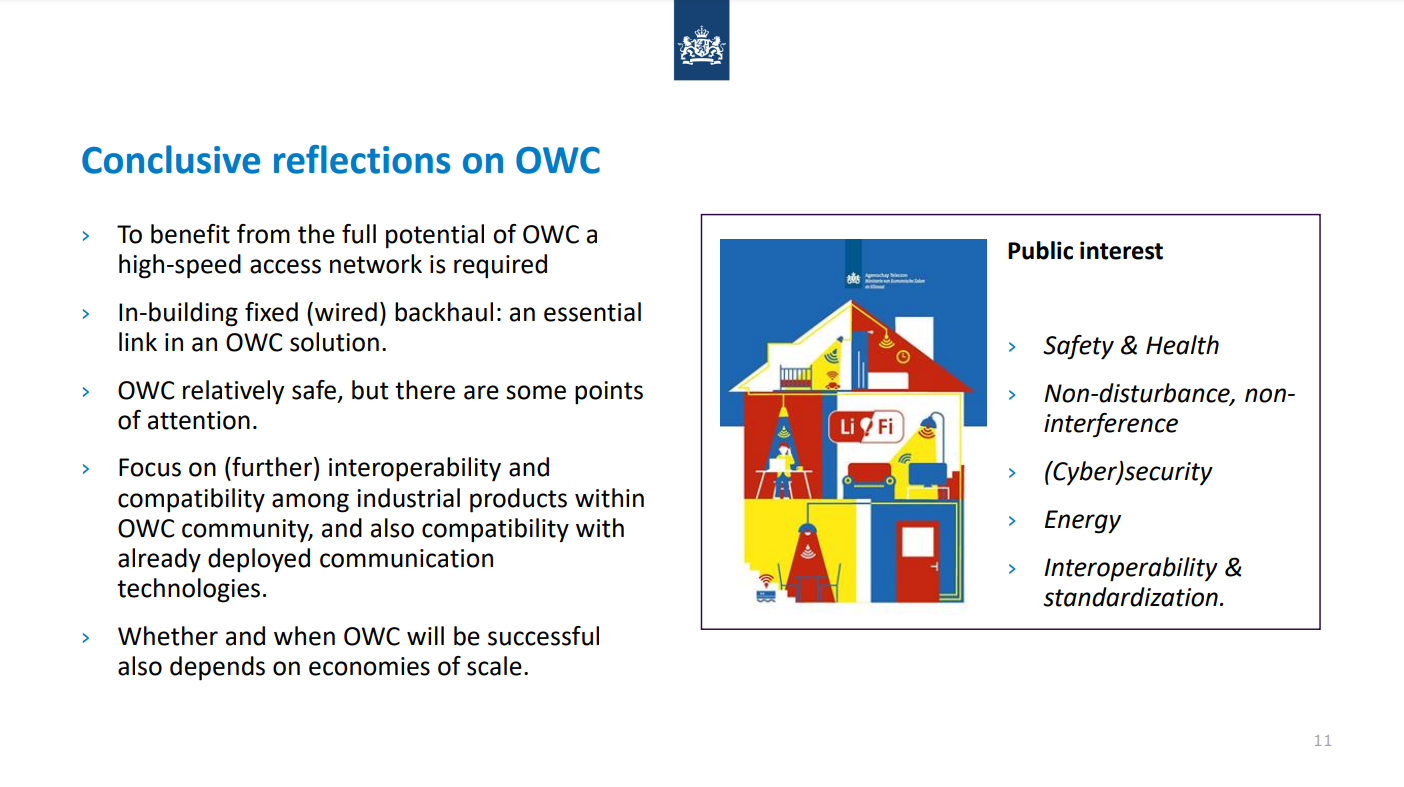
    The benefits from the full potential of optical wireless or high-speed access network is required and maybe not the technique is the bottleneck anymore or soon, but the way the data gets there. So, an in-building fixed-wired backhaul is an essential link in the complete optical wireless solution and it should be installed as we are also installing water pipes, gas pipes and electricity in houses. For as far as we can see, optical wireless is relatively safe, there are some points of attention, for example, on lights, eyes, safety, and light density, but needs to be addressed in a good way. And further on. The interoperability between products in the optical wireless community needs to be guaranteed, or at least we would prefer that. But also the compatibility with other already deployed communication technologies like Wi-Fi and 5G. So whether optical will become successful depends on economies of scale, and the market picking up. For us, it's important that attention is paid to public interests like safety and health, that it is not disturbing and not interfering or creating interference with other devices. And cybersecurity is becoming more and more important. So we will look upon that one, as a regulator. Energy consumption is already mentioned, but that's an European policy. So take that into account. And last but not least interoperability and centralisation are extremely important.”
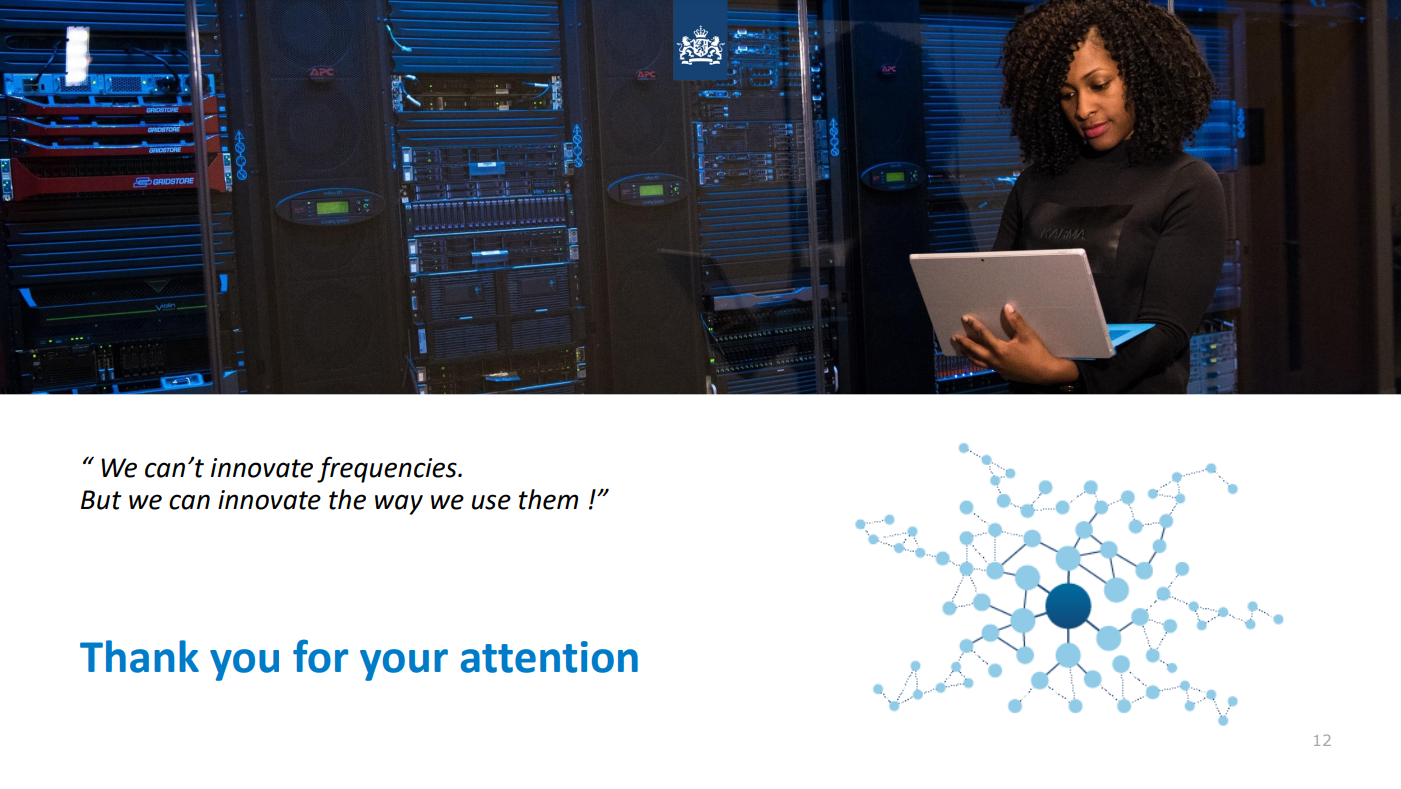
    So to conclude, we cannot innovate frequencies but we can innovate the way we use them. That's what we say. Thank you for your attention”.

    You can also watch the full video presentation on the following YouTube link from Jakajima YouTube channel.

    Li-Fi Conference 2022

    The next Li-Fi Conference is coming up on the 28th of June 2022 between 10 am and 4.30 pm CET.

    It is interesting to realise that lights that illuminate offices, homes, cars, factories, our streets and more locations also can connect us to data and hence power the growing demand for connectivity and speed.

    At this conference professionals from all over the globe will gather together in order to share applications, ideas, new developments and ways to integrate Li-Fi in services, both for consumers and professionals.

    This conference will be held Live and Online. The venue will be the High Tech Campus 1, The Strip 5656 AE Eindhoven The Netherlands.

    Online tickets can be bought at the following link:

    https://tikcit.com/register/61e002336d7fc4b6745cab83/

    What is LiFi?

    LiFi, also known as "Light Fidelity" is a wireless optical networking technology, which uses light-emitting diodes (LEDs) to transmit data. In 2011, professor Harald Haas made a LiFi demonstration at the TED (Technology, Entertainment, Design) Global Talk on Visible Light Communication (VLC).

    VLC uses light as a medium to deliver high-speed communication like Wi-Fi and complies with the IEEE standard IEEE 802.15.7. The IEEE 802.15.7 is a high-speed, bidirectional, and fully networked wireless communication technology-based standard similar to Wi-Fi's IEEE 802.11.

    How does LiFi work?

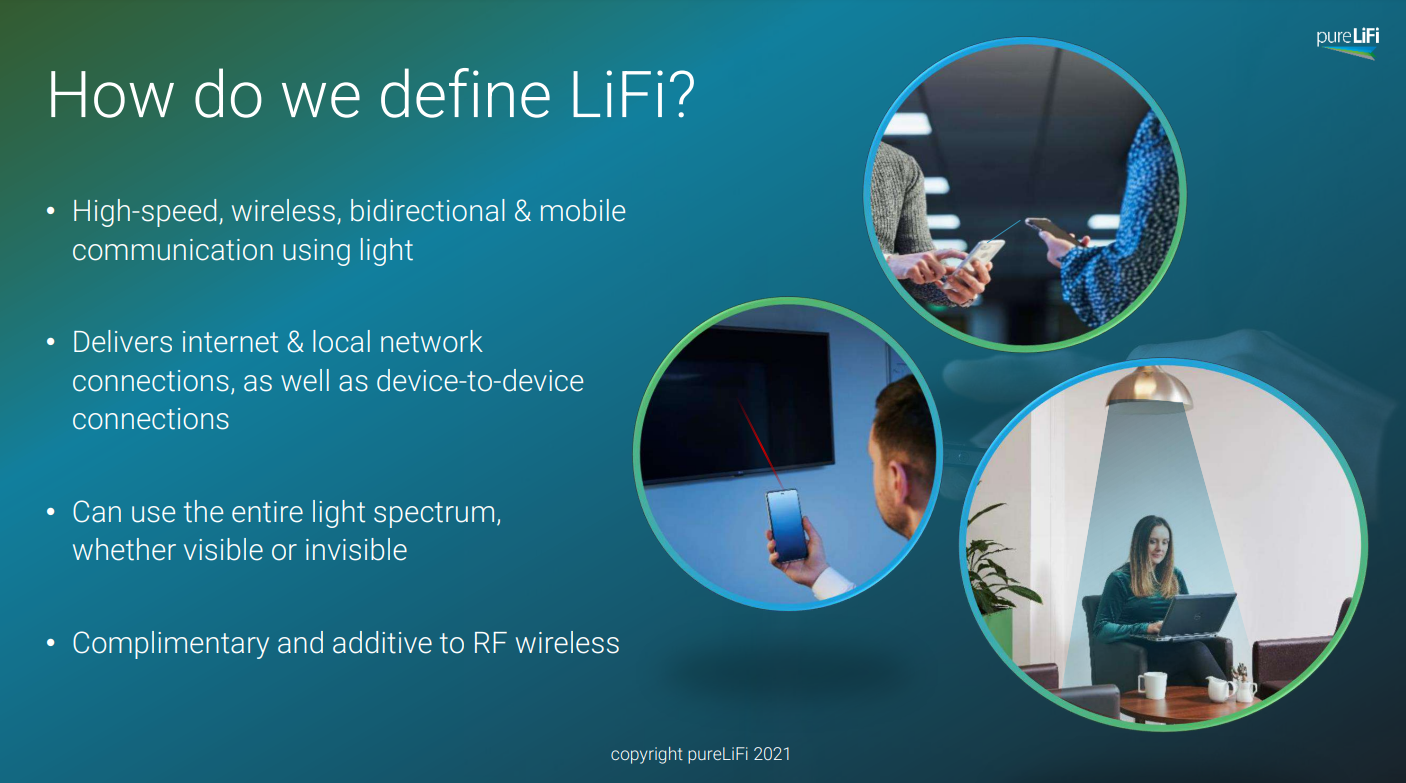
    LiFi is a high speed, bidirectional, and fully networked wireless communication of data using light. LiFi constitutes of several light bulbs that form a wireless network.

    When an electrical current goes through to a LED light bulb, a stream of light (photons) emits from the lamp. LED bulbs are semiconductor devices, which means that the brightness of the light flowing through them can change at extremely high speeds. The signal is sent by modulating the light at different rates. The signal can then be received by a detector that interprets the changes in light intensity (the signal) as data. Also when the LED is ON, you transmit a digital 1, and when it is OFF, you transmit a 0.

    LiFi Benefits

    The primary benefits of LiFi are as follows:

    Security: Provides entirely secure access. Where there is no light there is no data.

    Safety: Does not produce electromagnetic radiation and does not interfere with existing electronic systems.

    Localisation: Allows localisation due to the small coverage area of LiFi access point - localisation can be used for very precise asset tracking.

    Data density: Provides ubiquitous high-speed wireless access that offers substantially greater data density (data rate per unit area) than RF through high bandwidth reuse.

    Credit to Oledcomm

    LiFi Applications

    LiFi can be used for so many applications and the list is increasing every year. You can read our updated list of Li-Fi applications at the following link:

    https://www.lifitn.com/blog/2021/2/13/top-30-li-fi-applications-updated-list-including-potential-applications

    Credit to pureLiFi

    In conclusion, if you are also interested to hear more information about the OWNII Coin or enquire about LiFi devices such as the LiFiMax and Trulifi, you can contact us through our chatbot or by sending an email through our contact us form. If you enjoyed this post and would like to hear more updates about LiFi technology, subscribe to our newsletter. Don’t forget to subscribe to our social media accounts. You can also join our Telegram group about LiFi technology on this link:

    https://t.me/joinchat/FMzOmsEKyJFrU6Af

    Li-Fi Conference 2021 - Recap Part 9 - Fully Leveraging LiFi Capabilities Through Enhanced Integration With 5G Core And Services

    Table of Contents

      Li-Fi Conference 2021 - Recap Part 9 - Fully Leveraging LiFi Capabilities Through Enhanced Integration With 5G Core And Services

      Li-Fi Conference 2021

      In our last article from our ONLINE Li-Fi Conference 2021 recap series, we discussed the duo presentation on LiFi At The Heart Of Future Intelligent Communications Networks delivered by Sylvain Leroux, FoodTech & Light Communications Director, Orange and Micheline Perrufel, Researcher/Project manager Innovation, Orange. The conference was organised by the Jakajima, the global High Tech Conference organiser, and the Light Communications Alliance.

      Jakajima, Matchmaker for Innovators in the high tech industry, organises many events, ranging from LiFi Technology industry trends, 3D Printing to the Internet of Things, from Unmanned Cargo Aircraft to Health Tech, from 4D Printing to Photonics and from Vertical Farming to Sustainable Materials.

      The online Li-Fi Conference included live presentations from researchers, executives and industry specialists from pureLiFi, Nokia, Signify, Orange, Radiocommunications Agency Netherlands, Velmenni, OLEDCOMM, HomeGrid Forum and Weidmüller Deutschland.

      In another article recap series, we will talk about the presentation on Fully Leveraging LiFi Capabilities Through Enhanced Integration With 5G Core And Services delivered by Maximilian Riegel from Nokia. Before this, we will talk about Nokia.

      Nokia

      Nokia Corporation (natively Nokia Oyj, referred to as Nokia; stylized as NOKIA) is a Finnish multinational telecommunications, information technology, and consumer electronics company, founded in 1865. Nokia's main headquarters are in Espoo, Finland, in the greater Helsinki metropolitan area, but the company's actual roots are in the Tampere region of Pirkanmaa. In 2020, Nokia employed approximately 92,000 people across over 100 countries, did business in more than 130 countries, and reported annual revenues of around €23 billion. Nokia is a public limited company listed on the Helsinki Stock Exchange and New York Stock Exchange. It is the world's 415th-largest company measured by 2016 revenues according to the Fortune Global 500, having peaked at 85th place in 2009. It is a component of the Euro Stoxx 50 stock market index.

      The company has operated in various industries over the past 150 years. It was founded as a pulp mill and had long been associated with rubber and cables, but since the 1990s has focused on large-scale telecommunications infrastructure, technology development, and licensing. Nokia made significant contributions to the mobile telephony industry, assisting in the development of the GSM, 3G, and LTE standards. For a decade beginning in 1998, Nokia was the largest worldwide vendor of mobile phones and smartphones. In the later 2000s, however, Nokia suffered from a series of poor management decisions, and soon saw its share of the mobile phone market drop sharply.

      After a partnership with Microsoft and Nokia's subsequent market struggles,Microsoft bought its mobile phone business, creating Microsoft Mobile as its successor in 2014. After the sale, Nokia began to focus more on its telecommunications infrastructure business and on Internet of things technologies, marked by the divestiture of its Here mapping division and the acquisition of Alcatel-Lucent, including its Bell Labs research organization. The company then also experimented with virtual reality and digital health, the latter through the purchase of Withings. The Nokia brand returned to the mobile and smartphone market in 2016 through a licensing arrangement with HMD Global. Nokia continues to be a major patent licensor for most large mobile phone vendors. As of 2018, Nokia is the world's third-largest network equipment manufacturer.

      The company was viewed with national pride by Finns, as its mobile phone business made it by far the largest worldwide company and brand from Finland.

      Fully Leveraging LiFi Capabilities Through Enhanced Integration With 5G Core And Services By Maximilian Riegel

      Maximilian Riegel from Nokia, was the ninth presenter at the online Li-Fi Conference 2021. He discussed in his presentation the topic of Fully Leveraging LiFi Capabilities Through Enhanced Integration With 5G Core And Services.

      Maximilian Riegel received his Dipl.-Ing. degree in Electrical Engineering from TU Munich, Germany and is currently responsible for IEEE & Wi-Fi standardization within Nokia. He participies in IEEE 802 and other Wi-Fi related standardization for more than 15 years and led the development of IEEE 802.1CF-2019 specification. He was NWG vice chair in the WiMAX Forum, led the Ethernet over cellular work in IETF 16ng WG, and chaired the OmniRAN SG/TG activities in IEEE 802. He regularly acts as lecturer for Wi-Fi and as speaker at technical conferences. Formerly, he held R&D management positions within Siemens Communications and Philips Communication Industry.

      Below are some points discussed about Fully Leveraging LiFi Capabilities Through Enhanced Integration:

      Maximilian Riegel started his presentation by saying the following:

      What we are currently in is in the middle of a fourth industrial revolution, driven by the move of the industry to digitisation and optimise control. So, deploying IT technology to get production more enhanced, and really investing a huge amount of money now in enhancing industrial production capabilities and methods.” 

      Industry 4.0 use cases enabled by 3GPP 5G evolution

      And we see that this opens a new market. And it's not only opening a new market, it's already driving the standardisation and the development and the whole idea of 5G and the evolution of 5G, which started initially from doing much better Broadband now is going into machine type communication, ultra-light low latency communication techniques, enhancements, which are very important for control in factories, machineries, all this IoT stuff, industrial IoT stuff, where nowadays, we are not talking about the gigabits, but more about the milliseconds. And that's what's critical."

      Challenging connectivity options to address Industry 4.0 needs


      And where this industry 4.0 needs are really putting a burden on our communication technologies. And I have here on the right side, a table with different applications and a little bit of characterization of what's needed in terms of communication capabilities. If you're doing monitoring, if you're just collecting data, then yes, you are getting a huge amount of data. But what's not so critical is the delay. And it's also not so critical. When a bit is transferred incorrectly, you have always the possibility to retransmit. So that's where you can do a huge amount of pipe data without high precision transmission capabilities, it's getting a little bit more challenging when you're doing starting to control equipment like autonomous robots, where you may have to go down to some transmission capabilities challenging and where it stand finally, really starting to become challenging if you're doing modern things like augmented reality, where short delays are extremely important. People are really becoming seasick when there's too much delay. And we're we have also another way, where reliability is going up orders of magnitudes when doing robotic control, or when sitting with telecommunications or communications in control loops, extreme time-critical control loops when systems have to provide delay times millisecond or below a millisecond. That's where our technology our wireless technology currently has difficulties where the industry currently is doing. Wire, as you see it on the left side, but yeah, wire is excellent transmission capabilities, but has challenged in mobility flexibility, also in the economics, when setting up wire.” 


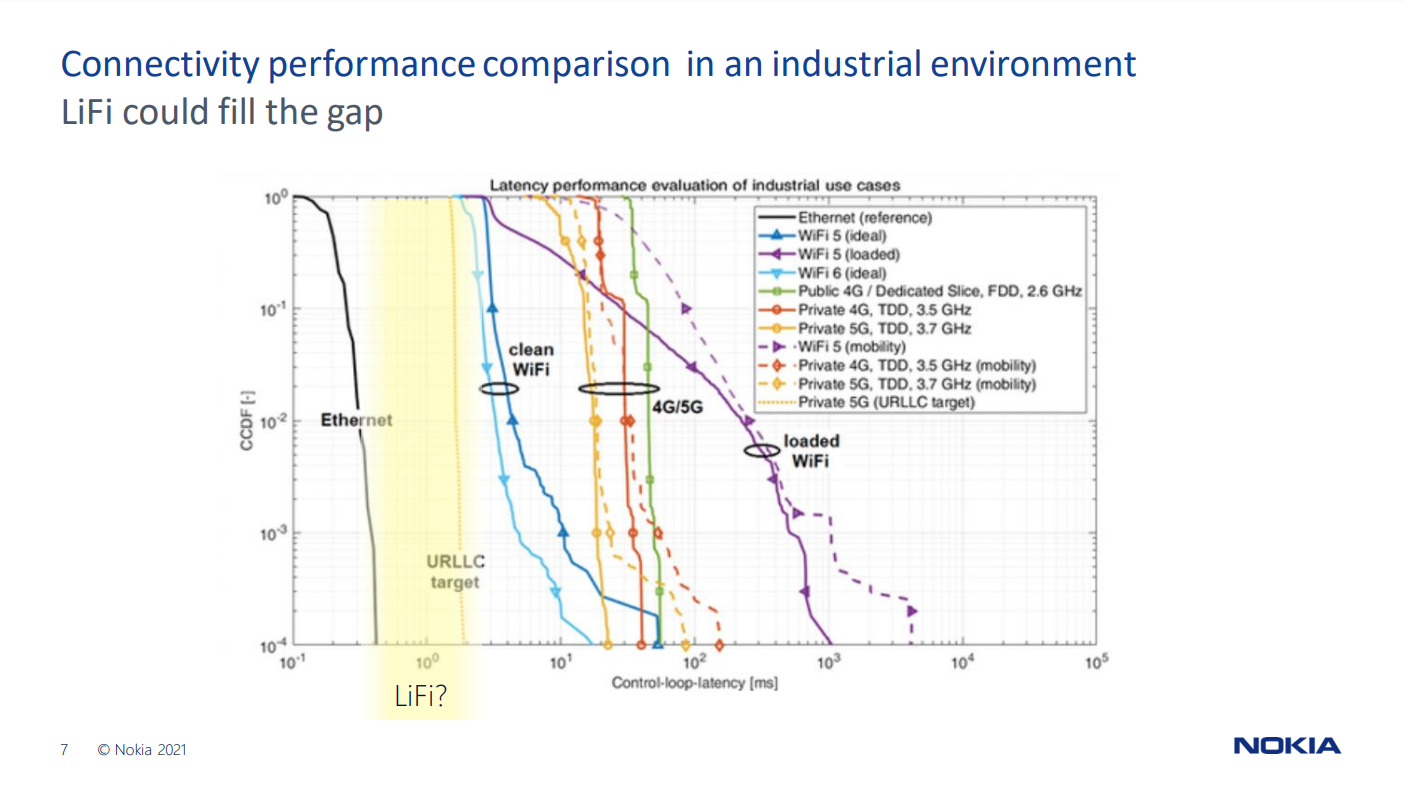
      Connectivity performance comparison in an industrial environment

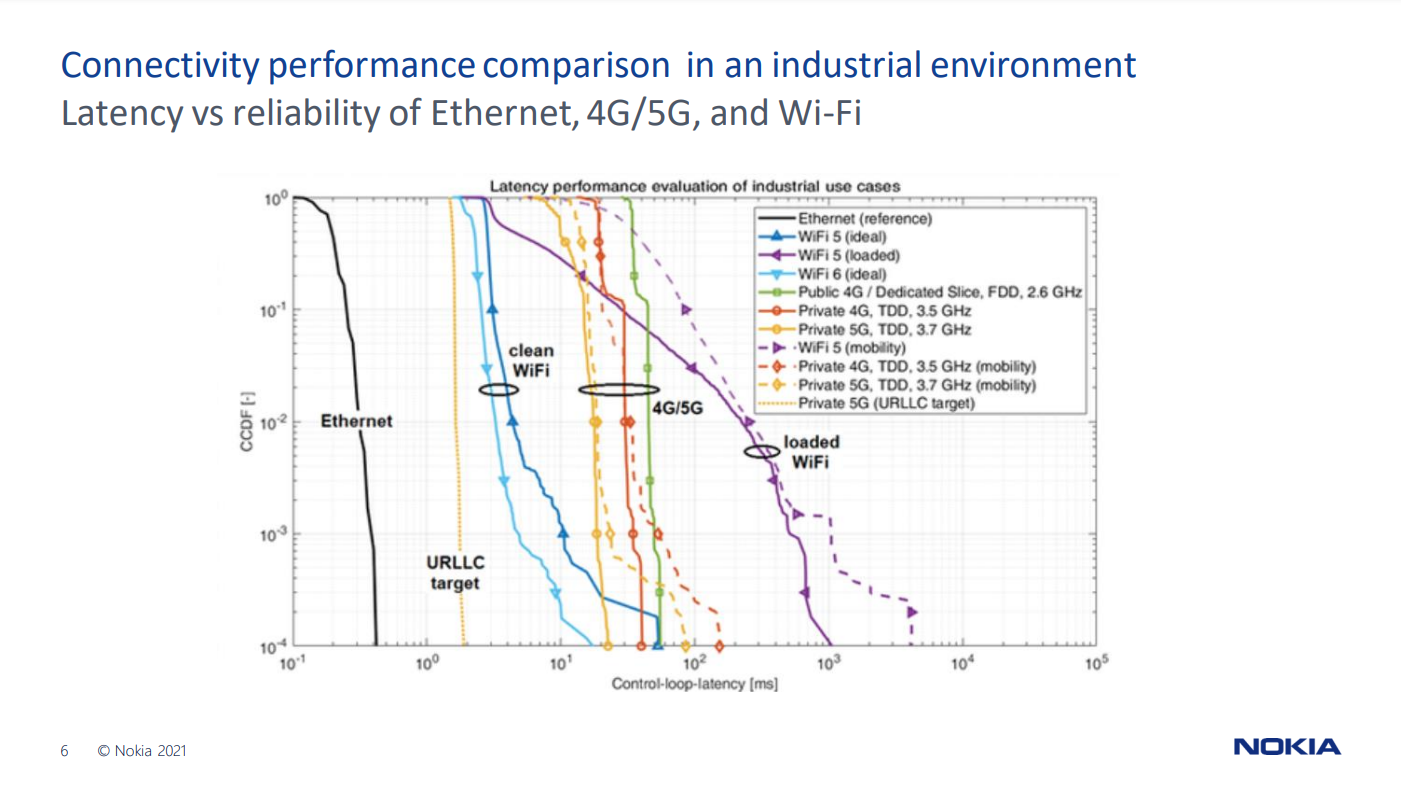
      And what we did is a little bit of comparison, where are the different technologies, where are different standards located when you're comparing latency and reliability and I have a figure here showing Ethernet 4G/5G, ci and Wi-Fi. And what you see is Ethernet is extremely low delay, up to extremely high reliability. And when our doing our most used radio technology, meanwhile was 4G/5G. We are coming down in the range of 20 milliseconds to 10 milliseconds. That's something we can do. But what's really desired and you have seen the applications is we have to go even shorter delays at high reliability at much lower transmission delays. And the assumption is just from the physics, LIFI could fill us, could provide us solutions, which are really suited for this industrial IoT, industrial control loaded low latency. Something going in that direction, we would like to have a wire but without a wire from transmission capabilities. So that's where LIFI could fit in.

      How to integrate LiFi into 5G?

      Now, LIFI into 5G. LIFI into 5G provides a comprehensive environment for doing complex communications of various applications. And what we have to think about is now we have to get LIFI into this overall 5G architecture.

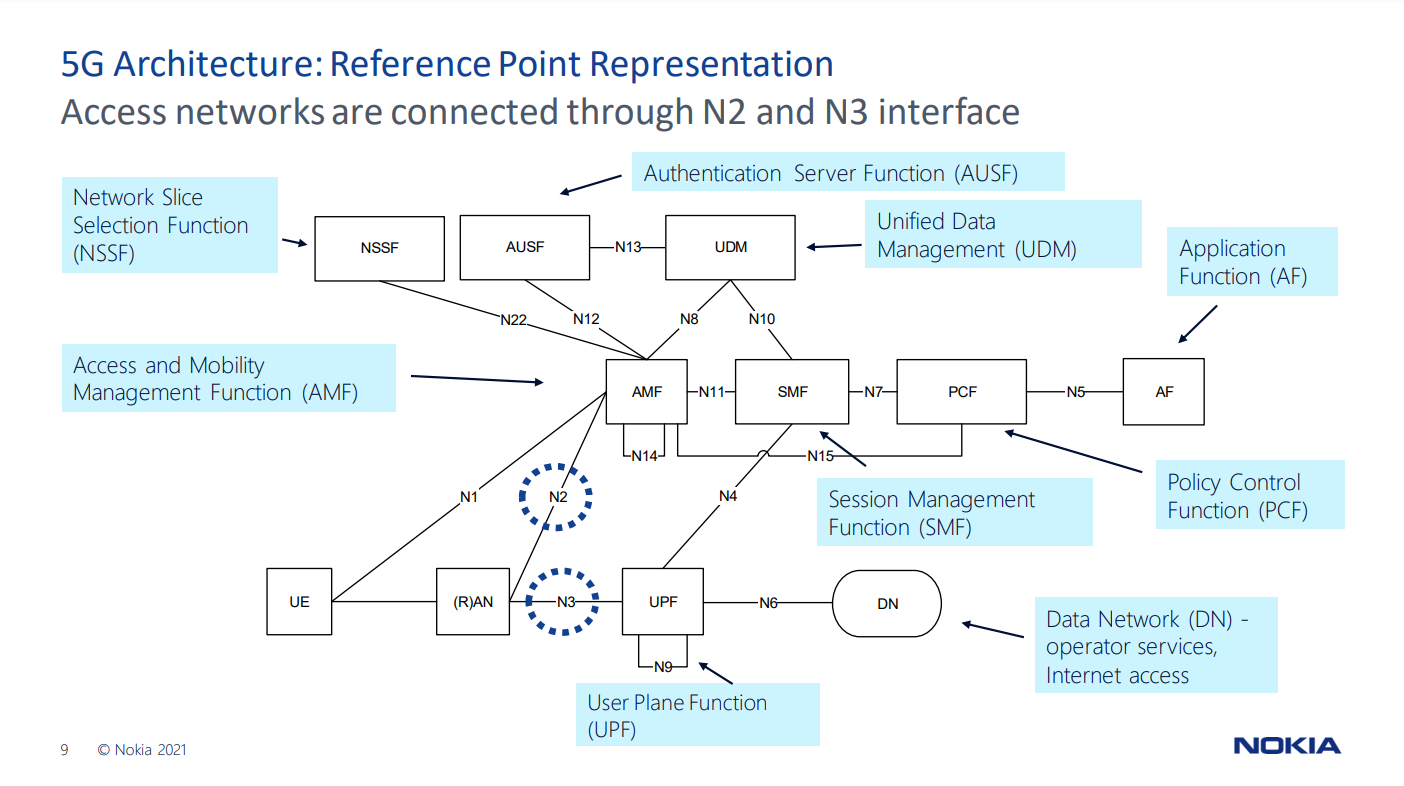
      5G Architecture: Reference Point Representation

      5G architecture is mainly dominated or created, focused around session control, quality of service control, which provides a huge complexity. The 5G architecture has also the capabilities to be completely implemented in software. So it's not done this hardware functional architecture, it's functional architecture, where functional units are interoperating not saying anything about implementation. And when thinking about the integration of LIFI, we have to think about how we are getting LIFI on this end through N2 and N3 interfaces. We're currently with the 5G run, that's where we have to think about.

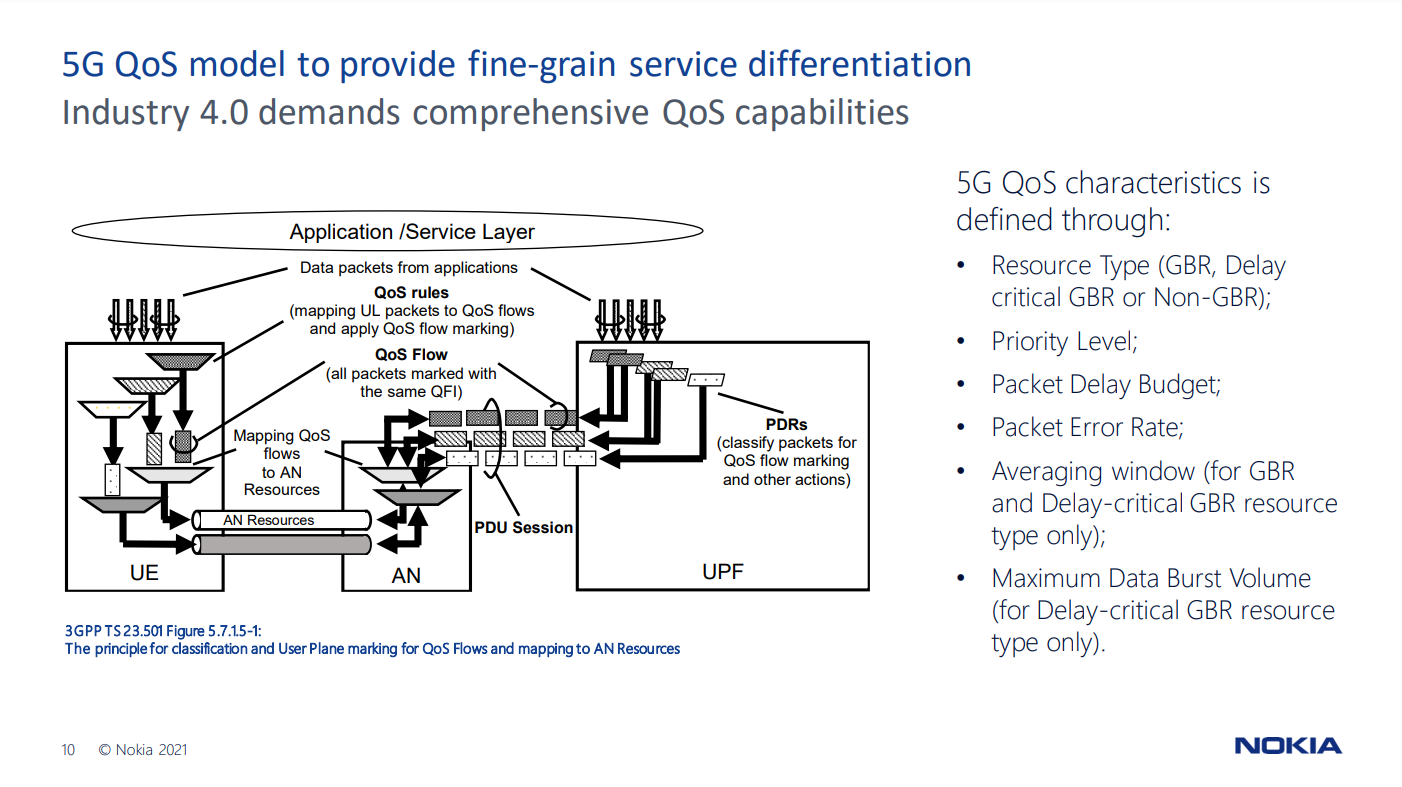
      5G QoS model to provide fine-grain service differentiation

      Why we are doing it as 5G provides the QoS model, the QoS control the need for industrial control. So 5G has an extremely comprehensive, sophisticated QoS model with a fine grain control capability. And 5G has the technology to do multiple different QoS flows on a common infrastructure, things really need it for industry, industrial applications and the industry 4.0 in the broad scope, if you'd like to do everything required in this industrial 4.0 area, you need a universal system, which has a huge variety of doing it.” 


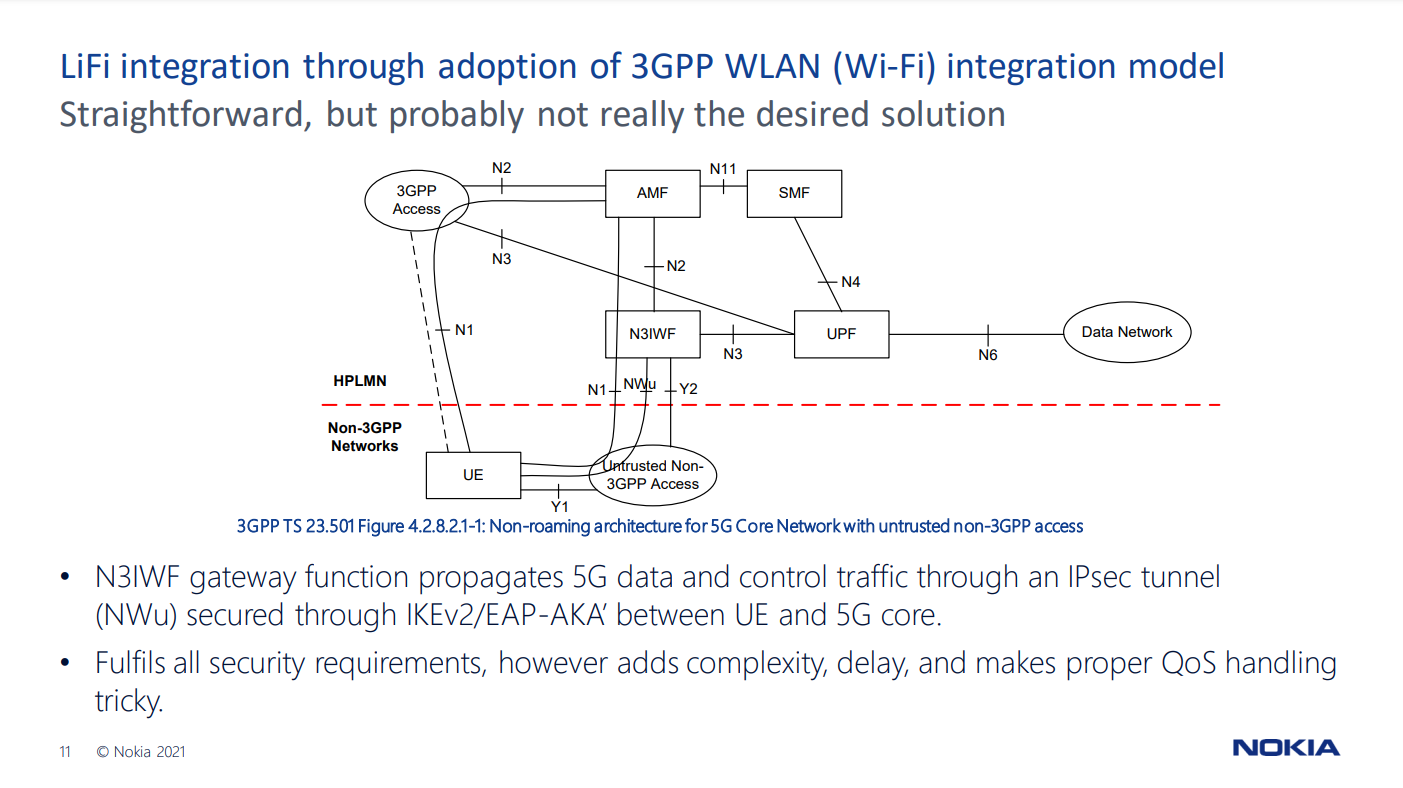
      LiFi integration through adoption of 3GPP WLAN (Wi-Fi) integration model

      So the first approach to adoption to do the inclusion of LIFI into 5G would be oh, there is a nice model for Wi-Fi. Yeah, let's use the Wi-Fi model, we are also having a standardisation approach where we are getting a Wi-Fi or 802.11 variant with light, straightforward. And that would be the shortest path together into integration. This Wi-Fi integration model, the primary Wi-Fi integration model currently is based on an N3 IWF gateway. Now technically speaking, that's gateway and VPN gateway setting up an IPsec tunnel between the 5G core system and wireless LAN user equipment tunnelling the data through and tunnelling also signalling through and this Wi-Fi model, that's currently Wi-Fi model. This VPN connectivity is highly flexible in the deployment of what's needed currently for Wi-Fi. It fulfils all the security requirements. But we're now going into we like to do pure essence, stream handling and something like that. And we like to have the lowest delay, then it's becoming really tricky because a VPN tunnel always adds additional delays.” 

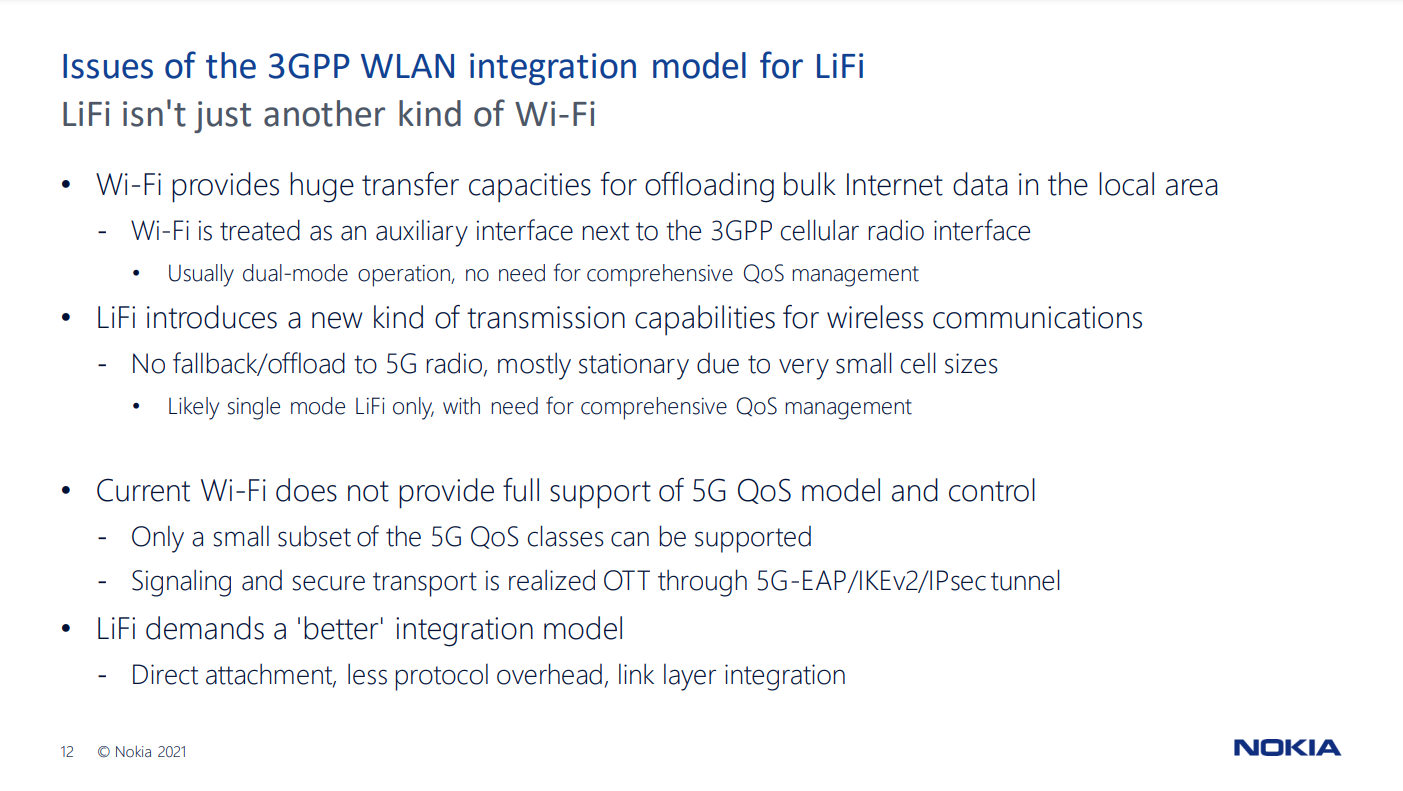
      Issues of the 3GPP WLAN integration model for LiFi

      So this is what we should keep in mind when doing Wi-Fi, LIFI integration into N3 or switching up to 5G core. The first thing is to consider what's Wi-Fi and what is LIFI. And that's the difference, LIFI isn't just a Wi-Fi. Wi-Fi is used as a huge transfer capability, offloading internet traffic in the local area. So it's an auxiliary interface to a primary switch up Key radio interface where you can just take off leverage cheaper channel when being in the local area. The terminals are usually dual-mode, they have all the 5g signalling, they have different signalling paths and they have no need for doing really a comprehensive QoS management. Now, when you have seen what we are thinking about LIFI, we see a new kind of transmission capability for wireless communication. No, a 5G radio is not just an alternative solution. LIFI is a new kind of quality. So, it's not necessary that there is a 5G radio interface in all LIFI interfaces. And we also expect that the LIFI interface devices are not such mobile, because LIFI cells are very small, so mostly stationary. So we have to think about a single-mode LIFI terminal. But we need a very comprehensive QoS management. So we have really to have access to the lower layer data not being encrypted on our IPsec tunnel where all service differentiation is really becoming challenging. And what we see is that the Wi-Fi integration model does not provide all this 5G QoS model and control. Only a small subset of 5G QoS can be supported in Wi-Fi, and we have the issue of the IPsec tunnel. So we need a kind of better integration model direct attachment, less overhead, less protocol overhead. And in particular link-layer integrations that we have access to the data streams.


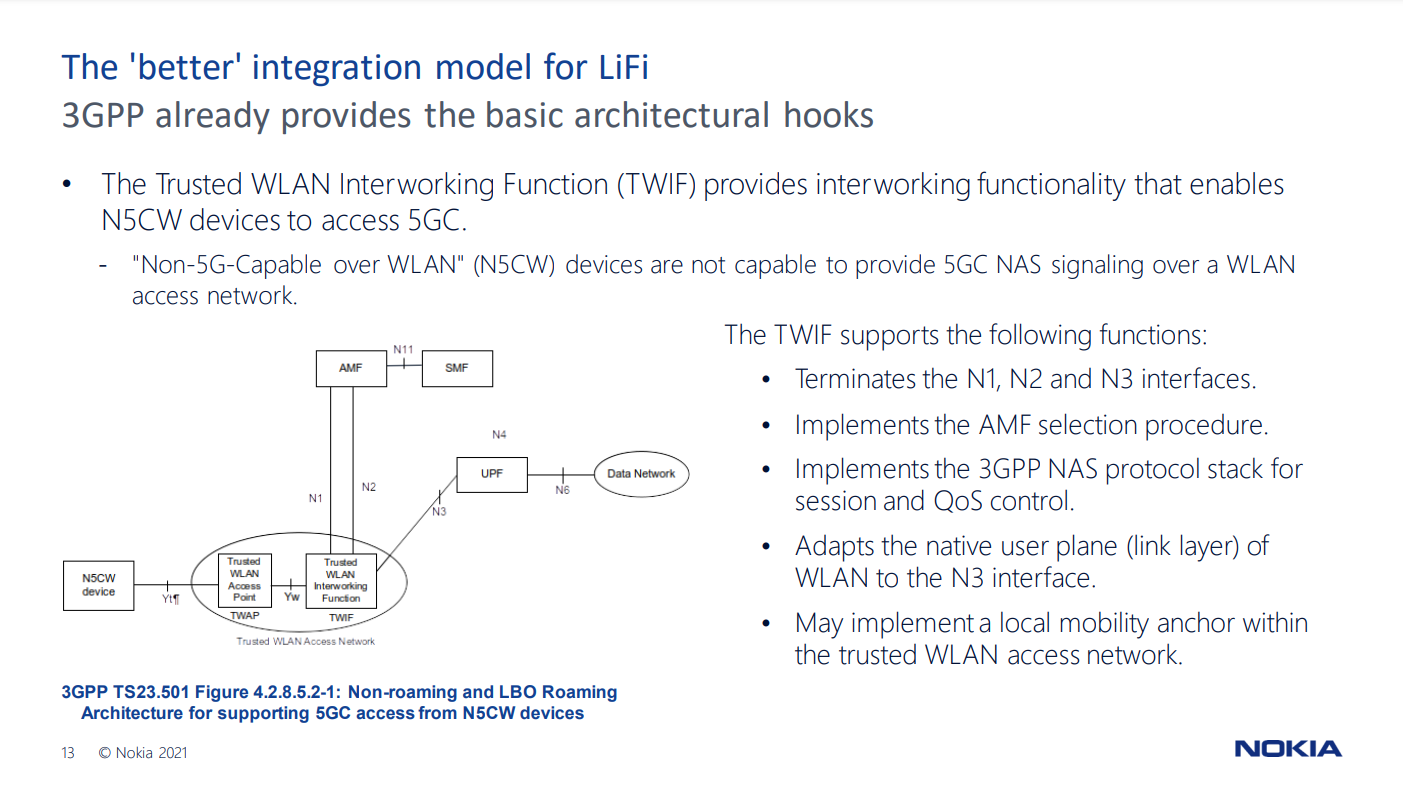
      The 'better' integration model for LiFi

      And such a model already exists. But it's not fully out or deployed for LIFI. But it's probably a hint on how to proceed. There is a definition of a trusted wireless LAN interworking function, which is terminating N2 to N3 interfaces into a non three GPP technology, not demanding the IPsec tunnel doing and allowing for all the functional integration, having link-layer access to the user plane, maybe support local mobility, which is important in the LIFI area with the small coverage zones. And that's the proposal here for going forward when thinking about LIFI, thinking about a more core s focused integration model than we currently have for LIFI and working on further enhancements to get this model adopted for LIFI but also LIFI addressing the need of industry 4.0 that means providing high reliability, low latency communication, that may also work a little already with the standard coming out of 802.11bb by avoiding congestion and allowing a higher control.”

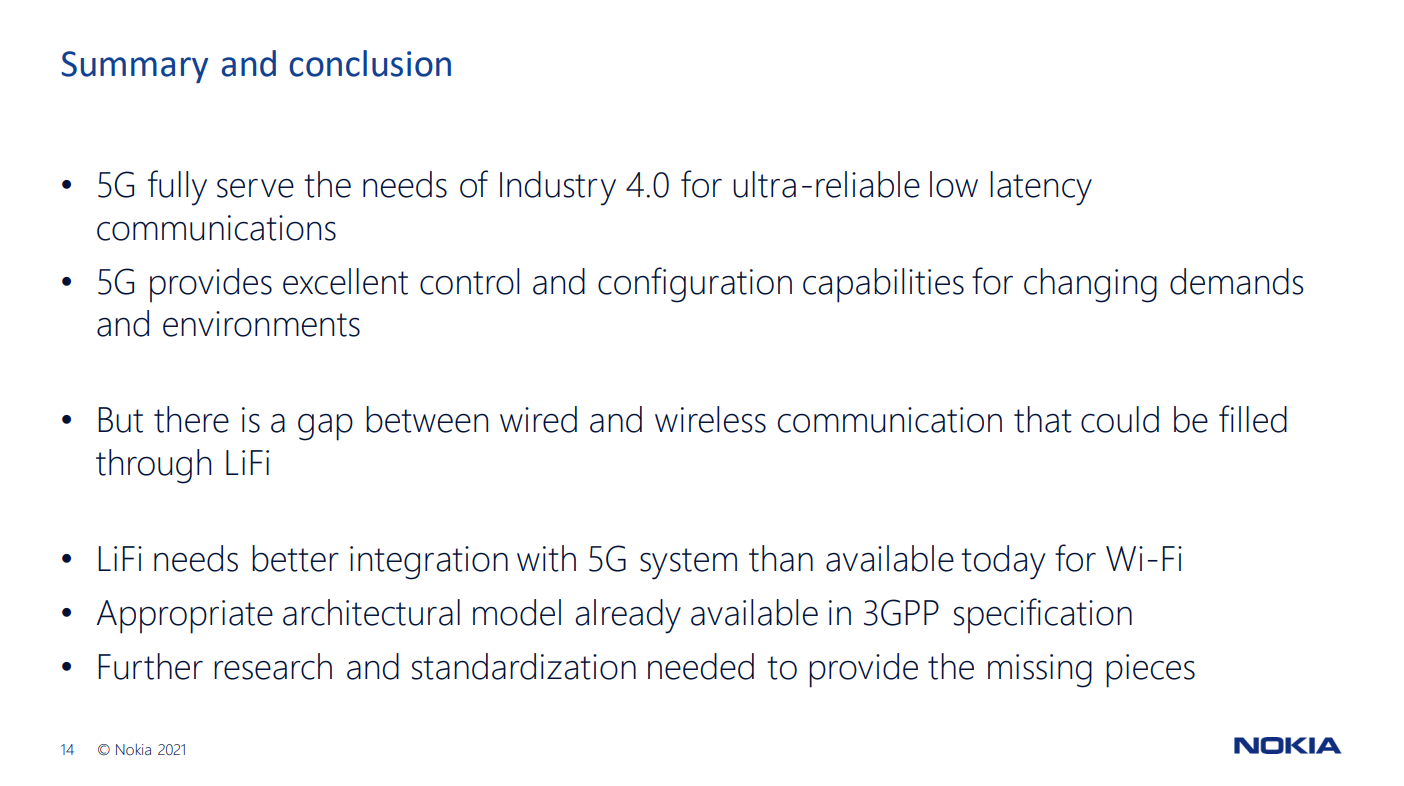
      Summary and conclusion

      And then I'm coming to the end of my presentation but I've shown 5G is a system that really serves the needs of industry 4.0 for all this critical communication. In particular, 5G provides the control and configuration capabilities that are needed in industrial deployments. Frequently, configuration has to be adopted. What we also discovered or what we found is that there is a technology gap between wired and wireless. And we are looking forward to a domain where LIFI could excel. But finally, to deploy LIFI in this industrial environment, we see the need for better integration. And we see the need for leveraging or basing it on a different approach than what we have currently on Wi-Fi. And yeah what's asked for is further research standardisation to get this LIFI deployment really working. Currently, we have just the hints of the framework, but there are so many technologies still missing to get it working.

      You can also watch the full video presentation on the following YouTube link from Jakajima YouTube channel.

      Li-Fi Conference 2022

      The next Li-Fi Conference is coming up on the 28th of June 2022 between 10 am and 4.30 pm CET.

      It is interesting to realise that lights that illuminate offices, homes, cars, factories, our streets and more locations also can connect us to data and hence power the growing demand for connectivity and speed.

      At this conference professionals from all over the globe will gather together in order to share applications, ideas, new developments and ways to integrate Li-Fi in services, both for consumers and professionals.

      This conference will be held Live and Online. The venue will be the High Tech Campus 1, The Strip 5656 AE Eindhoven The Netherlands.

      Online tickets can be bought at the following link:

      https://tikcit.com/register/61e002336d7fc4b6745cab83/

      What is LiFi?

      LiFi, also known as "Light Fidelity" is a wireless optical networking technology, which uses light-emitting diodes (LEDs) to transmit data. In 2011, professor Harald Haas made a LiFi demonstration at the TED (Technology, Entertainment, Design) Global Talk on Visible Light Communication (VLC).

      VLC uses light as a medium to deliver high-speed communication like Wi-Fi and complies with the IEEE standard IEEE 802.15.7. The IEEE 802.15.7 is a high-speed, bidirectional, and fully networked wireless communication technology-based standard similar to Wi-Fi's IEEE 802.11.

      How does LiFi work?

      LiFi is a high speed, bidirectional, and fully networked wireless communication of data using light. LiFi constitutes of several light bulbs that form a wireless network.

      When an electrical current goes through to a LED light bulb, a stream of light (photons) emits from the lamp. LED bulbs are semiconductor devices, which means that the brightness of the light flowing through them can change at extremely high speeds. The signal is sent by modulating the light at different rates. The signal can then be received by a detector that interprets the changes in light intensity (the signal) as data. Also when the LED is ON, you transmit a digital 1, and when it is OFF, you transmit a 0.

      LiFi Benefits

      The primary benefits of LiFi are as follows:

      Security: Provides entirely secure access. Where there is no light there is no data.

      Safety: Does not produce electromagnetic radiation and does not interfere with existing electronic systems.

      Localisation: Allows localisation due to the small coverage area of LiFi access point - localisation can be used for very precise asset tracking.

      Data density: Provides ubiquitous high-speed wireless access that offers substantially greater data density (data rate per unit area) than RF through high bandwidth reuse.

      Credit to Oledcomm

      LiFi Applications

      LiFi can be used for so many applications and the list is increasing every year. You can read our updated list of Li-Fi applications at the following link:

      https://www.lifitn.com/blog/2021/2/13/top-30-li-fi-applications-updated-list-including-potential-applications

      Credit to pureLiFi

      In conclusion, if you are also interested to hear more information about the OWNII Coin or enquire about LiFi devices such as the LiFiMax and Trulifi, you can contact us through our chatbot or by sending an email through our contact us form. If you enjoyed this post and would like to hear more updates about LiFi technology, subscribe to our newsletter. Don’t forget to subscribe to our social media accounts. You can also join our Telegram group about LiFi technology on this link:

      https://t.me/joinchat/FMzOmsEKyJFrU6Af

      Li-Fi Conference 2021 - Recap Part 8 - LiFi At The Heart Of Future Intelligent Communications Networks

      Table of Contents

        Li-Fi Conference 2021 - Recap Part 8 - LiFi At The Heart Of Future Intelligent Communications Networks

        Li-Fi Conference 2021

        In our last article from our ONLINE Li-Fi Conference 2021 recap series, we discussed the presentation on “Light Communication As A Part Of 5G And Beyond” delivered by Deepak Solanki from Velmenni. The conference was organised by the Jakajima, the global High Tech Conference organiser, and the Light Communications Alliance.

        Jakajima, Matchmaker for Innovators in the high tech industry, organises many events, ranging from LiFi Technology industry trends, 3D Printing to the Internet of Things, from Unmanned Cargo Aircraft to Health Tech, from 4D Printing to Photonics and from Vertical Farming to Sustainable Materials.

        The online Li-Fi Conference included live presentations from researchers, executives and industry specialists from pureLiFi, Nokia, Signify, Orange, Radiocommunications Agency Netherlands, Velmenni, OLEDCOMM, HomeGrid Forum and Weidmüller Deutschland.

        In another article recap series, we will talk about the duo presentation on LiFi At The Heart Of Future Intelligent Communications Networks delivered by Sylvain Leroux, FoodTech & Light Communications Director, Orange and Micheline Perrufel, Researcher/Project manager Innovation, Orange. Before this, we will talk about Orange Telecommunications.

        Orange

        Orange S.A., rebranded as Orange, formerly France Télécom S.A., stylized as France telecom, is a French multinational telecommunications corporation. It has 266 million customers worldwide and employs 89,000 people in France, and 59,000 elsewhere. It is the 11th largest mobile network operator in the world and the 4th largest in Europe after Vodafone, Telefónica, and Deutsche Telekom. In 2015, the group had a revenue of €40 billion. The company's head office is located in the 15th arrondissement of Paris.

        Orange has been the company's main brand for mobile, landline, internet and Internet Protocol television (IPTV) services since 2006. It originated in 1994 when Hutchison Whampoa acquired a controlling stake in Microtel Communications during the early 1990s and rebranded it as "Orange". It became a subsidiary of Mannesmann in 1999 and was acquired by France Télécom in 2000. The company was rebranded as Orange on 1 July 2013.

        Orange is also a leading provider of global IT and telecommunication services to multinational companies, under the brand Orange Business Services. In December 2019, the Group presented its new "Engage 2025" strategic plan, which, guided by social and environmental accountability, aims to reinvent its operator model. While accelerating in growth areas and placing data and AI at the heart of its innovation model, the Group will be an attractive and responsible employer, adapted to emerging professions.

        LiFi At The Heart Of Future Intelligent Communications Networks Delivered By Sylvain Leroux and Micheline Perrufel

        Sylvain Leroux, FoodTech & Light Communications Director, Orange and Micheline Perrufel, Researcher/Project manager Innovation, Orange, were the eighth presenters at the online Li-Fi Conference 2021. He discussed in his presentation the topic of Light Communication As A Part Of 5G And Beyond.

        Sylvain Leroux is a seasoned Marketing and communication professional with over 20 years of knowledge and experience in the telecom/internet industry from strategy in complex ecosystems, to operational project management for one of the world’s leading telecommunications operators. He currently works on IoT Program (B2B & B2B2C).

        He previously worked as Strategy of Services & Partnerships Marketing Manager focusing on change management, digital transformation and innovation. His mission was about to structure or manage game changing partners / ecosystems / services.

        Micheline Perrufel is currently Research Engineer and Innovation Project Manager at Orange Labs. She supports digital innovation by deploying light communication technology in addition to radio and ultrasound technologies. Her role also involves in responding to the new expectations of business and private customers with simple, ethical and environmentally friendly solutions. She also leads in the preparation of new user interaction services based on Beacon, LIFI, NFC, Lora technologies...using UCI (User Centric Innovation) design Thinking methods.

        Below are some points discussed about LiFi At The Heart Of Future Intelligent Communications Networks:

        Sylvain Leroux started the presentation by saying the following:

        My name is Sylvain Leroux and I'm working at Orange Innovation. and I'm working on different innovation programmes such as light communication and I'm working in pairs with Micheline who is also part of Orange innovation. So, today I'm happy to talk with you and to talk about future intelligence communication networks. And why it really matters on the chair of intelligent communication networks.”. 

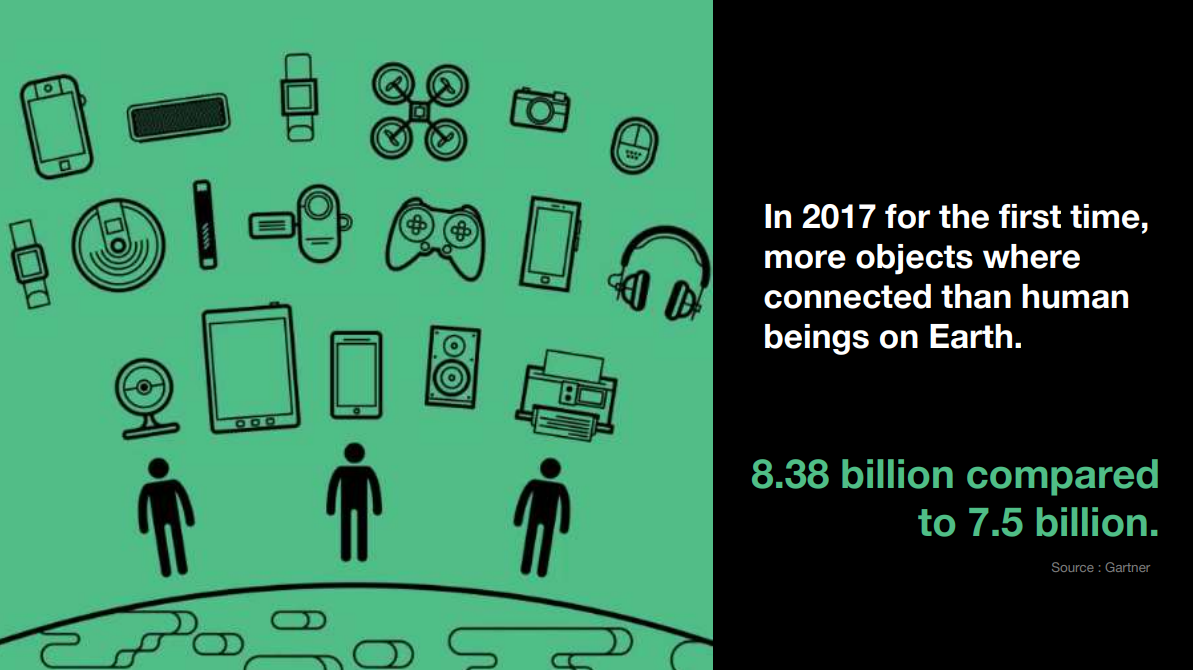
        We have reached a very symbolic tipping point four years ago, as we get more objects that were connected on the earth, rather than human beings, approximately more than 8 billion of connected objects on Earth".

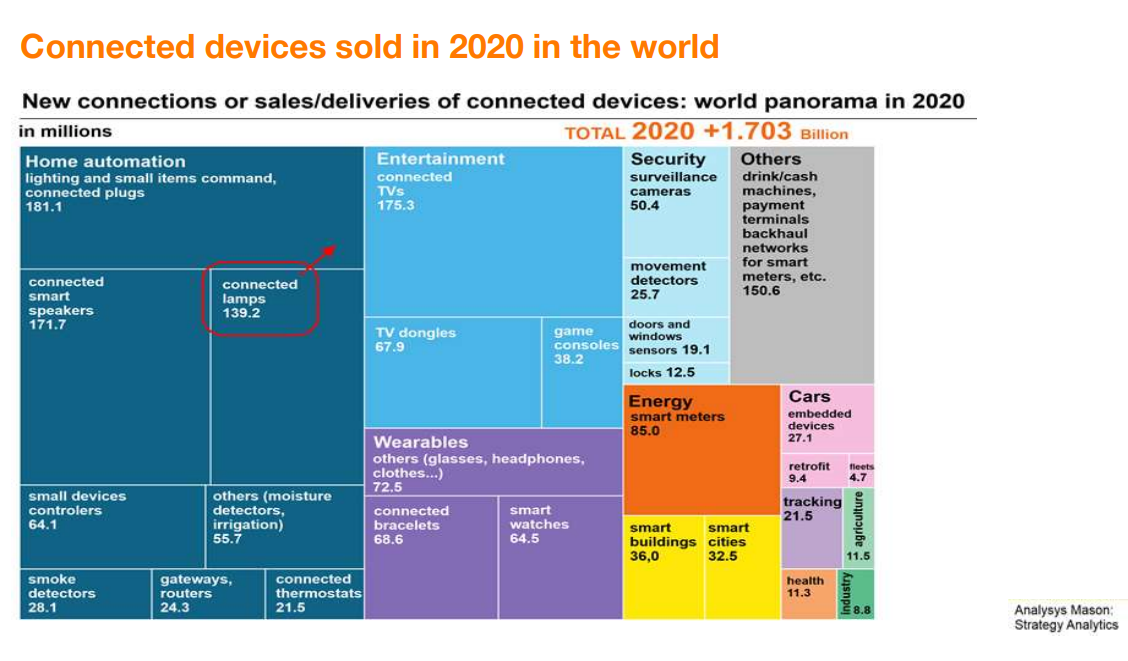
        Connected devices sold in 2020 in the world


        And we could see that the connected devices market also has grown very fast. Thanks to different connectivity, and new technology arriving on the market, you could see an interesting point here is that all of them are growing very fast. 


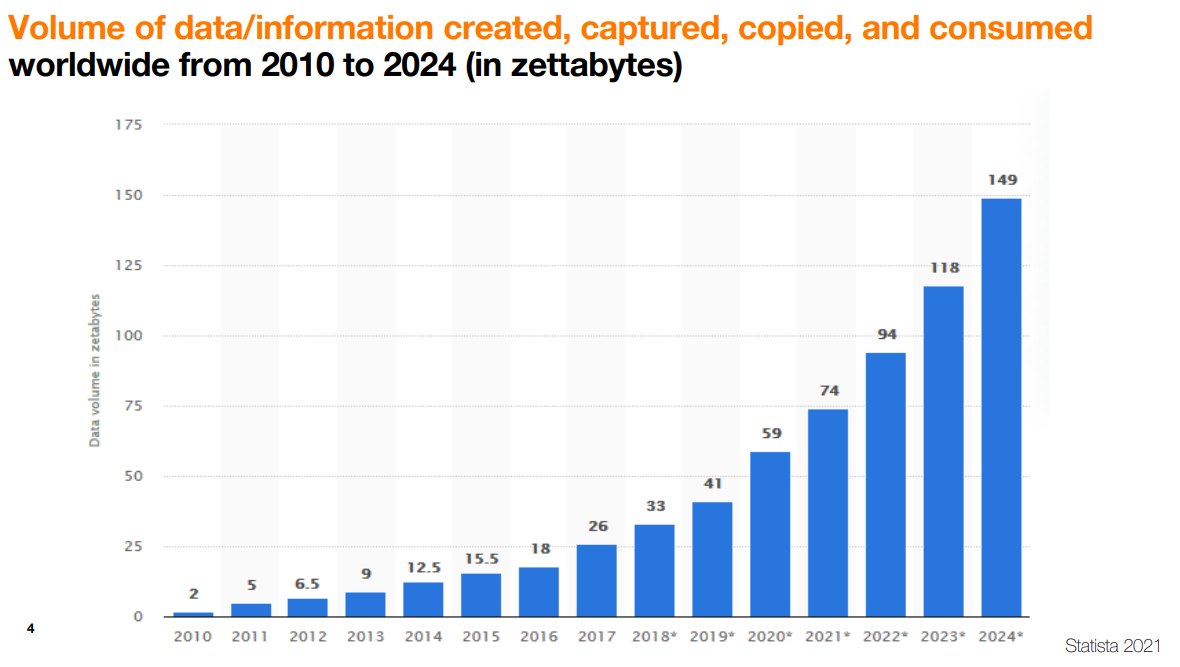
        Volume of data/information created, captured, copied, and consumed worldwide from 2010 to 2024 (in zettabytes)

        Connected devices are booming, but also the volume of consumer data is growing very, very fast. And the interesting thing that you can see on this chart,the consumption of data will be multiplying by two and the question is how can we face this explosion of data consumption. So, we know that there is currently a very big pressure on the availability of the radio spectrum. And this is why we are looking for some alternatives on the optical spectrum.”

        LIMITS OF EACH TECHNOLOGY

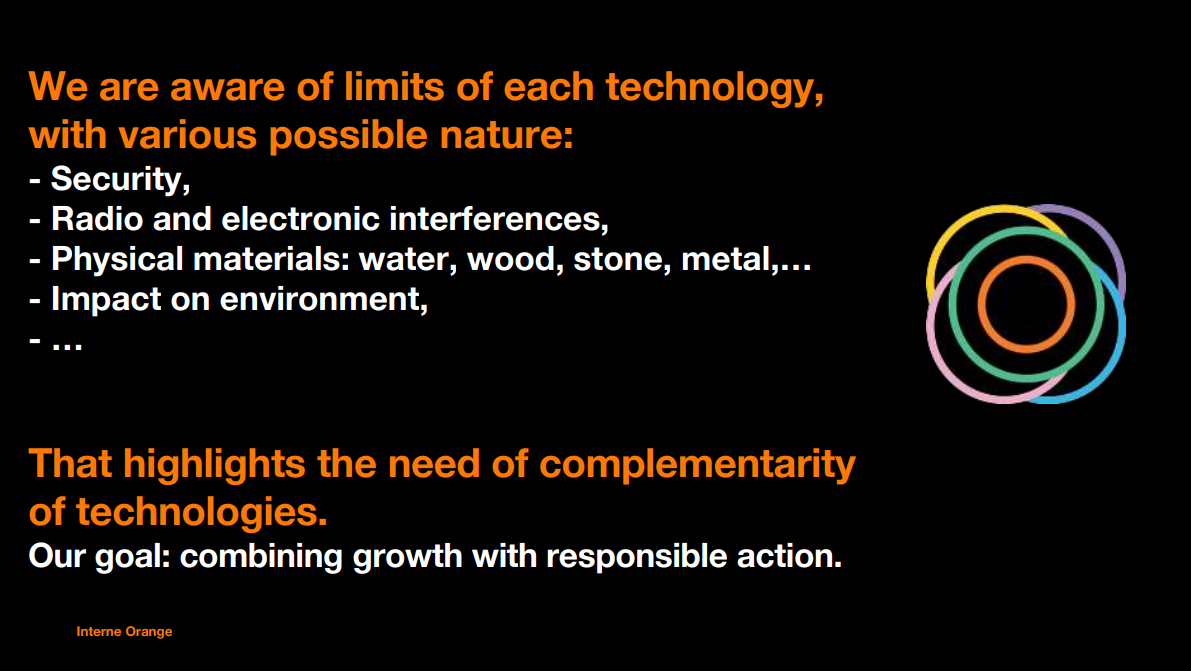
        As we are experts on this field because we run between networks, from space to the sea to your living room. But you know that edge technology has its own benefits but its own limits and you have various possible natures such as security limits, electronics interference, places where you are and the material inside places we were talking previously about industry and the presence of metallic environment is very difficult for waves for example, we know that there is no unique solution regarding the different technologies and the combination of different technologies and complementary with the technology will be received in order to deliver the best experience and the best connectivity.”

        Trends in global traffic and power usage of Wi-Fi access networks

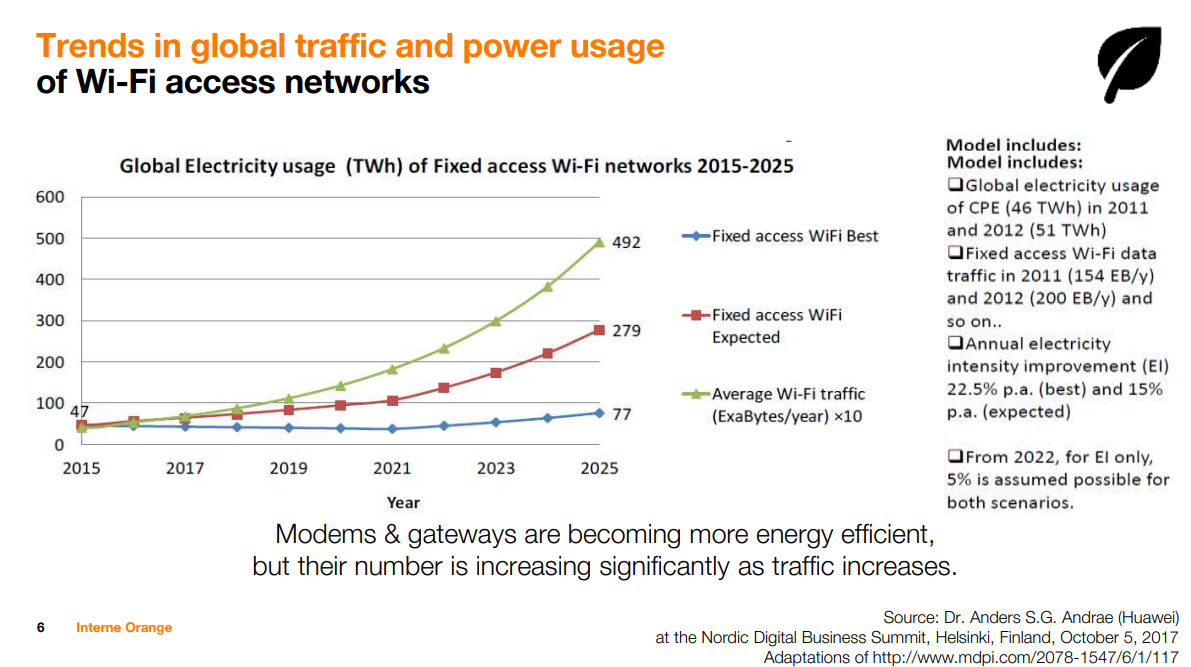
        And to give you some examples, we are facing some issues regarding, for example, electrical consumption and you get the examples here of going on electrical consumption of Wi-Fi. And even if the gateways and the modems are becoming more energy efficient, we are facing the increasing number of actually increasing traffic on the modem and gateways that increase the consumption of electricity.

        Environmental certification: more and more buildings certified

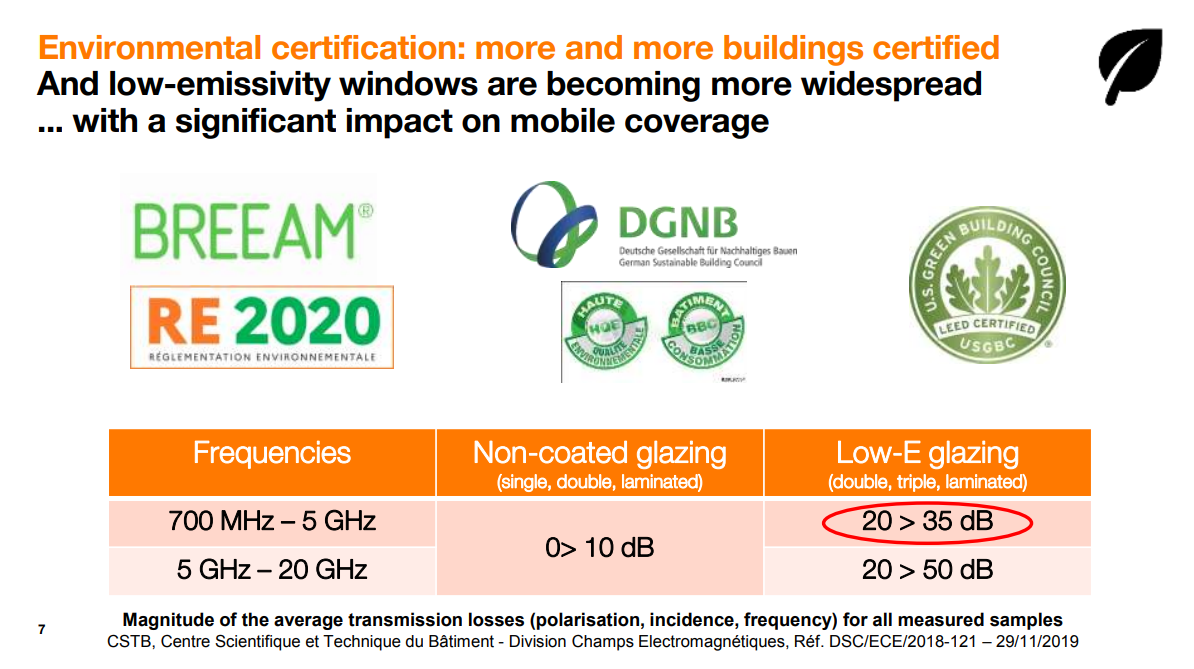
        Another example is that we use applications on the building market, for example. So, this is a very good concept but if you're looking to the quality of connectivity that you could provide the new sound out for low enlisted windows for example, it's checking for new products just to give you a look on the figures with the new type of glazing, it could be the radio signal could be divided into two for example, that's a very interesting challenge for us to get new, because some people have buildings that to get the best of the connectivity inside this visit.” 


        Future intelligent networks

        So, this is why we are approaching the future intelligent networks in order to combine different technology in order to have the best connectivity every time on every type of devices that I just told you previously revenue paradigm with richer devices are on the market during high speed connectivity, people ask for connectivity, they need real time, they want autonomous cars in the industry. We've also got cyber street and everyone wants to be connected from all three working for example or have the best connectivity in order to watch the Euro 2021. So, we have to think about the next generation of networks.” 

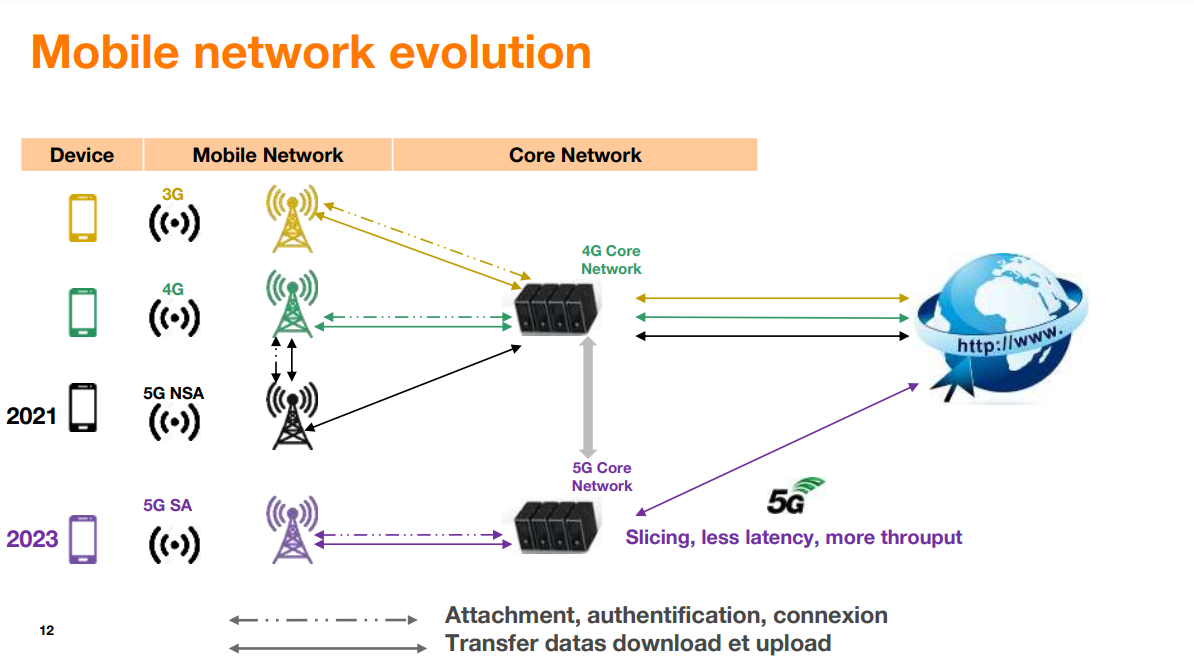
        Mobile network evolution

        These new networks are also evolutive and the interesting thing that I wanted to point out to us today is the different generation of 5g. The 5g router chain is what we call 5g and we says it's an evolution of the existing technologies on the existing core networks and the new generation with the and living a universities out you used to hear a day today on the news all about the little surprising is what we call this 5g standalone as a will have a dedicated 5g core network”.


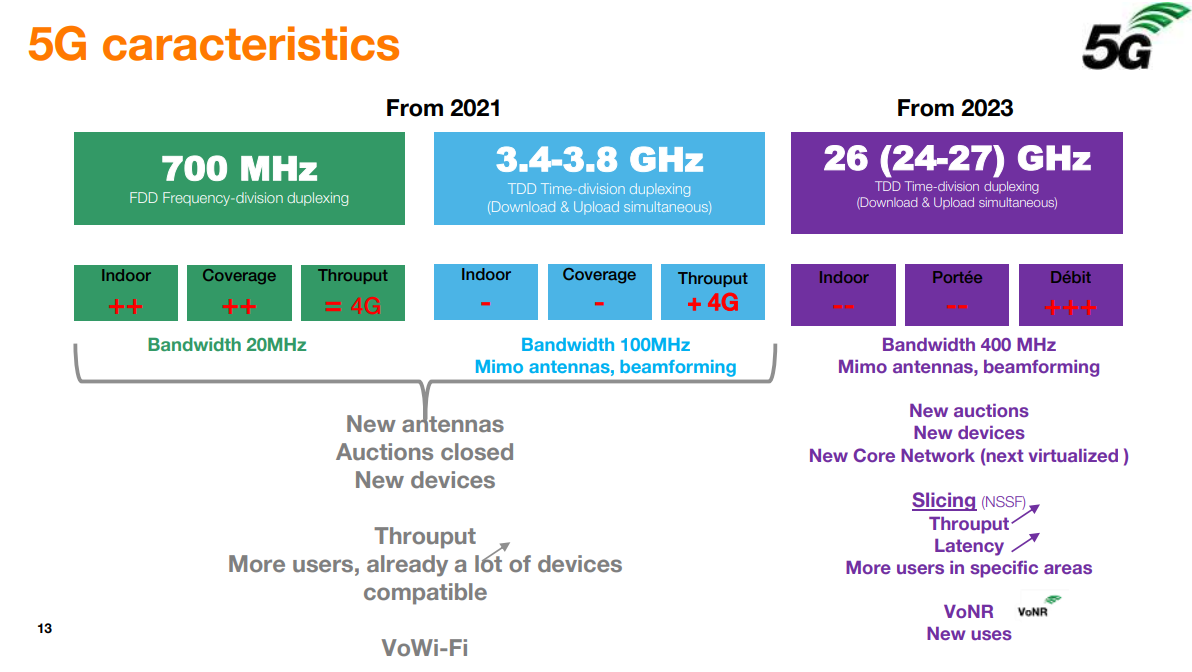
        5G cHaracteristics

        So, this is the the existing frequencies that we are using for 5g most time around and this is within two years what you will see with the new 5g core networks of the 5g standalone and you could see that's very interesting because rich technology as its benefits in its own limits, and I will let you see the difference between indoor coverage throughput and it can be done with the with the 5g.

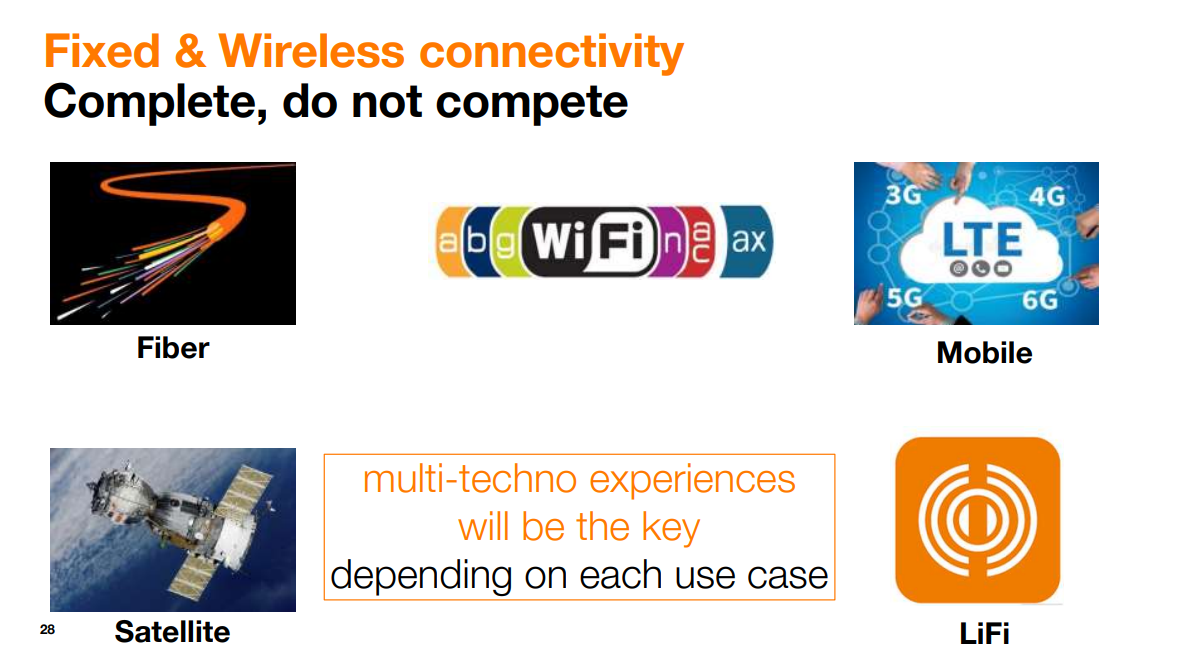
        Fiber complementary to 5G, Satellite, Wi-Fi & Light Connectivity

        Now fibre is in 2021, the basic connectivity network deployed by the telecom operator, it's very important for the Telco to deploy fibre and after the copper the fibre is deployed, why it's to offer to the customer big higher, big throughput, big speed and thanks to fibre, now, user can confirm data, can watch television and the fibre is a strategic vision for the Telco”.

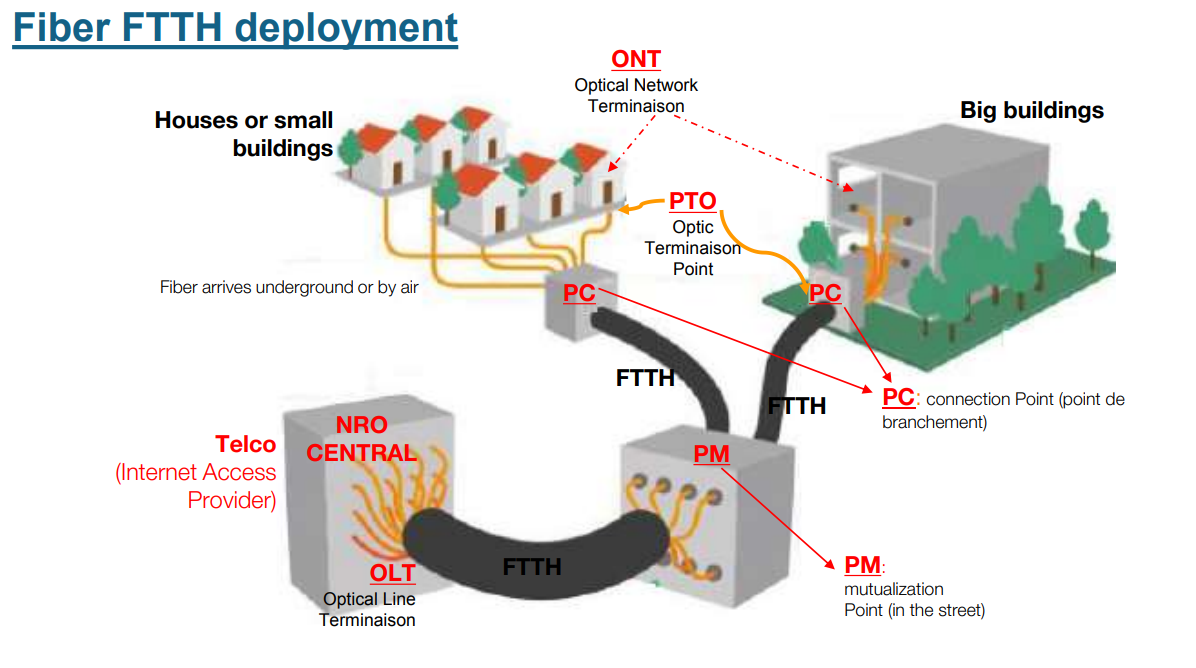
        Fiber FTTH deployment AND FTTH ARCHITECTURE

        Deploying fibre is very expensive. And to the Telco as a priority is to choose a good architecture to deploy the FTTH to the residential for example, little enterprise, the Telco choose architect to offer to the customer a signal with the fibre but a fibre share up to 65 customers by each fibre”. 

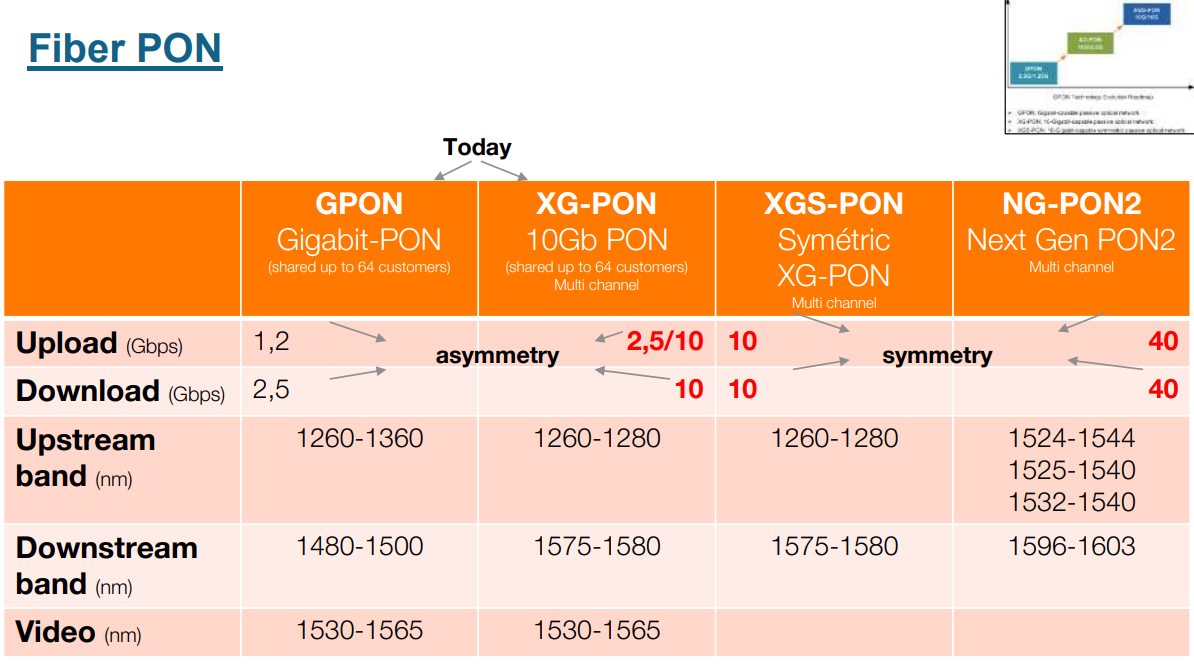
        Fiber PON

        Today's fibre name, GPON, is deployed and offers the customers the possibility to have up to one gigabyte in download. Now today, the customers have the possibility to have a throughput up to one gigabyte by second in download. And, for example with orange, up to 20 up to 200 megabyte by second. In one year, we hope to begin to deploy a new architecture named XGPON. XGPON cost more expensive to deploy that can offer to the customers the possibility to have up to 10 gigabyte by second and it's very relevant to offer more speed, more throughput, more performance, for example, for use Wi-Fi and use on LIFI”.

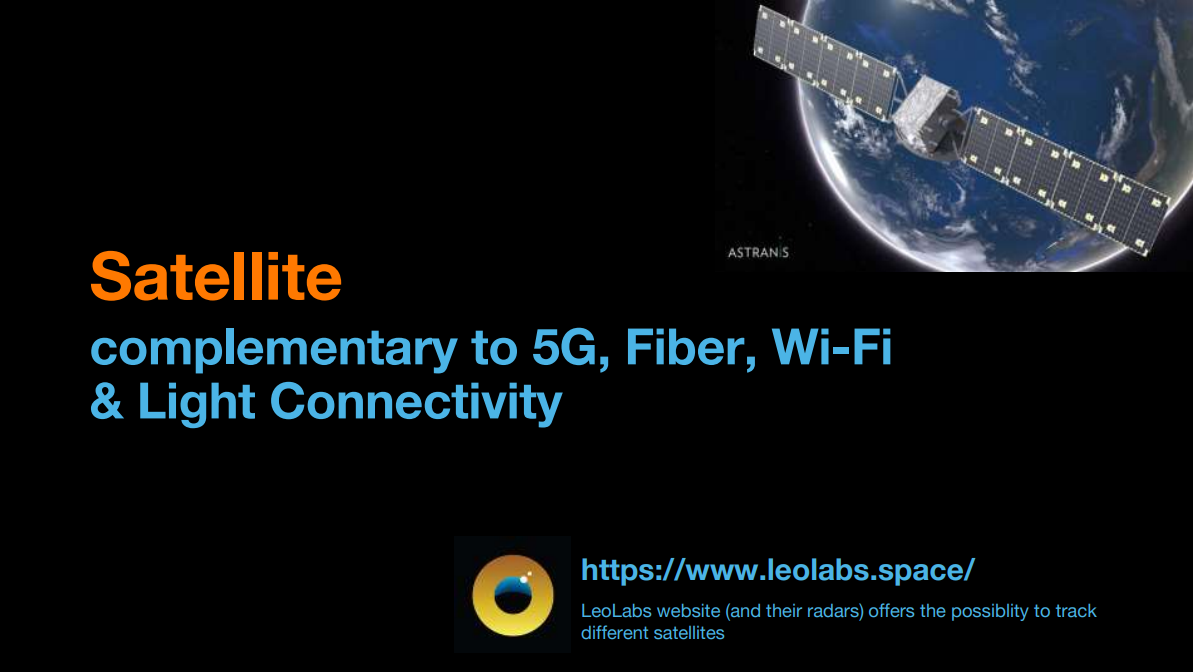
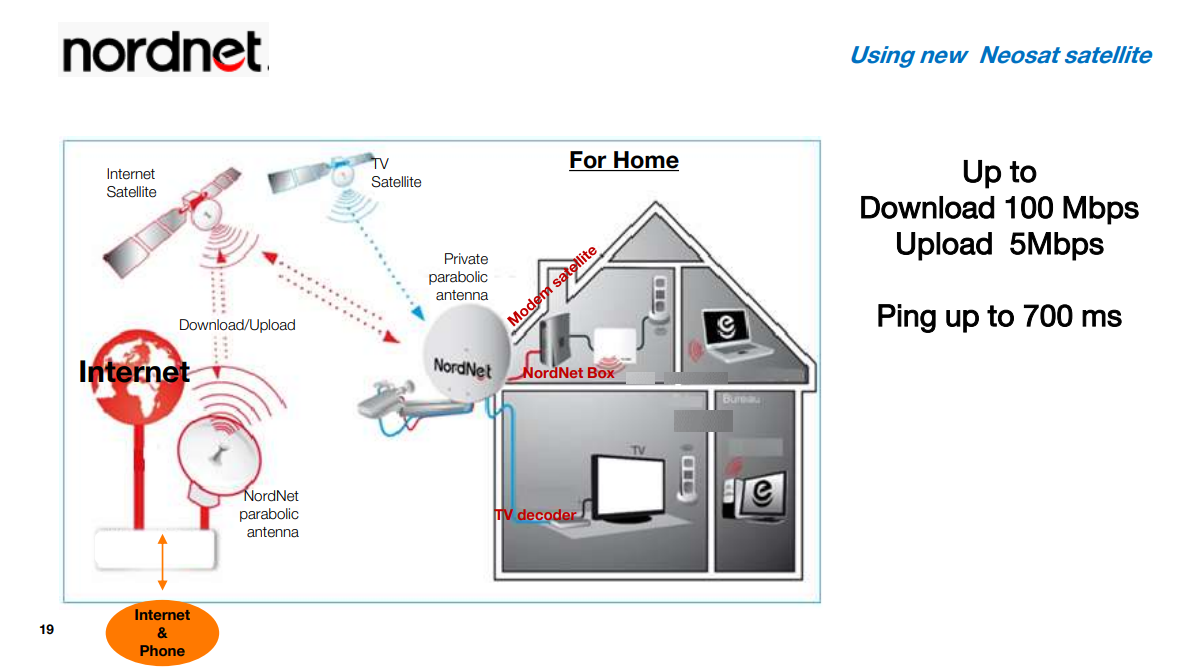
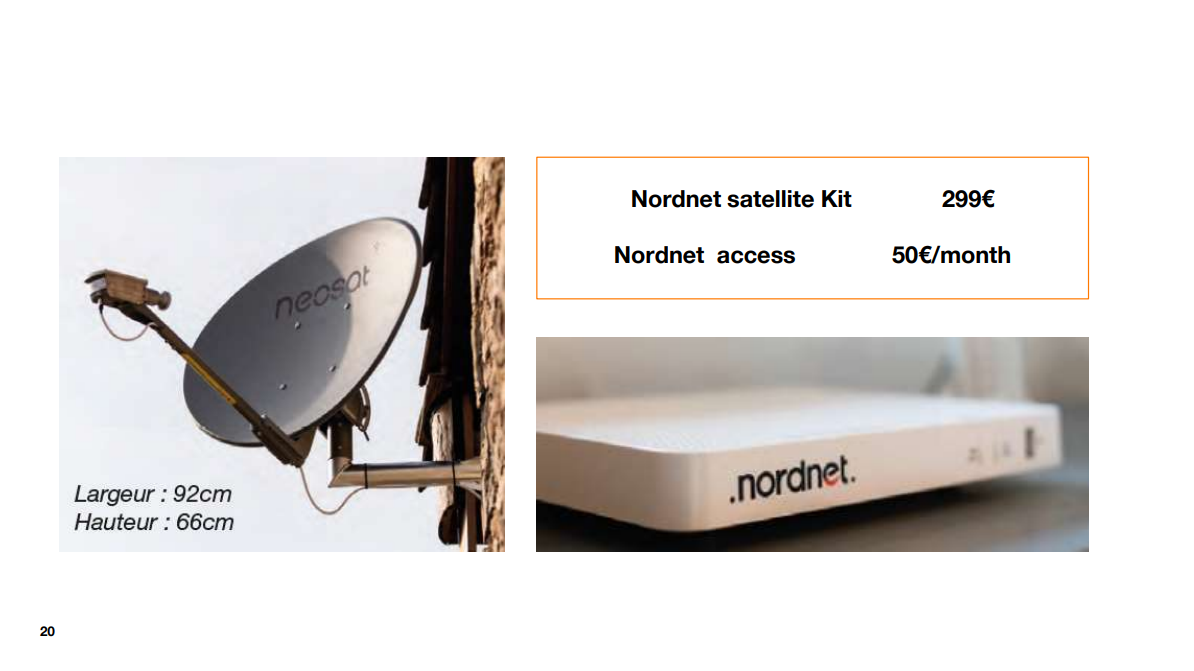
        Satellite complementary to 5G, Fiber, Wi-Fi & Light Connectivity

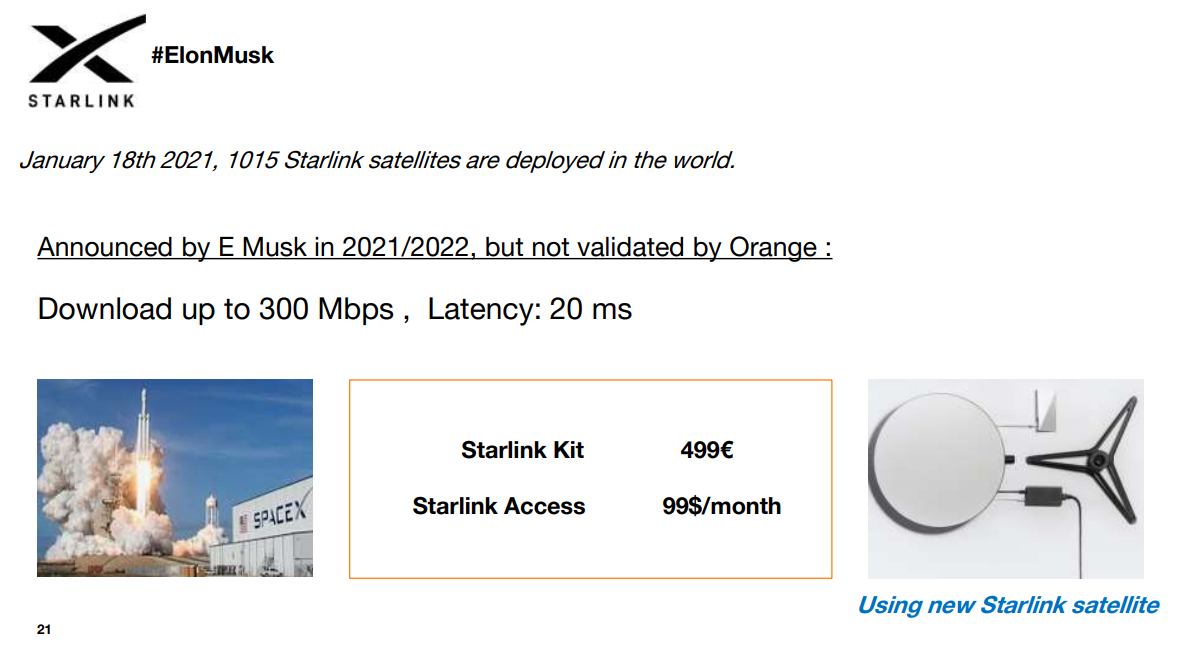
        Satellite data is also a priority now today for the Telco. In recent years, satellite connectivity has been offered to residential and also to enterprise when neither fibre or mobile network are present. Throughput with satellite is quite correct but look at the latency is very bad to have a good latency with the latency with satellite. And to use satellites, you have to buy and to keep an antenna and the specific books. And a new generation of satellite is coming but look at also as a throughput if it is better is also less good as the actual fibre of mobile network”.

        Wi-Fi 6 (ax) & Wi-Fi 6E

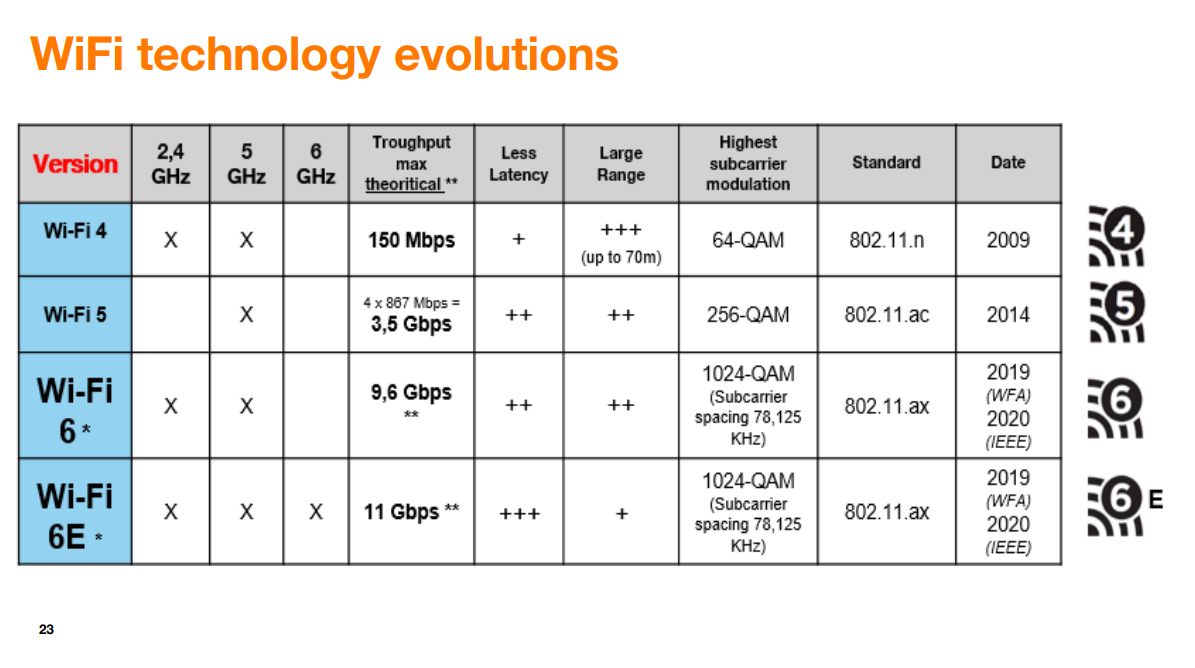
        Now when we look at Wi-Fi, we see that Wi-Fi still is the best technology. It is Remarkable. Who has not already used the Wi-Fi in the world, the Wi-Fi is everywhere every time and as mobile networks Wi-Fi evolve technology and each decade as Wi-Fi proposes a new version. And each time, it's a new version that proposes more performance, more throughput and less latency. But now today's this year, we speak about the Wi-Fi 6E extended and so Wi-Fi 6E is associated with both 2.4 GHZ and 5GHz with less interference but also with 6GHz. We hope with this new frequency, we will have less interference with other technology as for example Bluetooth excetera”.

        Light Connectivity

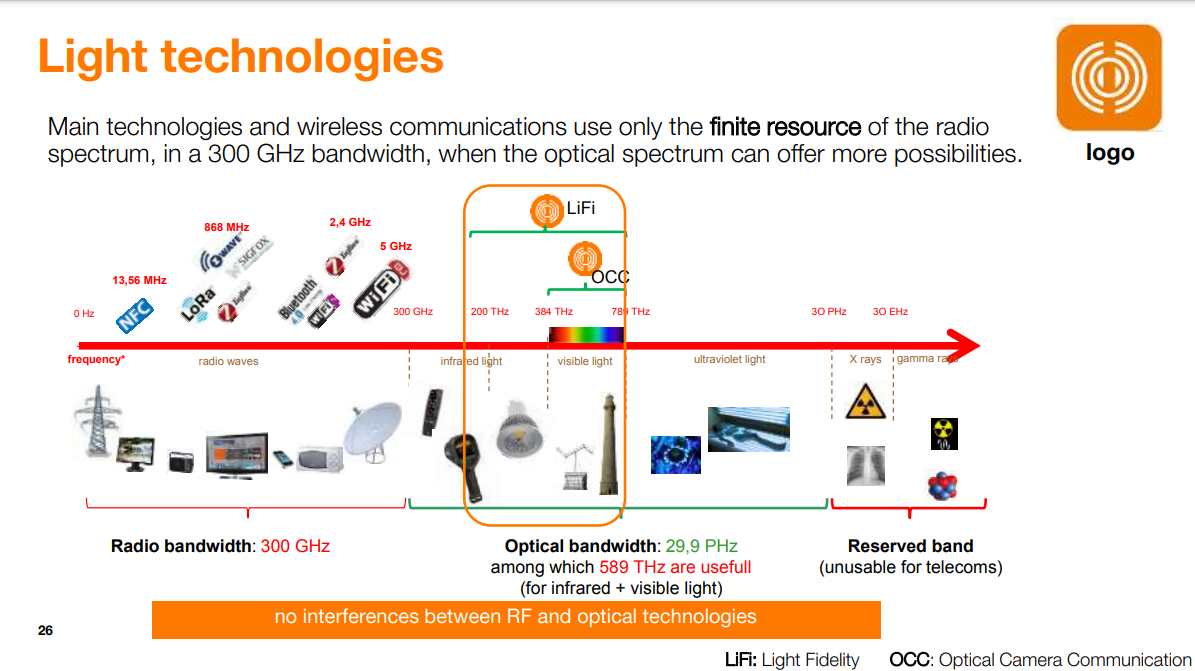
        But on the complementary of this access, light technology is complimentary as radio technology radiofrequency technology. And while we have no concrete information on the effective charge of the bandwidths by your institution in each country, we understand that the uses are more and more numerous. And it's time to exploit this bandwidth in the optical electromagnetic spectrum, especially with the LIFI and OCC but also with FA so it's also relevant and we begin to to speak about the FSO in the Telco.

        Light EQUIPMENTS

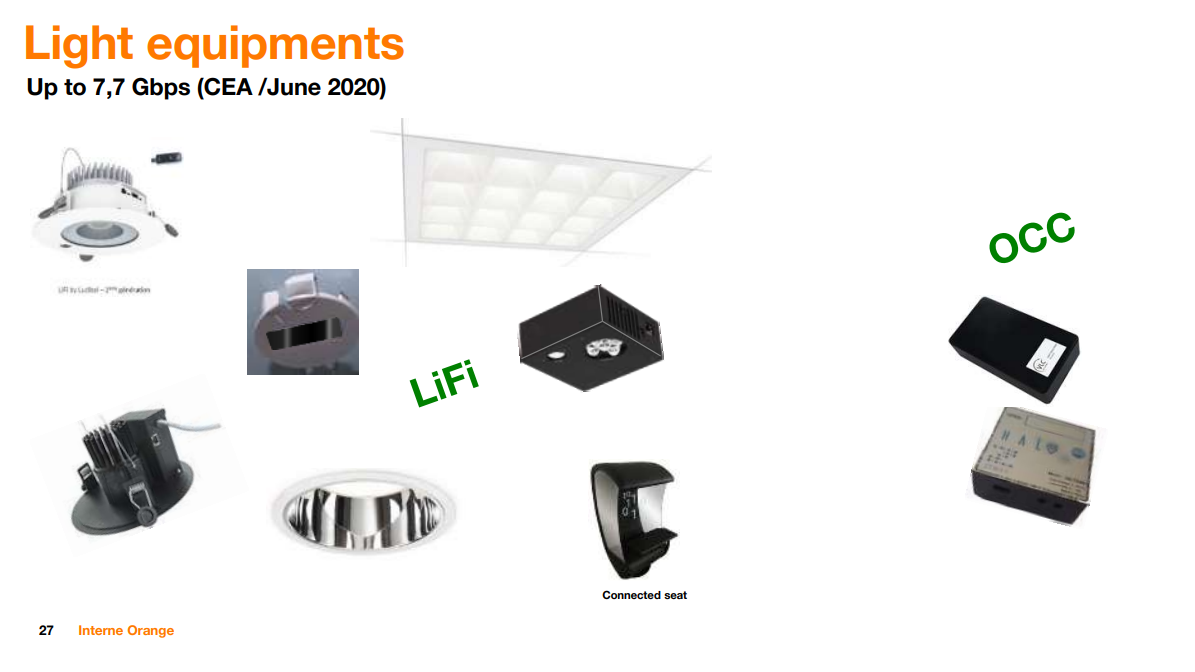
        Light equipments are many as their price are cheaper, and it's very also relevant for the Telco that they are not manufacturer, when we can propose a LIFI solution or OCC solution, we must make partnerships with different actors but we are not manufacturers, okay? We provide to the customers, the LAN access, the one access, but not the equipment. And a lot of arguments against at the beginning of the LIFI was that there were as they were no equipment compatible with Wi-Fi and with OCC. But if we remember, as the beginning of Wi-Fi. In 1999, there was no equipment directly compatible with Wi-Fi. And as today with the LIFI,we used Wi-Fi and also a USB key”.

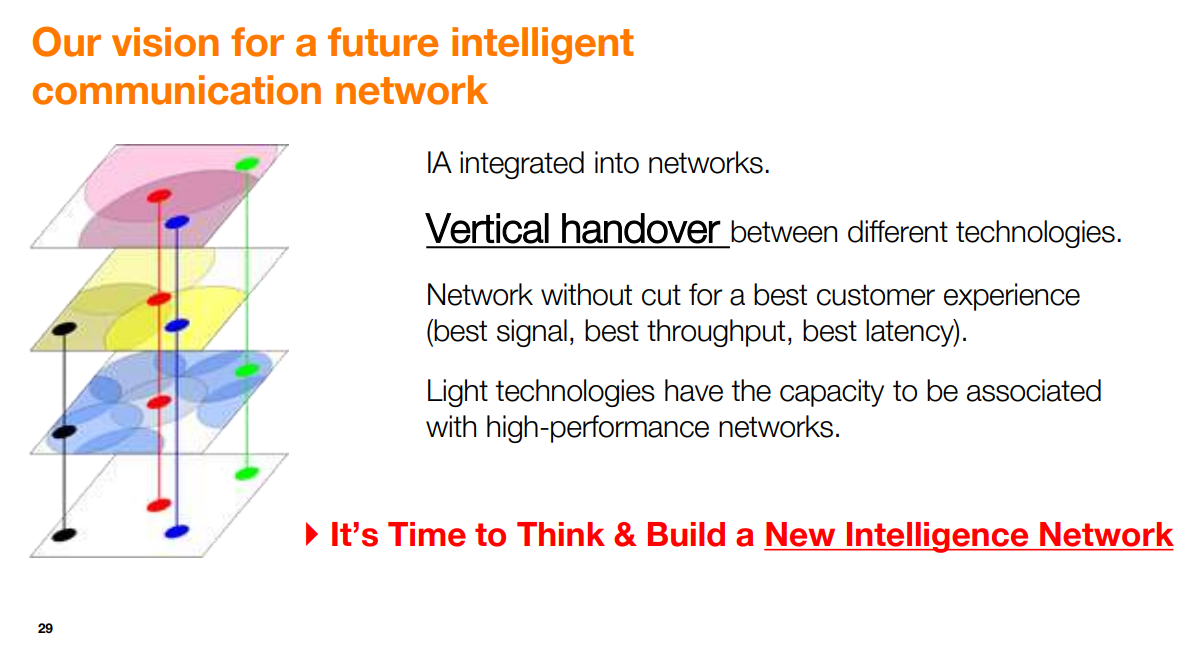
        Our vision for a future intelligent communication network

        So what we see at Orange, when we speak about a lot of technology with our customer, we see that users today are more and more lost. They don't know what is the good solution. And they want they would like a unique solution, a solution capable of giving them an universal signal and access. They need universal access with better throughput, with better latency and they don't know what solutions they have to choose. That's why we identify the opportunity to build projects and to make a solution to begin testing and to create a new network. A network with handover capability between different technologies. For example, when we use the mobile and the signal is bad, you can handover, you can use a new frequency or a new antenna, we speak about horizontal handover. When we speak about handover between different technologies, we speak about vertical handover. And we can manage this vertical handover for an intelligent new network. So we imagine a different architecture in the core network. And now with light, we think and it's my vision that is relevant to build a new architecture based on the 5g as the fibre also better the 5g, the LIFI and the Wi-Fi and the Satellite. So we think today that the vertical handover can be managed both by Fibre and the core network of mobile and PC and that is now a project in orange for example, to deploy this function and to enrich the global network in parallel of this evolution of old technology”.

        You can also watch the full video presentation on the following YouTube link from Jakajima YouTube channel.

        Li-Fi Conference 2022

        The next Li-Fi Conference is coming up on the 28th of June 2022 between 10 am and 4.30 pm CET.

        It is interesting to realise that lights that illuminate offices, homes, cars, factories, our streets and more locations also can connect us to data and hence power the growing demand for connectivity and speed.

        At this conference professionals from all over the globe will gather together in order to share applications, ideas, new developments and ways to integrate Li-Fi in services, both for consumers and professionals.

        This conference will be held Live and Online. The venue will be the High Tech Campus 1, The Strip 5656 AE Eindhoven The Netherlands.

        Online tickets can be bought at the following link:

        https://tikcit.com/register/61e002336d7fc4b6745cab83/

        What is LiFi?

        LiFi, also known as "Light Fidelity" is a wireless optical networking technology, which uses light-emitting diodes (LEDs) to transmit data. In 2011, professor Harald Haas made a LiFi demonstration at the TED (Technology, Entertainment, Design) Global Talk on Visible Light Communication (VLC).

        VLC uses light as a medium to deliver high-speed communication like Wi-Fi and complies with the IEEE standard IEEE 802.15.7. The IEEE 802.15.7 is a high-speed, bidirectional, and fully networked wireless communication technology-based standard similar to Wi-Fi's IEEE 802.11.

        How does LiFi work?

        LiFi is a high speed, bidirectional, and fully networked wireless communication of data using light. LiFi constitutes of several light bulbs that form a wireless network.

        When an electrical current goes through to a LED light bulb, a stream of light (photons) emits from the lamp. LED bulbs are semiconductor devices, which means that the brightness of the light flowing through them can change at extremely high speeds. The signal is sent by modulating the light at different rates. The signal can then be received by a detector that interprets the changes in light intensity (the signal) as data. Also when the LED is ON, you transmit a digital 1, and when it is OFF, you transmit a 0.

        LiFi Benefits

        The primary benefits of LiFi are as follows:

        Security: Provides entirely secure access. Where there is no light there is no data.

        Safety: Does not produce electromagnetic radiation and does not interfere with existing electronic systems.

        Localisation: Allows localisation due to the small coverage area of LiFi access point - localisation can be used for very precise asset tracking.

        Data density: Provides ubiquitous high-speed wireless access that offers substantially greater data density (data rate per unit area) than RF through high bandwidth reuse.

        Credit to Oledcomm

        LiFi Applications

        LiFi can be used for so many applications and the list is increasing every year. You can read our updated list of Li-Fi applications at the following link:

        https://www.lifitn.com/blog/2021/2/13/top-30-li-fi-applications-updated-list-including-potential-applications

        Credit to pureLiFi

        In conclusion, if you are also interested to hear more information about the OWNII Coin or enquire about LiFi devices such as the LiFiMax and Trulifi, you can contact us through our chatbot or by sending an email through our contact us form. If you enjoyed this post and would like to hear more updates about LiFi technology, subscribe to our newsletter. Don’t forget to subscribe to our social media accounts. You can also join our Telegram group about LiFi technology on this link:

        https://t.me/joinchat/FMzOmsEKyJFrU6Af


        Li-Fi Conference 2021 - Recap Part 7 - Light Communication As A Part Of 5G And Beyond

        Table of Contents

          Li-Fi Conference 2021 - Recap Part 7 - Light Communication As A Part Of 5G And Beyond

          Li-Fi Conference 2021

          In our last article from our ONLINE Li-Fi Conference 2021 recap series, we discussed the presentation on “LiFi For Education” delivered by Benjamin Azoulay from OLEDCOMM. The conference was organised by the Jakajima, the global High Tech Conference organiser, and the Light Communications Alliance.

          Jakajima, Matchmaker for Innovators in the high tech industry, organises many events, ranging from LiFi Technology industry trends, 3D Printing to the Internet of Things, from Unmanned Cargo Aircraft to Health Tech, from 4D Printing to Photonics and from Vertical Farming to Sustainable Materials.

          The online Li-Fi Conference included live presentations from researchers, executives and industry specialists from pureLiFi, Nokia, Signify, Orange, Radiocommunications Agency Netherlands, Velmenni, OLEDCOMM, HomeGrid Forum and Weidmüller Deutschland.

          In another article recap series, we will talk about the presentation on Light Communication As A Part Of 5G And Beyond delivered by Deepak Solanki from Velmenni. Before this, we will talk about Velmenni.

          Velmenni

          Velmenni, having developed LiFi, now comes among one of the most valued organizations in the world of optical wireless data transmission. Founded in 2012, Velmenni became the first venture to explore the universe of visible light communications technology in India. With their prime product, LiFi, Velmenni is among the leading LiFi companies disrupting the world of data communication.

          They have created a LiFi-based mesh network solution which helps in transferring data across long distances. The product makes setting up wireless networks in ground, motion & air possible, where optical cable infrastructure is difficult to implement. Their team has been working on LiFi for nearly 10 years. It has pioneered in achieving several technological milestones.

          Their main focus is on optimisation of speed efficiency and seamless connectivity within the LiFi domain.

          Light Communication As A Part Of 5G And Beyond Delivered By Deepak Solanki

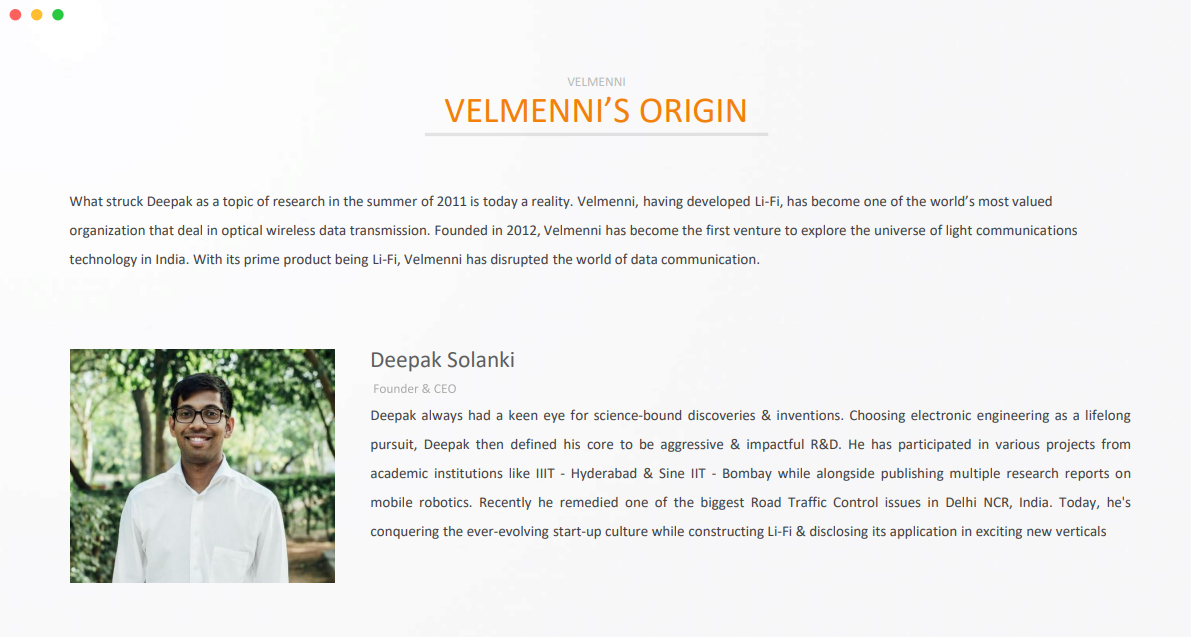
          Deepak Solanki, one of the founders and CEO at Velmenni, was the seventh presenter at the online Li-Fi Conference 2021. He discussed in his presentation the topic of Light Communication As A Part Of 5G And Beyond.

          Deepak always had a keen eye for science-bound discoveries & inventions. Choosing electronic engineering as a lifelong pursuit, Deepak then defined his core to be aggressive & impactful R&D. He has participated in various projects from academic institutions like IIIT - Hyderabad & Sine IIT - Bombay while alongside publishing multiple research reports on mobile robotics. Recently he remedied one of the biggest Road Traffic Control issues in Delhi NCR, India. Today, he's conquering the ever-evolving start-up culture while constructing Li-Fi & disclosing its application in exciting new verticals.

          Below are some points discussed about Light Communication As A Part Of 5G And Beyond:

          VELMENNI’S ORIGIN

          Deepak Solanki started his presentation by saying the following:

          Thank you, Peter, and good evening to all of you, my name is Deepak Solanki and I am the founder and CEO of Velmenni. Just to give you a brief about us. We are a startup based in India. And we have been in operation counted in back in 2012, and have been doing research in the light communication space for the past several years. Our objective was initially to focus on solving multiple challenges, building up light communication solutions, including work on fibre. So in the past several years, we have done different research on the technology and built up several kinds of solutions, which we are offering to end customers now and have been involved in building an ecosystem around light communication technologies”. 

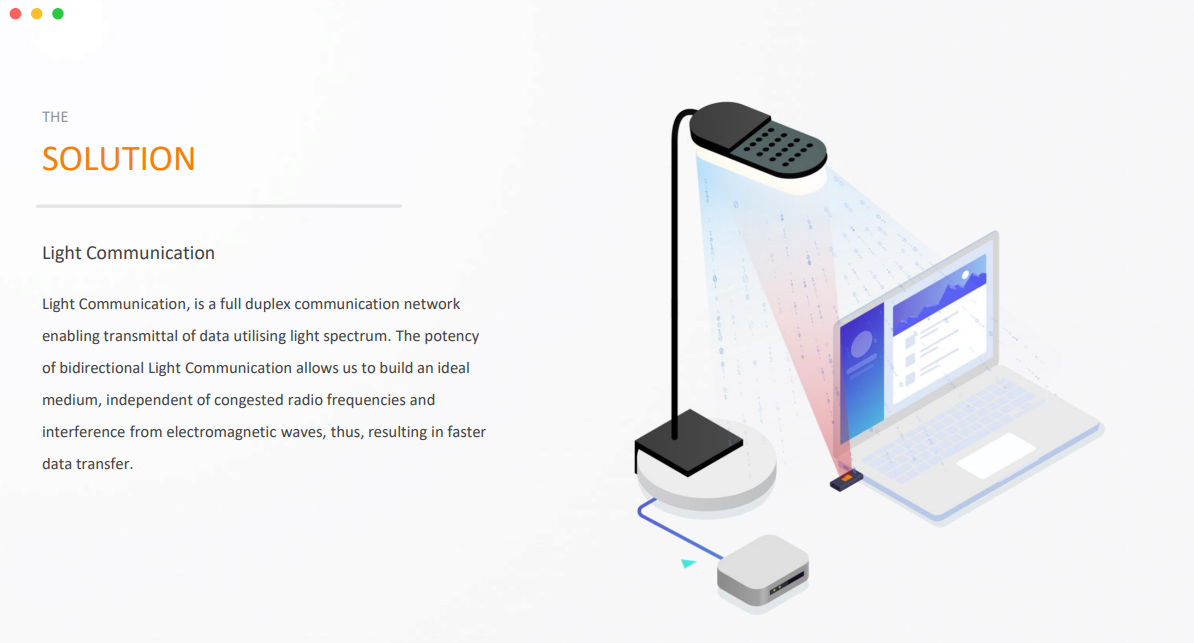
          THE SOLUTION


          So, I think most of us understand that light communication is a full duplex bi directional communication technology, which utilises the entire light spectrum for sending data starting from 380 nanometers going up to 1100 nanometers, which covers up the visible part of light spectrum as well as the near infrared. So, the entire light spectrum can be utilised on creating a truly wireless network and just independent from radio frequencies. Depending on the use case, any different kinds of wavelengths of light can be utilised, and a product and solution can be created”


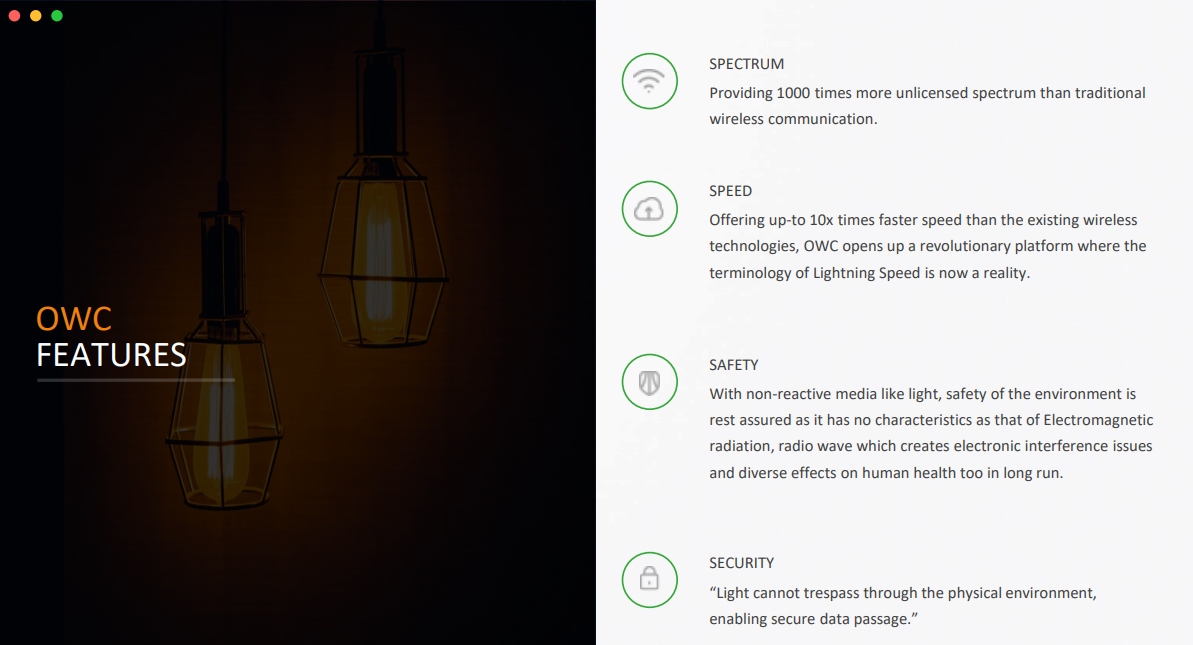
          OWC FEATURES

          So I think all of us understand that the light communication can offer several features. One of them is that the spectrum is truly freely available throughout the world. So there is no need to get the licence of spectrum from different authorities. And globally, most of our colleagues have shared that information earlier as well, the usable spectrum is quite bigger as compared to the radio frequency spectrum. We can achieve better data throughput as compared to the traditional radio based data communication system. We can go up to much higher in terms of at least the laboratory choice depending upon what kind of optical system you're using, you can achieve multi Gigabit ports in the light communication space. It's a safer technology in terms of EMF radiation. So, since we're not using any radio spectrum, so it's Radio Free, on the other hand, it can also provide really high data securities, most of us talked about the inherent properties of light, where the light can be concentrated to a specific area and in those particular areas, it becomes really secure because if somebody wants to enter into your system, they have to come under the light source which gives an extra layer of security as compared to the train traditional encryption which happens on the application layer.”

          THE PROBLEM

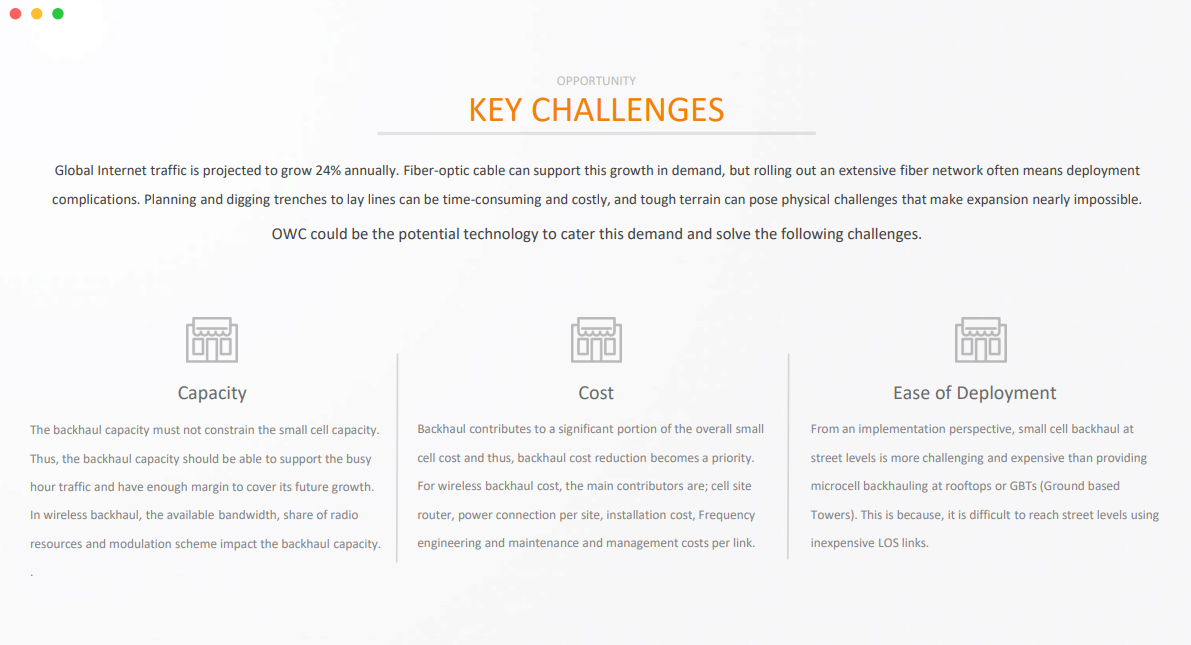
          So, I think all of us can understand that the data demand in the last several years has been exponentially increased. So, what is the need of IT you know, we already have video based wireless communication and the cable infrastructure to provide connectivity to the end users and what is the need of a you know, an alternate technology or a new technology? I think the major reason being if you talk about the current either a wired infrastructure or a wireless infrastructure, both have their own challenges, and I would like to talk about more challenges in a practical implementation scenario, when we are talking about a mobile network. In this presentation, I will specifically focus on outdoor backfill use cases of light communication technologies. My colleagues from pureLifI, Signify, and OLEDCOMM have talked about use cases which are more focused for indoor communication. I would like to bring a new perspective where and and a targeted use case where we can talk about outdoor communication and you know look to contribute and inform and to contribute into building up a secured connected wireless infrastructure in outdoor space”, said Deepak Solanki.

          KEY CHALLENGES

          So, if I talk about the current mobile networks, I come from a very densely populated country. We have 1.2 billion is our population and other cities are really big and congested. I live in New Delhi which is which has 13 million population in a single city. So there are a lot of congestion issues when I talk about the mobile network. So if I say we have a 4G right now available and in the 4G network, the average data throughput is less than 10 megabits per second hand. And even though there are so many areas within the cities where the connectivity is really cool. So the major challenge, if I talk about for telecom operator to build up a stronger connected infrastructure deploying more denser small cells within the cities, and that can be done, which requires a lot of investment, that's one thing. And then the backhaul becomes a big challenge in a city kind of an infrastructure where the Tensor Networks are there. So generally, to cater this kind of a demand, a telecom operator has to set up small cells at every 200 meters within the cities, and which is really complex to do that. And the battle becomes very challenging when you're deploying a street level, you know, small cells, so the backup can be done through optical fibre cables. But in developing nation, building up a fibre cable infrastructure takes a lot of time. It's expensive. And secondly, it's not easy to do that, because there are challenges in terms of trenching the streets, some of the areas you don't have the space to trench the streets and lay down a fibre cable. So, there is a requirement of wireless backhaul in those particular areas and the use cases and there are several technology which are available which can solve that kind of a challenge, but they come up with their own issues that are alternate technologies in any radio band.

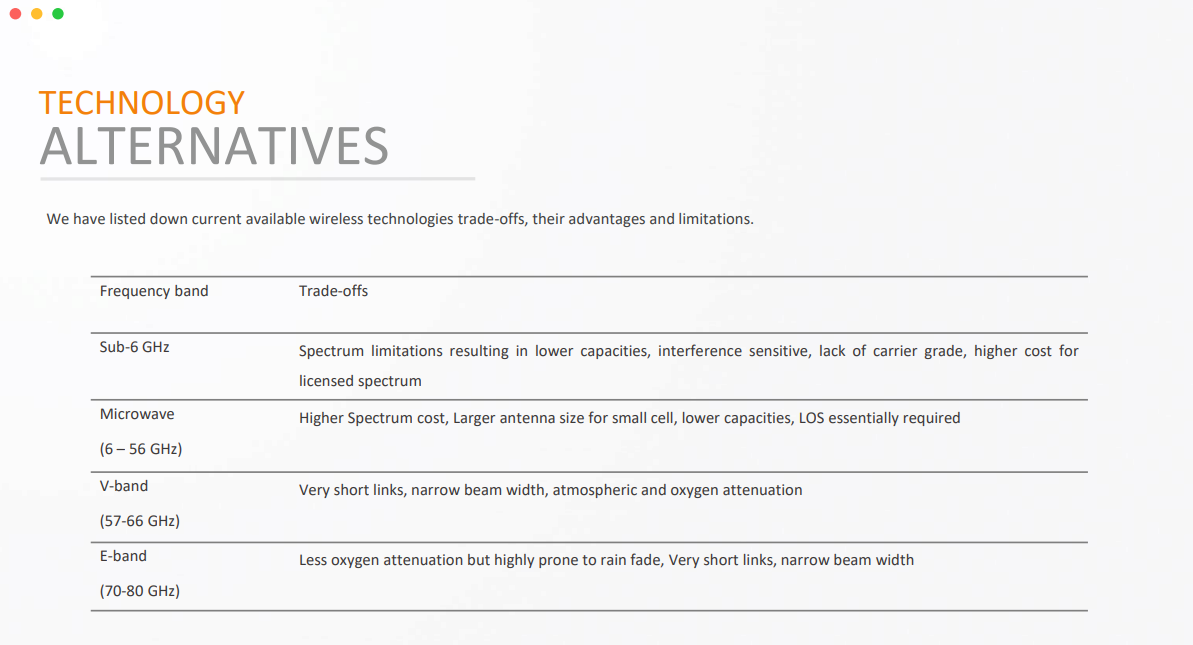
          TECHNOLOGY ALTERNATIVES

          We have V-band, E-band, microwave and all of them have certain trade-offs in terms of reliability of the connection in terms of, you know, having the condition into the network. So, if you talk about the ISN band based radio solution, they face a lot of issues in terms of congestion within the cities. So, I think the light communication technologies can offer a very interesting solution in those areas. It's a part of free space optical communication from a taxonomy point of view. Nikola shared in his previous talk about different taxonomies, we have LIFI which is used for indoor communication network, similar to Wi-Fi, we have OCC then we have free space optical communication. So, these outdoor products which can provide back full connectivity can come under free space optical communication, you know, there are various solutions, which can be made off depending upon what kind of throughput and a distance is required to communicate, but the objective of these kinds of solution is to basically complement the cable infrastructure. So, in the areas wherever you cannot lay down a fibre cable or an Ethernet cable, these devices can be integrated into the field and can provide the value as connectivity and replace the cable from the infrastructure.” 


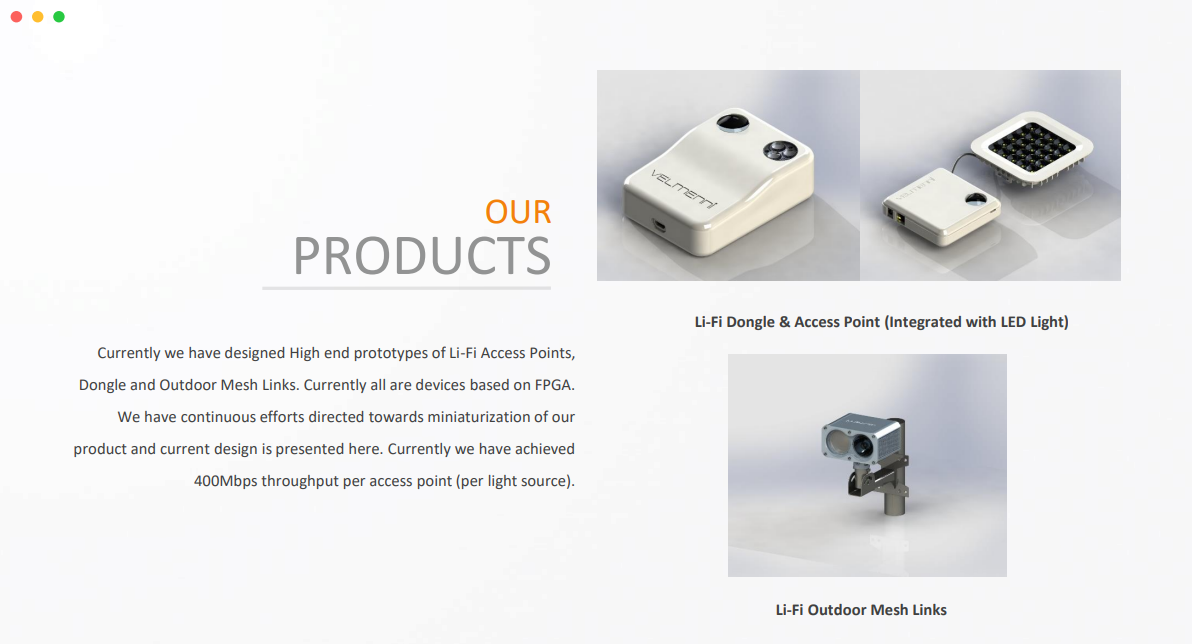
          OUR PRODUCTS

          So, I would like to talk about some of the products that we have built up, we do have a you'd say the traditional LIFI solution, which is meant for indoor use cases, but I would like to talk about outdoor product which is in point to point or point to multipoint communication system, which can work in outdoor scenarios and can basically complement the fibre cable infrastructure. So, on the bottom of the slide, we have our LIFI outdoor machines. We call it LIFI and because we use a similar kind of physical layer, which has been utilised in light communication system and then we are using NBS as a optical front end for this one. So it's basically an LED based outdoor solution.” 

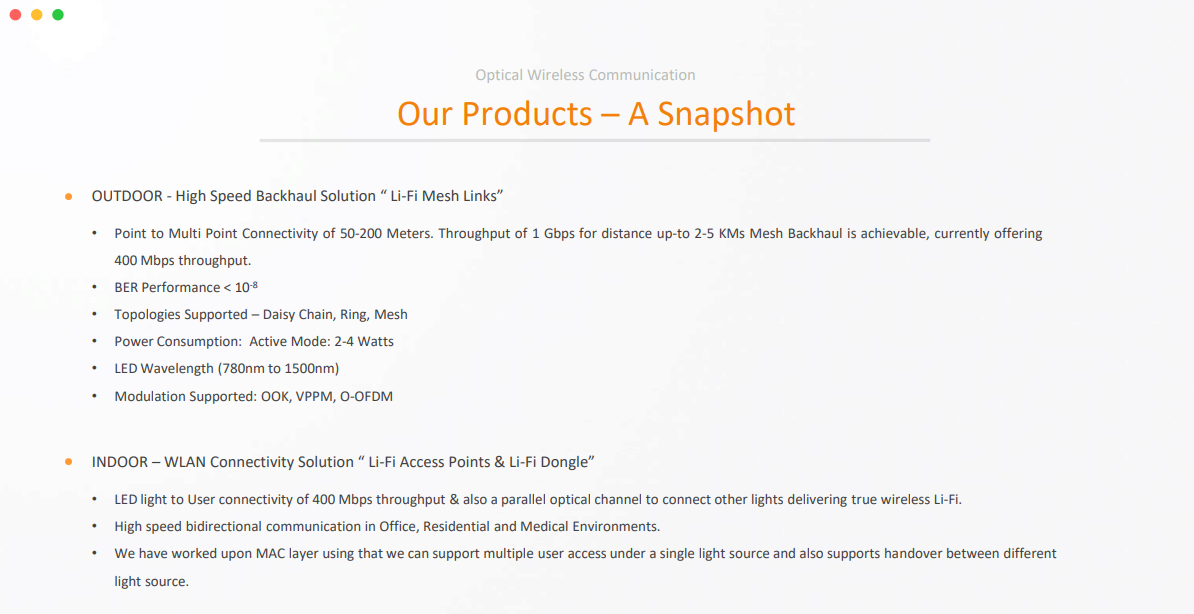
          Our Products – A Snapshot

          Some of the features of this product is the backlog product can be utilised to provide short distance point to point connectivity in where we can go up to 200 metres and up to a gigabit throughput can be achieved. Some of the interesting thing about this product is we can actually do point to point communication and also can enable long distance communication while building up a daisy chain network. So, we can send data from one point to another point second to the third, third to the fourth and can make a decision about other networking topologies such as sharing information and also can be implemented onto our product. So, for that, we have a specific node which can send data into multiple direction and can enable point to multipoint connectivity. So, that is also what we are offering as a product and I would like to talk more about that in the later slide. Different kinds of wavelengths can utilise into this product measured in the near infrared region. So, it can work from 780 nanometers to 1500 nanometers. So, though the wavelength is fixed into our product, but yes, it does have the option to choose wavelength depending upon what kind of environmental conditions we would like to use the product”.


          TARGETED APPLICATION – OUR FOCUS

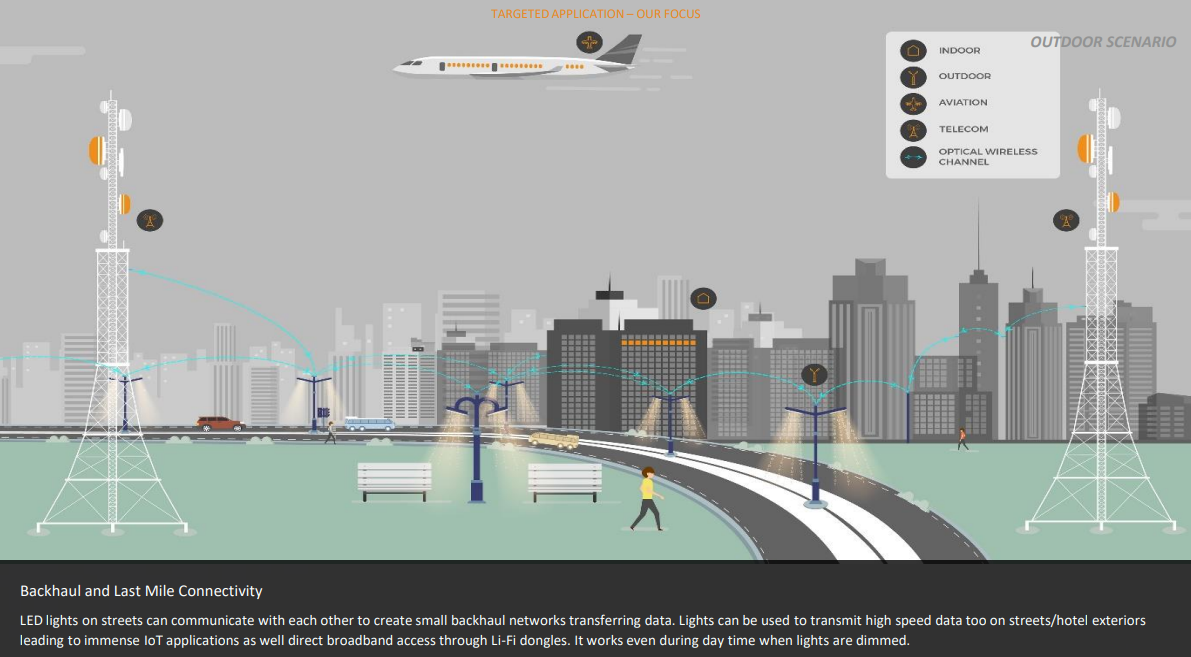
          So, how we can utilise it. One thing is, like I mentioned this product can be utilised for backhaul connectivity. In making the connection between the cell towers or from a cell tower to a small cell, all those kinds of battery connectivity can be provided with this product. Secondly, a street level deployment can be done. So, since the device is very small and consumes very less power, it can be directly integrated within the cities on a smartphone and can do a wireless backhaul to the pole. So, in that kind of a network, these are our product can take data from you know a sensor which has been integrated on a pole or even though the security cameras so, the feed from the camera can be taken in bringing into the network wirelessly and even it can provide the backhaul to the WI-FI access points, which can be integrated in a smart city kind of an infrastructure. So, this can complement and can become a part of coming 5g networks. So, in the 5g, the small cell deployments are going to be really dense within the cities you know, there is going to be small cells at every 100 or 150 metre within the cities and specifically in density area, the distance between the small cell will work to reduce a lot. So, the backhaul to those types of small cells can be done through FSO or light communication devices”

          BACKHAUL AND LAST MILE CONNECTIVITY

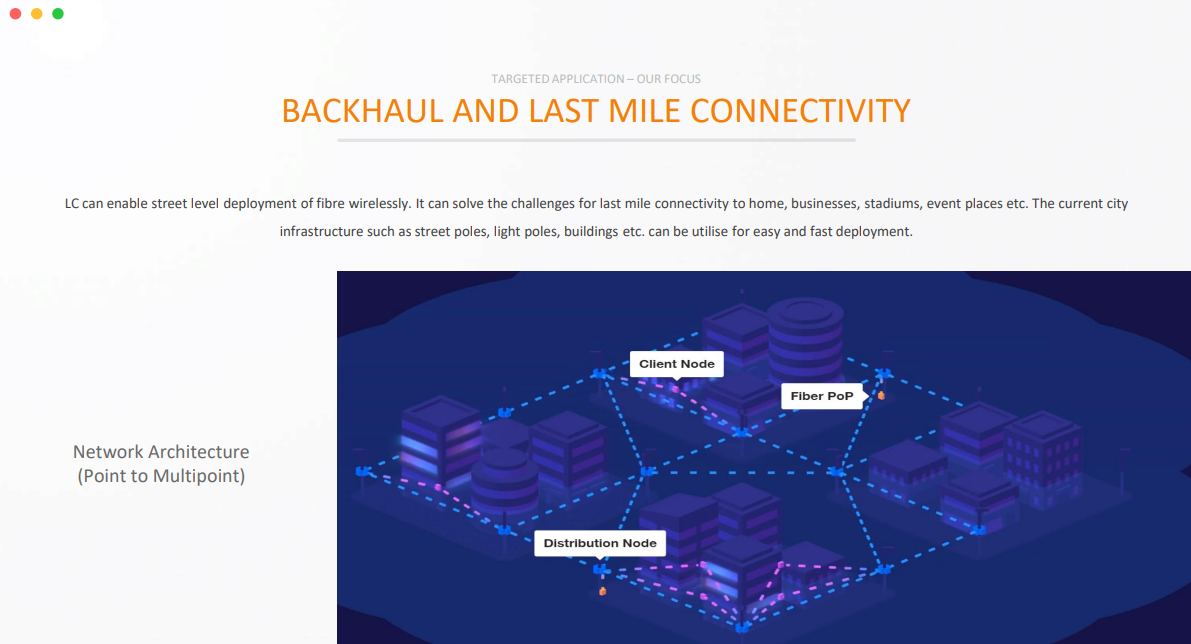
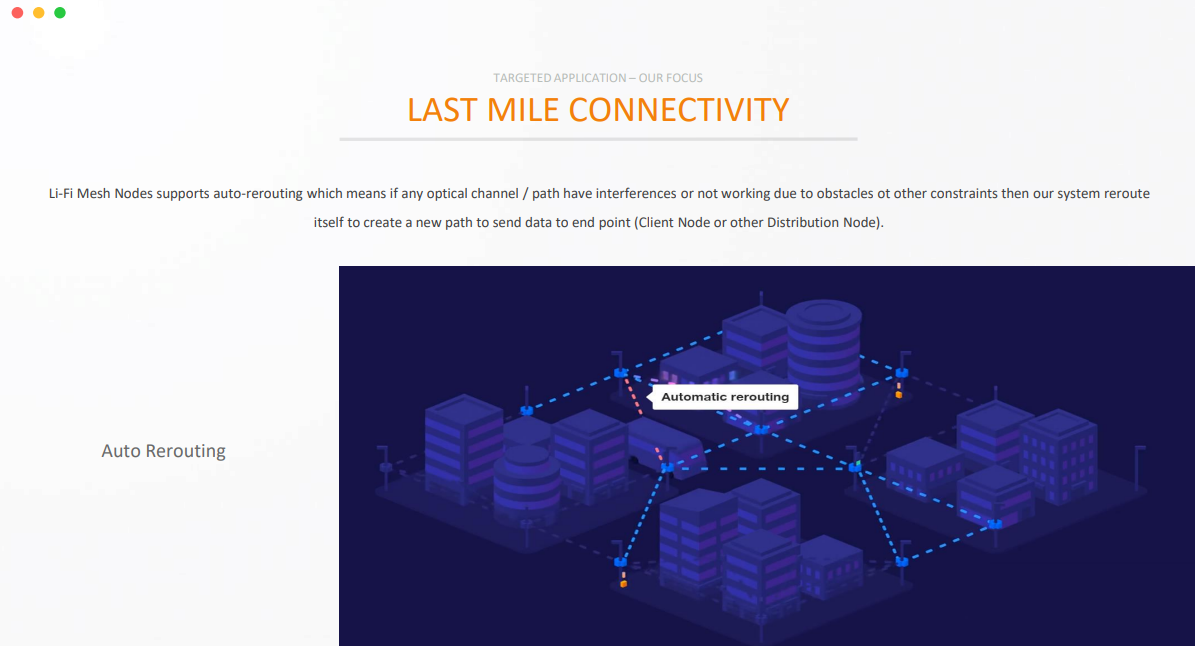
          So, this is one of the use cases that we have been focused upon. And we have done some of the real time deployments which I will talk later into the presentation. But more about on the deployment perspective how this product can be deployed. One thing is, we can have a starting node into the network, which can get the backhaul from a fibre from fibre POV, you can directly plug in the fibre input to as an input to like a source device, the source device can send data into multiple direction, it can also enable point to point connectivity but we have shown a point to multipoint architecture where the middle nodes can be distribution nodes can be integrated either on a phone or on a building. They can get data from different directions from different devices and can build up a stronger backhaul network. And this platform can be utilised like I mentioned either for small cell phone, smart poles or even though to provide the last mile connectivity in a broadband use cases. Some of the features of this product if I try to utilise this topology in that case, we can offer a truly mesh network and depending depending upon what kind of redundancy is required, we can choose a number of paths for sending data and if there is a blockage, which comes in any other part, our system can do an auto rerouting which means it can send data to distribution and declining nodes automatically from a different path. So, there is always a backup channel for sending data if there is a disruption in the network. So in this way, we can have a really redundant network which is required if we talk about mobile backhaul link. And we can offer 99.99% uptime in those cases”.

          CORE BENEFITS

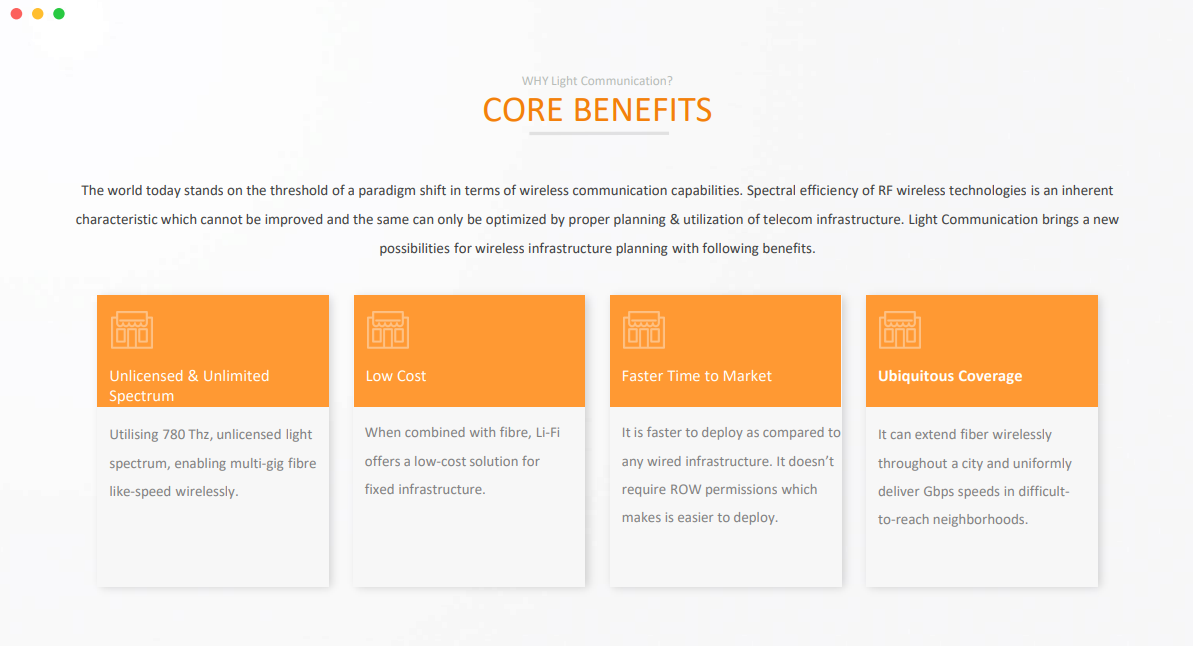
          Some of the benefits of utilising that kind of network is it's low cost as compared to fibre infrastructure because fibre infrastructure requires trenching of trees taking Arado to write of a permissions and which costs a lot in cities. Secondly, the time to market replaces drastically. So if you wanted to build up a 5g network, specifically in India, where the cities are really congested and really big, if we go with the traditional way and bring the backhaul through the fibre, it is going to take maybe 10 years to deploy a 5g network. So to reduce that time to market, light communication could be a very interesting solution. And light communication based wireless backhaul, I mean they are interesting solution. So apart from that, like if they're working in an unlicensed spectrum, so it can be deployed anywhere in the world without taking permission and spending time. Basically taking those commissions from the government, it can provide ambitious coverage and extend the wireless high fibre wirelessly.  So now these are the certain core benefits. I've mentioned this before that we can reduce the time to market as well as I can basically build up a wireless network or bring data to the end user in a case where the optical fibre cables are difficult to deploy”. 

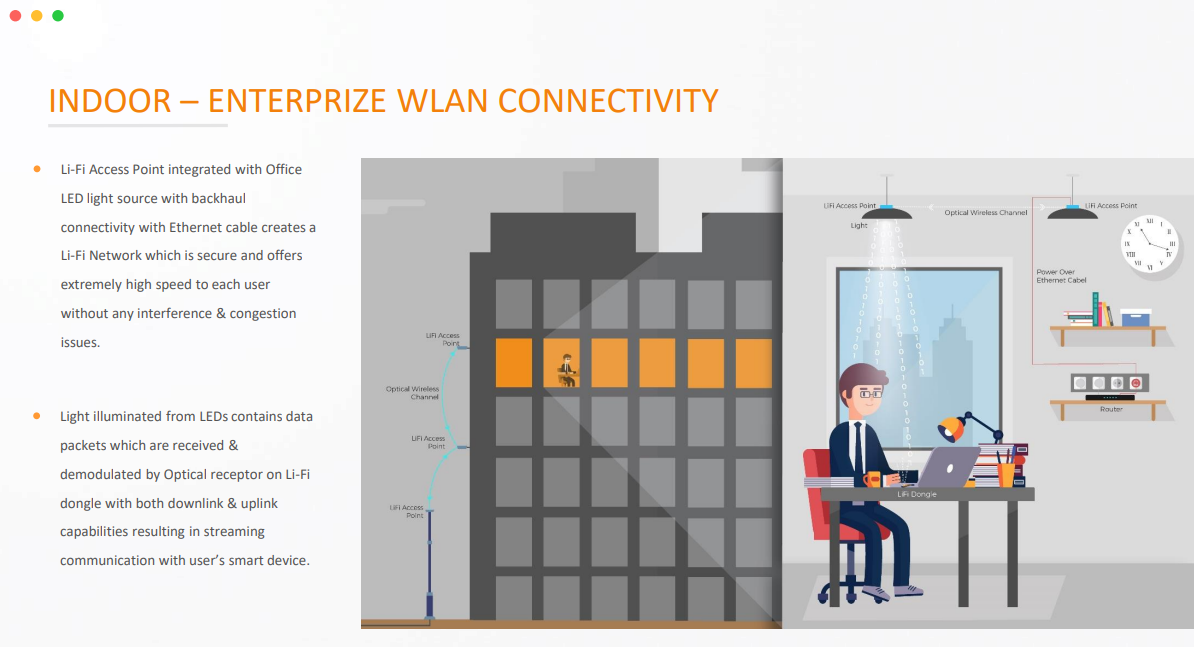
          INDOOR – ENTERPRIZE WLAN CONNECTIVITY

          I would also like to talk about some of the other use cases which are more indoor scenarios. So we can, like the other companies, offering solution indoor connectivity where the user device can be connected to the LIFI network. So, we do have a product which is based upon our access point and a dongle at this moment and we are also looking forward to build up the miniaturised version and working in the ecosystem to bring those use cases also to the market APAC use case”.

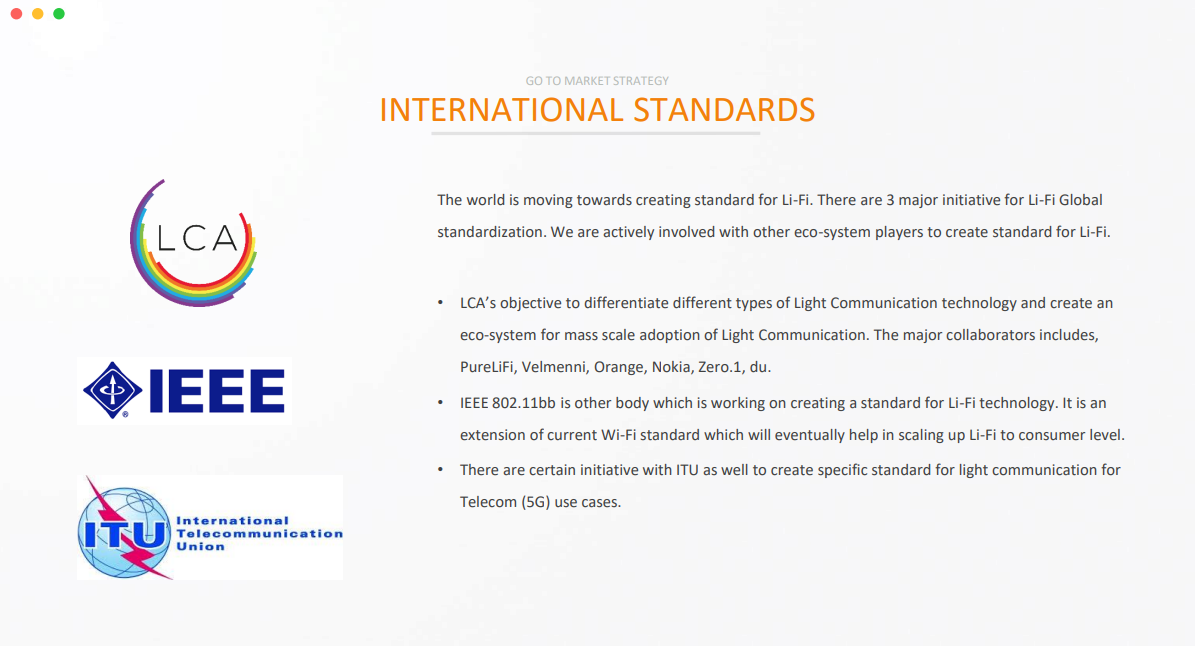
          “From my ecosystem perspective, I guess most of our colleagues have talked about building up a LIFI ecosystem or a light communication ecosystem. So, LCA is one of the major alliances around like communication technologies. So, we all the industry players are working together to do the education around light communication technology, building up the use cases and bringing the product to the market”.

          So, the standardisation is way too important for us and once we have the standardisation, we can look forward to mass induction of the technology”.

          You can also watch the full video presentation on the following YouTube link from Jakajima YouTube channel.

          Li-Fi Conference 2022

          The next Li-Fi Conference is coming up on the 28th of June 2022 between 10 am and 4.30 pm CET.

          It is interesting to realise that lights that illuminate offices, homes, cars, factories, our streets and more locations also can connect us to data and hence power the growing demand for connectivity and speed.

          At this conference professionals from all over the globe will gather together in order to share applications, ideas, new developments and ways to integrate Li-Fi in services, both for consumers and professionals.

          This conference will be held Live and Online. The venue will be the High Tech Campus 1, The Strip 5656 AE Eindhoven The Netherlands.

          Online tickets can be bought at the following link:

          https://tikcit.com/register/61e002336d7fc4b6745cab83/

          What is LiFi?

          LiFi, also known as "Light Fidelity" is a wireless optical networking technology, which uses light-emitting diodes (LEDs) to transmit data. In 2011, professor Harald Haas made a LiFi demonstration at the TED (Technology, Entertainment, Design) Global Talk on Visible Light Communication (VLC).

          VLC uses light as a medium to deliver high-speed communication like Wi-Fi and complies with the IEEE standard IEEE 802.15.7. The IEEE 802.15.7 is a high-speed, bidirectional, and fully networked wireless communication technology-based standard similar to Wi-Fi's IEEE 802.11.

          How does LiFi work?

          LiFi is a high speed, bidirectional, and fully networked wireless communication of data using light. LiFi constitutes of several light bulbs that form a wireless network.

          When an electrical current goes through to a LED light bulb, a stream of light (photons) emits from the lamp. LED bulbs are semiconductor devices, which means that the brightness of the light flowing through them can change at extremely high speeds. The signal is sent by modulating the light at different rates. The signal can then be received by a detector that interprets the changes in light intensity (the signal) as data. Also when the LED is ON, you transmit a digital 1, and when it is OFF, you transmit a 0.

          LiFi Benefits

          The primary benefits of LiFi are as follows:

          Security: Provides entirely secure access. Where there is no light there is no data.

          Safety: Does not produce electromagnetic radiation and does not interfere with existing electronic systems.

          Localisation: Allows localisation due to the small coverage area of LiFi access point - localisation can be used for very precise asset tracking.

          Data density: Provides ubiquitous high-speed wireless access that offers substantially greater data density (data rate per unit area) than RF through high bandwidth reuse.

          Credit to Oledcomm

          LiFi Applications

          LiFi can be used for so many applications and the list is increasing every year. You can read our updated list of Li-Fi applications at the following link:

          https://www.lifitn.com/blog/2021/2/13/top-30-li-fi-applications-updated-list-including-potential-applications

          Credit to pureLiFi

          In conclusion, if you are also interested to hear more information about the OWNII Coin or enquire about LiFi devices such as the LiFiMax and Trulifi, you can contact us through our chatbot or by sending an email through our contact us form. If you enjoyed this post and would like to hear more updates about LiFi technology, subscribe to our newsletter. Don’t forget to subscribe to our social media accounts. You can also join our Telegram group about LiFi technology on this link:

          https://t.me/joinchat/FMzOmsEKyJFrU6Af


          Li-Fi Conference 2021 - Recap Part 6 - LiFi For Education

          Table of Contents

            Li-Fi Conference 2021 - Recap Part 6 - LiFi For Education

            Li-Fi Conference 2021

            In our last article from our ONLINE Li-Fi Conference 2021 recap series, we discussed the presentation delivered by Daniel Behnke from Weidmüller Deutschland on “LiFi Use Cases And Demonstration Scenarios For Smart Manufacturing”. The conference was organised by the Jakajima, the global High Tech Conference organiser, and the Light Communications Alliance.

            Jakajima, Matchmaker for Innovators in the high tech industry, organises many events, ranging from LiFi Technology industry trends, 3D Printing to the Internet of Things, from Unmanned Cargo Aircraft to Health Tech, from 4D Printing to Photonics and from Vertical Farming to Sustainable Materials.

            The online Li-Fi Conference included live presentations from researchers, executives and industry specialists from pureLiFi, Nokia, Signify, Orange, Radiocommunications Agency Netherlands, Velmenni, OLEDCOMM, HomeGrid Forum and Weidmüller Deutschland.

            In another article recap series, we will talk about the presentation on LiFi For Education delivered by Benjamin Azoulay from OLEDCOMM. Before this, we will talk about OLEDCOMM.

            OLEDCOMM

            Oledcomm designs and develops LiFi network interface devices that enable high-speed wireless data communication. It also serves LiFi equipment in the telecom, datacom, personal electronics, and industrial markets. The company’s product portfolio includes hubs, routers, switches, adapters, drivers, power supplies, and many more.

            Oledcomm was founded in 2012 and is currently based in Paris, France. Oledcomm's adventure began in 2005 in the research laboratories of the University of Versailles-Saint-Quentin with the first work on communication by visible light.

            Following years of research & development and a passion for innovation, Oledcomm became the pioneer of LiFi (Light Fidelity) solutions and innovation on a global scale.

            Based in the Paris region, Oledcomm employs around 25 people and designs complete solutions for LiFi operation, including microcontrollers, LiFi photoreceivers and software platforms.

            Today, after more than 28 patents, 15 years of R&D, over 500 trusted clients and several awards, Oledcomm is pursuing a strong mission: to transform the 14 billion points of light in the world into a powerful communication network.

            LiFi For Education Delivered By Benjamin Azoulay

            Benjamin Azoulay, CEO at OLEDCOMM, was the sixth presenter at the online Li-Fi Conference 2021. He discussed in his presentation the LiFi Use Cases For Education.

            Benjamin Azoulay is the founder, CEO and President of Oledcomm. He previously worked at Philips Lighting as CEO business home Europe & North America. He completed his Ingenieur degree in Automatics from Ecole centrale de Nantes.

            Below are some points discussed about LiFi For Education:

            THE LIFI FOR EDUCATION

            Benjamin Azoulay started his presentation by saying the following:

            First of all, I'm going to try to focus on one use case, even if LIFI has many, many possible use cases, which is education because it's at the heart of our experience at OLEDCOMM in the last 18 months. And I would like just to share with you what is my view on the subject”. 

            Manifesto for LIFI AS MAINTREAM


            So, first of all, and before starting about this, I would like just to contribute to what my estimated colleagues have said about LIFI, the ecosystem and the LCA, what I realised during the last period is that at the end of the day, if I had there is one manifesto for the LIFI market as mainstream is we are here to replace cables at the end of the day. So, we are not here to compete with Wi-Fi, because I saw some questions about Wi-Fi being competitive in terms of price, we are here to offer an alternative to cables using light and everywhere the radio frequencies are not a solution, they are not desired sometimes they are not authorised sometimes in such an environment. So basically, to my opinion, LIFI is a niche market that a niche market for you know, in a huge market that is Wi-Fi, 4g, and 5g. And there are some spaces that are not covered with those technologies that we can cover as LIFI suppliers or as a LIFI ecosystem. So this is where I see and you know, these pictures show exactly. So I am not a Trump fan. But I think this picture is very nice because it shows the mess of tables inside a war room of the government. Because they are not authorised I guess to use Wi-Fi for security reasons in that environment. And if they would have used LIFI, it would get to the same latency, the same security as the cables with the convenience of having a wireless solution. So this is exactly where we could position our market as LIFI. So again, not to compete with radio frequencies, but to complement radio frequencies everywhere, the radio frequencies are not a solution. If we talk about the LIFI market, I think a lot of things have been said, I'm just mentioning here, a company called BIS research, a market research company, that shows that LIFI is an emerging market that that is obvious to everyone that the market would be of a size of $35 billion in 2028. It's very difficult to estimate. But let's say it's not a big market if you compare it to the radio frequency market, but you see that education is one of the main use cases that has been identified for the LIFI market and represent one of the big segments where the LIFI could have a real use case amongst close to healthcare and other aerospace we talked about, I will notice a few minutes ago.”


            LIFI MARKET

            So, that's why at least at OLEDCOMM, you know, we have decided to focus on it because we think that we should specialise in one or two verticals in order to be able to succeed with the risk of a company like for us is the strategic dispersion. So we have decided to focus on education as one of the main that's vertical that we have decided to focus on. So, what are the trends in education? So, first of all, if I have to mention some big trends in education, of course, digital transformation is something that is happening in some countries and is even mandatory. In France for instance, there are there is a programme called L' Ecole numerique and every school will have to equip its students, children, classrooms, with connectivity with tablets and with laptops.”

            TOP DIGITAL TRANSFORMATION TRENDS IN EDUCATION

            Because the digital transformation of the schools has completely transformed our accessibility to education, it's incredible how this digital transformation has affected the classrooms, has affected the teachers on how to teach their children and we know that with the COVID crisis, this has been accelerating even more because, during the lockdown, we were able to reach some of our students thanks to the digital transformation of the schools. The digital transformation enables also personalised learning approaches like virtual reality, cloud-based platforms are emerging everywhere today, you can even pass exams through digital tools that are today available in some countries and basically big data is also a big trend, the IoT is inside the schools are also being found like in any smart building. So, basically, the message here is that there is an enormous amount of efforts from all governments in our regions to digitalize the schools. And today, there is only one alternative today is Wi-Fi because as soon as you need to connect wirelessly classroom, you remember this is a very nice picture, remember the IT classroom of the past, you know with all cables everywhere, the nightmare of cables, and today with tablets that are connected directly wirelessly to the network.”, said Benjamin Azoulay.

            alternative to Wi-Fi IN THE CLASSROOM

            So, this is a big challenge. And today, at OLEDcomm what we try to understand, is how we could offer an alternative to Wi-Fi, which is the only solution today. The only alternative today to have a wireless connection in the classroom. Knowing that we are in an environment where there are reasons for the LIFI to succeed in this environment. First of all, the conductive classroom is a complex dense area from a connectivity point of view, you have simultaneously 20 to 30 people connecting at the same time, and sometimes exactly at the same time because they are the following the same caution, the same lecture”.

            WHY LIFI FOR EDUCATION?

            So, this is a big challenge. And today , at OLEDcomm what you try to understand, is how we could offer an alternative to Wi-Fi, which is the only solution today. The only alternative today to have a wireless connection in the classroom. Knowing that we are in an environment where there are reasons for the LIFI to succeed in this environment. First of all, the conductive classroom is a complex dense area from a connectivity point of view, you have simultaneously 20 to 30 people connecting at the same time, and sometimes exactly at the same time because they are the following the same caution, the same lecture. 

            The exposure to radiofrequency in this environment might be an issue because it's young children and sometimes in some countries like in France, there is a low recall Loi Abeille would just forbid exposing children below a certain age to radiofrequency. So there is concretely no alternative in that in those schools in those elementary schools, for instance, to connect in a wireless way. So LIFI in this environment is real, that's a must in order to connect those classrooms.

            The fact that it is a dense area means that Wi-Fi connectivity is also a big challenge. I don't know-how, how is your experience personally of connectivity inside a school. But very often, after 1015 connection, it's extremely difficult to have because of the latency of the solutions installed. The high latency it is very difficult to have too many people connecting at the same time, which is a very high limiting factor to the experience of learning inside the classroom. There are solutions which is meaning having professional Wi-Fi boxes inside the classroom, not in the corridor, but inside some schools are today experiencing and trying to put in place but again, the more you densify the Wi-Fi boxes the higher the radio frequency exposure is high. And this seems to be another issue. That's why for those reasons LIFI is a real credible alternative for education in a market which is extremely sizeable. So we are not again you remember we said about the fact that LIFI can be an alternative a niche market in the huge radiofrequency environment but niche market it can be quite big. For instance, in education, there are more than 10 million classrooms that are step by step equipped with connectivity around the globe. I let you measure how big this market is.

            EXAMPLE OF LIFI LAY OUT

            The example that I would like to share with you is how to, for instance, we can propose to instal a classroom this is a typical classroom of 10 metres by seven metres with the width around can be a little bit poor with around nine 10 antennas or access points with the coverage that you see here being shown. We can cover reasonably a classroom. So basically it means that having the infrastructure on the ceiling we have now today not tomorrow today. And I'm not talking about OLEDCOMM, I'm talking about the product of our colleagues Signify, pureLiFi and Lucibel. Well, there are solutions to connect a classroom in an easy way. And in a reasonable from an economical point of view also. So, this is a concrete example that we had at OLEDCOMM that really works today.

            KEY SUCCESS FACTORS

            The key success factor for LIFI in education to emerge, of course, is the price you are in an environment where I think this is my estimate that we should that LIFI total price should be in the range of plus or minus 30% versus professional Wi-Fi, to enable the How to say, early adopters, and then inflection point and move to the Wi-Fi, because then the benefits of the LIFI in terms of latency, in terms of comfort of connection, robustness, and we didn't talk about even security versus radiofrequency will have a big impact. So, professional LIFI is not an expensive though professional Wi-Fi 6 box is quite a price. And when a school is adopting your real connectivity series connectivity solution, then the price of LIFI could be reasonable, if it is plus or minus 30%. Versus the solutions today. The other key success factor is, of course, a laptop and tablets that need to be natively integrated, it's very difficult in this environment to have a dongle it's a very complicated our experience is that the professor will take will say hey guys, I will people will lose a dongle etc. So we need step by step to offer a solution to integrate the LIFI natively into tablets, into laptops or at least into cases to make it let's say to make the experience quite easy. And of course, some technical challenges because the classroom from a handover interference point of view is a very complex component. Not easy to do. So, from a technical point of view, we need to embed in order to have a solution that works with 20 to 30 people connecting at the same time in the same space to master completely do handover and reference management. And this is where the discussion we had earlier about how to embed those functionalities into the ITU G.VLC. IEEE 802.11bb is so important in the coming years and the role of the LCA is so important in the coming years to promote the solution and those functionalities. And again, at the end of the day, nothing is possible if we don't, if we are not able to make evangelization and awareness. Today, the people in all countries don't know they have an alternative to Wi-Fi. When they are moving to to to digitalize the schools, the only solution today is Wi-Fi. And we need to make sure they're at least aware that alternative to radiofrequency existing data in those environments, and that there is an alternative that could be let's say from a price point of view reasonable, and that is accessible to everyone. So, so creating awareness is absolute machinery to make the LIFI for educational success”.


            miniaturization will help the ecosystem

            I want to finish my presentation by announcing that we'll be making a few days at the Mobile World Congress in Barcelona because all that is going to contribute to the ecosystem of the LIFI, we're not the only one our colleagues have, at least to my understanding our colleagues of pureLiFi has also announced last year, the first chipset that is completely integrated to enable LIFI integration to mobile devices. It's our turn now to announce the first integrated circuit of OLEDCOMM, this is a picture this is a real picture of an optical front end that is made of maybe recognise it has a vaxon of two photodiodes and the grey chipset that you see on the picture is the new gigabit chipset of OLEDCOMM. And you see the size but with this size, with this compactness, there is a new word that is coming for integration of the LIFI into laptops into tablets for education also into mobile devices into IoT and into all kinds of possible use cases are coming in the coming years. Thank you very much”

            You can also watch the full video presentation on the following YouTube link from Jakajima YouTube channel.

            Li-Fi Conference 2022

            The next Li-Fi Conference is coming up on the 28th of June 2022 between 10 am and 4.30 pm CET.

            It is interesting to realise that lights that illuminate offices, homes, cars, factories, our streets and more locations also can connect us to data and hence power the growing demand for connectivity and speed.

            At this conference professionals from all over the globe will gather together in order to share applications, ideas, new developments and ways to integrate Li-Fi in services, both for consumers and professionals.

            This conference will be held Live and Online. The venue will be the High Tech Campus 1, The Strip 5656 AE Eindhoven The Netherlands.

            Online tickets can be bought at the following link:

            https://tikcit.com/register/61e002336d7fc4b6745cab83/

            What is LiFi?

            LiFi, also known as "Light Fidelity" is a wireless optical networking technology, which uses light-emitting diodes (LEDs) to transmit data. In 2011, professor Harald Haas made a LiFi demonstration at the TED (Technology, Entertainment, Design) Global Talk on Visible Light Communication (VLC).

            VLC uses light as a medium to deliver high-speed communication like Wi-Fi and complies with the IEEE standard IEEE 802.15.7. The IEEE 802.15.7 is a high-speed, bidirectional, and fully networked wireless communication technology-based standard similar to Wi-Fi's IEEE 802.11.

            How does LiFi work?

            LiFi is a high speed, bidirectional, and fully networked wireless communication of data using light. LiFi constitutes of several light bulbs that form a wireless network.

            When an electrical current goes through to a LED light bulb, a stream of light (photons) emits from the lamp. LED bulbs are semiconductor devices, which means that the brightness of the light flowing through them can change at extremely high speeds. The signal is sent by modulating the light at different rates. The signal can then be received by a detector that interprets the changes in light intensity (the signal) as data. Also when the LED is ON, you transmit a digital 1, and when it is OFF, you transmit a 0.

            LiFi Benefits

            The primary benefits of LiFi are as follows:

            Security: Provides entirely secure access. Where there is no light there is no data.

            Safety: Does not produce electromagnetic radiation and does not interfere with existing electronic systems.

            Localisation: Allows localisation due to the small coverage area of LiFi access point - localisation can be used for very precise asset tracking.

            Data density: Provides ubiquitous high-speed wireless access that offers substantially greater data density (data rate per unit area) than RF through high bandwidth reuse.

            Credit to Oledcomm

            LiFi Applications

            LiFi can be used for so many applications and the list is increasing every year. You can read our updated list of Li-Fi applications at the following link:

            https://www.lifitn.com/blog/2021/2/13/top-30-li-fi-applications-updated-list-including-potential-applications

            Credit to pureLiFi

            In conclusion, if you are also interested to hear more information about the OWNII Coin or enquire about LiFi devices such as the LiFiMax and Trulifi, you can contact us through our chatbot or by sending an email through our contact us form. If you enjoyed this post and would like to hear more updates about LiFi technology, subscribe to our newsletter. Don’t forget to subscribe to our social media accounts. You can also join our Telegram group about LiFi technology on this link:

            https://t.me/joinchat/FMzOmsEKyJFrU6Af
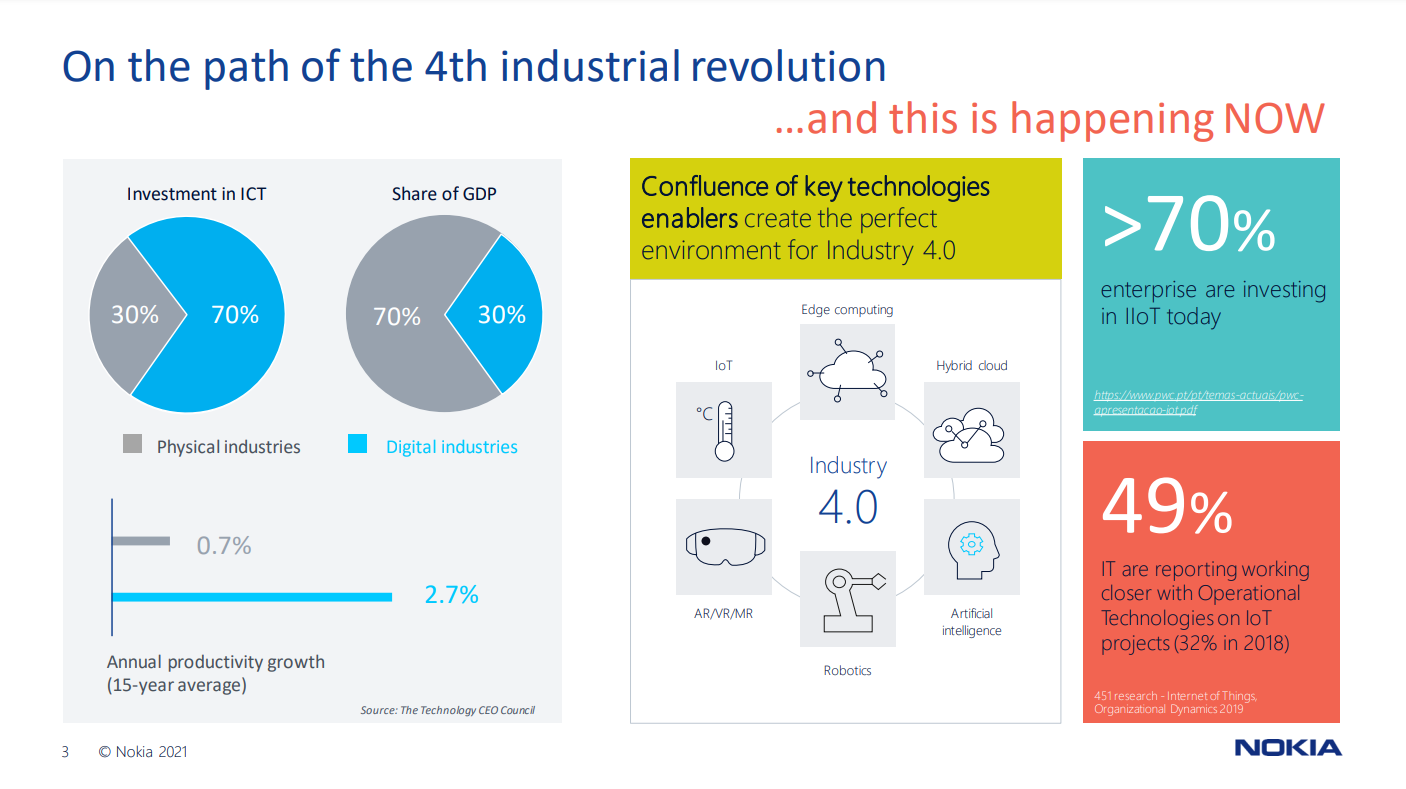

            Li-Fi Conference 2021 - Recap Part 5 - LiFi Use Cases And Demonstration Scenarios For Smart Manufacturing

            Table of Contents

              Li-Fi Conference 2021 - Recap Part 5 - LiFi Use Cases And Demonstration Scenarios For Smart Manufacturing

              Li-Fi Conference 2021

              In our last article from our ONLINE Li-Fi Conference 2021 recap series, we discussed the presentation delivered by Nikola Serafimovski from pureLiFi on “Taking LiFi Mainstream”. The conference was organised by the Jakajima, the global High Tech Conference organiser, and the Light Communications Alliance.

              Jakajima, Matchmaker for Innovators in the high tech industry, organises many events, ranging from LiFi Technology industry trends, 3D Printing to the Internet of Things, from Unmanned Cargo Aircraft to Health Tech, from 4D Printing to Photonics and from Vertical Farming to Sustainable Materials.

              The online Li-Fi Conference included live presentations from researchers, executives and industry specialists from pureLiFi, Nokia, Signify, Orange, Radiocommunications Agency Netherlands, Velmenni, OLEDCOMM, HomeGrid Forum and Weidmüller Deutschland.

              In another article recap series, we will talk about the presentation on LiFi Use Cases And Demonstration Scenarios For Smart Manufacturing delivered by Daniel Behnke from Weidmüller Deutschland. Before this, we will talk about Weidmüller Deutschland.

              Weidmüller Deutschland

              Weidmüller Interface GmbH & Co. KG is a German company in the field of electrical connection technology and electronics. Headquarters is in Detmold in the Ostwestfalen-Lippe region , in North Rhine-Westphalia .

              The company has production facilities, sales companies and agencies in 80 countries. In the 2019 financial year, Weidmüller achieved sales of around 830 million euros. The company employs around 5,000 people worldwide. With its products, Weidmüller is mainly active in mechanical engineering, the process industry, energy generation and renewable energies, traffic engineering, building infrastructure and the area of ​​device manufacturers.

              The company has been working on the topic of Industry 4.0 since 2013. Weidmüller is involved in the leading-edge cluster it's OWL and numerous other research partnerships, such as the Robotisation Academy Foshan, the Smart Factory KL and the Centrum Industrial IT in Lemgo.

              Along with Phoenix Contact and Harting, the company is one of the three major German connector manufacturers.

              CA Weidmüller was founded in 1850 as a company in the textile industry by Carl August Weidmüller in Reichenbrand near Chemnitz. Gottfried Gläsel joined the company management as a partner in 1931 and became the sole owner and managing director in 1937. For reasons of recognition, the company name CA Weidmüller was retained. In 1943 the product range changed due to the Second World War. While searching for suitable products for his company, Gottfried Gläsel met Wilhelm Staffel, who was a development engineer at AEG and was involved in the development of the first automatic machine controls (e.g. for milling machines). The collaboration with Wilhelm Staffel leads to the production of the first "Staffelterminal ” for AEG in Berlin.

              Reestablishing contact with Wilhelm Staffel in 1947 led to a contract that formed the basis for the reestablishment of CA Weidmüller in Berlebeck near Detmold in 1948. In the same year, production of the first plastic-insulated terminal block was started. In 1952, Weidmüller exhibited at the Hanover Fair for the first time. In the same year, the "switchgear row terminal" (SAK) was developed from thermoset plastics as the insulating material and a patented steel clamping yoke as the clamping system. According to the company, the terminal block was also a "best seller" at the end of 2018.

              In the years after 1952, the company expanded its international activities and established itself in Europe, America and Asia. Weidmüller is now represented in over 80 countries worldwide. The locations include Germany, the Czech, Republic, Romania, China and Brazil with a production site and at the locations Germany, Spain, Australia, China, Brazil and Singapore with a development centre.

              In 1959 the first foreign sales company was founded in England . Sales companies in Austria , France and Italy followed in 1967 . Spain joined in 1978, followed by Sweden and Belgium in the years that followed . With the founding of Thüringische Weidmüller GmbH in 1991, the company also expanded into Eastern and Central Europe. The youngest member of the group in Europe is the sales office in Switzerland .

              1975 saw the expansion of activities to Brazil , Canada and the United States . The presence on the American continent was supplemented in 1994 by a sales company in Mexico . After the sales companies were sold, Weidmüller bought them back from the American company Rockwell Automation , Inc. in 2017.

              In 1980, a sales company was founded in Japan , through which Weidmüller established its presence in Asia. A sales company in Singapore followed shortly afterwards . Since 1994, the company has also been continuously expanding its presence in China. Group companies and sales companies in Hong Kong , Shanghai and Malaysia complement the presence in the region. Today around 1,000 employees work at two locations and in 16 sales offices. Automation technology had already become the second mainstay in 1997, another area was interactive networking in production, building and energy technology.

              The industrial site of Weidmüller Interface GmbH & Co. KG in Detmold-Berlebeck, built around 1950, was demolished in 2005.

              In 2014, Weidmüller tried unsuccessfully to take over the family company R. Stahl , which operates in the field of explosion protection, under CFO Harald Vogelsang . Sales in the same year were 673 million euros; in Asia, it increased by around 120 percent after 50 percent in 2013.

              Weidmüller offers specific solutions that manufacturing companies can use to prepare for the requirements of Industry 4.0. In 2013, Weidmüller presented a remote I/O system for the first time at the SPS IPC/Drives in Nuremberg, which has been continuously expanded. Since 2018, u-mation, an open, platform-independent automation kit, has made it possible to set up individual control solutions. With Industrial Analytics, Weidmüller also introduced software that enables predictive maintenance, predictive quality and new business models. Artificial intelligence and machine learning are used here.

              LiFi Use Cases And Demonstration Scenarios For Smart Manufacturing delivered by Daniel Behnke

              Daniel Behnke, Head of Global Digitalization/Corporate Factory IT & Technologies at Weidmüller Deutschland, was the fifth presenter at the online Li-Fi Conference 2021. He discussed in his presentation the LiFi Use Cases And Demonstration Scenarios For Smart Manufacturing.

              Daniel Behnke worked as a research assistant at the Technische Universität Dortmund. Daniel went on to work at Weidmüller Deutschland as a smart factory digitalization engineer. He worked his way up to become a senior smart factory digitalization engineer and he is currently the Head of Global Digitalization/Corporate Factory IT & Technologies.

              Below are some points discussed about the LiFi Use Cases And Demonstration Scenarios For Smart Manufacturing:

              Weidmüller Group

              Daniel started his presentation by saying the following:

              First of all, I want to introduce on just a few slides, what my vital areas of balance are what we are doing, so you get a better perspective of why we are dealing with different communication technologies. So, Weidmuller is an expert and transmission of power signals and data. And that's real environments. And, of course, we have launched our product portfolios. As you can see here, we've been starting with Terminal Blocks 70 years ago now. Then after a few years, we added also connectors for different kinds of cables that are needed. So here, for example, recent, but of course, also digital and analogue I O. I, for my third, I'm working at the factories of Europe. So I'm not part of the product development department. But we are also having several large production sites all over the world. For us, it is the opportunity to think about better solutions for our production, and how we can get better, make them more efficient, and so on in the future. As you can see here, also on the right side, we are at the moment, not just talking anymore about just pure hardware components, but also about software components. That's on the 100% for us, for our customers. But of course, that's also very interesting for us at our own production sites”. 


              I've talked about our production sites on a worldwide level to here you can see the map where you can find more, I think your company is not so well known as for example, Signify what we've heard before. But our customers are generally in the business market. So we are not selling to private customers directly.  Our company's headquarters here in Germany and that mode where I'm at the moment and I want to talk about a little bit about our production site in the eastern part of Germany, where we are doing some use cases and demonstrations regarding LIFI technology”.


              The Challenge in production is to drive efficiency and availability

              So, why we are talking about different communication technologies. So, it's not that might be not that obvious, why we have some factory IT dealing with production sites here directly involved and also research regarding LIFI communications. So, in general generally what drives us is we want to increase of course, wearability and productivity of all our production sites, we want to increase the process efficiency and yield and also, we want to have better efficiency regarding energy and resources. resources, for example, at the moment is a very huge topic at our company. As maybe some of you are also experiencing at the moment that resources are very limited. And we have issues to continue our production at some times. And all of that lead source to a situation where we are talking about new IT technologies. For example, we want to integrate industrial IoT sensors, and things like that, and are also talking about automation many, many times where we also need communication technology. But in general and important aspect, stressing that many many times also in our research projects. For us communication technology is a servant, that's not a driver. So we are very open-minded regarding all communication technologies and want to see what fits the most for us.”

              Understand your production to optimize the results

              What kind of channel advantages do we see in the upcoming future. As I've mentioned, the number of sensors and actors that are increasing at the moment and will be much more in the future. We want to have a lot of data from all our machines and ultimates. Because we want to analyse them, we want to see what we can do better than we are doing at the moment. And therefore getting a lot more information will reduce the time to act, if we see some issues with some machines. And therefore at the end of the day, we also need the real-time analysis of our production states.”, said Daniel Behnke.

              EU Horizon 2020 project

              What kind of channel advantages do we see in the upcoming future. As I've mentioned, the number of sensors and actors that are increasing at the moment and will be much more in the future. We want to have a lot of data from all our machines and ultimates. Because we want to analyse them, we want to see what we can do better than we are doing at the moment. And therefore getting a lot more information will reduce the time to act, if we see some issues with some machines. And therefore at the end, we also need the real-time analysis of our production states”. 

              To get in touch with LIFI technologies, we are in the lucky situation that we are part of the EU Horizon 2020 project named ELIOT, where we can evaluate the use of LIFI by communication for smart manufacturing for us. What we are doing in this project is on the first-hand where I've been talking a lot about potential use cases. I will talk about that on the next slides. And we want to set up demonstration cases, to see how the technology works firsthand. We want to see them working in our factories and our production sites. And yeah, that's what we want to do our daily activities. Our main questions are, for example, is there sufficient coverage for all our machines? How many luminaires do we need at the end? Is the reliability better than Wi-Fi provides for us, we all know Wi-Fi peripheral technology but has some flaws at some times. But also we have to keep in mind the costs from for the different technologies. So for example, we are using Wi-Fi, you will see that on the next slides. Also, another factor is at the moment and working environment. But we see some issues over there. And the question for us is will LIFI be a benefit for us keeping costs and performance in mind. And also what are some very interesting topic, for the whole industry, our 5g campus networks, we are also involved in another 5g research project where we want to evaluate exactly the use of 5g over there. What's also very interesting and important for us at the end to evaluate the different technologies and our Setup and Maintenance efforts. So what we want to see not just what the investors want but also what are the costs forum for the next year's forum. Unfortunately, we wanted to be more at the demonstration phase at the moment but due to COVID-19, we weren't able to have any visitors and our production sites in the last month. So we couldn't set up the demonstrator, we will do that now in the fall. And at the moment we see the end of this project and of the year. Maybe it changes a little bit”.

              LiFi IIoT Network –Robust and reliable machine communication

              But let's talk about the use cases. So, we see three or four different use cases I want to introduce shortly. First of all, we have seen the industrial IoT network. So we need robust and reliable machine communication. For example, we want to transmit camera information for quality checks, present formation and things like that. And also, of course, energy from the energy monitoring work that we can increase our data transparency. We want to save efforts of maybe cable installation because we have a faster setup time for new machines and but also we want to have a look at technical challenges. So how to connect all the industrial IoT devices”.

              I was listening very carefully to Nikola's talk beforehand because that's, that's the most important aspect at the end. So what kind of end-user devices will be available for, LIFI communication. And also, if we want to talk about full automation at the end, we have to have very low latency.”

              LiFi IIoT Network – Mobility support

              What we are also examining and Elliott is the mobility support with the integration of LIFI into the 5g core. There, we are working together on the phone over-focus. And there were talking about different use cases, integration of more devices. I want to stress that a little bit more on some detailed slides. So first of all, as I've mentioned before, we want to directly interconnect the machines, we can do that either via LIFI or via 5g and maybe have some kind of edge server cluster onto the machines for real-time and machine data analysis”.

              LiFi IIoT Network – Order and process data

              Then, we also want to forward this data information to MDS or ERP systems. We want to inform our information like cycle times to a counsellor, etc, maybe to a cloud system could be also on intranet system”.


              LiFi IIoT Network – Maintenance

              For the iPad, that's mentioned here and done the Microsoft HoloLens we see the status monitoring and especially maintenance support. We are heavily using the Microsoft HoloLens at our production sites to support if there's an issue and also to set up new machines that have been developed here in Germany and are now operating for example, in Romania. And during the last month where we weren't able to travel, we did that with the Microsoft HoloLens and also with that, with that, we need a word reliable communication technology”

              LiFi IIoT Network – Mobility and fixed positions with iOS devices

              I want to show you some pictures. So, you get a better impression of what we foresee as use cases. For example, here for the iOS devices also from a mobility perspective, there were, for example, the icons, which we are using for confirmation of production parts. In the demonstration scenario for ELIOT, we will integrate those devices via 5g because they are we have mobility support everywhere and the factory. And we have also foreseen switching to the iPad. And data offloading scenario when we are close to our machine where we have a LIFI link available, then we can hand over the communication from 5g to LIFI to get some more information. But also we are using mobile devices such as an iPad on fixed positions, for example, here at the machine where we are doing all the different aspects regarding our manufacturing execution system. So, set output times will be monitored over there as well as order confirmations as well. quality checks, things like that. And for that LIFI integration would be very helpful for us because these iPads are at the moment connected via Wi-Fi. And, and generally, it's working, but it's working, I would say 95% and we want to have it somewhere above 99% of the time. But also you can see here in challenging environments because of course we have to keep the iPads in a robust case. So also there. That would be an interesting aspect of our discussions”.

              ITS – Intelligent Transport Systems

              “And we have another use case that's regarding positioning, we are using intelligent transport systems. You can see here a picture from our factory and we want to use much more in the upcoming future with enhanced automation. And automated logistics becomes also a very important topic in the next years. And there, we need a very high precision up to a few centimetres. And yeah, we are very interested to see how the technology is working in that regard”.

              With that, I want to conclude my tour. Unfortunately, I am not able to show you any results at the moment, because we are not in the phase where we could have set up the demonstrations. We will do that in the upcoming month and maybe end of this year or startup next year. We also have some results regarding our use cases. So our next steps are, we want to set up the demonstrations. And then we want to compare the technology, for example, adding 5g campus net networks. So at the end of the project, ELIOT, that will be the decision for us. And that's our aim and our goal. If LIFI is interesting technology and will be also part of our future strategy regarding future production sites, or why Wi-Fi and 5g are the benefits for us and we will focus on that communication technologies”.

              You can also watch the full video presentation on the following YouTube link from Jakajima YouTube channel.

              Li-Fi Conference 2022

              The next Li-Fi Conference is coming up on the 28th of June 2022 between 10 am and 4.30 pm CET.

              It is interesting to realise that lights that illuminate offices, homes, cars, factories, our streets and more locations also can connect us to data and hence power the growing demand for connectivity and speed.

              At this conference professionals from all over the globe will gather together in order to share applications, ideas, new developments and ways to integrate Li-Fi in services, both for consumers and professionals.

              This conference will be held Live and Online. The venue will be the High Tech Campus 1, The Strip 5656 AE Eindhoven The Netherlands.

              Online tickets can be bought at the following link:

              https://tikcit.com/register/61e002336d7fc4b6745cab83/

              What is LiFi?

              LiFi, also known as "Light Fidelity" is a wireless optical networking technology, which uses light-emitting diodes (LEDs) to transmit data. In 2011, professor Harald Haas made a LiFi demonstration at the TED (Technology, Entertainment, Design) Global Talk on Visible Light Communication (VLC).

              VLC uses light as a medium to deliver high-speed communication like Wi-Fi and complies with the IEEE standard IEEE 802.15.7. The IEEE 802.15.7 is a high-speed, bidirectional, and fully networked wireless communication technology-based standard similar to Wi-Fi's IEEE 802.11.

              How does LiFi work?

              LiFi is a high speed, bidirectional, and fully networked wireless communication of data using light. LiFi constitutes of several light bulbs that form a wireless network.

              When an electrical current goes through to a LED light bulb, a stream of light (photons) emits from the lamp. LED bulbs are semiconductor devices, which means that the brightness of the light flowing through them can change at extremely high speeds. The signal is sent by modulating the light at different rates. The signal can then be received by a detector that interprets the changes in light intensity (the signal) as data. Also when the LED is ON, you transmit a digital 1, and when it is OFF, you transmit a 0.

              LiFi Benefits

              The primary benefits of LiFi are as follows:

              Security: Provides entirely secure access. Where there is no light there is no data.

              Safety: Does not produce electromagnetic radiation and does not interfere with existing electronic systems.

              Localisation: Allows localisation due to the small coverage area of LiFi access point - localisation can be used for very precise asset tracking.

              Data density: Provides ubiquitous high-speed wireless access that offers substantially greater data density (data rate per unit area) than RF through high bandwidth reuse.

              Credit to Oledcomm

              LiFi Applications

              LiFi can be used for so many applications and the list is increasing every year. You can read our updated list of Li-Fi applications at the following link:

              https://www.lifitn.com/blog/2021/2/13/top-30-li-fi-applications-updated-list-including-potential-applications

              Credit to pureLiFi

              In conclusion, if you are also interested to hear more information about the OWNII Coin or enquire about LiFi devices such as the LiFiMax and Trulifi, you can contact us through our chatbot or by sending an email through our contact us form. If you enjoyed this post and would like to hear more updates about LiFi technology, subscribe to our newsletter. Don’t forget to subscribe to our social media accounts. You can also join our Telegram group about LiFi technology on this link:

              https://t.me/joinchat/FMzOmsEKyJFrU6Af
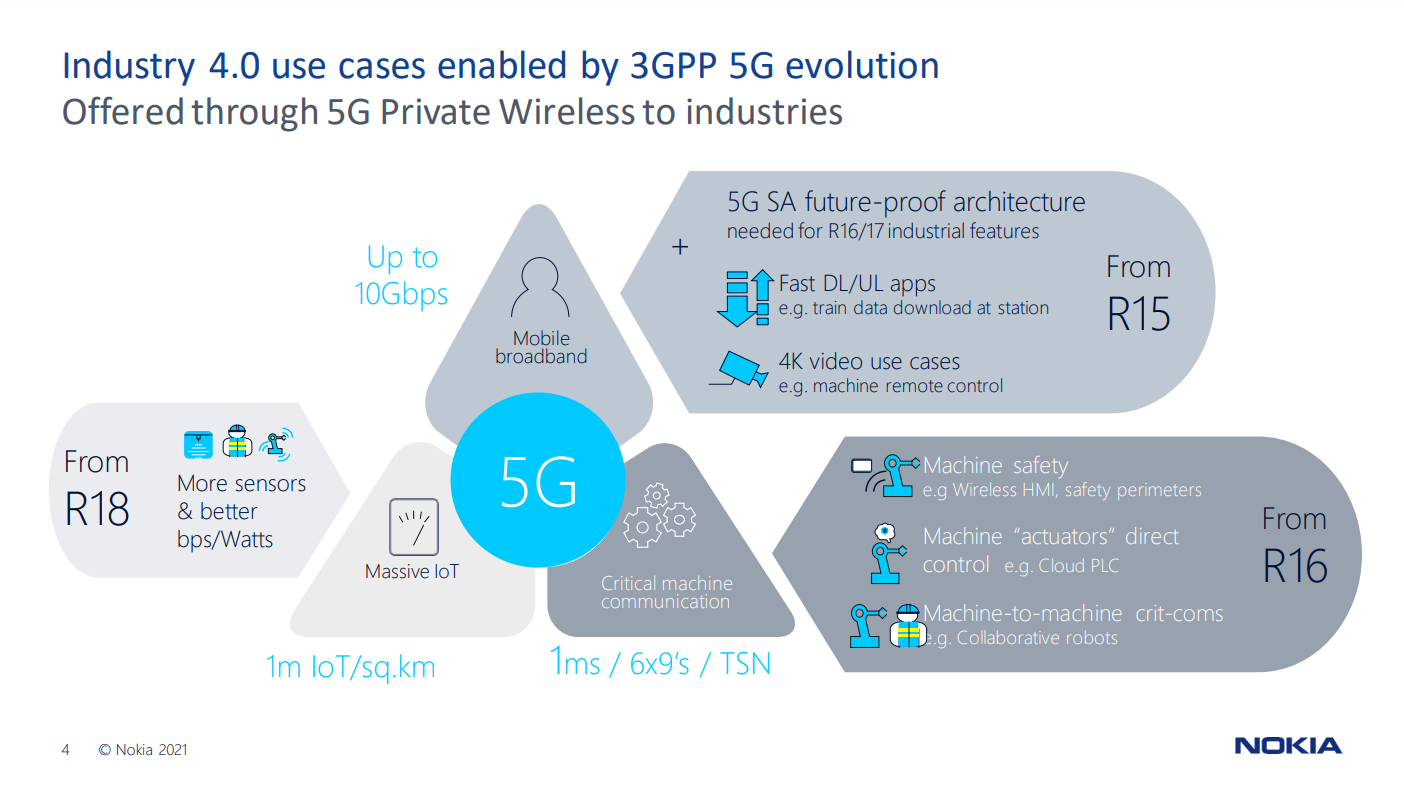

              Li-Fi Conference 2021 - Recap Part 4 - Taking LiFi Mainstream

              Table of Contents

                Li-Fi Conference 2021 - Recap Part 4 - Taking LiFi Mainstream

                Li-Fi Conference 2021

                In our last article from our ONLINE Li-Fi Conference 2021 recap series, we discussed the presentation delivered by Livia Rosu on “G.hn Backbone And Ecosystem Support For Li-Fi Use Cases, Standardization, Spectrum and Security”. The conference was organised by the Jakajima, the global High Tech Conference organiser, and the Light Communications Alliance.

                Jakajima, Matchmaker for Innovators in the high tech industry, organises many events, ranging from LiFi Technology industry trends, 3D Printing to the Internet of Things, from Unmanned Cargo Aircraft to Health Tech, from 4D Printing to Photonics and from Vertical Farming to Sustainable Materials.

                The online Li-Fi Conference included live presentations from researchers, executives and industry specialists from pureLiFi, Nokia, Signify, Orange, Radiocommunications Agency Netherlands, Velmenni, OLEDCOMM, HomeGrid Forum and Weidmüller Deutschland.

                In another article recap series, we will talk about the presentation on taking LiFi mainstream delivered by Nikola Serafimovski from pureLiFi. Before this, let’s talk briefly about pureLiFi.

                pureLiFi

                pureLiFi develops technology for communication networks that integrates data and lighting utility infrastructures. It offers a LiFi enabled device that converts the beam of lights into an electrical signal. The signal is then converted back into data. The company was founded in 2012 and is headquartered in Edinburgh.

                pureLiFi demonstrated the next LiFi system for the home at Mobile World Congress (MWC) 2022 in Barcelona. pureLiFi stated that this is the world’s first LiFi ecosystem for the consumer market, named LiFi@Home™.

                pureLiFi CEO, Alistair Banham stated the following:

                The door is open for LiFi to fill the gap. LiFi is the key to unlocking the next generation of connected experiences in an ecosystem where WiFi and 5G alone are not enough. What we’ve demonstrated here for the first time is how simple it is to bring LiFi into consumer environments. We’ve done all the hard work to make LiFi easy to integrate and simple to get started.”   

                The LiFi@Home™ family of LiFi connected experiences is made of a consumer-style downlighter, a smartphone, a smart TV and an AR Headset all connected by LiFi. The LiFi@Home system is powered by an easy to install power line communication (PLC) network backhaul that uses existing electrical cabling to connect everything to the internet. Installing the LiFi@Home™ system is as simple as changing a downlighter.


                Adding LiFi technology to a home will not only accommodate the growing demand for connected devices, it will also improve the user experience. LiFi enables more reliable connectivity that significantly improves latency and jitter and does not divide bandwidth. Next-generation experiences such as the metaverse and 8K streaming will be possible for everyone, pureLiFi claimed.


                pureLiFi’s demonstration of consumer-ready LiFi products is enabled by their world-leading light antennas which are compatible with the same WiFi basebands that already exist in billions of connected devices today, allowing for easy integration of LiFi technology.


                At MWC in Barcelona, pureLiFi CEO Alistair Banham made a direct call to the industry to show leadership beyond using WiFi and 5G. LiFi is for leaders who want to differentiate and offer their customers the best experience. We are calling on the industry to look beyond ordinary and unleash innovation with LiFi. The next and best in connectivity solutions is ready for the taking. LiFi is ready for you to design into your products and put you at the forefront of the next big wave of technology innovation.”

                Taking LiFi Mainstream by Nikola Serafimovski

                Nikola Serafimovski, Co-Chairman at Light Communications Alliance and senior member from pureLiFi, was the fourth presenter at the online Li-Fi Conference 2021. He discussed in his presentation about Taking LiFi mainstream.

                Nikola worked with major companies in the area of LiFi technology and commercialisation, leading the creation and cultivation of the LiFi ecosystem, marketing, sales and standardization. His experience with T-Mobile and T-Home in Macedonia focused on mobile network deployment and analysis as well as database app development. Nikola worked for the UK-China Science Bridges project to successfully demonstrate the world’s first practical implementation of the Spatial Modulation MIMO concept. He received a BSc in electrical engineering and computer science and an MSc in communications, systems and electronics, both from Jacobs University Bremen, Germany. Nikola earned his PhD in digital communications and signal processing from the University of Edinburgh.

                Below are some points discussed about the Taking LiFi mainstream:

                purelifi

                Nikola Serafimovski started his presentation by saying the following:

                Thank you very much everybody for your time. We've had a lot of conversations about what is LIFI? And what are some of the ecosystems and the challenge that we have. So, this is really more looking at it from a pureLiFi’s perspective. So, a little bit about us. We were co-founded by Professor Howard Haas, who coined the term LIFI back in 2011. During the TED Talk, we've come out with the world's first with respect to LIFI systems that are generating revenue today, working with some of the largest technology providers and device vendors created the world's first light antenna, and a gigabit light on thin out with a strong patent portfolio and lots of awards and technology recognition products around the globe. We are relatively small, but very tightly knit team, based out of Edinburgh, and we're very, very excited to see change as a consequence of our work.

                How do we define LiFi?

                So, what do we mean when we talk about LIFI? This has been defined a number of times, and I guess an important element to add is we use the entire light spectrum visible or invisible or infrared, to deliver this interconnected network experience, but as well as looking at the opportunity of using the devices to connectivity, which is completely complimentary and additive, to what to RF solutions that exist in the market today.”

                We Need More Wireless Tools in our Toolkit

                So, what do we need more wireless for? Right? That's basically what it comes down to? Well, I guess some of the challenges that we're facing today, as we mentioned previously, are privacy and security, security. There are a number of different attack vectors that effectively RF is vulnerable to. There are speed and bandwidth issues, in particular when it comes time for sharing the wireless medium. And especially if you're looking at the quality of service types of elements. And the quality of the connection is very, very important so that we're clear where and how that is going to look out for. So, we've identified kind of pain points that LIFI seems to be solving across a range of industries that boil down to some of these core features of LIFI.”, said Nikola Serafimovski.

                Consumers, industry & defence face the same challenges

                So, if we look a little bit closer, what we see is that the defence industry, the industrial space, and the consumers have a similar range of problems. So, of course, some of the work that we've done with the US DOD is looking at the electromagnetic footprint and how those devices look like in the space. But what we're seeing is that Wi-Fi is suffering and cyber is suffering. In particular, when it comes down to the home environment and to the industrial enterprise IoT environment. We see there's a much greater threat coming into not just the enterprise space, but also the home space. And so, you have this transition where problems that used to be government only are very quickly becoming problems of the industry. I think probably the cyber attack shut down in the world's fifth-largest beer maker, Molson Coors was an issue. I think some of you probably saw the ransomware that there was a target for the NHS, and so on. So the question is, how do you try and come up with some of the solutions to some of the vulnerabilities with RF and how to improve that information assurance.”

                LiFi helps overcome key challenges

                In our world, we think LIFI helps. So, LIFI can deliver the speed and bandwidth that's required. The low latency, which is, which can be easily much, much lower than their typical RF counterparts, because nobody's fighting for Channel access. It has a near-zero yen footprint, which means you can deploy it in almost any environment. And I'm sure people will be talking about some of the environments where they are using it, the quality of the connection can be much greater because the interference-free communications is there, in terms of the density of the network. So, you can keep adding LIFI access points. And you can keep reusing the full spectrum of the channel. You have very high levels of security, that physically limit your RF signals so that you know exactly where that information is going to and exactly who is listening to that information. And of course, because we're operating in an unlicensed spectrum or a licenced exempt spectrum, the same solution that is developed in China can be applied in Germany, or in Bolivia or in the US with no questions asked. It is simply identical. And that's very, very important when it comes time for understanding the overall consequences of spectrum sharing and licencing in particular on cross borders.”

                LiFi Pathway to Adoption

                So, what's the pathway that we see? This is all about talking or trying to understand how does LIFI go mass market some of the ecosystem challenges were very well articulated by Musa, and they're, they're very real. We've tried to look at it from an end customer use case perspective and where we think the time is going to come through with us. So from what we've seen, and what we've experienced currently, wireless access with military-grade security is hugely important in defence space. And we've seen a significant uptake in that space as a core driver. That demand is now driving manufacturers and device integrators to create platforms, which is extending the toolkit that's available to the industry as a whole, connected manufacturing and maintenance are following on the back of that, as they're looking to create more digital environments in RF limited or denied spaces or insecure areas. And they're looking to integrate the next generation of productivity such as AR and VR capabilities, we see an uptick in the requirement for secure reliable, robust wireless communications in those spaces. Dovetailing along with the same feature sets and product requirements coming out of the Defence space. So both of those elements are here today and are moving forward. But we're also seeing, however, is the need for fast and secure device to device connectivity becoming more and more prevalent. And we'll zoom in on that feature, in particular, some of the kind of phone to phone connectivity that we've seen or phone to TV connectivity that we've seen. And lastly, we see that bandwidth offloading into the home will be critical. Why should you be hanging on your precious Wi-Fi system at home if you're trying to stream or cast your screen or marry a screen to the TV, when somebody is trying to download something with the phone in their pocket when you could be using light. And then, of course, that drives to the inevitable broader ecosystem of enabling every device in the home to be LIFI connected in the enterprise as well as the home space”.

                LiFi in the Real World: Defence

                So, this was mentioned earlier, basically, looking at a specific case study. With the Kitefen product, we've deployed with the US Army, Europe and Africa. It's the first large scale deployment of LIFI of this nature, providing mission-critical communications, with 1000s of units, creating significant wireless security in the space. This is really looking at adding a meaningful element to an actual operational command, not just a proof of concept or a pilot. And this type of requirements and demand is what will drive this technology forward”.


                LiFi in the Real World: Education

                But that's not the extent of it. We've also seen that transition into a complementary solution where deployment with the Kyle Academy in Scotland created actually a combined benefit. We deployed LIFI in a single classroom while the other classroom was still Wi-Fi enabled. And what we saw was an aggregate improved performance because the load was taking from the congested RF spectrum into the light spectrum. And it created a better learning and a better more connected environment for everybody in the space. And we see demand for these types of hybrid solutions increasing as people want to seamlessly transition without any thought between an RF in space and a light connected space”. 

                LiFi home ecosystem

                So, this is where we see the home coming in. You know, powerline communications was very appropriately discussed just now it is a great solution that can take from. It is a great solution that will take whatever fibre or coaxial cable ends up coming into the home from that box and distributed to every single socket that you have available for illumination in the space throughout the house. Instantly, you can get LIFI enabled PLC connected devices that are actually providing a full-blown home coverage use case. But in addition to that, you can have phone to phone communications or phone to TV communications or TV to access point communications. All of these bandwidth-heavy elements can now be connected with LIFI in the home”.

                Taking LiFi Mainstream

                “So, what have we seen? Well, we've seen way back when starting with prototype LIFI systems, to commercial systems to initial pilots and industry offices and defence to smartphones and proof of concepts being and a tablet proof of concept is being developed. And that's kind of where we are now. We see that movement of the real world defence and industrial applications really taking into the next stage for real-world office and retail deployments. And some of the speakers later will talk to their experiences with deploying LIFI into offices, in the automotive and industrial spaces. This is the pathway that will lead to consumer-grade pilots and when eventually standardisation is done, of course with the IEEE 802.11bb being very important for this stage, we also see mainstream LIFI coming through. And the 802.11bb standard in particular brings in that kind of consumer-grade, chipset availability for Wi-Fi that is found in almost every single device in the world today. And that's what will allow the scale and the transition from specialist use cases into very much mass-market use cases”.

                The Light Communications Alliance, as was discussed earlier, plays a huge role in how this shapes up and we would really, really welcome and encourage everybody to join us on this journey and help us create this ecosystem and make sure that we're addressing the problems that you see. At the same time, though I chair the IEEE 802.11bb Task Group, which is standardising lifeline to scope which means LIFI according to 802.11bb will be natively interoperable with Wi-Fi, there are billions of Wi-Fi baseband chipsets that are available and integration with them can be done with very minimal if any modification to the chip to the chipset. It is a much-reduced barrier to entry for the mass market. at a very high level, this is the kind of standardisation timeline, we're looking at getting a stable draft sometime in the first half of next year, potentially pre-standard devices available in the second half of next year and really standard-compliant devices available sometime in 2023. This is a very high-level graphic, it is not meant to commit the tgbb group to any such timings. And it's very very important to understand that this 802.11bb group is a standards body that is contributions driven. So, while we try to do our best to get it on time and make sure that things happen. At the end of the day, the members decide the pace of change in that environment. But what we're really seeing is that the LCA in combination with tgbb. And the mass market is what creates that kind of fertile ground for mass-market deployability”.


                Made for Mobile™


                So to that extent, pureLiFi has created a made for a mobile system, which has a light antenna that is roughly the size of a single euro cent designed specifically for mobile devices communications. LIFI really is ready, it's ready for today. And as Musa has said earlier, it gets more and more advanced on a daily basis. Large scale deployments are there as most of set the technology is sufficient for the use cases that are needed. Security is an important quality of service for phones with new technology that can really excite and serve demand baseband chips as that are ready for LIFI are in everything if you're especially if you take data to that 802.11bb approach. And with that approach, you can make LIFI work together seamlessly”.


                READY FOR THE MAINSTREAM

                The presentation was concluded with the following statements:

                There is no transfer of data allowing for the user to control where information is shared. This makes LIFI particularly useful for sending payments or secure information. It is also possible to screen share between phones taking advantage of LIFI fast low latency connections. LIFI  can enable all-new multiplayer gaming scenarios that enable fast, reliable, low latency gaming just like using your console at home. As you can see here, the use of LIFI is not only fast but provides intentional and secure connections. As LIFI does not use radio frequencies and offers low latency connections, the user experience and the quality of connections can enable new user experiences with just your mobile phone”.

                You can also watch the full video presentation on the following YouTube link from Jakajima YouTube channel.

                Li-Fi Conference 2022

                The next Li-Fi Conference is coming up on the 28th of June 2022 between 10 am and 4.30 pm CET.

                It is interesting to realise that lights that illuminate offices, homes, cars, factories, our streets and more locations also can connect us to data and hence power the growing demand for connectivity and speed.

                At this conference professionals from all over the globe will gather together in order to share applications, ideas, new developments and ways to integrate Li-Fi in services, both for consumers and professionals.

                This conference will be held Live and Online. The venue will be the High Tech Campus 1, The Strip 5656 AE Eindhoven The Netherlands.

                Online tickets can be bought at the following link:

                https://tikcit.com/register/61e002336d7fc4b6745cab83/

                What is LiFi?

                LiFi, also known as "Light Fidelity" is a wireless optical networking technology, which uses light-emitting diodes (LEDs) to transmit data. In 2011, professor Harald Haas made a LiFi demonstration at the TED (Technology, Entertainment, Design) Global Talk on Visible Light Communication (VLC).

                VLC uses light as a medium to deliver high-speed communication like Wi-Fi and complies with the IEEE standard IEEE 802.15.7. The IEEE 802.15.7 is a high-speed, bidirectional, and fully networked wireless communication technology-based standard similar to Wi-Fi's IEEE 802.11.

                How does LiFi work?

                LiFi is a high speed, bidirectional, and fully networked wireless communication of data using light. LiFi constitutes of several light bulbs that form a wireless network.

                When an electrical current goes through to a LED light bulb, a stream of light (photons) emits from the lamp. LED bulbs are semiconductor devices, which means that the brightness of the light flowing through them can change at extremely high speeds. The signal is sent by modulating the light at different rates. The signal can then be received by a detector that interprets the changes in light intensity (the signal) as data. Also when the LED is ON, you transmit a digital 1, and when it is OFF, you transmit a 0.

                LiFi Benefits

                The primary benefits of LiFi are as follows:

                Security: Provides entirely secure access. Where there is no light there is no data.

                Safety: Does not produce electromagnetic radiation and does not interfere with existing electronic systems.

                Localisation: Allows localisation due to the small coverage area of LiFi access point - localisation can be used for very precise asset tracking.

                Data density: Provides ubiquitous high-speed wireless access that offers substantially greater data density (data rate per unit area) than RF through high bandwidth reuse.

                Credit to Oledcomm

                LiFi Applications

                LiFi can be used for so many applications and the list is increasing every year. You can read our updated list of Li-Fi applications at the following link:

                https://www.lifitn.com/blog/2021/2/13/top-30-li-fi-applications-updated-list-including-potential-applications

                Credit to pureLiFi

                In conclusion, if you are also interested to hear more information about the OWNII Coin or enquire about LiFi devices such as the LiFiMax and Trulifi, you can contact us through our chatbot or by sending an email through our contact us form. If you enjoyed this post and would like to hear more updates about LiFi technology, subscribe to our newsletter. Don’t forget to subscribe to our social media accounts. You can also join our Telegram group about LiFi technology on this link:

                https://t.me/joinchat/FMzOmsEKyJFrU6Af
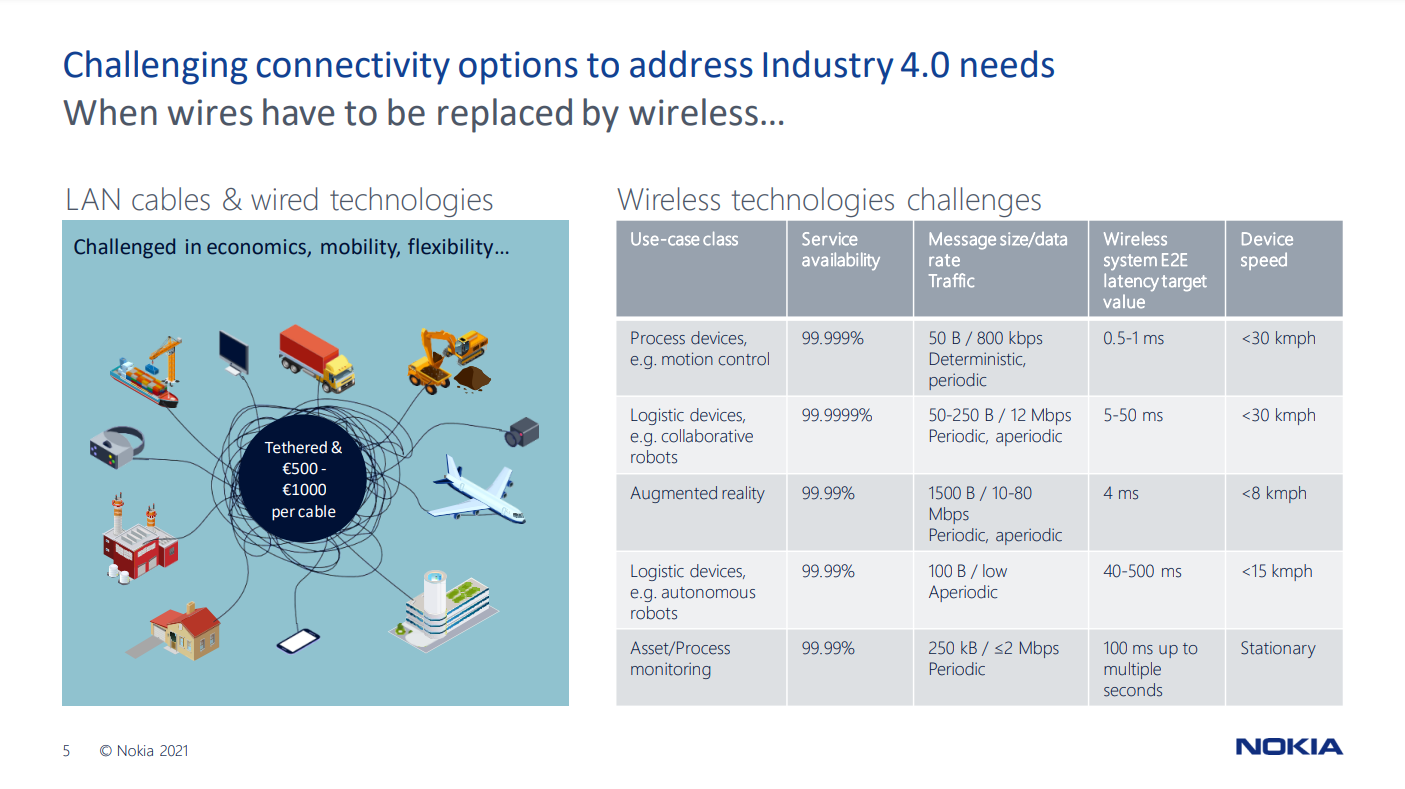

                Li-Fi Conference 2021 - Recap Part 3 - G.hn Backbone And Ecosystem Support For Li-Fi Use Cases. Standardization, Spectrum and Security

                Table of Contents
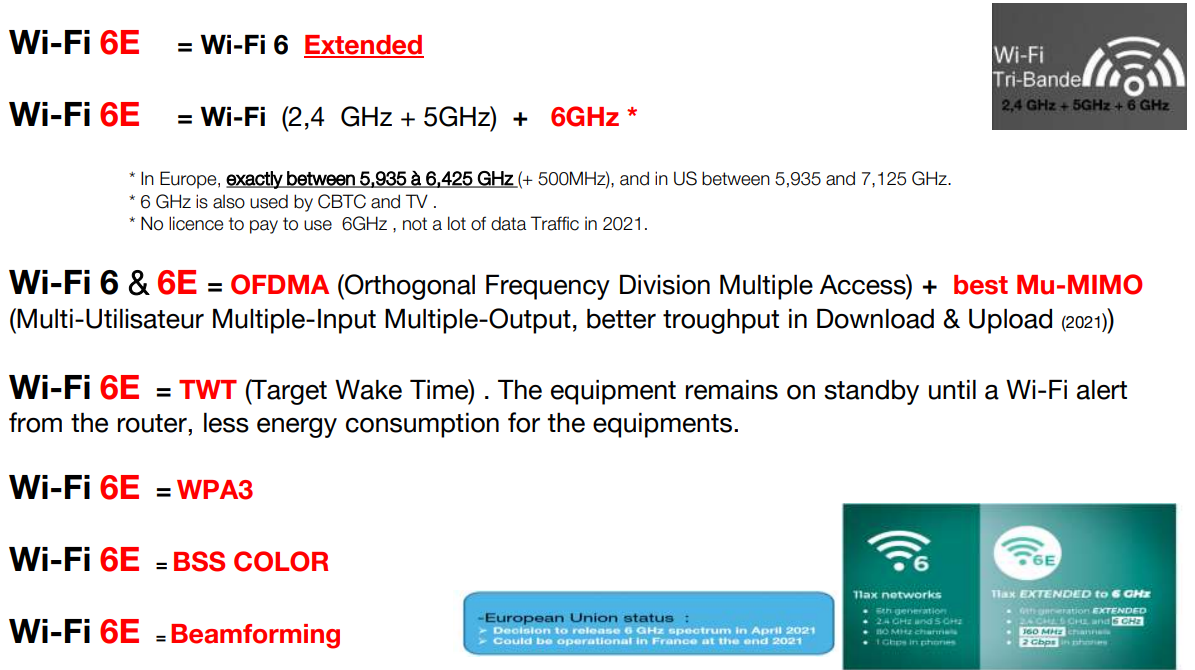
                  Li-Fi Conference 2021 - Recap Part 3 - G.hn Backbone And Ecosystem Support For Li-Fi Use Cases. Standardization, Spectrum and Security

                  Li-Fi Conference 2021

                  In our last article about our ONLINE Li-Fi Conference 2021 recap series, we discussed the presentation delivered by Musa Unmehopa on “Building The LiFi Ecosystem”. The conference was organised by the Jakajima, the global High Tech Conference organiser, and the Light Communications Alliance.

                  Jakajima, Matchmaker for Innovators in the high tech industry, organises many events, ranging from LiFi Technology industry trends, 3D Printing to the Internet of Things, from Unmanned Cargo Aircraft to Health Tech, from 4D Printing to Photonics and from Vertical Farming to Sustainable Materials.
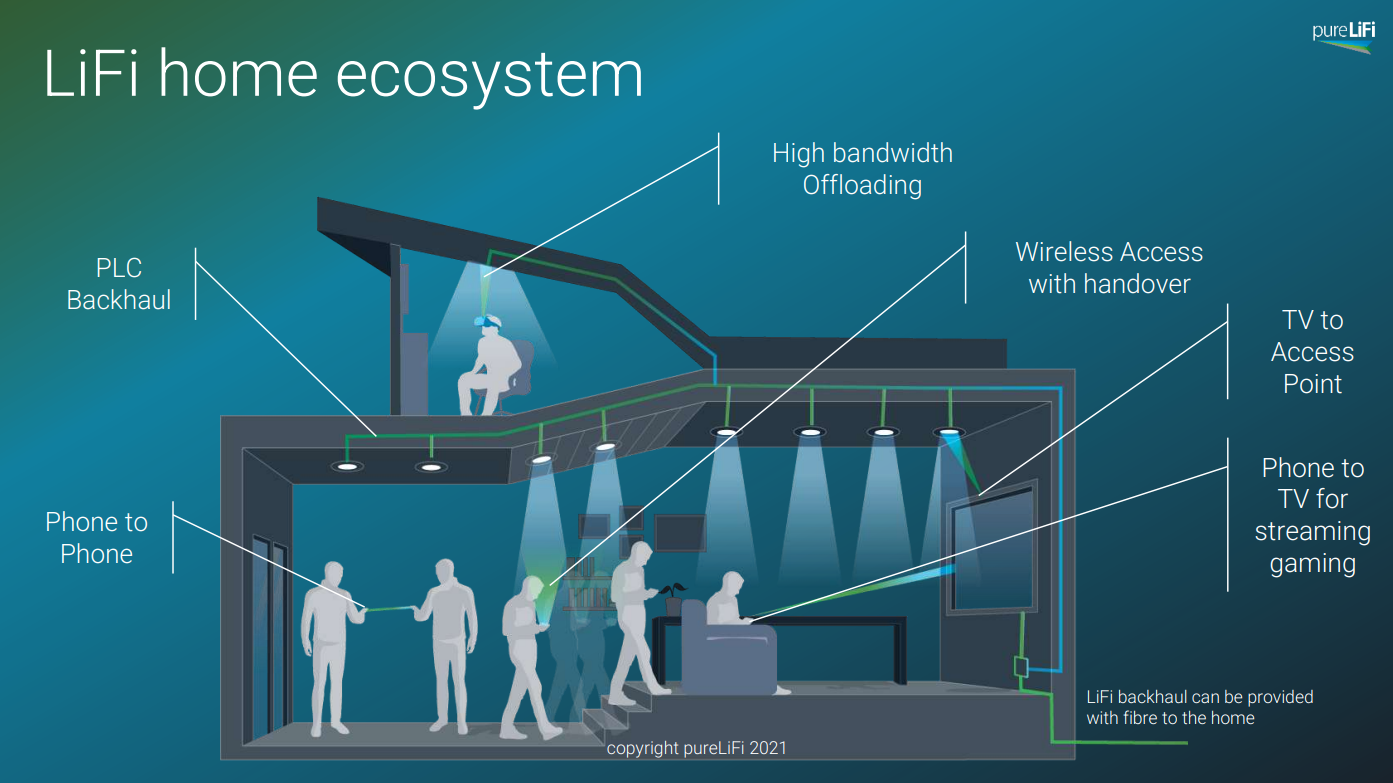
                  The online Li-Fi Conference included live presentations from researchers, executives and industry specialists from pureLiFi, Nokia, Signify, Orange, Radiocommunications Agency Netherlands, Velmenni, OLEDCOMM, HomeGrid Forum and Weidmüller Deutschland.

                  Livia Rosu from HomeGrid Forum talked about G.hn backbone and ecosystem support for LiFi use cases.

                  In this article recap series, we will talk about the presentation on G.hn backbone and ecosystem support for LiFi use cases, standardization, spectrum and security delivered by Livia Rosu. Before this, let’s talk briefly about HomeGrid Forum.

                  HomeGrid Forum

                  According to their website, HomeGrid Forum (HGF) is an industry alliance formed to support the development and deployment of a unified coaxial, phone line, powerline, and plastic optical fibre home networking technology called G.hn (Gigabit Home Networking). G.hn technology is based on standards developed by the UN’s International Telecommunications Union – Telecom (ITU-T) standards development organization.

                  HomeGrid Certification ensures compliance and interoperability (C&I) of silicon and systems through plugfests and rigorous C&I testing. A logo is issued for certified systems’ packaging and documentation of G.hn-based systems. HGF Certification ensures that retail customers and Service Providers have confidence in, and great satisfaction with all HGF G.hn Certified Certified products.

                  HomeGrid Forum members comprise an eco-system covering all aspects of the technology from Retailers to Service Providers, Utilities to Smart Grid think tanks, System Developers to Test Houses and Silicon Companies.

                  HomeGrid currently has four workgroups: a Clean Tech/Smart Grid/Smart Energy workgroup focused on in-home energy management and utility Distribution Automation and AMI applications for G.hn, a G.hn Contributions workgroup that continuously works to develop advanced enhancements for wired home networking, a Compliance & Interoperability workgroup, and a Marketing workgroup focused on promoting all HomeGrid Certified Products and technologies.

                  The purpose of HomeGrid Forum is to:

                  • Lead the work within the ITU-T to continuously expand G.hn, through a sustained effort to improve and extend this advanced home networking technology for any in-home wiring (coaxial cable, phone line, powerline and plastic optical fiber).

                  • Encourage and evangelize the adoption and widespread deployments of G.hn by Service Providers and through Retail channels.

                  • Provide a clear migration path for all legacy wired technologies to G.hn, where coexistence and G.hn’s ability to work over any wire type enables Service Providers to extend the life of their existing network investments while increasing coverage, robustness, and throughput in the home.

                  • Maintain a comprehensive compliance and interoperability program to promote an ecosystem of compliant silicon and interoperable products based on the ITU-T G.hn standards.

                  G.hn Backbone and Ecosystem Support for LiFi Use Cases, Standardization, Spectrum and Security by Livia Rosu

                  Livia Rosu, President at HomeGrid Forum, Senior Strategy and Alliances Manager, Connectivity & Access at MaxLinear and WCA Judge, was the third presenter at the online Li-Fi Conference 2021. She discussed in great detail the G.hn Backbone and Ecosystem Support for LiFi Use Cases.

                  The HomeGrid Forum supports the deployment of G.hn, the globally recognized Gigabit home networking technology based on ITU-T standards and designed for bandwidth-intensive and real-time applications. Livia is a Computer Science engineer with 18 years of business development experience in the telecommunications industry, dedicated to semiconductors and the standardization of revolutionary technologies ranging from Smart Cards to Smart Cities.

                  Livia joined Marvell Semiconductor, a US-based leading fabless semiconductor company with expertise in microprocessor architecture and digital signal processing, in 2010. At Marvell Livia managed strategic marketing and competitive positioning of G.hn, working closely with system vendors and carriers that require Plug & Play networking capabilities. In 2017 Livia joined MaxLinear, a leading US provider of high-performance radio-frequency and mixed-signal semiconductor solutions for the connected home, wired and wireless infrastructure markets when it acquired Marvell’s G.hn business unit.

                  Livia has built a strong knowledge of industry associations having served 8 years as Internet Business Development Officer and Head of External Relations for ETSI, the European Telecommunications Standards Institute in France until 2006, as a strategic signatory of 68 Co-operation Agreements with standards development organizations and alliances among which ITU, IPv6 Forum and IETF. Before HomeGrid Forum Livia also acted as Chair of the PSO Protocol Council of ICANN (Internet Corporation for Assigned Names and Numbers) and Member of the Interim Steering Group (ISG) by the EC-POP (European Commission Panel of Participants in Internet Organisation and Management), for the creation of the “Dot EU” Top Level Domain and Member of the ISOC-AC (Internet Society Advisory Council), in charge of open standards and protocols for the Internet administration.

                  Livia received a Master in Business Administration (MBA) from EDHEC Business School in France in 1999. She holds a Master in Computer Science and Internet Security (M.Sc., 1997) and a Bachelor of Science degree with Honours in Automation Engineering and Network Management (B.Sc., 1996) from the Polytechnic University of Romania with a scholarship award from France. Livia is fluent in 6 languages.

                  Below are some points discussed about the G.hn Backbone and Ecosystem Support for LiFi Use Cases.

                  G.hn - Ethernet over Anywire

                  Livia Rosu started her presentation by saying the following:

                  Thank you for the invitation and I'm glad to be part of the LiFi community joining forces with Nikola Musa and the other distinguished speakers. Where they are joining today for the objective of enlightening everyone with the standardisation, and with the software and the hardware that are all needed for complementing and accelerating the deployment of what we call LiFi technology. The purpose of my presentation today is to address the challenges from a different angle and that is what the backbone G.hn technology can bring into the picture because Ghn is offering a stable robust backbone and we are using that and offering the ecosystem of that to support the deployment of life I, how this is addressed and both Nikola and Musa have already mentioned the key topics of these two challenges, it is working through standardisation through spectral enabling spectrum beyond what we have until now and security aspects.

                  We call G.hn and Ethernet over any wiring technology. It has started as an international standard with the very first version approved back in 2009 by ITU standardisation Body with multiple updates since then, and building on the standardisation aspects, I keep saying and I have been working for a team before my senior semiconductors and I have been having a guest the one role from the standardisation side and supporting semiconductor companies and manufacturers who are involved in deploying the ecosystem of G.hn for 20 years now, you can tell it’s fast and it has been always around in intended to address the needs of the telecom industry. How is that achieved? Because the telecom industry has always been in the highest need for the gigabit home networking for serving their subscribers base that has been addressed initially for G.hn with the power line medium has been added in a coaxial twisted pair. And this is why nowadays, it is an Ethernet over any wired connectivity. It has been from day one a robust backbone for Wi-Fi connectivity, initially for the food, some political and technical challenges, as everyone tried to see what is best for wired connectivity or Wi-Fi connectivity. And already one decade back, the players have achieved to agree and come to a resolution that and I like to say that a lot. And that really is no single technology that addresses all topologies because they are all different. So we're seeing the presentation of today and also by other distinguished speakers that different topologies require different implementations of hardware or software. And precisely when it comes to Wired versus WiFi, we needed to understand that this can be combined and so that G.hn can provide a robust backbone for Wi-Fi connectivity and that’s seamless and that's transparent for the end-users. And we will see how we take that to the next level. Now to complement with we'd like by all means this has been deployed for a strict quality of service and management because again, this is these are top requirements by telecom industry players. And it started as a technology for home networking topologies and has been gradually extended to address a very broad range of applications successfully to broadband access and we'll explain what that means for the multi-dwelling units and single-family units for electricity utility applications, for industrial applications, a wide range of industrial applications and last but not least, and the main objective of being here today its LiFi applications”.

                  Whenever we have been supporting the ecosystem, it has been through allowing multi-vendors to participate and that is because you cannot have this one to one relationship in order to have a market deployable, so you need to allow a variety of vendors both on the technology side but means technology providers and also on the manufacturer side on the system integrator side. So that everyone can have a free selection of its own partner In this deployment, and how this can be achieved always through having interoperable systems. So, they are extensible always. G.hn comes with a multi-gigabit connectivity. But in order for the ecosystem to be highly connected, we needed to make sure they are all in their interoperable and this is chip for compliance interoperability certification that we can go more into detail next time”.

                  Standardization

                  It all started so, just very briefly, because Musa has addressed that already with the very first implementation so that you have that historically, how the G.9991 started in 2018 and CIF constant started already back in 2018. And now, now, the COVID like time is running. And it looks like it was yesterday. So, we had several implementations of that and ever since 2019, several vendors have already as you have seen in the content of the conference, launched compliant products, we did, we did have a chance.”

                  G.hn Standard Evolution at ITU-T

                  This is how the standard evolution looks like at the IP level and this is critical, so to grasp so that we can see the evolution of technology always is to have a future. So that it can be successfully deployed. So we are currently deploying everything on two gigabits per second and that target applications that started with the market segments that we have mentioned and the ITU vision going forward as we continue to deploy is addressing G.hn for the 10-gigabit full-duplex capabilities that are coming for the roadmap.”, said Livia Rosu.

                  ITU G9960/G.9991 deployment

                  Looking at the ecosystem and such, HomeGrid Forum has been created as an alliance to support the certification as we said to help ITU-T based standardisation ecosystem to advance very rapidly for certification. So, that comes with the highest performance we knew G.hn is a great technology for the wired backbone in terms of numbers here you have a very quick snapshot of what can provide so it started with a power line with the fire rate of 1.5 and the MAC rate of one one gigabit power line to note that is the most you know able to catch noise interference medium. So, if everything works on powerline, well then you can make sure on twisted pairs and actual pairs are going to work even beyond that highest speeds. So on boats, you do have a MAC of 1.7 gigabits and of course, that's because the fight it's two gigabits, it has the highest security Yes, 128. And topology flexibility will go in in detail Santos being the only standard solution. But again, I keep reinforcing the fact that this can only be deployed by and accelerated successfully for interoperability and certification.”

                  HomeGrid Forum Mission Statement

                  And this is how HomeGrid Forum came to enter into force to achieve that. So, the main objective here and this is the mission statement that the players have been embracing is to provide interoperability for consumers that are needing to deploy any type of device that needs robust connectivity.”

                  HomeGrid Forum Promoter Members

                  So, if we have a look at the promoter numbers, how this all started. So we have a number of service providers that have been very keen to look into visa accelerating requirements of G.hn based connectivity because it all started as a home networking as we said, so they needed to serve their subscribers based with the highest connectivity inside the homes to have the multi-room, multi-screen connectivity to have any type of devices inside the home connected on the highest speeds. And they have been promoting and sustaining the deployment of this technology”.

                  First G.hn Applications

                  The first G.hn applications were forthcoming in combination with a home networking so, we need once we have the connectivity inside the home like from the gateway into the box we needed to extend for the robustness of the wired connectivity again and we say it's always can be at the choice of the service provider it can be powerline phone line or any wire then that's the ubiquity and the beauty of this technology because whatever you have in a home already installed. In most of the homes, you have them all but when you're looking at the building itself, in especially multi-dwelling units, which are very tall buildings, when the service provider can actually select what is best for the infrastructure based. So, it can be for the last mile what we call, it can be the falling in cost for actually supporting longer distances and we're talking about 300 metres, 500 metres. So, beyond the 1000 feet in this case that can extend the connectivity in the multi-million units and the way you capture the topologies actually, you have the service provider providing the highest bandwidth to that particular building and it can be either on the fixed wireless access to the roof of the MTU within antenna or it can be fibre to the building getting fibre all the way to the building itself but then G.hn has been used in the multi-dwelling unit to actually extend the connectivity either from the roof down, either from the basement of the building going up to reach any floor in the building reusing what's already there”.


                  G.hn for Broadband Access in MDU

                  For extending the coverage, we added Wi-Fi in different devices. One Wi-Fi and phone line or Wi-Fi and the connection lines and then when the fibre stops anywhere it doesn't matter whether that's the basement of the building and even outside on the last mile can be at the curve as we call it, what is important here to understand is that the fibre stop somewhere. We call it the economical point by some reason because it is highly very expensive to have it all the way to any user or because it is historically prohibitive because it's just the high you know, multi-unit historically, preserved looking very nice so it’s difficult to take the permission of the owners to drill exist additional holes into the walls or when Never better said you actually extend what already have and avoiding any modifications in the structure of the building but you reuse what's already installed so that existing infrastructure”. 

                  International Market Adoption of G.hn

                  “So, you can see so many different flavours of the change and technology that has been deployed since back 2008. And best just a very quick snapshot to highlight the international market adoption of G.hn by service providers in different countries globally. And again, someone powerline who works in combination with the Wi-Fi connectivity”.

                  From Broadband to Industrial IoT

                  “Looking at the G.hn technology evolution because it has provided some very major advancements. So, it started as we said, home networking broadband access and what's important here, and it actually gets us to how we can support LiFi both went into the smart grid, the smart cities and capturing different needs.”

                  G.hn for Smart Grid


                  The incorporation of G.hn in what we call smart metres, so supporting missions with apologies and complying with the mandate from the European Commission having the ability of reading the power consumption in the smart metre by ourselves as users not on a monthly basis but on a daily basis and work out what is the best timing for us to have the cheapest consumption. So that's one for G.hn”.


                  G.hn for Smart Cities

                  In the smart cities as such, here we can be highly creative. So it has the smart street lighting for the energy saving. So not just having connectivity inside our homes but on the streets. So the traffic works like control distributed environment sensors. And as basic as having public Wi-Fi hotspots. So it was very much going into bad directions again, why because it was a simplified the architecture of the wiring and we can use what's already there and lower operating costs”.

                  G.hn Smart Parking System

                  It went beyond that to actually provide the smart parking system because the lights were already in place, the connectivity was already in place. So, that was highly robust. We all need to park somewhere when we go and visit an office or a shopping mall. So, the parking guidance it's only important if it's a huge parking system to find the car rapidly to make sure the car is protected. So, the global high definition video surveillance, having the snapshot of that apology again is key to know whether a location is occupied or not by another car. So, all that that comes into the visualisation of the networking spot was a great means to understand why G.hn can be used for that. But that actually led us to the next level and it was the security aspect. Because then all this can be highly protected for the video surveillance and captured intrusion.”


                  Advanced Powerline Noise Mitigation

                  And I get closer to the why security is important. When it comes to the deployments, again, talking about the three media but then I keep always focusing on the powerline noise mitigation because powerline has always been the most ubiquitous medium, right. So whenever you plug a device, and this is how G.hn came to bring to life IoT devices, you plug the device that gets power supply, but also connectivity at the same time. Of course, the power line, it's the most the noisiest media. So, we introduced an algorithm for the noise mitigation. And that was highly perceived by the players because when we had that apply to different subcarriers, the buildings of that detecting all these noises and the power supply switches and the charges and the LED lighting, here we go. So, that we could have the adaptive bid loading based on the channel condition. And last but not least, to optimise the spectrum efficiency in such a noisy channel environment”.


                  Intelligent Software for Industrial IoT

                  “We went beyond that and built this for the industrial IoT. So, IoT, it's all very nice and very appealing we have been using and applying so many different technologies for the IoT, wired and wireless. And this is the future. It's something that we all need to embrace and, like and take advantage of it. But what actually makes it even more interesting is the industrial flavour of it. Because beyond having a very nice experience with connectivity are some critical applications, which really need low latency, not just the highest connectivity, but low latency. And why is that because whether we can be more or less frustrated, whether we have a latency on you know, we're displaying the slide deck or getting an email on having our voice distracted. But then, whether that's the connectivity is actually involving industrial machinery, it's in the factory applications, robots, the Industrial Revolution, even surgeries in the healthcare and that it’s highest precision. So, this was actually looking into different types of topologies, we came up to say, okay, we need more levels of repetition, and then the self-organised network, not just plug and play that the network stability and then having the nodes configured understanding who's the master and the network self-healing, so that in case of any node fails, the network itself knows how to have the topology discovery, and to connect and create and ensure the stability of that industrial process. So, that was key for this application G.hn from the standard itself went to provide up to 250 nodes per network domain”.

                  Secured wireless with Li-Fi

                  Security is highly important. So I will, I will always want to one of my three minutes on this one, it is for whatever was highly perceived for the Wi-Fi as freedom of movement, and G.hn provided the backbone on the LiFi side, the line of sight is highly important for preventing intruders to get and get the signal. So, you have to look at that from the RF congestion point of view, which is getting worse. And then, improving the user experience in those dense environments. So, the light spread through the light waves provides all those advantages. At the same time, the security is highly improved because you have the boundaries of the wall in any meeting room that prevents the communication from being captured by intruders”.

                  Network architecture (using G.hn Powerline backbone)

                  This is the network architecture with something for you to have as a reference. So, you move around with your laptop with your devices and instead of getting from one access point to another on the Wi-Fi you can use the LiFi luminaries, and again, you'll have plenty of speakers today that can go into details on how that works and the client device on that patient. The roaming itself”. 


                  Network architecture for professional market segment

                  In case it's a professional market segment, multi-dwelling units or bigger rooms, then you have another NetSuite and different LiFi controllers that can create and handle that communication from one device to another

                  G.hn + Li-Fi ecosystem collaboration

                  The first handover between the mobile clients was one of the key questions that was asked today. So, that's the industry itself and the finalisation phase but are focusing on that together with the power consumption, which are all key requirements from all the different players that need to collaborate for the ecosystem itself”.

                  The multiple connectivities here is for you as a reference. So, any topology can be addressed with the G.hn as a backbone, and then you build on top of that with a different software”.

                  Keep in mind that HomeGrid Forum foreign players, from the silicon vendors, from the manufacturers, from the system integrators and service providers, can provide you with a total means the silicon, the filmer, the reference designs, and the software tools, the configuration to adapt that to the needs of the topologies”.

                  The certification of the HomeGrid Forum addresses all these different markets. So, available for the market players to certify well devices to ensure compliance with the G.hn technology so that you can mix devices from different manufacturers in the same network”.

                  HGF certification process

                  Livia Rosu concluded her presentation with the following statements:

                  And this is the logo that you have to look for these certifications to make sure the interoperability is ensured. This was a very fast overview of the challenges and how the standardisation is here to help. As Nikola and Musa have already highlighted, there is no single technology that does it all. But what's important to capture is to have all the layers built in deployments on top of standardised technology is the only way to accelerate deployments and capture all the requirements”.

                  You can also watch the full video presentation on the following YouTube link from Jakajima YouTube channel.

                  Li-Fi Conference 2022

                  The next Li-Fi Conference is coming up on the 28th of June 2022 between 10 am and 4.30 pm CET.

                  It is interesting to realise that lights that illuminate offices, homes, cars, factories, our streets and more locations also can connect us to data and hence power the growing demand for connectivity and speed.

                  At this conference professionals from all over the globe will gather together in order to share applications, ideas, new developments and ways to integrate Li-Fi in services, both for consumers and professionals.

                  This conference will be held Live and Online. The venue will be the High Tech Campus 1, The Strip 5656 AE Eindhoven The Netherlands.

                  Online tickets can be bought at the following link:

                  https://tikcit.com/register/61e002336d7fc4b6745cab83/

                  What is LiFi?

                  LiFi, also known as "Light Fidelity" is a wireless optical networking technology, which uses light-emitting diodes (LEDs) to transmit data. In 2011, professor Harald Haas made a LiFi demonstration at the TED (Technology, Entertainment, Design) Global Talk on Visible Light Communication (VLC).

                  VLC uses light as a medium to deliver high-speed communication like Wi-Fi and complies with the IEEE standard IEEE 802.15.7. The IEEE 802.15.7 is a high-speed, bidirectional, and fully networked wireless communication technology-based standard similar to Wi-Fi's IEEE 802.11.

                  How does LiFi work?

                  LiFi is a high speed, bidirectional, and fully networked wireless communication of data using light. LiFi constitutes of several light bulbs that form a wireless network.

                  When an electrical current goes through to a LED light bulb, a stream of light (photons) emits from the lamp. LED bulbs are semiconductor devices, which means that the brightness of the light flowing through them can change at extremely high speeds. The signal is sent by modulating the light at different rates. The signal can then be received by a detector that interprets the changes in light intensity (the signal) as data. Also when the LED is ON, you transmit a digital 1, and when it is OFF, you transmit a 0.

                  LiFi Benefits

                  The primary benefits of LiFi are as follows:

                  Security: Provides entirely secure access. Where there is no light there is no data.

                  Safety: Does not produce electromagnetic radiation and does not interfere with existing electronic systems.

                  Localisation: Allows localisation due to the small coverage area of LiFi access point - localisation can be used for very precise asset tracking.

                  Data density: Provides ubiquitous high-speed wireless access that offers substantially greater data density (data rate per unit area) than RF through high bandwidth reuse.

                  Credit to Oledcomm

                  LiFi Applications

                  LiFi can be used for so many applications and the list is increasing every year. You can read our updated list of Li-Fi applications at the following link:

                  https://www.lifitn.com/blog/2021/2/13/top-30-li-fi-applications-updated-list-including-potential-applications

                  Credit to pureLiFi

                  In conclusion, if you are also interested to hear more information about the OWNII Coin or enquire about LiFi devices such as the LiFiMax and Trulifi, you can contact us through our chatbot or by sending an email through our contact us form. If you enjoyed this post and would like to hear more updates about LiFi technology, subscribe to our newsletter. Don’t forget to subscribe to our social media accounts. You can also join our Telegram group about LiFi technology on this link:

                  https://t.me/joinchat/FMzOmsEKyJFrU6Af