Lucibel Announces The 3rd Generation of Their Li Fi Products, The “Lucipanel”

Lucibel Announces The 3rd Generation of Their Li Fi Products, The “Lucipanel”
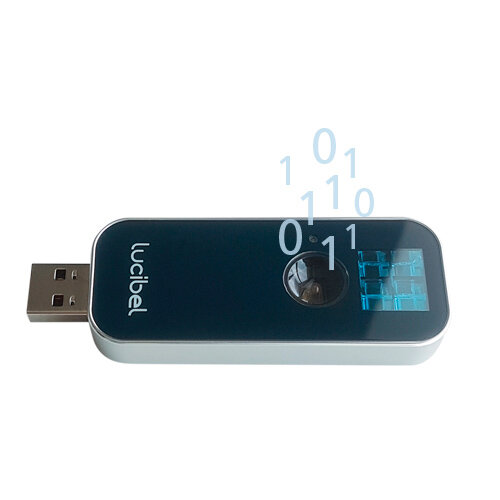
LiFi-Cle-USB-500x500px-1.jpg

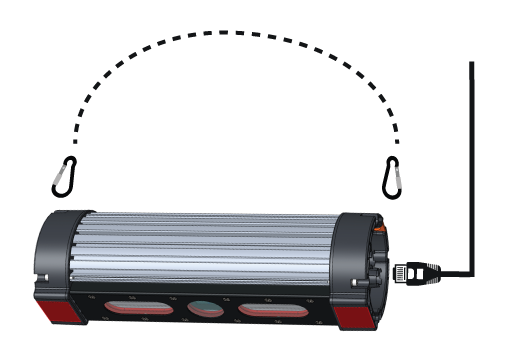
A few days ago, Lucibel made the announcement of the upcoming unveiling of their 3rd generation Li Fi product, the “Lucipanel LIFI”.

Lucibel

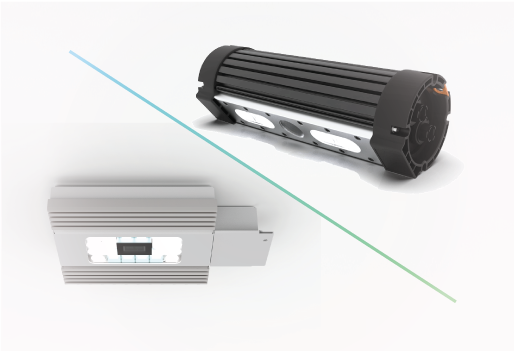
After the release of their 1st generation of Li Fi products in September 2016, the first industrialized LiFi luminaire in the world, followed the release of their 2nd generation of Li Fi products in October 2018, Lucibel is now bringing their third generation, with improved performance and a very sleek design, to the Li Fi market.  

Lucibel is an innovative French group that designs and manufactures new-generation lighting products and solutions in France based on LED technology. LED technology is cost efficient, sustainable, and smart. It is transforming the world and is now part of the digital era. Not only are Lucibel lighting solutions compatible with remote management systems. Light can now interact with its surroundings and be controlled and measured in real time. But it also allows for a new medium for data transmission, interactions, and well-being thanks to the development by Lucibel of innovative and smart solutions.

The drafting of a Li Fi standard, which began in July 2018 under the guidance of the international organization IEEE (Institute of Electrical and Electronics Engineers) Standards Association, should end in May 2022 with the publication of a global LiFi standard (802.11bb).

The eagerly awaited outcome of this process is creating a strong stir around this emerging technology. The growing interest in LiFi technology on the part of many players (designers and integrators of Li Fi solutions, manufacturers of smartphones and computers, telecom operators, end customers, etc.) makes it possible to anticipate a rapid acceleration in Li Fi penetration from the start. next year.

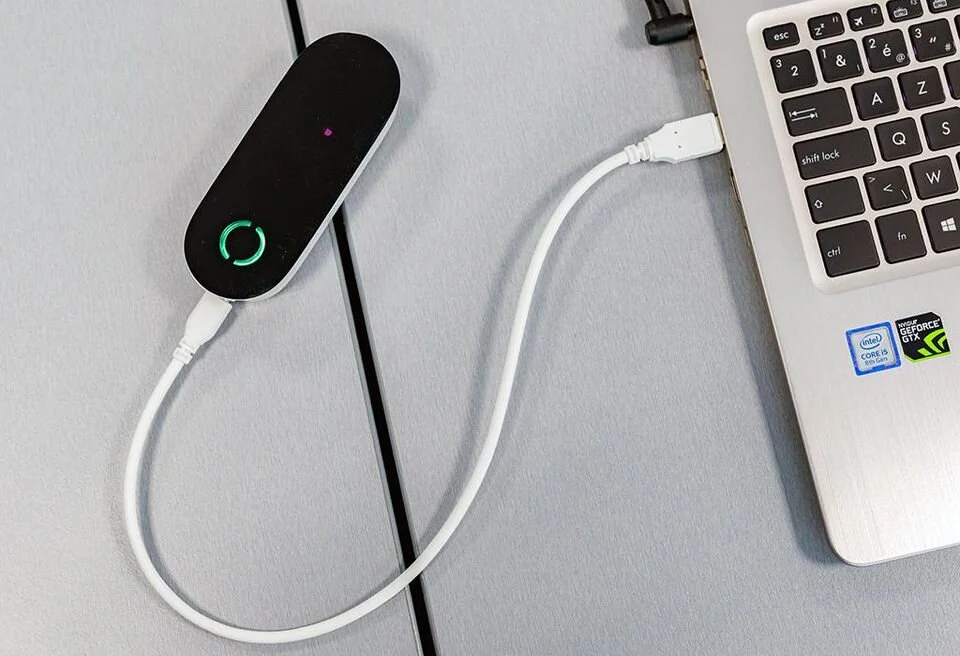
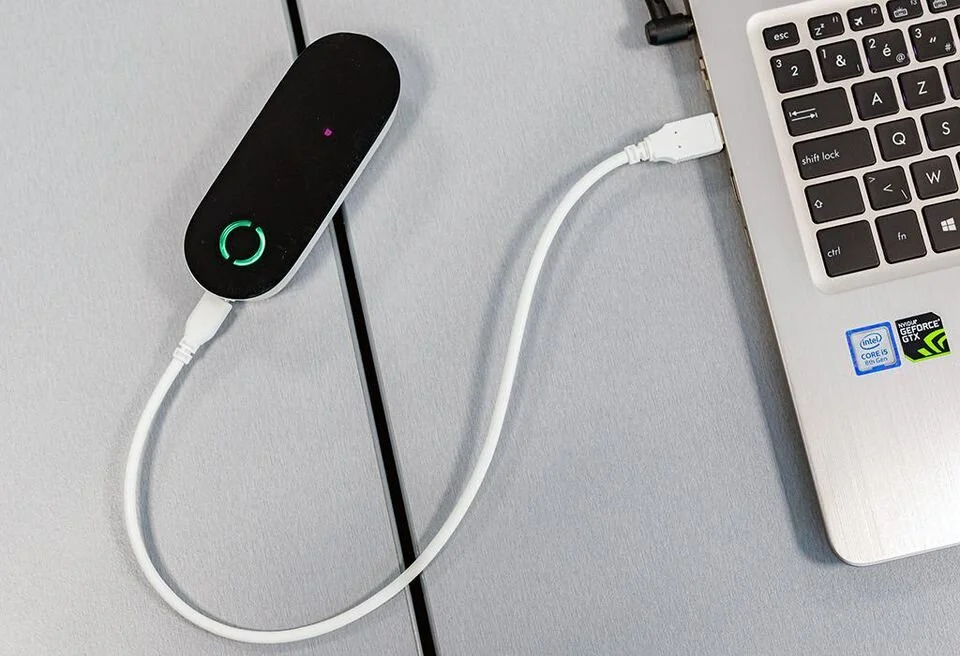
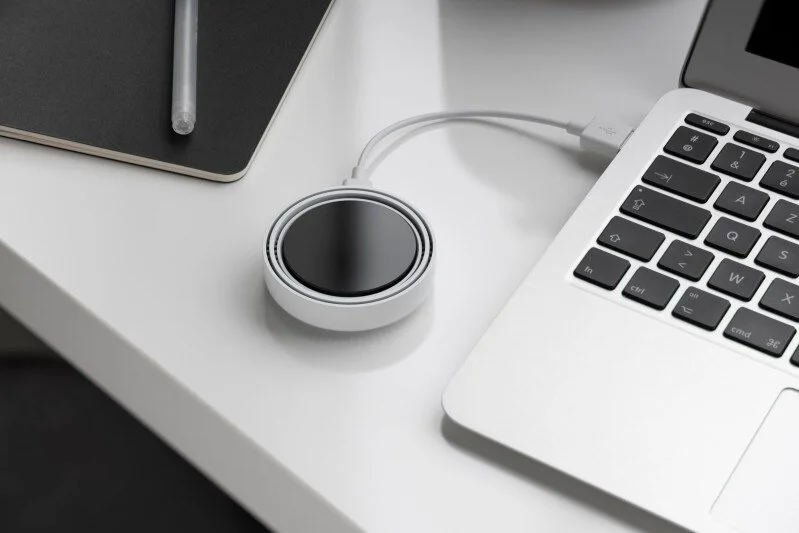
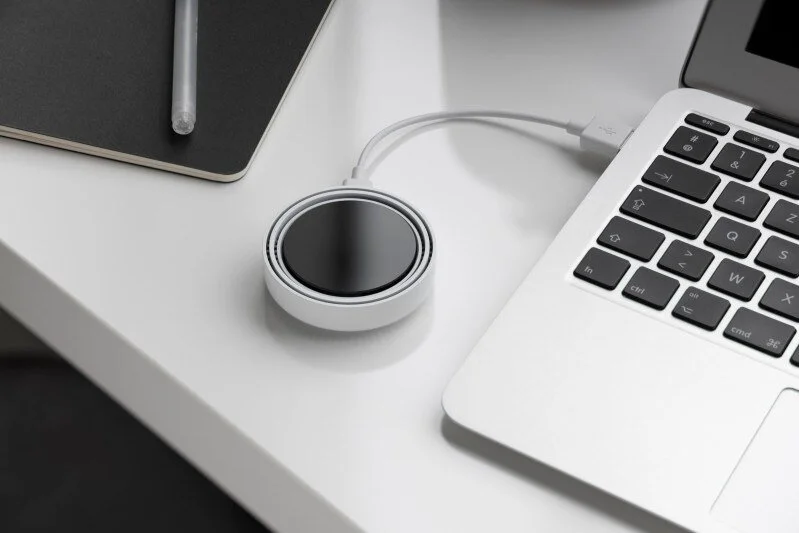
Indeed, the publication of a Li Fi standard will allow the native integration of the technology into the hardware (smartphones, PCs, tablets) which will include light emission and reception cells and will be able to interact directly with the Li Fi infrastructure. integrated into the ceiling. The user will thus be able to do without the Li Fi key which is still necessary today to establish the connection between the luminaire and the terminal.

The positioning of the Li Fi technology in the hardware market, expected in 2nd half of 2022, will enable a strong acceleration in the demand for deployments Li Fi infrastructure (lighting networks and Li Fi access points in buildings ceilings) which constitute the strategic development axis of Lucibel on this technology.


A pioneer in LiFi and with a significant customer base, Lucibel will benefit from this expected strong acceleration.

The first two generations of Lucibel LiFi have been marketed to more than 100 different customers (army, banks, companies in the defence sector, R&D centres, head offices, constrained industrial environments, hospitals, nurseries, etc…).

These first users have confirmed their interest in this solution, which allows a secure wireless Internet connection, without radiofrequency waves and offering excellent quality of service.

While the first two LiFi generations were mainly deployed on pilot projects (experimental phases), this third generation, which is compatible with the global standard currently being drafted, will allow a much wider deployment thanks to improved performance. and at a significantly lower marketing price.

LUCIPANEL LIFI, a powerful solution and a very discreet integration of LiFi technology in the luminaire. Convinced that a LiFi luminaire must be both beautiful and efficient, the Lucibel group designed this third generation with the desire that the LiFi functionality is as discreet as possible in the luminaire so that it can be deployed as widely as possible in workspaces, in perfect harmony with other luminaires already installed.


The main technical characteristics of the LUCIPANEL LIFI are as follows:

-A flow, up and down, of 100 Mbps, which is 2 times more than the 2nd generation of Lucibel LiFi products.

-The LiFi functionality is dissociated from the light and works even if the latter is off, thus ensuring continuity of service and optimized electricity consumption.

-The connectivity coverage area of ​​the LUCIPANEL LiFi is approximately 10 m² per luminaire.

-A simultaneous connection is possible for up to 16 users per access point.

-Lucipanel LiFi: a sleek design and discreet integration of LiFi technology

- LUCIPANEL LIFI: LiFi accessible for less than 100 € per m2 connected

To achieve this performance, Lucibel chose bi-directional infrared light which by nature needs a black coloured exit window. By an ingenious and patented process, this black window is replaced by a luminous surface that blends harmoniously with the light diffused by the LED panel. The integration of LiFi functionality into the luminaire is therefore almost imperceptible to the naked eye.

The technological leaps made over the past three years, combined with sharply rising volume forecasts, have made it possible to significantly reduce marketing prices.

The LUCIPANEL LIFI thus makes it possible to offer a lighting and connection solution in LiFi for a price of fewer than 100 € per metre square.

This third-generation will be delivered by Lucibel to its customers from October 15, 2021.  The LUCIPANEL LIFI will be presented in preview on the Lucibel group's stand at the Architect @ work Paris trade fair on September 23 and 24.

Frédéric Granotier, Chairman and founder of the Lucibel group, stated that: “With the launch of this third generation, Lucibel confirms its leadership in LiFi technology and remains ahead of its competitors. With good complementarity and technological compatibility with 5G, LiFi, soon to be standardized, offers very attractive prospects for growth and value creation."

What is Li Fi?

Li-Fi, also known as "Light Fidelity" is a wireless optical networking technology, which uses light-emitting diodes (LEDs) to transmit data. In 2011, professor Harald Haas made a Li-Fi demonstration at the TED (Technology, Entertainment, Design) Global Talk on Visible Light Communication (VLC).

VLC uses light as a medium to deliver high-speed communication like Wi-Fi and complies with the IEEE standard IEEE 802.15.7. The IEEE 802.15.7 is a high-speed, bidirectional, and fully networked wireless communication technology-based standard similar to Wi-Fi's IEEE 802.11.

How does Li Fi work?

Li-Fi is a high speed, bidirectional, and fully networked wireless communication of data using light. Li-Fi constitutes of several light bulbs that form a wireless network.

When an electrical current goes through to a LED light bulb, a stream of light (photons) emits from the lamp. LED bulbs are semiconductor devices, which means that the brightness of the light flowing through them can change at extremely high speeds. The signal is sent by modulating the light at different rates. The signal can then be received by a detector that interprets the changes in light intensity (the signal) as data. Also when the LED is ON, you transmit a digital 1, and when it is OFF, you transmit a 0.

Li Fi Benefits

The primary benefits of Li-Fi are as follows:

Security: Provides entirely secure access. Where there is no light there is no data.

Safety: Does not produce electromagnetic radiation and does not interfere with existing electronic systems.

Localisation: Allows localisation due to the small coverage area of Li-Fi access point - localisation can be used for very precise asset tracking.

Data density: Provides ubiquitous high-speed wireless access that offers substantially greater data density (data rate per unit area) than RF through high bandwidth reuse.
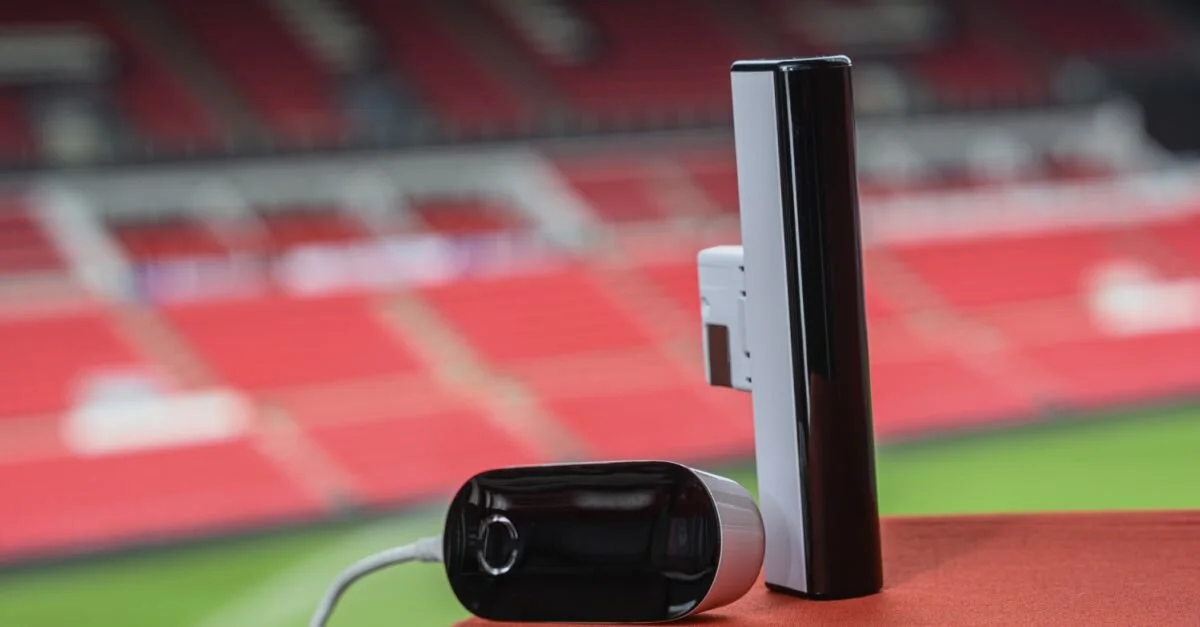
Credit to Signify

Li Fi Applications

Li-Fi can be used for so many applications and the list is increasing every year. You can read our updated list of Li-Fi applications at the following link:

https://www.lifitn.com/blog/2021/2/13/top-30-li-fi-applications-updated-list-including-potential-applications

Credit to pureLiFi

In conclusion, if you are also interested to hear more information about the OWNII Coin, investing in it, or enquire about Li-Fi devices such as the LiFiMax and Trulifi, you can contact us through our chatbot or by sending an email through our contact us form. If you enjoyed this post and would like to hear more updates about Li-Fi technology, subscribe to our newsletter. Don’t forget to subscribe to our social media accounts. You can also join our Telegram group about Li-Fi technology on this link:

https://t.me/joinchat/FMzOmsEKyJFrU6Af


Ahmedabad-based Nav Wireless Technologies Pvt Install Li Fi Technology at The Students' Educational and Cultural Movement of Ladakh (SECMOL)

Ahmedabad-based Nav Wireless Technologies Pvt Install Li Fi Technology at The Students' Educational and Cultural Movement of Ladakh (SECMOL)

nav.PNG

Nav Wireless Technologies and Students' Educational and Cultural Movement of Ladakh

Ahmedabad-based Nav Wireless Technologies (NavTech) Pvt Ltd has announced the installation of LiFi technology at India's highest altitude educational organisation, the Students' Educational and Cultural Movement of Ladakh (SECMOL).  This is done to helping the local education fraternity, the company said in a statement here.

SECMOL was founded in 1988 by a group of Ladakhi college students who felt that the education system needed great change. For many years, SECMOL worked on reforming the government school system. At the same time, SECMOL Campus grew into an eco-village where students, staff and volunteers live, work, and learn together. It’s not a conventional school, but a place to pursue practical, environmental, social, and traditional knowledge, values, and skills. The Campus is solar powered and solar heated; students learn ancient Ladakhi songs, dance, and history alongside modern academic knowledge; and the students mainly manage, run, and maintain the campus.

Ladakh is a high desert region in the Indian Himalayas, with a culture and history drawing from Tibet, India, Kashmir, and Central Asia.  SECMOL strives to equip young Ladakhis and others growing up in Ladakh, especially those from rural or disadvantaged backgrounds, with the knowledge, skills, perspective, and confidence to choose and build a sustainable future. 

Li Fi means transmitting data with a light beam spectrum through open space in outdoor and indoor environments.

Li Fi systems provide ultra-fast data connections and are especially useful in urban areas where radio spectra are congested and also very useful in rural areas wherein Fiber Optic Cables or networks are not reachable.

With this Li Fi setup, it said the faculties and students would get faster and safer internet connections over the existing electric power lines for various educational purposes.

According to their website, Nav Wireless Technologies Pvt Ltd is a global leading solutions and services provider of wireless and information communications systems with its own R&D facilities, manufacturing base, and sales and service teams. The company offers a comprehensive suite of products and services including Optical Wireless Communication Systems, Wireless Electricity Transmission systems, Electronic Tattoo for Healthcare Monitoring systems, Wireless enhancement products, and subsystems and wireless transmission systems to its global customers.

NavTech is a technology company focused on Research, Design and Development in the field of Optical Wireless Communications, Electronic Materials, Renewable Energy – Nanoscale to develop high-efficiency photovoltaic devices. NavTech's R&D initiative brings advanced wireless technologies to improving lives with projects that strengthen economic and social development.

NavTech product portfolio includes Optical Wireless Communication, Smart LED Lights, Advanced Wireless Transmission Systems, Wireless Broadband and Wireless Access Equipment. NavTech's services range includes consultation, product & network design, optimisation and commissioning.

Nav Wireless Technologies is the only registered company in the LiFi sector in Asia. Expounding on the motive behind the project, CTO of Nav Wireless Technologies Hardik Soni stated that "We had approached the institute authorities for this project, and they were highly impressed with such an innovative idea to provide faster, safer, and cheaper internet.  Under the leadership of SECMOL founder and president Sonam Wangchuk, the company will team up for covering the entire Ladakh and connect the unconnected areas using LiFi technology”.

"I am happy to see the set up for permanent internet connectivity using the innovative LiFi technology at our campus. This Li-Fi technology can bring revolutionary changes in the education sector,” Wangchuk said.

He said it would enable the students to stream educational videos and download resources with flawless connectivity.

"Faculties will also benefit from conducting online lectures and improving their skills. As this technology is environment-friendly, it goes with our vision to make a pollution-free and green world," he said.

What is Li Fi?

Li Fi, also known as "Light Fidelity" is a wireless optical networking technology, which uses light-emitting diodes (LEDs) to transmit data. In 2011, professor Harald Haas made a Li Fi demonstration at the TED (Technology, Entertainment, Design) Global Talk on Visible Light Communication (VLC).

VLC uses light as a medium to deliver high-speed communication like Wi-Fi and complies with the IEEE standard IEEE 802.15.7. The IEEE 802.15.7 is a high-speed, bidirectional, and fully networked wireless communication technology-based standard similar to Wi-Fi's IEEE 802.11.

How does Li Fi work?

Li Fi is a high speed, bidirectional, and fully networked wireless communication of data using light. Li-Fi constitutes of several light bulbs that form a wireless network.

When an electrical current goes through to a LED light bulb, a stream of light (photons) emits from the lamp. LED bulbs are semiconductor devices, which means that the brightness of the light flowing through them can change at extremely high speeds. The signal is sent by modulating the light at different rates. The signal can then be received by a detector that interprets the changes in light intensity (the signal) as data. Also when the LED is ON, you transmit a digital 1, and when it is OFF, you transmit a 0.

Li Fi Benefits

The primary benefits of Li Fi are as follows:

Security: Provides entirely secure access. Where there is no light there is no data.

Safety: Does not produce electromagnetic radiation and does not interfere with existing electronic systems.

Localisation: Allows localisation due to the small coverage area of Li Fi access point - localisation can be used for very precise asset tracking.

Data density: Provides ubiquitous high-speed wireless access that offers substantially greater data density (data rate per unit area) than RF through high bandwidth reuse.

Credit to Signify

Credit to Signify

Li Fi Applications

Li-Fi can be used for so many applications and the list is increasing every year. You can read our updated list of Li-Fi applications at the following link:

https://www.lifitn.com/blog/2021/2/13/top-30-li-fi-applications-updated-list-including-potential-applications

Credit to pureLiFi

In conclusion, if you are also interested to hear more information about the OWNII Coin, investing in it, or enquire about Li-Fi devices such as the LiFiMax and Trulifi, you can contact us through our chatbot or by sending an email through our contact us form. If you enjoyed this post and would like to hear more updates about Li-Fi technology, subscribe to our newsletter. Don’t forget to subscribe to our social media accounts. You can also join our Telegram group about Li-Fi technology on this link:

https://t.me/joinchat/FMzOmsEKyJFrU6Af
University Researchers Released A New Paper On Unexplored Semiconducting Materials for Li Fi And Other Next-Generation Data Communications

University Researchers Released A New Paper On Unexplored Semiconducting Materials for Li Fi And Other Next-Generation Data Communications

lifi 23.jpg

Research Team from Surrey, Cambridge and UESTC

A few days ago, a team of researchers from the University of Surrey and the University of Cambridge along with a partnership with the University of Electronic Science and Technology of China released a paper on the development of emerging LED materials—organic semiconductors, colloidal quantum dots and metal halide perovskites—for use in optical communications.

Organic semiconductors are made up of polymers or π-bonded molecules and can conduct when charge carriers are injected into them. Colloidal quantum dots (QDs) are nanoscale semiconductor crystals with surface ligands that enable their dispersion in solvents. Metal halide perovskites refer to a large family of crystalline materials with structures similar to that of the natural mineral calcium titanate, which was discovered by Gustav Rose in 1839 and named after Russian mineralogist Lev Perovski. Metal halide perovskites have shown promising optoelectronic properties suitable for light-emitting applications according to a recent paper published by naturematerials.

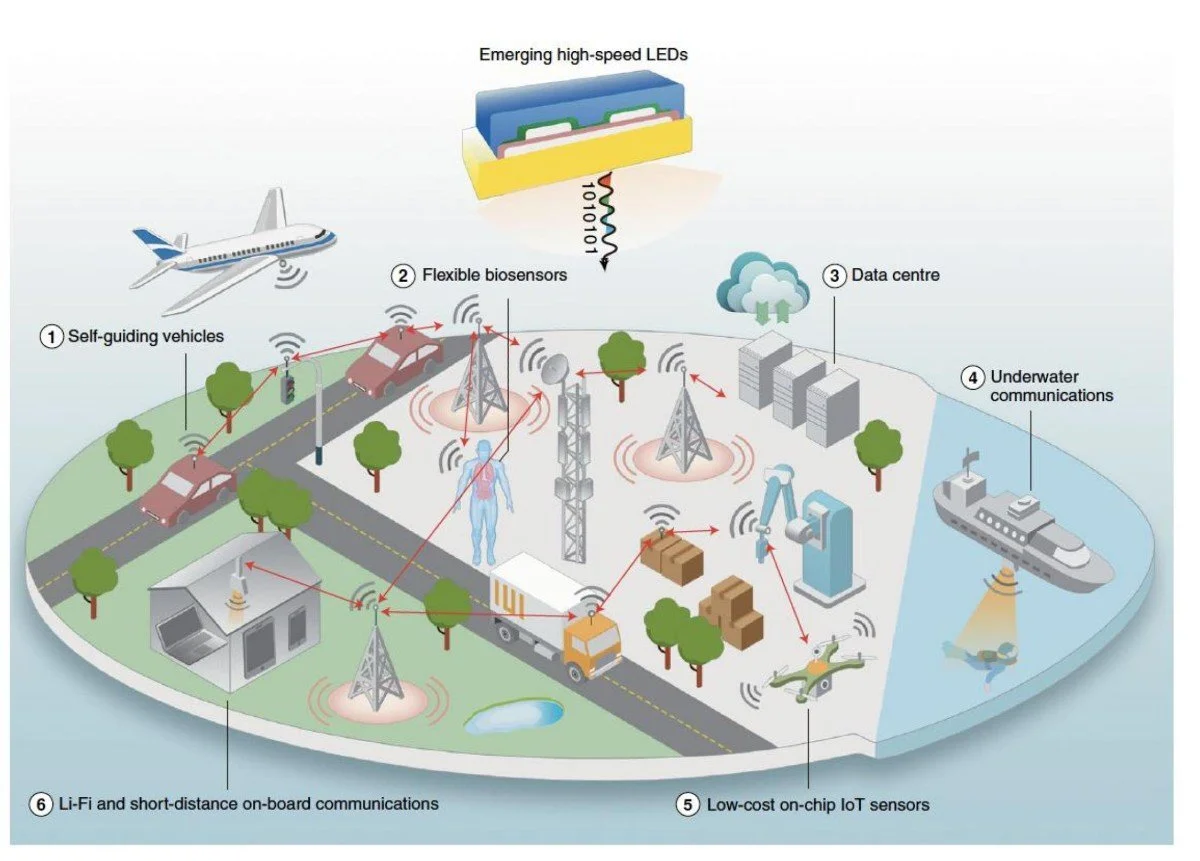
The Research team examined efforts to improve the modulation performance and device efficiency of these LEDs and consider potential applications in on-chip interconnects and light fidelity (Li Fi, also spell "Li-Fi). They also explore the challenges that exist in developing practical high-speed LED-based data communication systems. The paper was published by natureelectronics .

The continuing development of consumer electronics, mobile communications and advanced computing technologies has led to rapid growth in data traffic, creating challenges for the communications industry. Light-emitting diode (LED)-based communication links are of potential use in both free space and optical interconnect applications, and LEDs based on emerging semiconductor materials, which can offer tunable optoelectronic properties and solution-processable manufacturing, are of particular interest in the development of next-generation data communications.

Credit to University of Surrey

Credit to University of Surrey

Dr Aobo Ren, the co-first author and visiting postdoctoral researcher at the University of Surrey, said:

“There’s excitement surrounding CQDs and perovskites because they offer great promise for low-power, cost-effective and scalable communications modules.

“Although the conventional inorganic thin-film technologies are likely to continue to play a dominant role in optical communications, we believe that LEDs based on these materials can play a complementary role that could have a sizeable impact on the industry.”

Hao Wang, the co-first author and PhD student at the University of Cambridge, said:

“Future applications of LEDs will not be limited to the fields of lighting and displays. The development of LEDs based on these solution-processable materials for optical communication purposes has only begun, and their performance is still far from what’s required. It is necessary and timely to discuss the potential strategies and present technical challenges for the deployment of real-world communication links using these LEDs from the material, device and system aspects.”

Professor Jiang Wu, the corresponding author from the University of Electronic Science and Technology of China, said:

“Photonic devices for the Internet of Things (IoT) and 6G communication systems need to be high-speed, low-cost and easy to integrate. Organic semiconductors, CQDs and perovskites are promising materials that could be used to complement and/or compete with conventional inorganic counterparts in particular optoelectronic applications.”

Dr Wei Zhang, the corresponding author and Senior Lecturer from the University of Surrey, said:

“IoT and 6G communication systems represent a trillion-dollar market in the next few years. We are proud to collaborate with the top research teams in this field and accelerate the development of emerging data communication technology for rapid entry to the market in the next decade.”

What is Li Fi?

Li-Fi, also known as "Light Fidelity" is a wireless optical networking technology, which uses light-emitting diodes (LEDs) to transmit data. In 2011, professor Harald Haas made a Li-Fi demonstration at the TED (Technology, Entertainment, Design) Global Talk on Visible Light Communication (VLC).

VLC uses light as a medium to deliver high-speed communication like Wi-Fi and complies with the IEEE standard IEEE 802.15.7. The IEEE 802.15.7 is a high-speed, bidirectional, and fully networked wireless communication technology-based standard similar to Wi-Fi's IEEE 802.11.

How does Li Fi work?

Li-Fi is a high speed, bidirectional, and fully networked wireless communication of data using light. Li-Fi constitutes of several light bulbs that form a wireless network.

When an electrical current goes through to a LED light bulb, a stream of light (photons) emits from the lamp. LED bulbs are semiconductor devices, which means that the brightness of the light flowing through them can change at extremely high speeds. The signal is sent by modulating the light at different rates. The signal can then be received by a detector that interprets the changes in light intensity (the signal) as data. Also when the LED is ON, you transmit a digital 1, and when it is OFF, you transmit a 0.

Li Fi Benefits

The primary benefits of Li Fi are as follows:

Security: Provides entirely secure access. Where there is no light there is no data.

Safety: Does not produce electromagnetic radiation and does not interfere with existing electronic systems.

Localisation: Allows localisation due to the small coverage area of Li Fi access point - localisation can be used for very precise asset tracking.

Data density: Provides ubiquitous high-speed wireless access that offers substantially greater data density (data rate per unit area) than RF through high bandwidth reuse.

LiFiMAX-Oledcomm.jpg

Li Fi Applications

Li-Fi can be used for so many applications and the list is increasing every year. You can read our updated list of Li-Fi applications at the following link:

https://www.lifitn.com/blog/2021/2/13/top-30-li-fi-applications-updated-list-including-potential-applications

Credit to pureLiFi

Credit to pureLiFi

In conclusion, if you are also interested to hear more information about the OWNII Coin, investing in it, or enquire about Li-Fi devices such as the LiFiMax and Trulifi, you can contact us through our chatbot or by sending an email through our contact us form. If you enjoyed this post and would like to hear more updates about Li-Fi technology, subscribe to our newsletter. Don’t forget to subscribe to our social media accounts. You can also join our Telegram group about Li-Fi technology on this link:

https://t.me/joinchat/FMzOmsEKyJFrU6Af
Signify Joins HomeGrid Forum For The Expansion Of G.hn Technology Deployment With Li Fi Technology

Signify Joins HomeGrid Forum For The Expansion Of G.hn Technology Deployment With Li Fi Technology

signify 3.PNG

A few days ago, HomeGrid Forum announced that Signify has joined the organisation for expanding the innovation and deployment of G.hn technology for Li Fi applications.

HomeGrid Forum

According to their website, HomeGrid Forum (HGF) is an industry alliance formed to support the development and deployment of a unified coaxial, phone line, powerline, and plastic optical fibre home networking technology called G.hn (Gigabit Home Networking). G.hn technology is based on standards developed by the UN’s International Telecommunications Union – Telecom (ITU-T) standards development organization.

HomeGrid Certification ensures compliance and interoperability (C&I) of silicon and systems through plugfests and rigorous C&I testing. A logo is issued for certified systems’ packaging and documentation of G.hn-based systems. HGF Certification ensures that retail customers and Service Providers have confidence in, and great satisfaction with all HGF G.hn Certified Certified products.

HomeGrid Forum members comprise an eco-system covering all aspects of the technology from Retailers to Service Providers, Utilities to Smart Grid think tanks, System Developers to Test Houses and Silicon Companies.

HomeGrid currently has four workgroups: a Clean Tech/Smart Grid/Smart Energy workgroup focused on in-home energy management and utility Distribution Automation and AMI applications for G.hn, a G.hn Contributions workgroup that continuously works to develop advanced enhancements for wired home networking, a Compliance & Interoperability workgroup, and a Marketing workgroup focused on promoting all HomeGrid Certified Products and technologies.

The purpose of HomeGrid Forum is to:

  • Lead the work within the ITU-T to continuously expand G.hn, through a sustained effort to improve and extend this advanced home networking technology for any in-home wiring (coaxial cable, phone line, powerline and plastic optical fiber).

  • Encourage and evangelize the adoption and widespread deployments of G.hn by Service Providers and through Retail channels.

  • Provide a clear migration path for all legacy wired technologies to G.hn, where coexistence and G.hn’s ability to work over any wire type enables Service Providers to extend the life of their existing network investments while increasing coverage, robustness, and throughput in the home.

  • Maintain a comprehensive compliance and interoperability program to promote an ecosystem of compliant silicon and interoperable products based on the ITU-T G.hn standards.

Livia Rosu, HomeGrid Forum President, stated: “This is an extremely exciting time for the LiFi community, and we are thrilled to welcome Signify as a Contributor member. Together we will enable innovation and network infrastructure that are fully interoperable with a growing number of devices, at a time when demand for reliable and secure connectivity is increasing”.

Livia Rosu further stated that “LiFi will build on an open standard to ensure full interoperability and widespread market acceptance. Signify’s expertise will be instrumental as the Forum continues to innovate G.hn technology for LiFi use cases in airports, banks, factories, government and defence organizations – all of which require simultaneous high security and low latency connectivity.

Signify

Signify is the new brand name of Philips Lighting. The name change occurred in March 2018 to represent the transformation from an analogue lighting company into digital lighting and Internet of Things (IoT) company. Signify is the world leader in lighting for professionals, consumers and lighting for the Internet of Things. The company provides lighting solutions for professional segments such as automotive, healthcare, horticulture, office, outdoor, phototherapy, petrol stations, solar, purification, schools, fashion, cinema, and more. These lighting solutions include indoor and outdoor luminaires, lamps, electronics, lighting controls, lighting control software, IoT systems and platforms.

Signify has also other brands under its belt such as Philips, Interact, Modular Lighting Instruments, Luceplan, Color Kinetics, ILTI Luce and Philips Hue.

“Standardization is the cornerstone for LiFi interoperability, which is an essential condition for lowering barriers to adoption, encouraging competition and innovation, and building consumer confidence,” said Musa Unmehopa, Head of Ecosystems and Strategic Alliances at Signify. “We join HomeGrid Forum to grow the LiFi ecosystem in which we collectively create and build a global market where we can all compete effectively and serve consumers.”

Dr. Leonard Dauphinee, Vice President and CTO of Broadband Products at MaxLinear added: “Signify’s Trulifi product series is embedding MaxLinear’s G.hn chipsets to modulate the light waves to transmit data and to provide backhaul over existing wires, such as powerline. By leveraging their lighting infrastructure, Signify customers get the best of both worlds: a great lighting experience and a high speed wireless G.hn-encoded LiFi connection with a reliable G.hn wired backbone.”

Trulifi system

In 2019, Signify launched a new Li-Fi system called “Trulifi”. Trulifi uses light waves to enable highly reliable, secure two-way wireless communications at speeds far above most conventional workplace wireless technologies.

Trulifi uses optical wireless transceiver technology built, or retrofitted, into Philips luminaires. This means customers do not have to replace their existing lighting infrastructure to receive great quality light and wireless connectivity.

trulifi-2.jpg

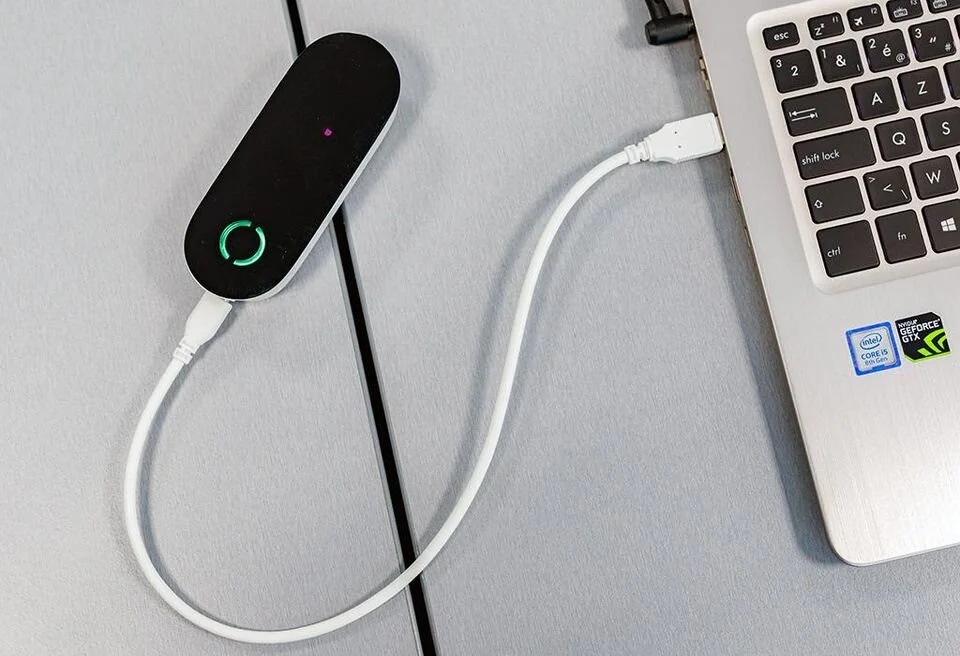
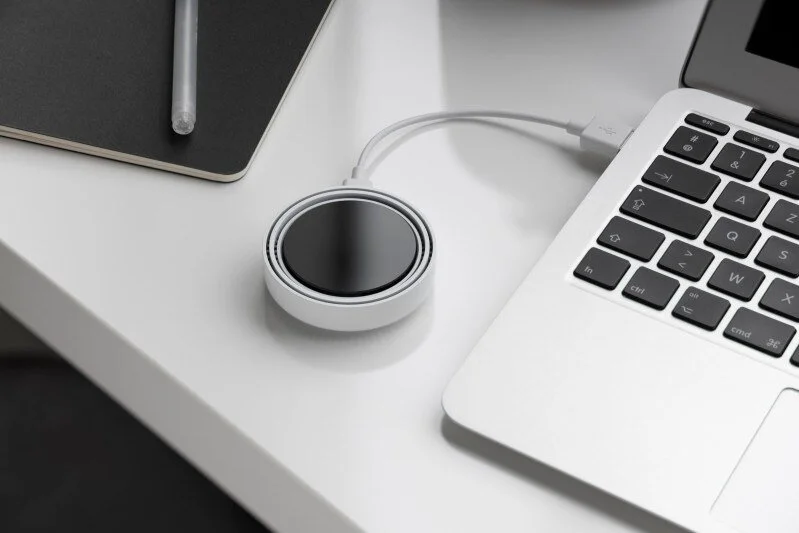
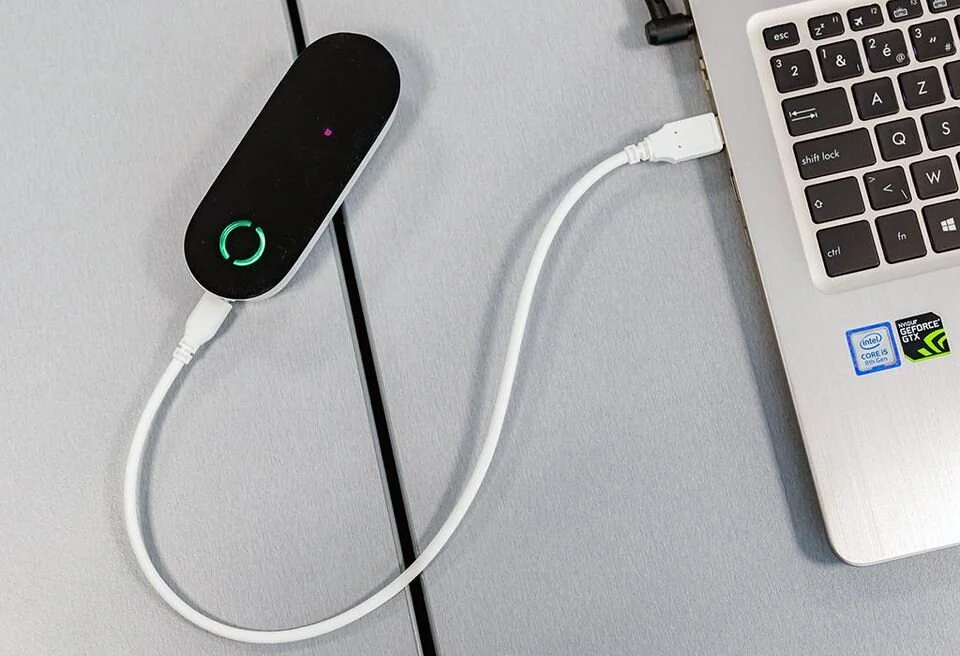
The new Li-Fi system comprises of a USB Network Access adapter, Li-Fi enabled LED lights and a Trulifi-6002 Plug-In Optical Transceiver. The Trulifi-enabled luminaires can provide wireless connectivity at speeds up to 150 Megabits per second (Mbps) over large spaces, such as meeting rooms and office floors. There is seamless handover between each Trulifi-enabled luminaire enabling users to roam around. The speed is fast enough to stream simultaneously 30 1080p HDTV movies. A USB-access key, plugged into a laptop, is needed to receive the LiFi signal and acts as an emitter to send data back to the luminaire.

The Trulifi range also includes a fixed point-to-point system, up to 250 Mbps speed, which acts as a wireless cable. This is ideal for mobile devices connectivity. This Li-Fi system can also be useful to connect robots or machines in radio frequency (RF) harsh environments like industrial plants, or hospitals where RF communications may not be permitted, or where there’s a need to send and receive large data files securely and quickly. Currently, Trulifi is aimed at professional markets, including offices, hospitality, retail, industry, construction and healthcare.

What is Li Fi?

Li-Fi, also known as "Light Fidelity" is a wireless optical networking technology, which uses light-emitting diodes (LEDs) to transmit data. In 2011, professor Harald Haas made a Li-Fi demonstration at the TED (Technology, Entertainment, Design) Global Talk on Visible Light Communication (VLC).

VLC uses light as a medium to deliver high-speed communication like Wi-Fi and complies with the IEEE standard IEEE 802.15.7. The IEEE 802.15.7 is a high-speed, bidirectional, and fully networked wireless communication technology-based standard similar to Wi-Fi's IEEE 802.11.

How does Li Fi work?

Li-Fi is a high speed, bidirectional, and fully networked wireless communication of data using light. Li-Fi constitutes of several light bulbs that form a wireless network.

When an electrical current goes through to a LED light bulb, a stream of light (photons) emits from the lamp. LED bulbs are semiconductor devices, which means that the brightness of the light flowing through them can change at extremely high speeds. The signal is sent by modulating the light at different rates. The signal can then be received by a detector that interprets the changes in light intensity (the signal) as data. Also when the LED is ON, you transmit a digital 1, and when it is OFF, you transmit a 0.

Li Fi Benefits

The primary benefits of Li-Fi are as follows:

Security: Provides entirely secure access. Where there is no light there is no data.

Safety: Does not produce electromagnetic radiation and does not interfere with existing electronic systems.

Localisation: Allows localisation due to the small coverage area of Li-Fi access point - localisation can be used for very precise asset tracking.

Data density: Provides ubiquitous high-speed wireless access that offers substantially greater data density (data rate per unit area) than RF through high bandwidth reuse.

Trulifi.jpg

Credit to Signify

Li Fi Applications

Li-Fi can be used for so many applications and the list is increasing every year. You can read our updated list of Li-Fi applications at the following link:

https://www.lifitn.com/blog/2021/2/13/top-30-li-fi-applications-updated-list-including-potential-applications

kitefin 1.png

Credit to pureLiFi

In conclusion, if you are also interested to hear more information about the OWNII Coin, investing in it, or enquire about Li-Fi devices such as the LiFiMax and Trulifi, you can contact us through our chatbot or by sending an email through our contact us form. If you enjoyed this post and would like to hear more updates about Li-Fi technology, subscribe to our newsletter. Don’t forget to subscribe to our social media accounts. You can also join our Telegram group about Li-Fi technology on this link:

https://t.me/joinchat/FMzOmsEKyJFrU6Af


Oledcomm Presented Their New Gigabit Optical Front End (OFE) Chip At The MWC (Mobile World Congress) Barcelona 2021

Oledcomm Presented Their New Gigabit Optical Front End (OFE) Chip At The MWC (Mobile World Congress) Barcelona 2021

MWC 21.PNG

Oledcomm

Oledcomm designs and develops LiFi network interface devices that enable high-speed wireless data communication. It also serves LiFi equipment in the telecom, datacom, personal electronics, and industrial markets. The company’s product portfolio includes hubs, routers, switches, adapters, drivers, power supplies, and more.

Oledcomm was founded in 2012 and is based in Paris, France. Oledcomm's adventure began in 2005 in the research laboratories of the University of Versailles-Saint-Quentin with the first work on communication by visible light.

Following years of research & development and a passion for innovation, Oledcomm became the pioneer of LiFi (Light Fidelity) solutions and innovation on a global scale.

Credit to Oledcomm

Credit to Oledcomm

Based in the Paris region, Oledcomm employs around 20 people and designs complete solutions for LiFi operation, including microcontrollers, LiFi photoreceivers and software platforms.

Today, after more than 28 patents, 15 years of R&D, over 500 trusted clients and several awards, Oledcomm is pursuing a strong mission: to transform the 14 billion points of light in the world into a powerful communication network.

MWC Barcelona 2021

MWC Barcelona (formerly Mobile World Congress) is the largest mobile event in the world as well as the meeting place for the leaders of the mobile and related industries. The event is held in Barcelona, Catalonia, Spain at the Fira de Barcelona Gran Via, usually in February or early March. It is attended primarily by device manufacturers, network equipment providers, representatives of wireless carriers, and the press, among others. Its annual attendance is generally around 100,000 people, while mobile phone manufacturers often use the conference to unveil upcoming devices.

GSMA has extended the MWC brand to two other trade shows in Shanghai, China (MWC Shanghai) and Los Angeles, United States (MWC Los Angeles, formerly MWC Americas), but the brand remains most synonymous with Barcelona event.

MWC Barcelona attracts some of the most influential decision-makers in the world. It’s where 2,400 leading companies and trailblazers share the latest topics relevant to the future. And the best place for networking opportunities with mobile and tech industry influencers.

During the Mobile World Congress, which took place from June 28 to July 1 in Barcelona (Spain), Oledcomm presented its new Gigabit Optical Front End (OFE) chip. It integrates directly into mobile devices to allow them to exchange data by light thanks to Li Fi (Light Fidelity) technology.

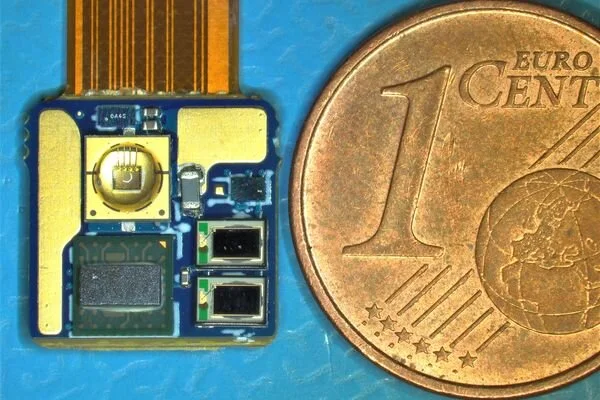
Credit to Oledcomm.  Li Fi chip is equipped with a VCSEL laser (yellow circle), two photodiodes (lower right) and an ASIC processor (grey rectangle lower left)

Credit to Oledcomm. Li Fi chip is equipped with a VCSEL laser (yellow circle), two photodiodes (lower right) and an ASIC processor (grey rectangle lower left)

This integrated circuit makes it possible to insert Li Fi functions directly into mobile devices, and in particular smartphones for which the dongle is not suitable. "It's a revolution," proclaims Benjamin Azoulay, president of the company. This places us among the only two companies in the world to have miniaturized LiFi technology. " The competitor in question being the Scottish pureLiFi.

Li Fi transmits information at high-speed thanks to the ultra-fast flickering of light sources. Manufactured by STMicroelectronics, the Gigabit OFE chip has a light source which can be a small VCSEL laser (for vertical-cavity surface-emitting laser) - the same type as those found in some smartphones for facial recognition - or a light-emitting diode (LED). The light is received by two photodiodes and an ASIC (Application-Specific Integrated Circuit) microprocessor processes the transmitted and received signals.

Thanks to his chip, Mr Azoulay imagines a future for LiFi similar to that of WiFi: “Before manufacturers integrated it into their devices, WiFi was also obtained with USB keys. We have engaged in discussions with major manufacturers of mobile devices. "

Applications range from the general public to education, including industry and defence. “Let's be clear, LiFi will never replace WiFi, admits Mr Azoulay, however. But it has its place in niche markets which already represent significant volumes. For now, we are targeting more professional applications. The general public will come later. » Two equipped devices can exchange data for example. They can also communicate with a LiFi router positioned on the ceiling of a room. “Education is an application area in which we believe a lot,” says Mr Azoulay, who imagines student tablets connected to routers on the ceiling of the classroom.

Credit to Oledcomm

Credit to Oledcomm

Because light does not pass through walls, Li Fi offers more security when transmitting data. A weight advantage over WiFi which nevertheless wins from the point of view of speed. While Oledcomm announces that it will reach a speed of 1 Gbps (gigabit per second) over a distance of 1 to 5 meters, WiFi 6 theoretically allows reaching a speed of 10 Gbps. On the other hand, LiFi outclasses Bluetooth for the exchange of data between devices: "Li Fi speed is about a thousand times higher," says Mr Azoulay. LiFi also makes it possible to avoid the presence of radiofrequency waves in places where they are sometimes unwelcome - especially in classrooms or certain industrial environments.

What is Li Fi?

Li-Fi, also known as "Light Fidelity" is a wireless optical networking technology, which uses light-emitting diodes (LEDs) to transmit data. In 2011, professor Harald Haas made a Li-Fi demonstration at the TED (Technology, Entertainment, Design) Global Talk on Visible Light Communication (VLC).

VLC uses light as a medium to deliver high-speed communication like Wi-Fi and complies with the IEEE standard IEEE 802.15.7. The IEEE 802.15.7 is a high-speed, bidirectional, and fully networked wireless communication technology-based standard similar to Wi-Fi's IEEE 802.11.

How does Li Fi work?

Li-Fi is a high speed, bidirectional, and fully networked wireless communication of data using light. Li-Fi constitutes of several light bulbs that form a wireless network.

When an electrical current goes through to a LED light bulb, a stream of light (photons) emits from the lamp. LED bulbs are semiconductor devices, which means that the brightness of the light flowing through them can change at extremely high speeds. The signal is sent by modulating the light at different rates. The signal can then be received by a detector that interprets the changes in light intensity (the signal) as data. Also when the LED is ON, you transmit a digital 1, and when it is OFF, you transmit a 0.

Li Fi Benefits

The primary benefits of Li-Fi are as follows:

Security: Provides entirely secure access. Where there is no light there is no data.

Safety: Does not produce electromagnetic radiation and does not interfere with existing electronic systems.

Localisation: Allows localisation due to the small coverage area of Li-Fi access point - localisation can be used for very precise asset tracking.

Data density: Provides ubiquitous high-speed wireless access that offers substantially greater data density (data rate per unit area) than RF through high bandwidth reuse.

Credit to Signify

Credit to Signify

Li Fi Applications

Li-Fi can be used for so many applications and the list is increasing every year. You can read our updated list of Li-Fi applications at the following link:

https://www.lifitn.com/blog/2021/2/13/top-30-li-fi-applications-updated-list-including-potential-applications

Credit to pureLiFi

Credit to pureLiFi

In conclusion, if you are also interested to hear more information about the OWNII Coin, investing in it, or enquire about Li-Fi devices such as the LiFiMax and Trulifi, you can contact us through our chatbot or by sending an email through our contact us form. If you enjoyed this post and would like to hear more updates about Li-Fi technology, subscribe to our newsletter. Don’t forget to subscribe to our social media accounts. You can also join our Telegram group about Li-Fi technology on this link:

https://t.me/joinchat/FMzOmsEKyJFrU6Af
pureLiFi Demonstrates Their New LiFi Enabled Phone At The OFC Conference

pureLiFi Demonstrates Their New LiFi Enabled Phone At The OFC Conference

w1.PNG

pureliFi

pureLiFi announced and demonstrated their LiFi enabled phone at the OFC Conference. OFC is the largest global conference and exhibition for optical communications and networking professionals. The program is comprehensive ranging from research to the marketplace, from components to systems and networks and from technical sessions to the exhibition. For over 40 years, OFC has drawn attendees from all corners of the globe to meet and greet, teach and learn, make connections and move the industry forward.

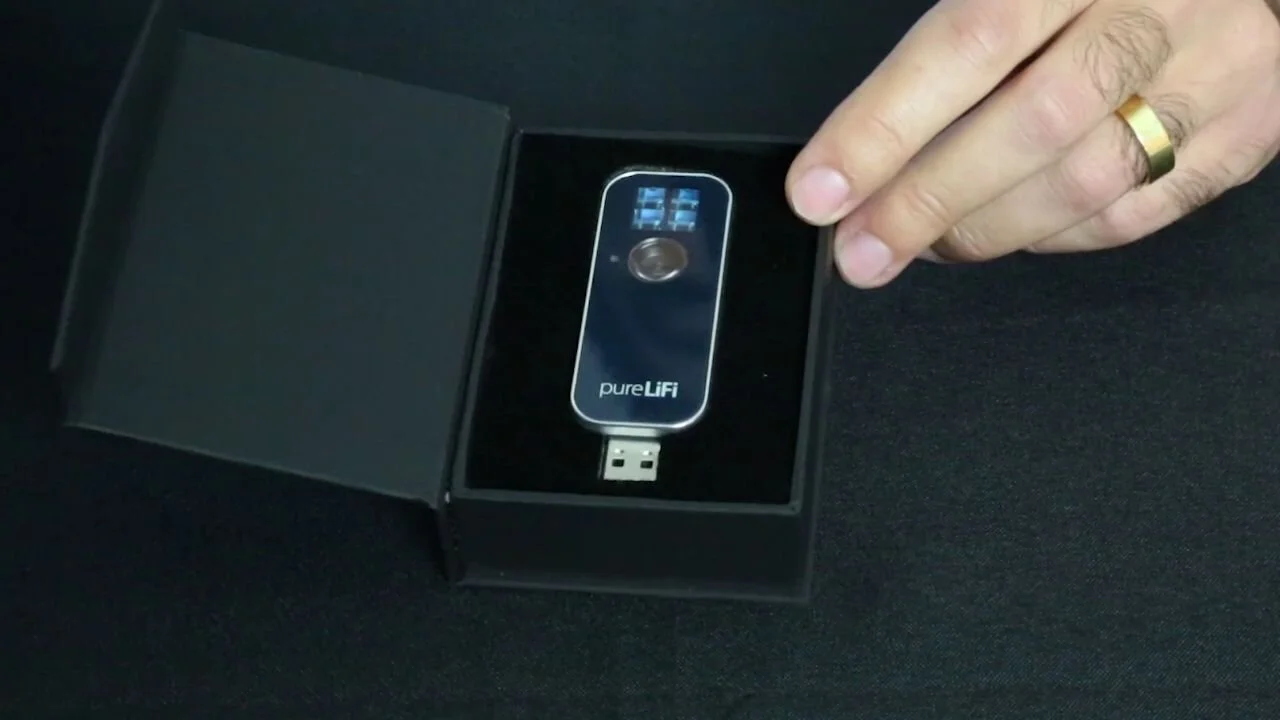
pureLiFi develops technology for communication networks that integrates data and lighting utility infrastructures. It offers a LiFi enabled device that converts the beam of lights into an electrical signal. The signal is then converted back into data. The company was founded in 2012 and is headquartered in Edinburgh.

Credit to pureLiFi

Credit to pureLiFi

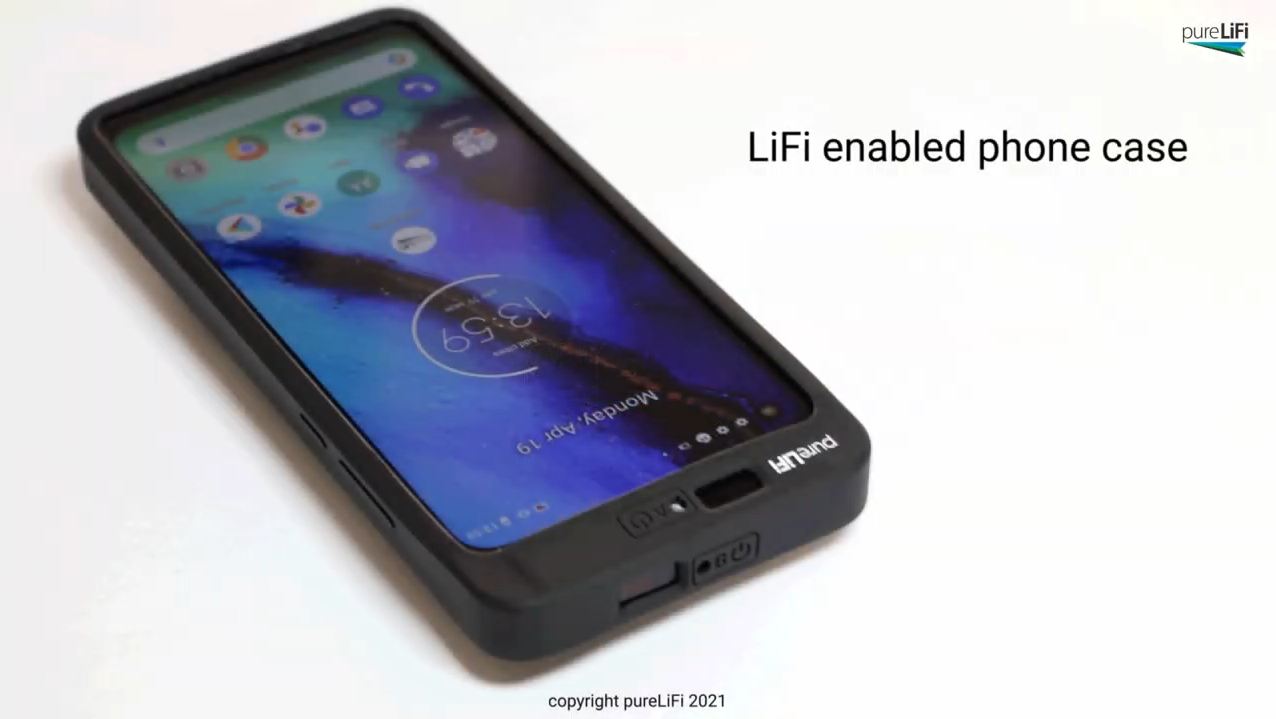
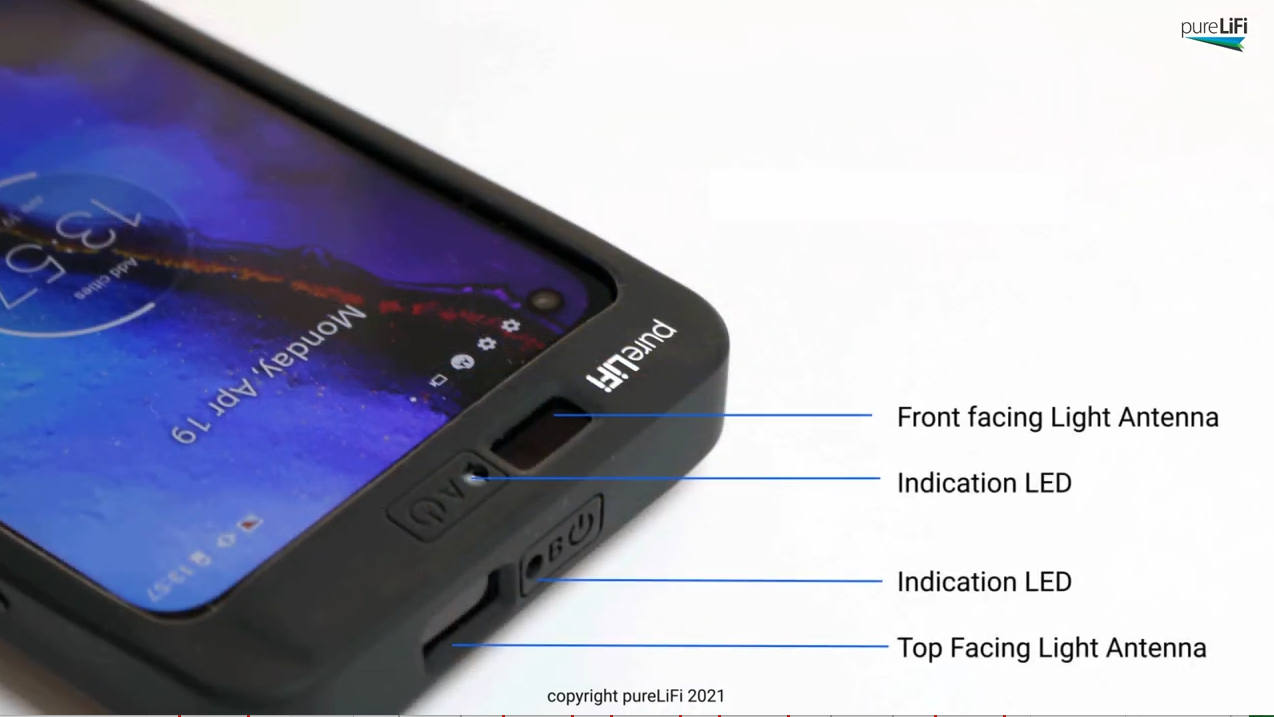
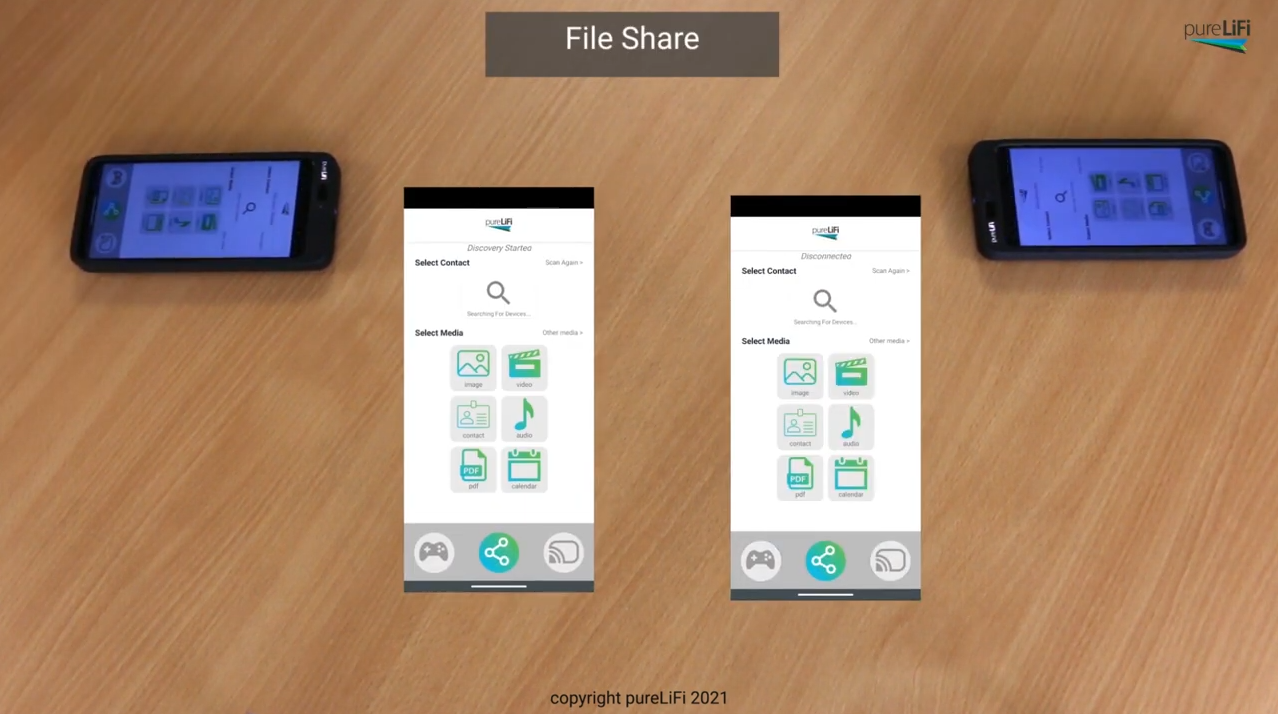
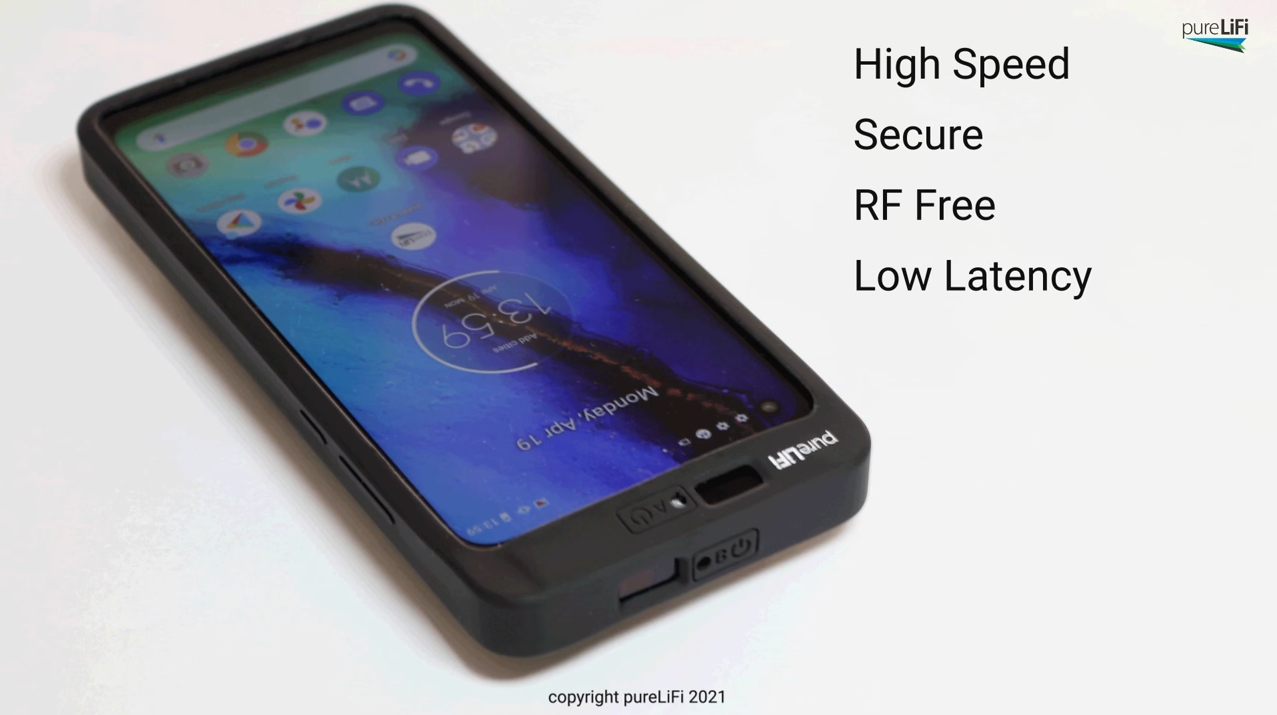
pureLiFi showed how two LiFi enabled phones can connect to each other offering more reliable, fast, and secure communications, making it safer and easier to share data, collaborate, and play games with friends using your phone. You can watch the following video about pureLiFi new LiFi enable phone:

“This video will demonstrate the Li Fi enabled phone case for the Moto G mobile phone. As you can see here, the phone case incorporates two lightened tennis one front facing and the other top facing. The phone case also incorporates to indicator LED lights. For demonstration purposes, this would not be required in the real-world integration. These lights do not transmit data. First, we will demonstrate how the life enable phone can quickly and securely transfer a file while pointing at another life enabled phone.”

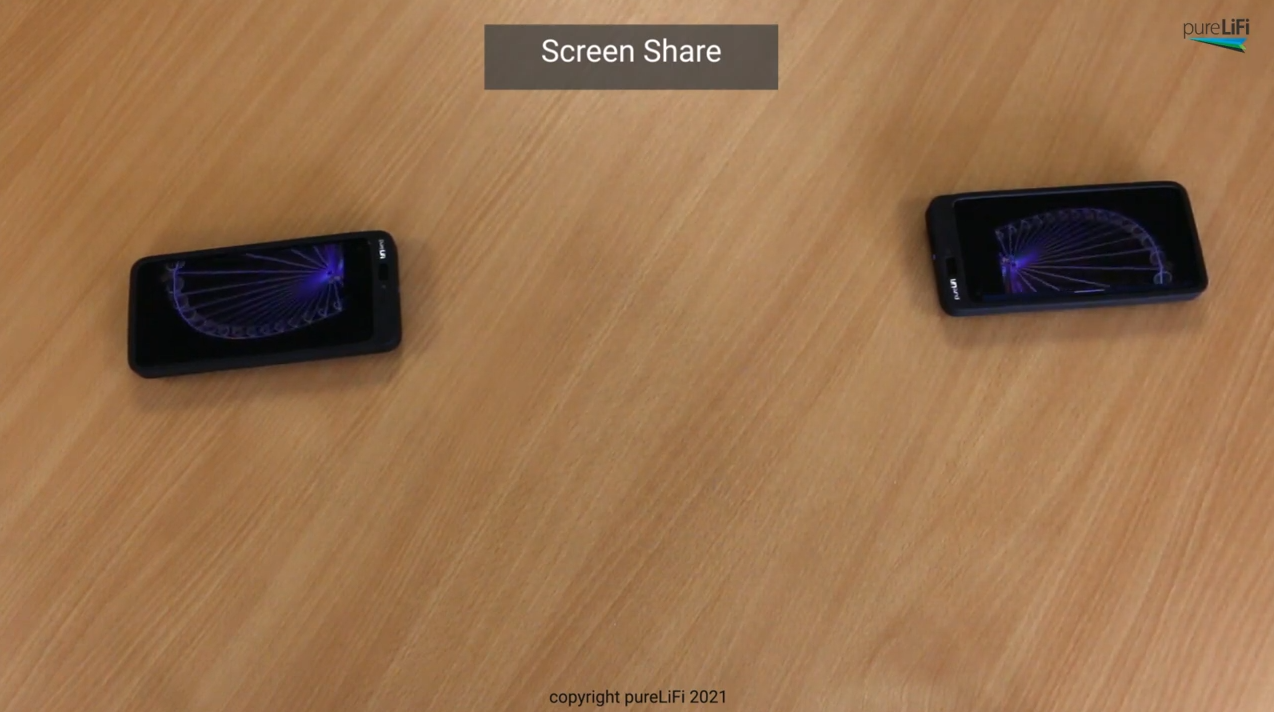
“As you can see here, this 4k video is transferring in a couple of seconds. Li Fi is a wireless technology that requires intentional connectivity. As you can see here when the phone is pointed away from the target, there is no transfer of data allowing for the user to control where information is shared. This makes Li Fi particularly useful for sending payments or secure information. It is also possible to screen share between phones taking advantage of Li Fi fast low latency connections. Li Fi can enable all new multiplayer gaming scenarios that enable fast, reliable low latency gaming just like using your console at home.”

“As you can see here the use of Li Fi is not only fast, but provides intentional and secure connections. As Li Fi does not use radio frequencies and offers low latency connections. The user experience and the quality of connections can enable new user experiences with just your mobile phone.”

Credit to pureLiFi

Credit to pureLiFi

Credit to pureLiFi

Credit to pureLiFi

Credit to pureLiFi

Credit to pureLiFi

Credit to pureLiFi

Credit to pureLiFi

The OFC Conference is still still until the 11th June. You can still register and buy your ticket on the following link:

https://www.ofcconference.org/en-us/home/registration/

What is Li-Fi?

Li-Fi, also known as "Light Fidelity" is a wireless optical networking technology, which uses light-emitting diodes (LEDs) to transmit data. In 2011, professor Harald Haas made a Li-Fi demonstration at the TED (Technology, Entertainment, Design) Global Talk on Visible Light Communication (VLC).

Credit to pureLiFi

VLC uses light as a medium to deliver high-speed communication like Wi-Fi and complies with the IEEE standard IEEE 802.15.7. The IEEE 802.15.7 is a high-speed, bidirectional, and fully networked wireless communication technology-based standard similar to Wi-Fi's IEEE 802.11.

How does Li-Fi work?

Li-Fi is a high speed, bidirectional, and fully networked wireless communication of data using light. Li-Fi constitutes of several light bulbs that form a wireless network.

When an electrical current goes through to a LED light bulb, a stream of light (photons) emits from the lamp. LED bulbs are semiconductor devices, which means that the brightness of the light flowing through them can change at extremely high speeds. The signal is sent by modulating the light at different rates. The signal can then be received by a detector which interprets the changes in light intensity (the signal) as data. Also when the LED is ON, you transmit a digital 1, and when it is OFF, you transmit a 0.

Li-Fi Benefits

The primary benefits of Li-Fi are as follows:

Security: Provides entirely secure access. Where there is no light there is no data.

Safety: Does not produce electromagnetic radiation and does not interfere with existing electronic systems.

Localisation: Allows localisation due to small coverage area of Li-Fi access point - localisation can be used for very precise asset tracking.

Data density: Provides ubiquitous high-speed wireless access that offers substantially greater data density (data rate per unit area) than RF through high bandwidth reuse.

Credit to Signify

Credit to Signify

Li-Fi Applications

Li-Fi can be used for so many applications and the list is increasing every year. You can read more on Li-Fi applications at the following link:

https://www.lifitn.com/blog/2021/2/13/top-30-li-fi-applications-updated-list-including-potential-applications

Credit to Oledcomm

Credit to Oledcomm

In conclusion, if you are also interested to hear more information about the OWNII Coin, investing in it, or enquire about Li-Fi devices such as the LiFiMax and Trulifi, you can contact us through our chatbot or by sending an email through our contact us form. If you enjoyed this post and would like to hear more updates about Li-Fi technology, subscribe to our newsletter. Don’t forget to subscribe to our social media accounts. You can also join our Telegram group about Li-Fi technology on this link:

https://t.me/joinchat/FMzOmsEKyJFrU6Af
Airbus Corporate Jet Announces Partnership With Latécoère Interconnection Systems On Delivering ACJ Smart LiFi Monitors

Airbus Corporate Jet Announces Partnership With Latécoère Interconnection Systems On Delivering ACJ Smart LiFi Monitors

unsplash-image-UfWJJ_WFe9E.jpg

Airbus Corporate Jet 

Airbus Corporate Jet (ACJ) has placed a new order for the A319neo version of its business jets, announced an agreement with Latécoère for in-flight entertainment via LiFi , and launched in Mirabel the assembly of the first ACJ TwoTwenty based on the A220-100 .

On the first day of the EBACE virtual fair on May 17, 2021, the European aircraft manufacturer announced the order by an anonymous customer of an ACJ319neo , which will be equipped with CFM International LEAP-1A engines. This is the sixth acquisition for the small model in the ACJ320neo family , which has recorded a total of sixteen orders from twelve customers. With the ability to carry eight passengers 6750 nm / 12,500 km or for 15 hours, the ACJ319neo "brings much of the world within reach nonstop." Deliveries of the ACJ319neo began in December 2019 , and three are already in service with three customers.

We are delighted to win a new order for the ACJ319neo. Guests will enjoy traveling in the spacious cabin on intercontinental routes. The ACJ319neo has robust reliability, ”said Benoit Defforge, president of ACJ in a statement. “Customers will also benefit from higher passenger capacity with exceptional comfort and operating costs similar to traditional business jets, due to more cost-effective maintenance, training and improved value”.

More than 200 Airbus business jets are in service “on all continents, including Antarctica, emphasizing their versatility in harsh environments”.

unsplash-image-A7LD0YJneRE.jpg

Airbus also announced the signing of a partnership agreement with Latécoère Interconnection Systems (LIS) to develop a new and unique in-flight entertainment (IFE) technology: the “  ACJ Smart LiFi monitor  ”. LiFi (Light Fidelity) is the latest wireless communication technology that uses light to transmit data. With this agreement, ACJ "becomes the pioneer and the only aircraft manufacturer to offer the next generation of communication systems technology on board a business aircraft."

According to Airbus, the ACJ Smart LiFi Monitor “provides a unique entertainment experience and was designed to be an easy plug and play solution”. It is a multi-technology smart 4K monitor offering Wi-Fi , Bluetooth and LiFi connectivity . It will include analog audio output, USB-C ports as well as HDMI connections. Features include audio video on demand (AVOD), streaming, mirroring, a web browser, live TV, and its own built-in video conferencing.

“In keeping with ACJ's excellence in customer service, ACJ is developing the ACJ Smart LiFi Monitor to make our customers' cabin experience unique and easily scalable and with the same features you would have at home. ". This new technology will be available in retrofit and as standard equipment “before the end of the year”.

Airbus also said yesterday that the assembly of the first ACJ TwoTwenty , the VIP version of the A220-100 launched last October , had started at its facilities in Mirabel . The center section of the fuselage arrived in FAL, making the model the first ACJ assembled in Canada. Six units have already been ordered, Comlux (two units) having planned to enter service in 2023.

In this “brand new Xtra Large Bizjet market segment”, the ACJ Two Twenty has an “unmatched” personal space with 73 m² of floor space spread over six large living areas. The cabin will allow up to 18 passengers to 'work, share, dine and relax at their discretion thanks to its versatility and options tailored to their needs and tastes - all under the slogan Reimagine your place in the sky … ”. The ACJ TwoTwenty will have an increased range allowing the aircraft to fly up to 5650 nm / 10,500 km over 12 flight hours, "directly connecting pairs of cities such as London and Los Angeles, Moscow and Jakarta, Tokyo and Dubai as well. than Beijing and Melbourne ”.


What is Li-Fi?

Li-Fi, also known as "Light Fidelity" is a wireless optical networking technology, which uses light-emitting diodes (LEDs) to transmit data. In 2011, professor Harald Haas made a Li-Fi demonstration at the TED (Technology, Entertainment, Design) Global Talk on Visible Light Communication (VLC).

Credit to pureLiFi

VLC uses light as a medium to deliver high-speed communication like Wi-Fi and complies with the IEEE standard IEEE 802.15.7. The IEEE 802.15.7 is a high-speed, bidirectional, and fully networked wireless communication technology-based standard similar to Wi-Fi's IEEE 802.11.

How does Li-Fi work?

Li-Fi is a high speed, bidirectional, and fully networked wireless communication of data using light. Li-Fi constitutes of several light bulbs that form a wireless network.

When an electrical current goes through to a LED light bulb, a stream of light (photons) emits from the lamp. LED bulbs are semiconductor devices, which means that the brightness of the light flowing through them can change at extremely high speeds. The signal is sent by modulating the light at different rates. The signal can then be received by a detector which interprets the changes in light intensity (the signal) as data. Also when the LED is ON, you transmit a digital 1, and when it is OFF, you transmit a 0.

Li-Fi Benefits

The primary benefits of Li-Fi are as follows:

Security: Provides entirely secure access. Where there is no light there is no data.

Safety: Does not produce electromagnetic radiation and does not interfere with existing electronic systems.

Localisation: Allows localisation due to small coverage area of Li-Fi access point - localisation can be used for very precise asset tracking.

Data density: Provides ubiquitous high-speed wireless access that offers substantially greater data density (data rate per unit area) than RF through high bandwidth reuse.

trulifi-2.jpg

Credit to Oledcomm

Li-Fi Applications

Li-Fi can be used for so many applications and the list is increasing every year. You can read more on Li-Fi applications at the following link:

https://www.lifitn.com/blog/2021/2/13/top-30-li-fi-applications-updated-list-including-potential-applications

In conclusion, if you are also interested to hear more information about the OWNII Coin, investing in it, or enquire about Li-Fi devices such as the LiFiMax and Trulifi, you can contact us through our chatbot or by sending an email through our contact us form. If you enjoyed this post and would like to hear more updates about Li-Fi technology, subscribe to our newsletter. Don’t forget to subscribe to our social media accounts. You can also join our Telegram group about Li-Fi technology on this link:

https://t.me/joinchat/FMzOmsEKyJFrU6Af

pureLiFi Announces The World First Large Scale Li Fi Deployment And Deal With The US ARMY Europe And Africa

pureLiFi Announces The World First Large Scale Li Fi Deployment and Deal With The US ARMY Europe and Africa

photo5944940388362071732.jpg

pureLiFi and the US ARMY Europe and Africa

pureLiFi made the announcement of the world first large scale Li Fi deployment with the US ARMY Europe and Africa.

pureLiFi develops technology for communication networks that integrates data and lighting utility infrastructures. It offers Li-Fi enabled devices that convert the beam of lights into an electrical signal. The signal is then converted back into data. The company was founded in 2012 and is headquartered in Edinburgh.

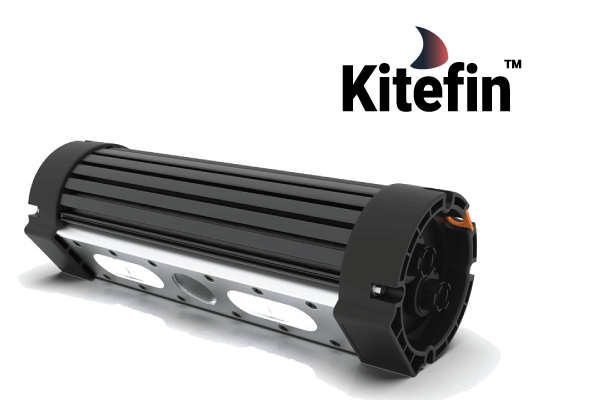
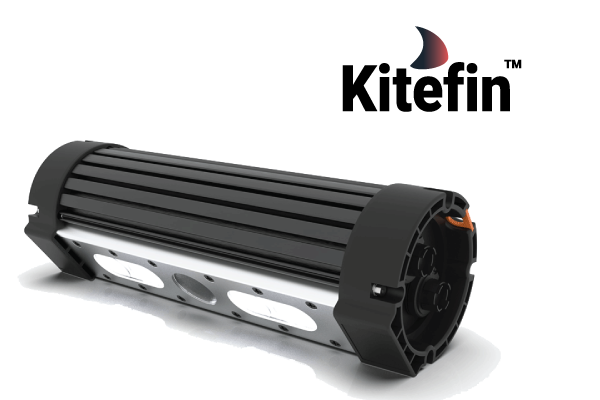
This new deal aims to supply the pureLiFi kitefin system, a next-generation optical wireless communication system using LiFi for secure data transmission without radio frequencies. The deployment is composed of thousands of certified office and field-deployable LiFi units in real tactical and strategic environments. Kitefin™ is a newly developed system with unique features for defence use cases.

kitefin 1.png

Credit to pureLiFi - Kitefin Li Fi system

The use of Radio Frequencies (RF) in secure and Defense environments can bring many challenges; mainly, as RF is a technology that can be detected and targeted. pureLiFi stated on their website that the Kitefin Li Fi system eliminates this risk as it cannot be detected outside of its defined cone of coverage. The Kitefin™ system also allows for rapid setup and positive logistical impact saving time, money and lives on each deployment.

In 2019, a trialling of Li Fi technology with the US ARMY Europe and Africa took place. This helps to persuade key Army stakeholders in realising the great potential of Li Fi applications in the future of Defense communications.

CW5 Andrew Foreman, USAREUR-AF Chief Technology Officer said

Including optical wireless in the commander’s toolbox is imperative to the survival of communications, command and control systems and, more importantly, Soldiers. Leadership within the Department of Defense are at a major transitional crossroads for communications and mission command systems and must make a critical decision.

Start deploying LiFi and FSO and explore other optical wireless communications technologies or continue to subject the warfighter to increased emission by continuing to field highly detectable RF systems to the tactical edge, thus putting Soldiers and systems in dire straits.”

Secure-Communications-three-4.png

Credit to pureLiFi

Alistair Banham, CEO of pureLiFi, stated the following statement about the adoption of LiFi technology:

This largest real-world deployment of LiFi with the US Army Europe and Africa is a testament to the benefits that LiFi can offer and the technology’s usability. If one of the most significant and advanced Defense organisations in the world can rely on LiFi for the most critical of communications, LiFi can offer unprecedented benefits to the consumer. LiFi, like so many technologies before it, is on a classic journey of adoption in Defense to wide-spread acceptance in the consumer market and eventually LiFi in everyone’s home

Since offering our gigabit components to the market we have developed some very innovative proof of concept integrations with some of the world’s largest consumer electronic and mobile phone brands. We are closer than ever to seeing consumers having LiFi in their homes and their pockets.

This first major deployment with the US ARMY Europe and Africa is just the beginning.

kitefin 2.png
kitefin 3.png

Credit to pureLiFi

What is Li-Fi?

Li-Fi, also known as "Light Fidelity" is a wireless optical networking technology, which uses light-emitting diodes (LEDs) to transmit data. In 2011, professor Harald Haas made a Li-Fi demonstration at the TED (Technology, Entertainment, Design) Global Talk on Visible Light Communication (VLC).

Credit to pureLiFi

VLC uses light as a medium to deliver high-speed communication like Wi-Fi and complies with the IEEE standard IEEE 802.15.7. The IEEE 802.15.7 is a high-speed, bidirectional, and fully networked wireless communication technology-based standard similar to Wi-Fi's IEEE 802.11.

How does Li-Fi work?

Li-Fi is a high speed, bidirectional, and fully networked wireless communication of data using light. Li-Fi constitutes of several light bulbs that form a wireless network.

When an electrical current goes through to a LED light bulb, a stream of light (photons) emits from the lamp. LED bulbs are semiconductor devices, which means that the brightness of the light flowing through them can change at extremely high speeds. The signal is sent by modulating the light at different rates. The signal can then be received by a detector which interprets the changes in light intensity (the signal) as data. Also when the LED is ON, you transmit a digital 1, and when it is OFF, you transmit a 0.

Li-Fi Benefits

The primary benefits of Li-Fi are as follows:

Security: Provides entirely secure access. Where there is no light there is no data.

Safety: Does not produce electromagnetic radiation and does not interfere with existing electronic systems.

Localisation: Allows localisation due to small coverage area of Li-Fi access point - localisation can be used for very precise asset tracking.

Data density: Provides ubiquitous high-speed wireless access that offers substantially greater data density (data rate per unit area) than RF through high bandwidth reuse.

LiFiMAX-Oledcomm.jpg

Credit to Oledcomm

Li-Fi Applications

Li-Fi can be used for so many applications and the list is increasing every year. You can read more on Li-Fi applications at the following link:

https://www.lifitn.com/blog/2021/2/13/top-30-li-fi-applications-updated-list-including-potential-applications

In conclusion, if you are also interested to hear more information about the OWNII Coin, investing in it, or enquire about Li-Fi devices such as the LiFiMax and Trulifi, you can contact us through our chatbot or by sending an email through our contact us form. If you enjoyed this post and would like to hear more updates about Li-Fi technology, subscribe to our newsletter. Don’t forget to subscribe to our social media accounts. You can also join our Telegram group about Li-Fi technology on this link:

https://t.me/joinchat/FMzOmsEKyJFrU6Af